
 951-249-7500
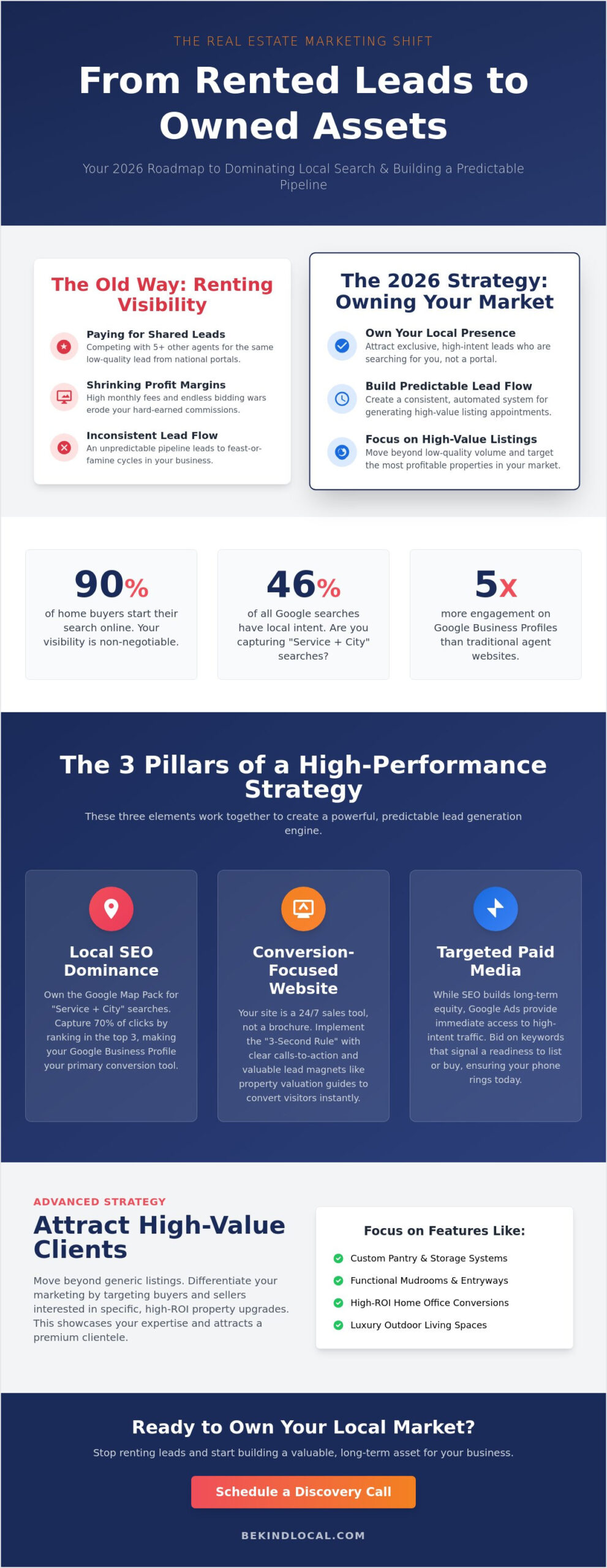
Paying for shared leads on national portals is the fastest way to shrink your profit margins while building someone else’s brand. It’s frustrating to watch your hard earned commissions disappear into monthly fees for leads that every other agent in your zip code is also chasing. You’re likely tired of the inconsistent pipeline and the technical overwhelm that comes with trying to stay visible. Effective digital marketing for real estate agents shouldn’t feel like a bidding war you’re destined to lose. We know that nearly 90% of buyers start their search online, yet most agents are still renting their visibility instead of owning it.
You deserve to own your local search presence and connect with homeowners who are actually ready to list. This article will show you how to bypass those expensive portals by using high intent SEO and targeted conversion strategies designed for 2026. We’ll explore how to build a predictable monthly lead flow that focuses on high value property listings rather than low quality volume. By the end, you’ll have a clear roadmap to dominate your local market with the same precision and heart we use to help local service brands stand out. Let’s get started on building a business that works for you, not the portals.
Key Takeaways
- Learn why shifting from national lead portals to local authority is the only way to own your lead generation ecosystem in 2026.
- Discover how to optimize your Google Business Profile to capture “Service + City” intent, making it a more powerful conversion tool than your website homepage.
- Master a data-driven approach to digital marketing for real estate agents by balancing the immediate wins of Google Ads with the long-term equity of organic SEO.
- Attract high-value buyers by moving beyond generic listings and targeting specific property upgrades like custom pantry systems, mudrooms, and high-ROI storage solutions.
- Implement the “3-Second Rule” on your website to instantly communicate value and convert visitors using advanced lead capture tools like valuation guides.
What is Digital Marketing for Real Estate Agents in 2026?
In 2026, digital marketing for real estate agents isn’t about vanity metrics or social media likes. It’s a strategic ecosystem of online tools built to capture “Service + City” search intent. This means appearing exactly when a homeowner searches for “sell my home in Austin” or “best listing agent in Phoenix.” The focus has shifted from broad visibility to surgical precision. You don’t need everyone to see you; you need the right people to find you at the exact moment they’re ready to move.
Achieving this level of precision requires a well-structured digital strategy. Working with a specialist agency like Cornerstone Marketing Solutions can help you build an online presence that captures these high-intent local leads effectively.
The landscape of Internet real estate has matured significantly. National portals no longer dictate the terms for local experts. In a market where interest rates have remained above 6% for several years, buyers and sellers are more cautious. They aren’t looking for a generic brand. They want local authority. Be Kind Local bridges the gap between technical SEO and your actual sales goals. We ensure your digital footprint converts cold traffic into signed contracts through an ethical, community-focused lens.
The Death of the Generic Lead Portal
Relying on Zillow or Realtor.com is a race to the bottom. These platforms often sell the same lead to five different agents, forcing you to compete on speed rather than value. This model erodes your commission. In 2026, top-tier agents prioritize first-party data. Owning your lead pipeline means you control the relationship from the first click. Local algorithms now favor individual experts over national aggregators. Google’s 2025 updates specifically prioritized “Experience, Expertise, Authoritativeness, and Trustworthiness” (E-E-A-T) for local service providers, giving individual agents a massive advantage over faceless corporations.
Core Pillars of a High-Performance Strategy
A winning strategy rests on three foundational pillars that work together to create a predictable flow of business:
- Local SEO: You must dominate the Google Map Pack. Data shows that 46% of all Google searches have local intent. If you aren’t in the top three results for your specific geographic area, you’re losing 70% of potential clicks to your competitors.
- Conversion-focused web design: Your site isn’t a digital business card. It’s a 24/7 sales tool. It needs clear calls-to-action (CTAs), mobile-first optimization, and proof of your local success.
- Paid Media: Google Ads provide immediate access to high-intent traffic. While SEO builds long-term equity, targeted ads ensure your phone rings today by bidding on keywords that signal a readiness to list or buy.
Effective digital marketing for real estate agents requires a shift in mindset. Stop chasing volume and start focusing on lead quality. When you own your platform, you own your future. If you’re ready to stop renting leads and start owning your local market, schedule a discovery call with Be Kind Local today. We specialize in helping local service brands stand out through conversion-driven strategy and technical excellence.
Dominating Local SEO and the Google Business Profile
Your Google Business Profile (GBP) is no longer a secondary directory listing; it’s the actual front door of your business. In 2026, data shows that the GBP receives nearly 5 times more direct engagement than a traditional agent website. This is because users want immediate answers. They want to see your 5-star rating, your recent sales, and your office location without clicking through three different pages. Mastering digital marketing for real estate agents starts with treating this profile as a high-conversion landing page rather than a “set it and forget it” task.
Optimization requires more than just filling out your name. You must select “Real Estate Agency” as your primary category, but don’t ignore secondary categories like “Real Estate Consultant” or “Property Management” if they apply. Use the attributes section to highlight specific values, such as “Identifies as women-led” or “Appointment required,” which build immediate trust. High-quality imagery is also vital. Profiles with more than 100 photos receive 520% more directions requests than those with fewer images, so upload professional shots of your latest listings and community events weekly.
Winning the Local Map Pack
Google determines the top three “Map Pack” spots through proximity, relevance, and prominence. Proximity is the distance between the searcher and your office, while relevance is how well your profile matches the search query. Prominence is a measure of your digital authority, often fueled by how well you manage the impact of digital media in real estate across other platforms. NAP consistency requires that your business name, address, and phone number remain identical across every digital touchpoint to ensure Google’s crawlers verify your location’s legitimacy. If you serve multiple counties, use the “Service Area” settings to list specific zip codes within a 50-mile radius rather than cluttering your profile with multiple physical addresses you don’t actually staff.
The Power of Local Citations
Citations are mentions of your business on authoritative sites like Zillow, Realtor.com, and even local neighborhood blogs. These act as digital votes of confidence. To rank higher, you need a steady stream of reviews. Review velocity, the speed at which you gain new feedback, is a major ranking factor in 2026. A sudden spike of 20 reviews followed by months of silence looks suspicious to search algorithms. Aim for a consistent flow of 2 or 3 reviews per week. Encourage clients to include specific keywords, such as the neighborhood name or the property type, in their text.
Utilize GBP “Posts” to keep your profile active. Treat these like a local news feed. Share “Just Sold” updates with specific neighborhood mentions and brief market reports. This signals to Google that you’re an active, relevant expert in your specific geographic area. When you combine consistent posting with keyword-rich reviews, you create a profile that’s hard to ignore. If you want to see how your current profile stacks up against the top performers in your city, a specialized local SEO audit can identify the gaps in your digital marketing for real estate agents strategy. Focus on these local signals to ensure you’re the first person a buyer sees when they search for help in your zip code.
Google Ads vs. Organic SEO: Choosing Your Lead Engine
Choosing between Google Ads and Organic SEO isn’t a binary decision. It’s a balance of speed versus sustainability. Pay-Per-Click (PPC) offers a fast start. You can launch a campaign and appear at the top of search results within 24 hours. This is vital for agents entering a new territory or pushing for immediate listing inventory. Organic SEO acts as long-term equity. It builds authority that persists even when your ad spend stops. By the 12 to 18 month mark, a well-executed SEO strategy often delivers leads at a 60% lower cost than paid channels.
Budgeting requires a clear understanding of your target Cost Per Acquisition (CPA). Don’t just track clicks. Divide your total monthly spend by the number of signed listing agreements. If your average commission is $15,000, spending $500 to $1,000 to acquire that client represents a healthy margin. Local Services Ads (LSAs) further refine this. The “Google Screened” badge provides an immediate trust signal that traditional text ads lack. It tells homeowners you’ve passed a background check before they even click. This is similar to how a garage remodeling or floor coating specialist uses certification to prove expertise in a local market.
PPC for Real Estate: Targeting Seller Intent
Effective digital marketing tips often emphasize intent. Generic terms like “real estate agent” are expensive and attract window shoppers. Focus your budget on high-intent phrases like “sell my home [City]” or “what is my house worth [Neighborhood]”. Use negative keyword lists to filter out “jobs”, “rentals”, or “cheap homes”. This prevents your budget from bleeding into low-quality traffic. Never send paid traffic to your homepage. A dedicated landing page with a single, clear call-to-action converts at a much higher rate than a cluttered site. For example, a page offering a “Instant Home Value Report” captures seller data far better than a general bio page.
The SEO Compound Interest Effect
Organic rankings are the backbone of sustainable digital marketing for real estate agents. Unlike ads, organic traffic doesn’t disappear when you pause your budget. Build authority by publishing long-form content on local market trends or neighborhood guides. These pieces should be at least 1,200 words to signal depth to search engines. Use internal linking to guide users from a blog post about “Top 5 Neighborhoods in [City]” directly to your contact page. This keeps users engaged and signals to Google that your site is a comprehensive resource. Over time, this content ranks for hundreds of long-tail keywords, providing a steady stream of leads without the per-click cost.
A hybrid approach is the only way to maintain a consistent pipeline. Use PPC to capture immediate demand while your SEO foundation hardens. This strategy ensures you aren’t reliant on a single source of leads and protects your business from sudden algorithm changes or rising ad costs.
Niche Differentiation: Marketing High-Value Property Features
Generic listings that only highlight “3 bedrooms and 2 bathrooms” are no longer enough to capture high-intent leads in a competitive market. By 2026, buyers are looking for homes that solve their lifestyle friction points before they even unpack. Effective digital marketing for real estate agents now requires a shift toward promoting specific, high-ROI upgrades that suggest a “move-in ready” organized lifestyle. Highlighting custom storage systems and advanced floor coatings positions you as a specialist who understands the value of a property beyond its square footage.
The Home Organization Boom
Luxury buyers and busy professionals prioritize order. When you use technical terms like “reach-in systems,” “custom cabinetry,” and “integrated mudroom storage” in your listings, you signal a higher level of property quality. These features aren’t just conveniences; they’re assets that increase appraisal value. A 2024 industry report indicated that 65% of homebuyers consider a walk-in closet a “must-have” feature. You can leverage this by creating content around how custom closets increase home appraisal value or by partnering with local contractors to provide pre-sale organization audits. This strategy builds trust and provides tangible data to potential sellers who want to maximize their ROI.
- Reach-in systems: Highlight how these maximize vertical space in smaller urban properties.
- Pantry systems: Market these as essential for the modern “home chef” demographic.
- Mudrooms: Focus on the transition from outdoor to indoor living, especially in suburban markets.
The Modern Garage and Concrete Coatings
The garage has evolved into the “new kitchen remodel” for 2026 sellers. It’s no longer a dark storage area but a functional extension of the home. Marketing a “Garage Transformation” involves more than just mentioning a clean floor. You should explain the technical superiority of polyaspartic and polyurea coatings over standard epoxy. These systems are 4 times more durable and can be installed in a single day, making them a massive selling point for hobbyists or luxury car collectors.
When you incorporate these details into your digital marketing for real estate agents, you attract a specific segment of the market willing to pay a premium for durability and aesthetics. Mentioning “slatwall storage” and “overhead racks” in your property descriptions appeals to the buyer’s desire for a clutter-free environment. This level of specificity proves you aren’t just selling a house; you’re selling a high-performance living space. This approach generates more qualified leads because it speaks directly to the functional needs of modern homeowners.
If you want to dominate your local market by highlighting these high-value niches, we can help you build a strategy that converts. Schedule a discovery call with BeKind Local to see how our specialized SEO and conversion strategies can elevate your real estate brand.
Building Your Conversion-Focused Real Estate Website
Your website isn’t a digital business card. It’s your most important lead generation tool. Most visitors apply what’s known as the 3-second rule. They decide whether to stay or leave based on how quickly they identify your value proposition and your service area. If a homeowner doesn’t see your specific local expertise and a clear reason to trust you within three seconds, they’ll bounce to a competitor. Strategic digital marketing for real estate agents starts with a homepage that speaks directly to local needs.
Effective lead capture goes far beyond a generic “Contact Us” form. High-value leads look for immediate utility. You should integrate automated home valuation tools or downloadable neighborhood guides. These mechanisms provide value before you ever ask for a listing appointment. Data shows that over 70% of real estate leads now find agents through a smartphone. If your site isn’t optimized for mobile-first browsing, you’re losing the majority of your potential market. A seamless mobile experience isn’t a luxury; it’s a requirement for survival in 2026.
Technical SEO for Real Estate Sites
Site speed is a conversion killer. Google’s Core Web Vitals aren’t just technical metrics; they represent the user’s patience. A site that takes longer than 2.5 seconds to load can see a 20% drop in conversion rates. You also need to implement Schema markup. This specific code helps search engines understand your listings, reviews, and office location, allowing them to display rich snippets in search results. Stop posting generic industry news on your blog. Instead, answer local questions. Focus on topics like “How polyurea floor coatings affect property value in [City]” or “The best neighborhoods for homes with custom pantry systems.” This hyper-local approach builds genuine authority.
The Path to Conversion
Every page on your site must guide the visitor toward a specific action. Craft your Calls to Action (CTAs) to offer tangible benefits. Instead of a “Submit” button, use “Get My Home Organization Value Report” or “Download the 2026 Seller’s Guide.” These low-friction offers convert at much higher rates than simple contact requests. Trust is built through social proof. Use active review management to showcase testimonials from clients in specific neighborhoods. Seeing a neighbor’s positive experience with your brand reduces the perceived risk for new leads.
Your digital presence should work as hard as you do. Schedule your discovery call with Be Kind Local today to audit your current website and implement a digital marketing for real estate agents strategy that generates high-quality, local leads.
Future-Proof Your Real Estate Lead Pipeline
Dominating your local market in 2026 requires a shift from broad visibility to high-intent precision. Success hinges on mastering your Google Business Profile and choosing a lead engine that prioritizes quality over sheer volume. You’ve seen how niche differentiation, like highlighting custom mudrooms or polyaspartic garage coatings, attracts the right kind of buyer. Effective digital marketing for real estate agents isn’t about chasing every click; it’s about building a conversion-focused website that turns local searches into exclusive appointments. We’ve built our reputation as specialists in high-intent local service niches. Our team focuses on strategic lead quality rather than vanity metrics, ensuring your marketing spend translates into actual revenue growth. It’s time to stop settling for generic results and start implementing a strategy that’s built for long-term authority. We’re ready to help you optimize your local presence and outpace the competition with proven SEO and conversion tactics.
Schedule a discovery call with Be Kind Local to dominate your local market
You’ve got the blueprint for success; now take the first step toward owning your territory.
Frequently Asked Questions
How long does it take to see results from real estate SEO?
You should expect to see measurable results from real estate SEO within 6 to 12 months. This timeline depends on your local market competition and the current authority of your domain. While initial indexing happens faster; ranking for high intent keywords like “homes for sale in [City]” takes consistent effort. We focus on building a foundation that generates organic leads long after you stop paying for ads.
Is Google Ads better than Facebook Ads for real estate agents?
Google Ads is generally better for capturing high intent buyers who are actively searching for properties right now. Facebook Ads works best for top of funnel brand awareness and lead magnets. According to 2024 industry benchmarks; search ads convert at a 3.75 percent higher rate than social media ads for real estate. We recommend a balanced approach that prioritizes Google Search to capture immediate demand in your specific zip codes.
How do I get my real estate business into the Google Map Pack?
You get into the Google Map Pack by optimizing your Google Business Profile with consistent name, address, and phone data. Proximity, relevance, and prominence are the three main ranking factors Google uses. Ensure you collect at least 5 new reviews monthly to signal active engagement. This is a core part of digital marketing for real estate agents because it captures local search intent before users ever reach a national portal.
What is the average cost per lead for real estate digital marketing?
The average cost per lead for real estate digital marketing typically ranges between $20 and $60 depending on the platform and market. Google Ads often sees higher costs but better lead quality compared to social media. A 2024 WordStream report identifies the real estate industry average cost per lead at $44.22. We focus on lowering this figure by improving your website’s conversion rate and targeting specific long tail keywords.
Do real estate agents really need a custom website?
Yes, a custom website is essential if you want to own your lead data and build long term SEO equity. Template sites provided by big brokerages often lack the technical flexibility needed to rank for specific local “service + city” searches. A custom site allows you to integrate IDX feeds properly and create unique landing pages for specific neighborhoods. This control is vital for standing out in competitive markets where you need to showcase local expertise.
What are Google Local Services Ads (LSAs) for Realtors?
Google Local Services Ads are pay per lead advertisements that appear at the very top of search results, even above traditional PPC ads. They feature a “Google Screened” badge which builds immediate trust with potential clients. Unlike standard ads where you pay for clicks, LSAs charge you only when a lead calls or messages you directly. This makes them a highly efficient tool for agents looking for a predictable return on investment in 2026.
How can I compete with Zillow in local search results?
You compete with Zillow by dominating hyper local search terms that large national portals cannot cover with the same depth. Focus on neighborhood specific content and maintaining a perfect Google Business Profile to win the Map Pack. Zillow cannot provide the same level of local expertise or personal connection that a dedicated agent can. By using digital marketing for real estate agents strategically, you can capture leads at the exact moment they search for local market expertise.
Ready to dominate your local market and generate higher quality leads? Schedule a discovery call with Be Kind Local today. We specialize in helping local service brands stand out through a combination of local SEO, Google Ads, and high performing conversion strategies.