
 951-249-7500
With high-intent legal keywords now commanding between $50 and $300 per click in 2026, many firms feel like they’re just funding Google’s growth rather than their own. Mastering ppc for law firms in this climate requires more than just a big budget; it requires an ethical, strategic approach that filters out the noise. It’s exhausting to watch your hard-earned money disappear on “pro bono” seekers or people looking for free advice while your current marketing vendor remains vague about the actual results. You deserve a partner who values your firm’s integrity and growth as much as you do.
We agree that the current landscape often feels like an uphill battle where only the biggest spenders win. That’s why we’ve designed this guide to show you how to transform expensive clicks into signed cases through a high-intent strategy built for the modern legal market. You’ll learn how to lower your cost-per-acquisition while maintaining a predictable, scalable lead generation system. We’ll preview the shift toward hybrid PPC and LSA strategies, the impact of new advertising regulations like California’s SB 37, and how to use data to out-strategize your competition without losing your shirt.
Key Takeaways
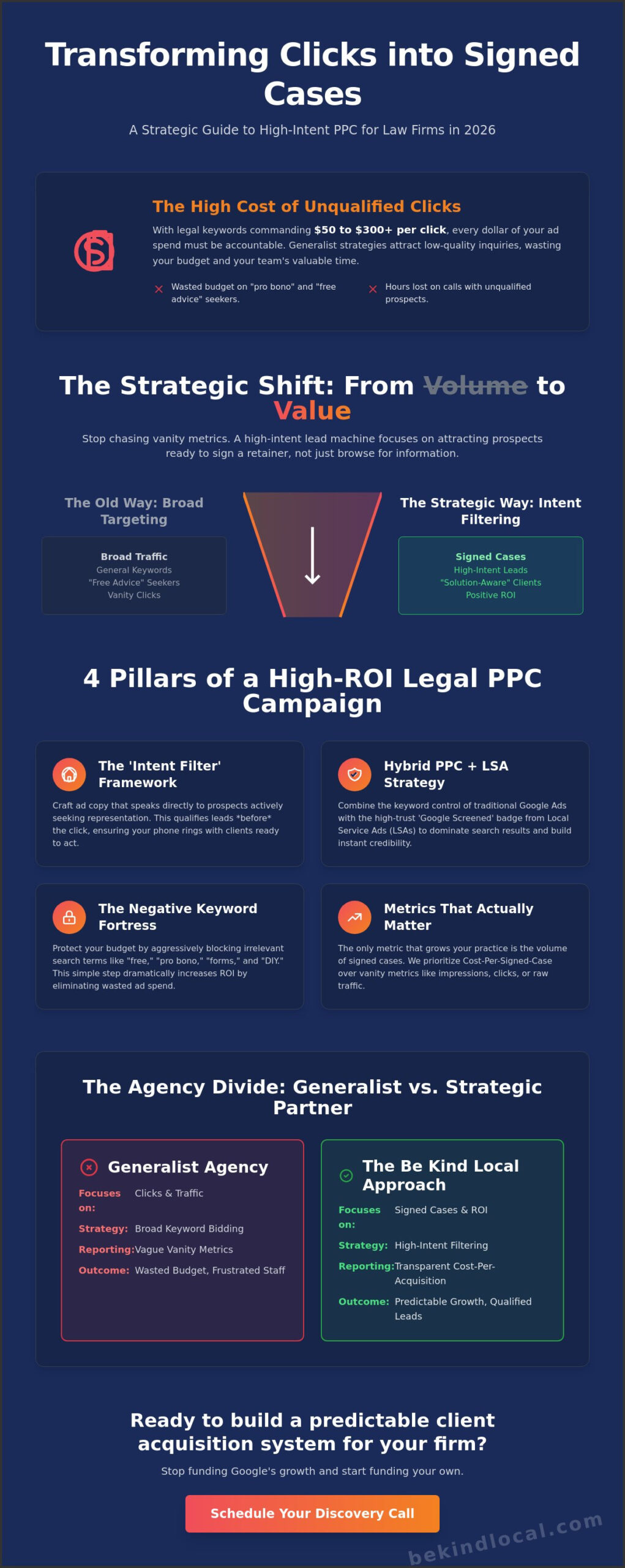
- Navigate the high-cost 2026 legal market by shifting from broad visibility to precision targeting that captures immediate client needs.
- Implement the ‘Intent Filter’ framework to ensure your ad copy attracts qualified cases while naturally repelling those seeking free advice.
- Master a hybrid strategy that combines the trust of ‘Google Screened’ Local Service Ads with the keyword control of traditional search campaigns.
- Build a ‘Negative Keyword Fortress’ to protect your budget, creating a more efficient system for ppc for law firms that focuses on ROI.
- Focus on the metrics that actually grow your practice, prioritizing the volume of signed cases over vanity traffic and clicks.
What is PPC for Law Firms? Navigating the 2026 Legal Search Market
Think of online advertising as a digital handshake. For your practice, ppc for law firms isn’t just about showing up; it’s a precision tool designed to capture someone at their moment of highest need. People searching for legal help usually have an immediate, pressing problem. They don’t have time to browse. They need an expert they can trust right now. In 2026, this market has shifted away from simple keyword bidding toward a sophisticated system of intent filtering. It’s about being in the right place, at the right time, with a message of genuine help.
While long-term growth often relies on a solid SEO foundation, PPC acts as the catalyst. It provides the immediate visibility you need while your organic authority builds. By 2026, search engines have moved toward intent-based matching, meaning the system tries to understand the “why” behind a search. This shift is a gift for firms that prioritize quality. It allows us to step away from broad, expensive terms and focus on specific queries that indicate a person is ready to sign a retainer. We believe in using these tools to build bridges between your expertise and the people who need it most.
The Economics of Legal PPC: Why Every Click Matters
Legal keywords are some of the most expensive on the planet. This happens because the stakes are incredibly high. In practice areas like personal injury or family law, you’re entering a high-stakes auction where competitors are willing to pay a premium for the right case. To win, you have to look past the initial acquisition cost and focus on the Lifetime Value (LTV) of a client. A single signed case can justify dozens of clicks, provided those clicks come from the right people. At Be Kind Local, we believe PPC ROI is defined solely by the number of signed cases your firm secures, not by the number of leads that end up being dead ends.
Why ‘Generalist’ Agencies Fail Law Firms
Many agencies apply the same retail tactics to law firms that they use for low-ticket consumer goods. They’ll brag about raw traffic volume, but that’s often a vanity metric that masks poor performance. If your ads attract “free advice” seekers, your team wastes hours on the phone with people who will never hire you. We’ve learned from our work in specialty contractor advertising, specifically for epoxy floor coating and custom closet businesses, that high-ticket services require a different level of qualification. You need a partner who understands that five high-quality consultations are worth more than five hundred clicks from people who aren’t ready to commit. We treat your marketing budget with the same respect you’d give a trusted partner, focusing on ethical growth and genuine connections.
Quality Over Volume: Building a High-Intent Legal Lead Machine
Most agencies focus on getting your phone to ring. We focus on who is on the other end of that line. Successful ppc for law firms requires a digital sieve that lets high-value cases through while catching those seeking “pro bono” work or “free legal advice” before they ever cost you a cent. We treat your budget with the same care a craftsman uses when selecting materials for a custom build. We’ve seen that raw traffic volume is a vanity metric; if your intake team is busy fielding calls from people who can’t afford your retainer, your marketing has failed you.
Think of it like lead generation for a high-end custom closet company. You don’t want calls from people looking for a wire rack from a big-box store; you want the homeowner ready for a bespoke walk-in closet or reach-in system. The same logic applies here. We use specific language to ensure your ppc for law firms strategy attracts people who understand the value of your counsel and are ready to move forward. We prioritize lead quality over raw traffic volume, utilizing internal linking to build authority and trust from the first interaction.
Qualifying Leads Before the Click
Qualification starts with your ad copy. We differentiate between “Problem-Aware” prospects who know they have a legal issue and “Solution-Aware” prospects who are actively looking for your specific expertise. If someone searches for “divorce help,” they’re often just starting to browse. However, someone searching for a “contested divorce attorney in [City]” is ready to hire. By using precise terminology and practice-area-specific language, we signal to the right people that you’re the expert they need. Ad extensions further this trust by highlighting your specific successes or office locations, providing immediate value before the first click.
The Anatomy of a High-Converting Legal Landing Page
Sending paid traffic to your homepage is a recipe for wasted spend. A homepage is a generalist; a landing page is a specialist. Your landing page needs to mirror the exact promise made in your ad. If your ad mentions motorcycle accidents, your landing page should talk about nothing else. It needs trust signals, like client testimonials and “Google Screened” badges, to settle the prospect’s nerves.
Effective conversion requires a seamless marriage between your ads and custom web design. We prioritize simplified contact forms and clear, singular calls-to-action. A busy law firm doesn’t have time to chase down incomplete data. Every element of the page should move the visitor toward a single goal: reaching out for a consultation. If your current system feels like a revolving door of low-quality leads, it might be time to review your lead generation strategy with a partner who understands the difference between a click and a client.
The Hybrid Strategy: Combining Google PPC with Local Service Ads (LSAs)
Success in 2026 requires a multi-layered approach to search. While traditional search ads are powerful, Local Service Ads (LSAs) provide a different kind of value. These are the ads that appear at the very top of Google, often featuring the “Google Screened” checkmark. The primary difference lies in the billing model. Traditional ppc for law firms operates on a pay-per-click basis, where you pay for every visitor. LSAs use a pay-per-lead model, meaning you generally only pay when a potential client actually calls or messages your firm. We’ve found that combining these two creates a dominant presence that builds instant authority.
If you’re practicing in highly competitive cities like Indianapolis or Houston, appearing twice on the first page isn’t just a luxury; it’s a necessity. We recommend a strategic budget allocation to maximize this synergy. For most firms, a 60/40 split works best. Allocate 60% of your budget to LSAs to capture broad, high-volume searches. Use the remaining 40% for traditional search ads to target specific, complex case types that LSAs might miss. This dual approach ensures you’re capturing both the immediate phone calls and the deeper, research-based inquiries.
LSAs: The ‘Google Screened’ Advantage
The “Google Screened” badge is a powerful trust signal. To earn it, your firm must pass a background check and have its insurance and bar status verified. This vetting process tells local clients that you’re a legitimate, verified professional before they even read your first review. Managing this platform requires consistent effort. Google rewards firms that are highly responsive and maintain a strong volume of recent reviews. By tightening your geographic radius to the specific neighborhoods you serve, you can ensure your budget is spent on clients who are actually close enough to visit your office. This local precision is exactly how we help you build a community-focused practice.
PPC: Capturing Specific, Complex Case Types
Traditional search ads are the precision tools of your digital strategy. While LSAs are great for broad categories, traditional advertising allows you to target complex, niche practice areas like corporate litigation or specific medical malpractice claims. You can use specific keywords that LSAs don’t always trigger for. It also gives you the ethical opportunity to bid on competitor brand names, allowing you to present your firm as a viable alternative when someone is searching for a specific peer. When you appear in both the LSA section and the paid search results, you take up more digital real estate. This makes it significantly more likely that a high-intent prospect will choose your firm over a competitor who only appears once.
Strategic Keyword Management: Eliminating Wasted Spend in Legal Ads
Precision is the tactical execution of the “Intent Filter” strategy we discussed earlier. While broad goals set the direction, your keyword match types determine how much of your budget is actually working for you. Many firms fall into the trap of using Broad Match keywords, hoping to catch every possible lead. For ppc for law firms, this is often a recipe for financial drain. Broad match allows Google to show your ads for “related” terms that frequently have zero commercial intent. We prefer a shift toward Phrase and Exact match, giving you total control over which searches trigger your ads and how your budget is spent.
Focusing on long-tail keywords allows you to find the specific, high-value cases that generic campaigns miss. Instead of bidding on a broad term like “lawyer,” we target specific queries like “contested divorce attorney” or even niche technical issues like “polyurea floor coating litigation.” These terms indicate that the searcher has a clear, complex problem and is looking for a specialist. By narrowing your focus, you aren’t just buying clicks; you’re buying the right conversations with the right people.
Building a Proactive Negative Keyword List
A well-maintained negative keyword list can save your firm up to 30% of its total ad budget by preventing clicks from non-buyers. This “Negative Keyword Fortress” is built by identifying and excluding terms that signal low intent or irrelevant needs. We proactively block categories such as employment seekers, students researching for papers, and anyone searching for “free” or “cheap” legal services. If someone is looking for an internship or a pro bono clinic, your ad shouldn’t be the one they click. Regular audit cycles are essential here. We review search term reports weekly to spot new, underperforming queries and kill them before they eat up your daily budget.
Bidding Strategies for 2026: AI vs. Manual Control
By 2026, AI-driven bidding has become the standard, but it still requires a human touch to stay ethical and effective. Strategies like “Maximize Conversions” or “Target CPA” (Cost Per Acquisition) are powerful because they use thousands of data points to predict which user is most likely to call. However, these systems are only as good as the data they receive. It is vital to feed high-quality conversion data, such as signed cases rather than just form fills, back into the Google algorithm. This teaches the AI to find more people like your best clients.
We also keep a close eye on brand protection. Local competitors will often try to “poach” your firm’s name by bidding on your brand as a keyword. We implement specific defensive campaigns to ensure that when someone searches for you specifically, they find you first, not a rival. If you want to see how a more disciplined approach can stop the bleed in your current ppc for law firms campaigns, reach out for a strategic account audit today.
Choosing a Strategic Partner: The Be Kind Local Approach to Legal PPC
Choosing a partner for ppc for law firms shouldn’t feel like a cold transaction. It’s a relationship built on shared values and a deep commitment to helping people find the expert support they need. At Be Kind Local, we don’t look at your firm as just another account in a spreadsheet. We see you as a vital pillar of your community. Our approach moves away from the technology-first models used by generic agencies. Instead, we focus on the human element of every search. We believe that marketing is about building bridges, not just buying clicks. You deserve a partner who cares about your signed cases as much as you do.
Transparency is our baseline. We provide reporting that shows you exactly where your ad spend goes. There’s no hiding behind vague agency jargon or vanity metrics that don’t impact your bottom line. If a keyword isn’t leading to a signed case, we identify it and pivot. This level of honesty allows us to treat your budget with the same respect a craftsman gives his finest tools. We prioritize quality over volume because we know your time is valuable. You need a system that works in the background, allowing you to focus on the practice of law while we handle the growth of your firm.
We’ve spent years perfecting our “Intent Filter” framework across various high-stakes industries. Whether we’re helping a specialist in polyurea floor coatings or a partner at a family law firm, the goal remains the same: find the person who needs your specific expertise right now. We use brand strategy to make your firm the obvious choice for high-intent prospects. This isn’t about being the loudest in the room. It’s about being the most trusted and reliable option available when a crisis hits.
Ethical Positioning in a Competitive Market
You don’t have to look like an ambulance chaser to be successful in 2026. It’s possible to be aggressive in the auction while maintaining a dignified, professional brand voice. This strategy works because it’s rooted in ethical marketing principles that protect your long-term reputation. We don’t use hypey claims or generic AI-generated copy that feels hollow. Every ad we write is designed to reflect your specific values. We focus on being helpful and informative, which naturally attracts the kind of clients who value your counsel and respect your expertise.
Your Path to a Predictable Pipeline
Our discovery call is a simple, no-fluff conversation. We’ll look at your current ppc for law firms campaigns and identify exactly where your budget is leaking. We call this our “No-Fluff” audit. We won’t give you a generic sales pitch. Instead, we’ll provide a clear roadmap to a more predictable pipeline of signed cases. You’ll see how to stop wasting money on low-intent queries and start connecting with the people who are ready to hire you. If you’re ready to grow your firm with a partner who values integrity and results, schedule your discovery call today.
Securing Your Firm’s Future Through Strategic Intent
The 2026 search landscape doesn’t reward those who simply spend the most. It rewards those who out-strategize their competition by focusing on the human intent behind every query. By moving away from broad, wasteful bidding and embracing a hybrid model of LSAs and targeted search ads, you transform your marketing from a cost center into a predictable growth engine. You’ve seen how a “Negative Keyword Fortress” and specialized landing pages ensure that every dollar you invest in ppc for law firms works harder to find people who actually need your expertise.
We take pride in being specialists in high-ticket lead generation. We offer a direct, strategic partnership that cuts through the typical agency fluff. Our team understands the deep synergy between Local SEO and paid visibility, ensuring your firm remains the most trusted name in your community. You don’t have to navigate these rising costs or vague vendor reports alone. Stop wasting ad spend and start signing more cases; schedule your discovery call with Be Kind Local today. We’re here to help you build a practice that thrives on quality, integrity, and sustainable growth.
Frequently Asked Questions
How much does PPC for law firms cost in 2026?
Costs vary significantly by practice area and location, with high-intent legal keywords often ranging from $50 to over $300 per click. Solo and small firms typically require a monthly budget between $2,000 and $5,000 to maintain a presence. Mid-sized firms should plan for $5,000 to $15,000 to compete effectively in high-stakes markets like personal injury or family law.
Is Google Ads better than SEO for lawyers?
Neither is inherently better because they serve different roles in a healthy growth strategy. Google Ads provides immediate visibility and a predictable lead flow, while SEO builds long-term authority and reduces your cost-per-lead over time. We recommend a balanced approach that uses ppc for law firms to generate instant cases while your organic foundation matures.
What is a good conversion rate for law firm PPC?
A healthy conversion rate for legal ads usually averages around 7%, although some specific areas like bankruptcy law can reach as high as 13.56%. While these numbers are useful benchmarks, we focus on the quality of the conversion. A lower conversion rate that yields high-value signed cases is always more profitable than a high volume of low-intent form fills.
Can I run my own legal PPC campaigns or do I need an agency?
You can technically manage your own ads, but the high cost of legal keywords makes learning through trial and error extremely expensive. Professional management provides the strategic filtering and technical expertise needed to protect your budget from wasted spend. An experienced partner ensures your campaigns are optimized for signed cases rather than just raw traffic volume.
How do Local Service Ads (LSAs) differ from traditional Google Ads?
LSAs operate on a pay-per-lead model, meaning you only pay when a prospect actually calls or messages your firm. They appear at the very top of search results and feature the “Google Screened” badge to build immediate trust. Traditional ads offer more control over specific keyword targeting and ad copy, making a hybrid strategy the most effective choice.
What are negative keywords and why are they vital for law firms?
Negative keywords are terms you proactively exclude to prevent your ads from appearing for irrelevant or low-intent searches. For any firm using ppc for law firms, excluding terms like “free,” “pro bono,” or “internship” is essential. Implementing a robust negative keyword list can save up to 30% of your total ad budget by eliminating clicks from non-buyers.
How long does it take to see results from a legal PPC campaign?
Initial leads often start appearing within the first 48 hours of launching a new campaign. However, it generally takes 60 to 90 days of consistent data collection to fully optimize your bidding strategy and stabilize your cost-per-acquisition. This period allows the algorithm to learn which searchers are most likely to become signed clients for your specific practice.
How do I measure the ROI of my law firm’s advertising spend?
Measure ROI by tracking every lead through your sales funnel to a signed retainer and comparing that revenue against your total ad spend. A successful campaign should aim for a return of $4 to $7 for every $1 spent. Focus on your cost-per-signed-case and total revenue generated rather than vanity metrics like impressions or click-through rates.