
 951-249-7500
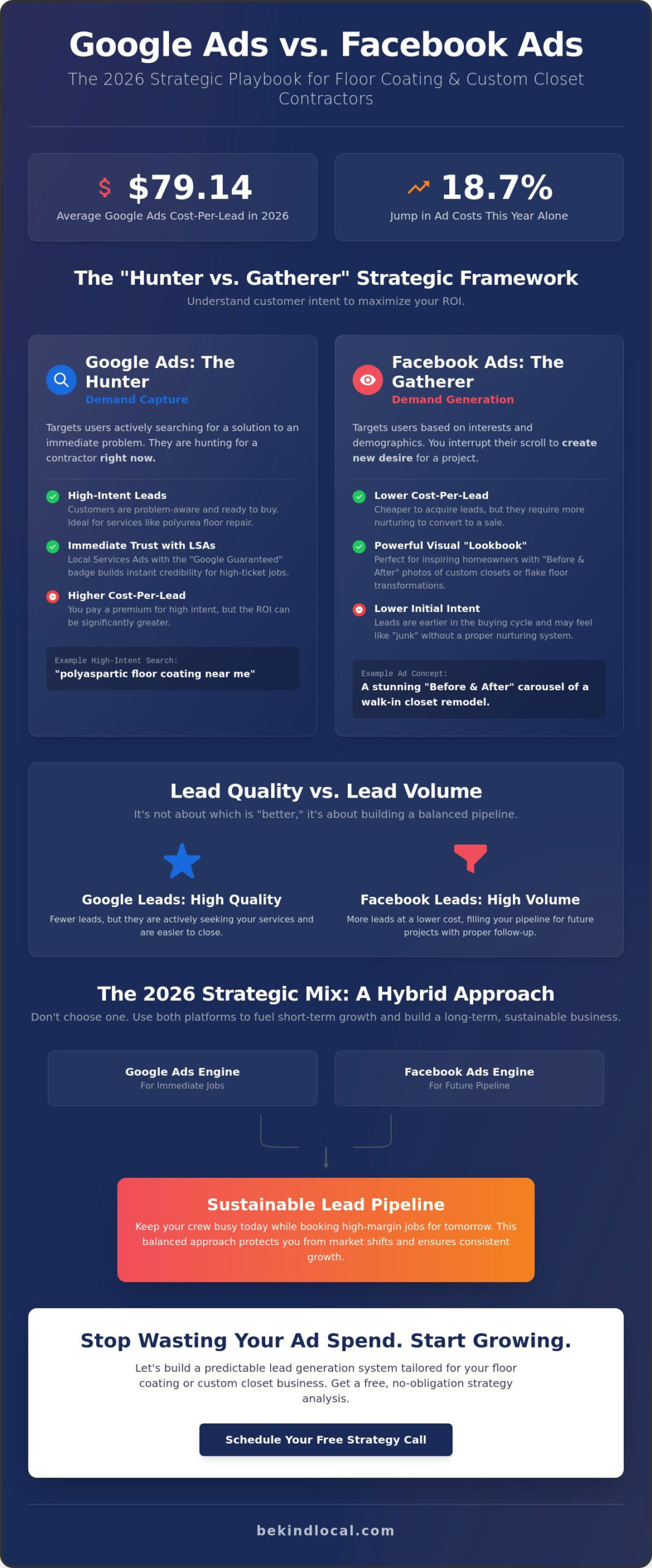
With the average cost-per-lead on Google Ads climbing to $79.14 in 2026 according to data from Amra & Elma, you might feel like you’re paying a premium just to keep your crew busy. When evaluating google ads vs facebook ads for local business, the 18.7% jump in costs this year means every click on your polyurea flooring or custom closet ads must count. It’s frustrating to deal with “junk” leads that never pick up the phone or Facebook ads that generate plenty of likes but zero booked appointments for your garage slatwall systems.
We understand that as a contractor, you’re looking for partners, not just more noise. You want a consistent flow of high-intent leads that match your specific ticket price. This strategic guide will help you decide which platform generates the highest quality leads for your floor coating or custom closet business and show you exactly how to allocate your 2026 budget for maximum ROI. We’ll explore the “Hunter” versus “Gatherer” framework and break down the latest 2026 AI disclosure requirements so you can stay ahead of the competition while building a business rooted in quality and trust.
Key Takeaways
- Learn to distinguish between “demand capture” on Google and “demand generation” on Facebook to align your marketing with how your customers actually buy.
- Discover why Google Ads and Local Services Ads are essential for capturing high-intent floor coating leads when homeowners are actively searching for a solution.
- Master the art of the visual “Lookbook” on Facebook to inspire homeowners with custom closet transformations before they even realize they need a remodel.
- Evaluate google ads vs facebook ads for local business to understand why lead intent differs by platform and how to filter out “tire-kickers” from your sales pipeline.
- Create a balanced 2026 budget that uses a hybrid approach to fuel immediate growth while building a long-term lead pipeline for your contracting business.
Google Ads vs. Facebook Ads: The “Hunter” vs. “Gatherer” Strategic Framework
Choosing where to put your hard earned marketing dollars often feels like a gamble, but it’s actually about understanding human psychology. When we look at google ads vs facebook ads for local business, we’re really comparing two distinct behaviors: hunting and gathering. Google Ads is a demand capture tool. It’s for the person actively hunting for an epoxy floor repair or a polyaspartic system because their current garage floor is a peeling mess. They have a problem, and they want it fixed now.
Facebook Ads operates as a demand generation engine. Think of it as a digital lookbook where homeowners are gathering inspiration for a future dream walk-in closet or a mudroom renovation. They aren’t necessarily looking to hire a contractor today, but a beautiful “Before and After” photo stops their scroll. Because Google leads are closer to making a purchase, you’ll often see a higher cost per click. You’re paying for that immediate intent. Facebook leads are usually cheaper to acquire, but they require more patience and nurturing to turn into a signed contract. It’s a trade-off between the high ROI of intent and the high volume of interest.
The Psychology of the Local Searcher
A homeowner typing “polyaspartic floor coating near me” into a search bar is sending a powerful signal. They’ve moved past the “someday” phase and are ready to talk to a professional. This high intent makes Google the ideal place for services with high urgency or specific functional needs. On the other hand, Facebook users are often interrupted by ads while they’re connecting with friends. Your ad has to be compelling enough to pull them away from their social feed. For luxury upgrades like custom pantry designs or reach-in closet systems, this visual interruption works beautifully because it taps into a desire they didn’t know they had yet.
Platform Comparison for 2026
The technical side of these platforms has evolved significantly. Google relies on keyword targeting to match your service with a specific search query. Facebook uses sophisticated social media targeting to find people based on their life stages, homeownership status, and design interests. Intent-based advertising fulfills an existing need, while interest-based advertising sparks a brand new desire. If your craft is highly visual, like a flake floor transformation, the visual dominance of social platforms is a huge asset. If you rely on being the first person someone calls when they need a solution, Google’s text based search results remain your strongest ally. You can explore how we balance these approaches on our advertising services page to see which fits your current growth stage.
Google Ads for Contractors: Capturing High-Intent Leads for Floor Coating and Closets
When a homeowner’s garage floor is flaking or their pantry is a cluttered disaster, they don’t usually wait for an ad to find them. They go to Google. This “problem-solution” dynamic is why search advertising remains a powerhouse for floor coating and custom closet contractors. Unlike the passive discovery on social platforms, search traffic is active. It’s the difference between someone browsing for inspiration and someone ready to book a consultation for a polyurea floor system.
In 2026, building immediate trust is non-negotiable. Local Services Ads (LSAs) put your business at the very top of search results with the “Google Guaranteed” badge. This placement is crucial for high-ticket services where homeowners are nervous about quality. By focusing on specific services like walk-in closet installation rather than broad terms, you ensure your budget goes toward buyers, not browsers. For a deeper dive into these tactics, read our Google Ads for home services guide.
The Power of Search Intent
Success on Google comes down to targeting the right keywords. There’s a massive gap in intent between someone searching for “garage ideas” and someone searching for “garage cabinet systems” or “reach-in closet design.” One is looking for a hobby; the other is looking for a contractor. Google Ads allows you to dominate the top of the page while your Local SEO efforts build your long term presence in the Map Pack. To keep your lead quality high, we use negative keywords to filter out DIYers and people looking for “cheap” solutions. This ensures you aren’t paying for clicks from people who aren’t a fit for your premium craftsmanship.
Maximizing ROI on Search
Getting the click is only half the battle. Your landing page must be optimized to convert that high-intent traffic into a lead. When weighing Google Ads Vs. Facebook Ads, Google often wins on lead quality because the friction is lower for the user. For floor coating businesses, we track “Call Leads” and “Form Leads” separately to see exactly where your best jobs are coming from. Because services like garage slatwall systems or mudroom renovations often have short decision windows, being the first professional they see on Google is a massive advantage. If you’re ready to stop guessing and start growing, you can reach out to our team for a strategic review of your current search performance.
Facebook Ads for Local Business: Driving Demand Through Visual Transformations
While Google Ads captures those with immediate needs, Facebook and Instagram serve as the ultimate digital showroom for your craftsmanship. For a custom closet designer or floor coating contractor, these platforms function as a high-end lookbook. You aren’t just showing an ad; you’re sparking an emotional “Aha!” moment by showing a homeowner what their cluttered garage or cramped reach-in closet could become. This visual disruption is a key factor when weighing google ads vs facebook ads for local business, as it allows you to reach customers before they even start their search. A direct Google Ads vs. Facebook Ads comparison shows that while intent is lower on social, the ability to inspire is unmatched.
In 2026, Meta’s “Advantage+” targeting has simplified how you find your ideal customer. Instead of manually guessing interests, the AI analyzes who engages with your high-quality imagery of polyaspartic floor systems or boutique walk-in closets. It then finds similar homeowners in your specific local service area. Building this kind of brand authority requires more than just a few random posts. It’s why many successful contractors invest in professional social media marketing services to ensure their brand looks as premium as the work they deliver on-site.
The “Aha!” Moment: Visual Storytelling
Short-form video is your best friend when demonstrating the durability of polyurea and polyaspartic systems. A 15-second clip showing a floor being prepped and finished carries more weight than a thousand words of copy. For custom closet designers, carousel ads are the gold standard. You can lead a potential client through a “Before” shot of a messy mudroom followed by several “After” shots of an organized walk-in, pantry, and reach-in closet. This creates a narrative that makes your business the obvious choice long before they ever search for a competitor. It builds a local presence that feels personal and trustworthy.
Lead Forms vs. Website Conversions
A common debate for contractors is whether to use Facebook’s on-platform Lead Forms or send traffic to their website. Lead forms are frictionless and often result in a lower cost-per-lead, but they can sometimes attract “tire-kickers” who clicked by accident. To combat this, we implement “Qualification Questions” within the form. Asking if they own their home or what their project timeline is helps filter out low-intent leads before they ever reach your inbox. If someone visits your site but doesn’t book an estimate, retargeting ads allow you to stay top-of-mind. Showing them a different angle of that garage slatwall system they just viewed can be the nudge they need to finally pick up the phone.
Lead Quality vs. Volume: Why Your Facebook Leads Might Feel Like “Junk”
A common complaint among garage remodelers and closet designers is that social media leads are “tire-kickers.” They don’t answer the phone, or they “don’t remember” filling out a form. This frustration highlights the core challenge of google ads vs facebook ads for local business. On Google, the user is the hunter. On Facebook, they are the gatherer. If you treat a Facebook lead with the same passive follow-up as a high-intent Google lead, you’ll likely feel like you’re wasting money. The lead isn’t necessarily “junk,” it just hasn’t reached the same level of buying urgency yet.
The friction gap is real. A Google lead has already done the mental work of identifying a problem and searching for a solution. A Facebook lead was simply inspired by a photo of a sleek polyaspartic garage floor or a custom walk-in closet. They need to be sold on the value of the project, not just given a price. To turn these leads into booked appointments, you have to shift your mindset from order-taker to consultant. You’re building a relationship with someone who is still in the “gathering” phase of their home improvement journey.
Filtering for Quality, Not Quantity
It’s tempting to want the lowest cost-per-lead possible, but 50 leads who don’t own a home are useless to a contractor. You can improve your lead quality by adding intentional friction to your forms. Ask specific questions like “Do you own your home?” or “What is your estimated budget for this project?” While this might increase your cost-per-lead, it ensures that your sales team is only talking to qualified homeowners. Your Brand Strategy plays a massive role here too. If your messaging clearly positions you as a premium provider of overhead storage and custom cabinetry, you’ll naturally repel those looking for a “cheap” DIY fix.
The Sales Process Difference
Speed is the most critical factor for social media lead generation. If you don’t call a Facebook lead within five minutes, your chances of reaching them drop significantly. These users are in a “scroll and click” mindset, and they’ll forget you quickly if you wait hours to respond. Automated SMS nurturing can help bridge the gap by immediately acknowledging their interest and warming them up. When comparing google ads vs facebook ads for local business, the follow-up strategy makes or breaks the campaign. Ultimately, the quality of your sales follow-up is the deciding factor in whether your Facebook Ads generate a positive ROI or just a list of names. If you want to see how we refine this process for specialty contractors, schedule a discovery call with our team today.
The 2026 Strategic Mix: Building a Sustainable Lead Pipeline
The most successful floor coating and custom closet contractors don’t treat digital marketing as an “either/or” decision. They understand that winning in a competitive market requires a unified strategy. While Google Ads captures the homeowner who needs a solution right now, Facebook Ads plants the seeds for next season’s projects. When you evaluate google ads vs facebook ads for local business, the goal is to create an ecosystem where your brand is visible exactly when and where your customers are looking. This balanced strategy ensures you aren’t just surviving on the next phone call but building a predictable revenue stream for your crew.
Allocating Your Marketing Dollars
A proven starting point for many specialty trades is the 70/30 rule. We typically recommend investing 70% of your budget into high-intent search platforms like Google to secure immediate jobs for your polyurea or garage slatwall installations. The remaining 30% goes toward visual discovery on Facebook and Instagram to build brand authority and fill your future pipeline with custom closet and pantry projects. As your business matures and your local market presence grows, you can shift these percentages to scale your reach. It’s vital to look beyond the cost-per-lead and focus on your Customer Acquisition Cost (CAC). A lead that costs more but closes at a higher rate is always more valuable than a cheap lead that never converts. Our team helps you integrate strategic advertising with long-term SEO efforts to lower your overall acquisition costs over time.
Partnering for Growth
Managing complex ad auctions while running a crew is often a recipe for wasted spend. The platforms are designed to spend your budget quickly if your campaigns aren’t dialed in with precision. At Be Kind Local, we take a strategic and ethical approach to growth, focusing exclusively on high-ticket trades like epoxy flooring and custom organization. We don’t just set up ads; we partner with you to dominate your local market through transparency and expertise. Whether you’re operating in CA, IN, TX, FL, NC, or GA, we understand the specific nuances of your region and your craft. We treat your business with the same respect you show your customers, prioritizing lead quality and sustainable growth over vanity metrics. If you’re ready to stop the “junk” lead cycle and build a professional pipeline, schedule a discovery call with us at bekindlocal.com today.
Master Your Local Market Strategy
Building a sustainable pipeline for your floor coating or custom closet business requires a shift from chasing raw traffic to capturing genuine intent. We’ve explored how the choice between google ads vs facebook ads for local business isn’t about picking a winner; it’s about matching your marketing to the psychology of the homeowner. By using Google to capture immediate needs and Facebook to inspire future transformations, you create a resilient lead engine that works year round. Success in 2026 depends on prioritizing lead quality and conversion over “junk” volume.
At Be Kind Local, we act as strategic partners for contractors across CA, IN, TX, FL, NC, and GA. We bring specialized expertise in the epoxy flooring and custom organization industries, ensuring your budget is spent on high ticket opportunities rather than wasted clicks. Ready to stop wasting ad spend and start generating high intent leads? Schedule your discovery call with Be Kind Local today. Your craft deserves a marketing strategy that is as precise and durable as the floors and closets you build. We look forward to helping you grow.
Frequently Asked Questions
Which is cheaper for local businesses, Google Ads or Facebook Ads?
Facebook Ads typically offer a lower cost-per-lead, but Google Ads often deliver a lower cost-per-acquisition because the buyer intent is much higher. When weighing google ads vs facebook ads for local business, you’re balancing the price of a lead against its likelihood to close. You’ll likely pay more for a click on Google, but that person is actively searching for a solution right now.
Do Facebook Ads work for high-ticket services like custom closets?
Yes, because high-ticket home improvements are deeply visual. Facebook and Instagram are perfect for showcasing luxury walk-in closets or pantry transformations that inspire homeowners to start a project. While these leads may take longer to close than search leads, the visual nature of the platform helps you build a desire for premium services before a competitor even enters the picture.
How much should a local contractor spend on ads per month in 2026?
Most successful specialty contractors find that a monthly budget between $2,500 and $5,000 is necessary to stay competitive in 2026. This range provides enough data for AI bidding models to optimize your campaigns for polyurea flooring or garage storage systems. To ensure this investment is managed with precision, many businesses partner with a specialized PPC agency Dublin to oversee their performance marketing campaigns. Your spend should always be tied to your specific capacity to follow up and your local market’s click costs.
Why am I getting clicks on Google Ads but no phone calls?
This usually happens when your keywords are too broad or your landing page doesn’t build immediate trust. If you’re bidding on “garage ideas” instead of “garage cabinet installation,” you’re paying for browsers rather than buyers. Make sure your website features your “Google Guaranteed” badge and clear photos of your work to convert that high-intent traffic into actual inquiries.
Can I run Facebook Ads without a large following on my business page?
You don’t need a single follower to run a successful ad campaign. Meta’s targeting tools find homeowners based on their interests and behaviors, not who already likes your page. While having a professional-looking profile helps build trust when someone clicks your name, the ad itself is what does the heavy lifting of finding new leads in your service area.
How long does it take to see results from Google Ads for a floor coating business?
You can see traffic and initial leads within the first 48 hours of a campaign going live. However, it typically takes 60 to 90 days of consistent data to fully optimize your bidding and filter out low-quality search terms. This “seasoning” period is when your cost-per-lead usually begins to stabilize and your lead quality improves.
What is the best way to track leads from both platforms?
The gold standard is using a CRM integrated with call tracking software. This allows you to see whether a high-value polyaspartic job came from a specific Google keyword or a Facebook “Before and After” video. Tracking “Call Leads” and “Form Leads” separately ensures you know exactly which platform is contributing to your bottom line.
Is it better to use a lead form or send people to my website?
Lead forms are excellent for capturing interest quickly on social media, but sending people to a dedicated landing page often results in better-qualified leads. When comparing google ads vs facebook ads for local business, we often suggest using lead forms on Facebook to reduce friction and high-conversion landing pages on Google to capitalize on existing search intent.