
 951-249-7500
Did you know that 42% of businesses report that lead quality, not quantity, is their biggest marketing hurdle? For a specialist in polyaspartic floor coatings or custom pantry systems, a cheap lead that never picks up the phone is worse than no lead at all. It wastes your time and your budget. You deserve to know exactly where every dollar goes and whether it’s actually bringing a high-value project into your shop. Learning how to calculate cost per lead for a service business isn’t just about spreadsheets; it’s about the health of your local business and your peace of mind.
We understand the pressure of balancing a mounting ad spend with the need for signed contracts. You want to grow, but you’re tired of the uncertainty that comes with generic marketing tactics. In this guide, we’ll give you a clear, honest formula to track your marketing efficiency and distinguish between a “cheap” lead and a truly profitable one. We’ll walk through actionable steps to lower your costs for those high-ticket garage remodels and reach-in closet designs, ensuring your marketing works as hard as you do.
Key Takeaways
- Master the essential formula for how to calculate cost per lead for a service business to distinguish between raw inquiries and high-value design consultations.
- Learn to aggregate all marketing expenses, including ad spend and CRM fees, to get an honest look at your monthly investment for flooring or closet projects.
- Identify the “Conversion Gap” and why focusing solely on a low CPL can lead to “Cheap Lead Syndrome” instead of actual signed contracts.
- Discover practical ways to lower your lead costs by optimizing your Google Business Profile and targeting high-intent, long-tail keywords for polyaspartic systems and custom mudrooms.
- Understand how shifting from volume-based marketing to a quality-first strategy ensures your sales team spends time on profitable, high-ticket projects.
What is Cost Per Lead (CPL) for Specialty Contractors?
In the world of high-ticket home improvements, being busy isn’t the same as being profitable. You’ve likely seen your digital dashboard light up with clicks, but if those don’t turn into signed contracts for polyaspartic garage floors, they’re just noise. Cost per lead (CPL) is the metric that cuts through that noise. It tells you exactly what you’re paying to get a potential customer to raise their hand and ask for a quote. For a business owner, this is the first step toward genuine financial clarity.
To understand how to calculate cost per lead for a service business, you simply take your total marketing investment and divide it by the number of qualified leads generated. This number is your North Star. It helps you predict your 2026 growth and determines when you can afford to put another crew on the road or invest in a new sprayer. Without a firm grasp of this math, you’re just guessing. Knowing your CPL allows you to distinguish between high-intent searches, such as “epoxy floor coating near me,” and informational research that rarely leads to a sale.
Why CPL Matters More Than Clicks
Clicks are a vanity metric. You can’t pay your suppliers or your mortgage with clicks. A high-intent search is worth ten times more than someone looking for “DIY garage floor paint ideas.” Understanding your CPL allows you to make strategic decisions about where to put your money. If you’re seeing a lower CPL for garage slatwall systems compared to polyurea floor systems, you can shift your advertising budget to the more efficient channel. This is especially vital in competitive markets like Florida or Texas, where every dollar must work harder to beat out the local competition.
Defining a “Lead” in the Home Service Industry
Not every phone call is a lead. If your math includes wrong numbers, bot spam, or someone asking for a residential repair on a reach-in closet when you only do full installs, your data is skewed. For a custom closet or floor coating business, a true lead is a qualified design consultation. You must track both phone calls and contact forms, but you have to be disciplined about what you count. A lead for a master walk-in closet system carries significantly more weight than a small pantry inquiry. By focusing on lead quality over raw volume, you ensure your sales team stays focused on the high-ticket projects that actually move the needle for your bottom line.
How to Calculate Cost Per Lead: The Step-by-Step Formula
Knowing your numbers is the only way to move from guessing to growing. Many contractors make the mistake of only looking at their monthly Google Ads bill and calling it a day. If you want to know how to calculate cost per lead for a service business with precision, you need a holistic view of your investment. This isn’t just about what you pay the search engines; it’s about every dollar spent to get that phone to ring with a qualified homeowner on the other end.
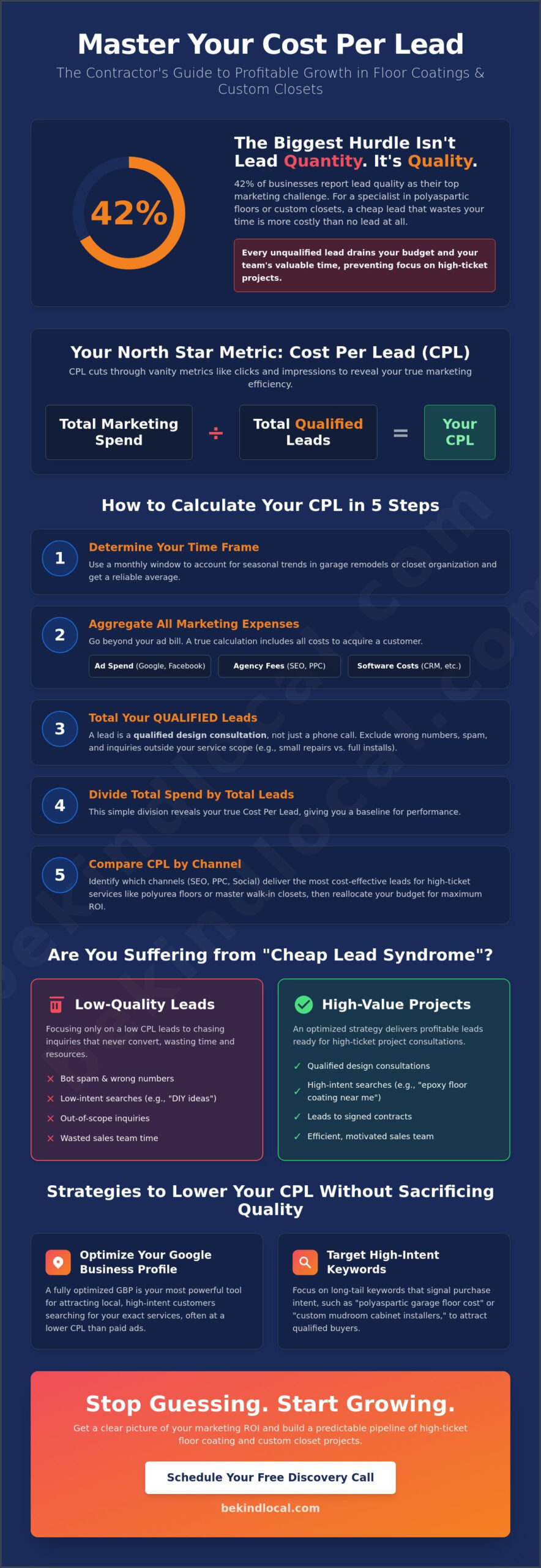
- Step 1: Determine your time frame. A monthly window is usually best. Seasonal shifts in garage remodeling or spring closet organization trends can skew data if you look at a window that’s too short.
- Step 2: Aggregate all marketing expenses. This means your ad spend, agency management fees, and the cost of your software stack.
- Step 3: Total your qualified leads. Look across all channels like SEO, PPC, and Social. Only count leads that actually fit your service profile.
- Step 4: Divide total spend by total leads. This simple math gives you your actual CPL.
- Step 5: Compare CPL by channel. This is where the magic happens. You’ll see which platform brings in the most affordable design consultations and which ones are draining your budget.
What to Include in Your “Total Marketing Spend”
Be honest with your ledger. Include your direct ad spend on platforms like Google Ads and Facebook. You must also factor in agency management fees for Local SEO and PPC services. If you pay for specialized lead tracking software or landing page builders, those belong in the total too. Learning how to calculate your cost per lead correctly means including every resource used to attract a new customer. Ignoring these “hidden” costs leads to an artificially low CPL that hides the truth about your profitability.
Tracking Lead Sources Accurately
Manual tracking is a recipe for “leaky” data. In a busy service business, you can’t rely on your office staff to ask every caller how they found you. People often forget or just say “the internet.” Instead, use Dynamic Number Insertion (DNI) to track exactly which ad group triggered a phone call. A tight CRM integration allows you to attribute a lead directly to a specific polyaspartic floor coating campaign or a reach-in closet promotion. This level of detail helps you stop wasting money on dead-end keywords. If your current data feels a bit messy, you might need to audit your lead attribution system to ensure you’re making decisions based on facts rather than feelings.
CPL vs. CAC: Understanding the Conversion Gap
While mastering how to calculate cost per lead for a service business gives you a clear view of your marketing efficiency, it doesn’t tell the whole story of your profitability. Cost per lead (CPL) measures interest; it tells you how much it costs to get a homeowner to pick up the phone. Customer Acquisition Cost (CAC), however, measures the final sale. If you’re spending all your time chasing leads that never book an estimate, your CPL might look great on paper while your business actually struggles to stay afloat.
Specialty contractors often fall into the trap of “Cheap Lead Syndrome.” This happens when you prioritize a low CPL above all else, resulting in a flood of inquiries from people looking for “cheap garage paint” rather than a professional polyaspartic system. A $100 lead that closes at a 50% rate is fundamentally better than a $20 lead that closes at 5% because the higher-quality lead results in a lower CAC and prevents your sales team from burning out on dead-end calls. You must validate your marketing spend by looking at the conversion gap between that initial click and the final signed contract.
Measuring Lead-to-Close Ratios
To bridge this gap, you need to track how many garage cabinet leads or closet inquiries actually turn into on-site estimates. High-intent buyers ready for a polyurea installation behave differently than “tire-kickers” just browsing for ideas. By analyzing which channels produce the highest closing rates, you can refine your advertising strategy to focus on quality. If your SEO leads close at double the rate of your social media leads, you know exactly where your next dollar of investment should go to ensure a healthy sales pipeline.
High-Ticket Math: Why $150 CPL Might Be a Steal
In the custom closet and flooring world, the value of a project varies wildly. A $150 CPL might feel expensive until you realize those leads are for $10,000 custom pantry projects or full-garage transformations. Compare that to a $30 lead that only wants a minor repair or a single reach-in closet. Specialty contractors should focus on “Cost Per Qualified Lead” (CPQL) rather than just raw volume. When you target high-ticket projects, you can afford a higher CPL because the return on investment is so much greater. Check out our guide on floor coating leads to see how high-ticket math changes your approach to local growth.
Strategies to Lower Your CPL Without Sacrificing Quality
Lowering your costs shouldn’t mean lowering your standards. Once you understand how to calculate cost per lead for a service business, the next logical step is finding ways to trim the fat without losing those high-ticket projects. It’s a delicate balance. You don’t want to just drive “more” traffic; you want to drive the right traffic. Strategic adjustments to your targeting and your digital presence can significantly reduce your CPL while actually improving the quality of the homeowners reaching out to you.
Start with your Google Business Profile (GBP). This is the digital storefront for your local business. A well-optimized profile drives a steady stream of “free” leads that bypass the expensive bidding wars of PPC. By consistently updating your profile with photos of recent polyaspartic garage floor installs and encouraging client reviews, you build immediate trust. This trust doesn’t just look good; it actually lowers your cost per click (CPC) because Google rewards high-quality, relevant businesses with better visibility and higher engagement rates.
The Power of Local Search Intent
Generic keywords are a budget killer. If you’re bidding on “garage floors,” you’re competing with national brands and DIY home centers. Instead, focus on high-intent, long-tail keywords like “polyaspartic garage floor installers in Indianapolis.” These specific terms usually have lower competition and a much lower CPL. Integrating Local SEO into your long-term strategy creates a pipeline of leads that doesn’t disappear the moment you stop paying for ads. It’s about building an asset for your business, not just renting space on a search results page.
Landing Page Optimization for Contractors
Your website needs to do more than just look pretty. It has to convert. If a homeowner clicks an ad for a custom walk-in closet but arrives at a generic homepage, they’ll likely leave. Use high-quality visual portfolios that showcase the tangible quality of your craft. Technical terms like polyurea, slatwall, and reach-in systems signal to high-end buyers that you’re an expert, not just another general laborer. Focus your call-to-action on a specific outcome, like “Get My Free Closet Design Consultation,” rather than a vague and uninspiring button.
To further protect your budget, implement a robust negative keyword list in your ad campaigns. This filters out people searching for “DIY” or “cheap” options. You aren’t looking for the bargain hunter; you’re looking for the homeowner who values a long-lasting polyaspartic system. If your current site isn’t turning visitors into design consultations, it might be time to look at professional web design services tailored specifically for contractors. Ready to stop wasting ad spend? Schedule a discovery call with Be Kind Local today to see how we can refine your local lead generation strategy.
Partnering for Growth: How Be Kind Local Optimizes Your Lead Gen
Mastering the math of your marketing is the first step toward true business freedom. Now that you understand how to calculate cost per lead for a service business, you have the power to stop guessing and start growing. At Be Kind Local, we believe that you deserve a partner who cares as much about your bottom line as you do. We move beyond the role of a traditional vendor. We act as a strategic extension of your team, focused on the health and ethics of your local growth. This need for specialized support isn’t unique to the home service industry; for example, elite plaintiff law firms often utilize the growth infrastructure provided by nexuslegal.group to scale their practices with similar precision and efficiency.
Our philosophy is simple: quality always beats volume. Your sales team shouldn’t spend their days chasing “leads” that never answer the phone or don’t have the budget for a premium polyaspartic floor coating. We focus on attracting high-intent homeowners who value your craftsmanship. Our custom reporting doesn’t just show you clicks; it shows you the exact CPL and ROI of your closet and flooring campaigns. This transparency allows you to see exactly which projects are driving your profits and which ones are just wasting your time. When you’re ready to scale, schedule a discovery call with Be Kind Local to see the difference a strategic partner makes.
Our Strategic Approach to Specialty Contracting
We don’t believe in one-size-fits-all marketing. Your business is unique, and your marketing should reflect that. We bring deep niche expertise in the epoxy flooring, garage storage, and custom closet industries. We understand the difference between a reach-in pantry and a luxury walk-in closet. Our brand strategy for specialty contractors focuses on building long-term equity. We use ethical marketing practices that don’t just hunt for the next lead but build a community of trust around your local brand. This approach ensures that your business remains resilient even as market conditions shift.
Taking the Next Step Toward Profitable Growth
The path to a more profitable business starts with data. It’s time to stop letting your ad spend disappear into a black hole. We help contractors in competitive markets like Texas and Florida dominate their local map pack, ensuring they are the first name homeowners see. Whether you’re looking to fill your calendar with garage slatwall installs or master mudroom projects, we provide the clarity you need. Stop wondering if your marketing is working and start making data-driven decisions that move the needle. Visit bekindlocal.com to start your journey toward better lead generation and a more sustainable, profitable future.
Take Control of Your Local Growth
You now have the framework to move from guesswork to strategic growth. Mastering how to calculate cost per lead for a service business gives you the clarity to see exactly where your marketing dollars are working and where they are being wasted. A low CPL is only a win if those leads turn into signed contracts for polyurea floors or master walk-in closets. Focus on high-intent buyers who value your professional craft, and use your data to bridge the gap between raw interest and actual revenue.
Be Kind Local acts as a strategic partner for contractors ready to dominate their local markets. We provide transparent reporting on CPL and CAC, ensuring you always understand your ROI. Our focus remains on high-ticket leads that keep your crews busy and your business profitable. Let’s work together to build a more resilient brand in your community.
Schedule a Discovery Call to Optimize Your Lead Gen
You’ve already done the hard work of building a great business. We’re here to help you make sure it stays booked and profitable for years to come.
Frequently Asked Questions
What is a good cost per lead for a floor coating business in 2026?
A good CPL is relative to your average ticket price and profit margins for polyaspartic systems. While blended averages for home services often hover around $53, your specific target should be based on your project’s value. If a typical garage floor coating project brings in several thousand dollars, you can afford a higher CPL than a contractor performing minor residential repairs. Focus on lead quality over raw numbers to ensure your spend stays profitable.
How do I track which leads came from Google Ads vs. Local SEO?
You track these different sources using Dynamic Number Insertion (DNI) and UTM parameters on your contact forms. DNI automatically changes the phone number on your website based on how the visitor found you, letting you see exactly which calls came from a paid ad versus an organic search. This level of detail is vital when you want to know how to calculate cost per lead for a service business across multiple digital channels.
Should I include my marketing agency fees when calculating CPL?
Yes, you must include agency management fees to understand the true cost of your lead generation. If you only look at your direct ad spend, you’re working with an artificially low number that hides the real investment required to grow. Including these fees gives you an honest look at your marketing efficiency. It helps you decide if your current strategy is actually building equity for your custom closet or flooring business.
Can I calculate CPL if I don’t have a CRM?
You can calculate CPL using a simple manual log or spreadsheet, though it requires strict discipline from your office staff. You’ll need to record every qualified inquiry and ask each caller how they found your business. While a CRM makes this process much easier and more accurate, a manual system still allows you to track the basic math of your marketing. It’s a great starting point for any contractor who wants to stop guessing.
Why is my CPL increasing even though my ad spend is the same?
An increasing CPL usually indicates rising competition in your local market or a drop in your website’s conversion rate. If more garage remodelers start bidding on keywords like “polyurea floor coating,” the cost to reach those homeowners will naturally go up. It could also mean your landing page is no longer speaking directly to the needs of high-intent buyers. Regular audits of your ad copy and website visuals can help bring these costs back down.
How does Google Business Profile affect my overall CPL?
A well-optimized Google Business Profile (GBP) lowers your overall CPL by generating “free” organic leads from the local map pack. When your profile ranks for high-intent searches like “custom closet designers in my city,” you get phone calls without paying for each click. These organic leads balance out your more expensive paid campaigns. This creates a more sustainable and cost-effective lead generation pipeline for your specialty contracting business over the long term.
What is the difference between CPL and CPA for a custom closet company?
CPL measures the cost of a lead, while CPA (Cost Per Acquisition) measures the cost of a signed contract. For a custom closet company, a lead is often a design consultation request, but an acquisition only happens when the homeowner pays a deposit for their walk-in or reach-in system. Tracking both helps you identify if your marketing needs adjustment or if your sales process is where the “leak” is happening.
How often should a service business review its CPL metrics?
You should review your CPL metrics at least once a month to stay on top of seasonal trends and market shifts. For industries like garage remodeling that see peaks in the spring and fall, a monthly review helps you adjust your how to calculate cost per lead for a service business formula for different times of the year. This consistent habit prevents you from overspending on low-quality leads and keeps your growth strategy on the right path.