
 951-249-7500
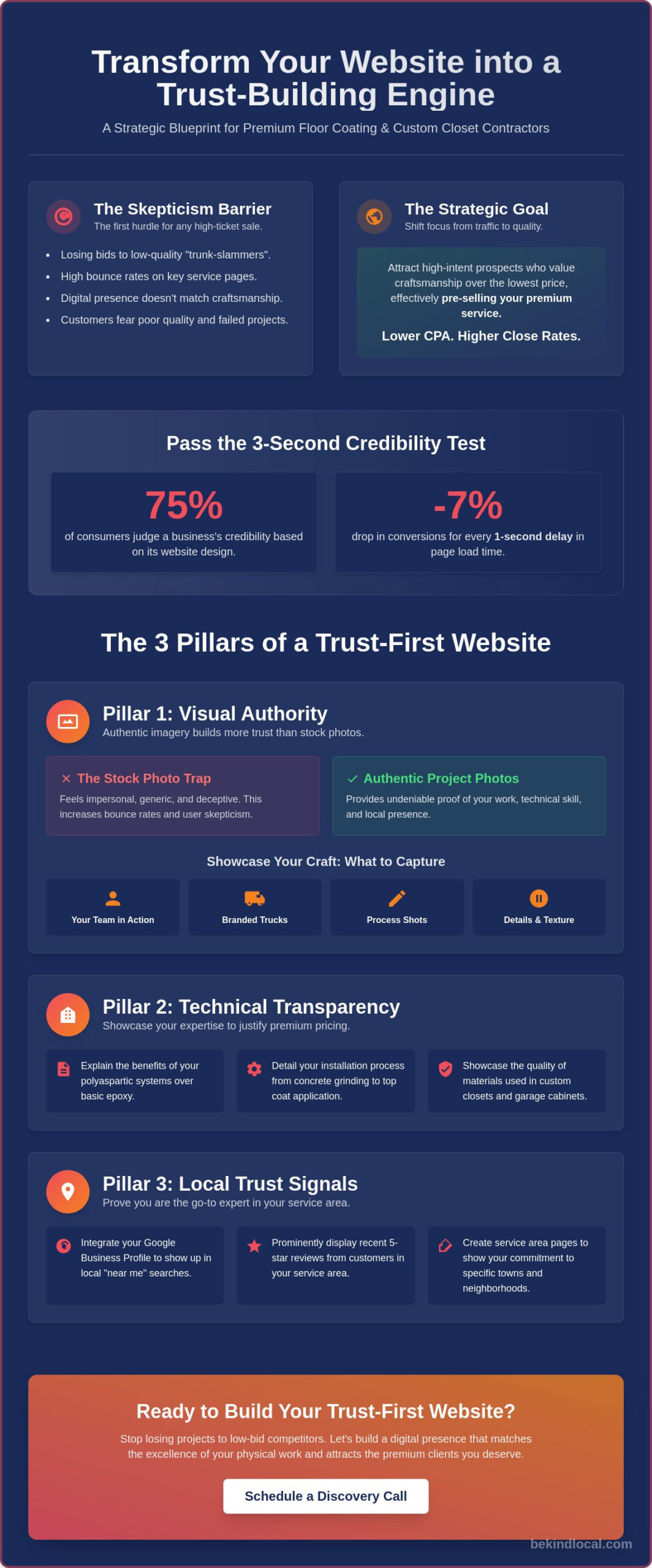
What if your website could do the heavy lifting of justifying a premium polyaspartic floor quote before you even pick up the phone? Most specialty contractors are tired of losing high-ticket projects to “trunk-slammers” who underbid quality work with inferior materials. You know your craftsmanship is superior. However, if your digital presence feels cold or outdated, you’re likely seeing high bounce rates on your most important service pages. In 2026, effective website design that builds trust with customers isn’t about flashy graphics; it’s about demonstrating technical mastery and local accountability.
We understand the pride you take in every garage slatwall system and walk-in closet you install. That’s why we’ve developed this strategy to help you transform your site into a high-converting engine for premium leads. You’ll learn how to handle the latest Google Business Profile updates and new data privacy laws to pre-sell your quality. We’ll explore how to showcase your expertise in polyurea systems and custom cabinetry so that your digital front door finally matches the excellence of your physical work.
Key Takeaways
- Learn how to align your digital presence with your physical craftsmanship to break through the “skepticism barrier” inherent in high-ticket home remodeling.
- Discover why authentic project photos of polyaspartic applications and custom closet installs build more authority than generic stock imagery.
- Master the use of technical transparency as a website design that builds trust with customers, helping you justify premium pricing over low-cost competitors.
- Understand how to integrate your Google Business Profile and local reviews to create a digital front door that resonates with your specific service area.
- Shift your marketing focus from raw traffic volume to lead quality by positioning your brand as a strategic expert in your local market.
The Psychology of Trust in High-Ticket Home Services
Trust in the specialty contracting world is the alignment of your digital promise with your physical expertise. When a homeowner looks for a garage remodel, they aren’t just buying polyaspartic coatings; they’re buying peace of mind. The Psychology of Trust suggests that reliability and competence are the foundations of any high-stakes decision. In our industry, this manifests as the “Skepticism Barrier.” Most prospects have heard horror stories of contractors disappearing or work failing after six months. Your website design that builds trust with customers must dismantle this barrier by proving you are a strategic partner rather than a transactional vendor.
Positioning yourself as a partner means moving beyond “we do floors” to “we protect and organize your home.” In 2026, customers are more educated than ever. They prioritize ethical transparency. They want to see the face behind the business and understand the “why” behind your process. If your site looks like every other epoxy company in the city, you’re just a commodity. Real trust comes from showing the humanity and the local roots of your craftsmanship. It’s about being an pathfinder for your clients, not just another name in a search result.
The 3-Second Credibility Test
You have about three seconds to pass the initial sniff test. Visual hierarchy tells the visitor’s brain whether you’re a professional outfit or an amateur. If your service pages are cluttered or slow, you’ve already failed the competence check. According to verified industry data, 75% of consumers judge a business’s credibility based on its website design. A one-second delay in page load can slash conversions by 7%. High-end B2B and B2C clients don’t have time for fluff or hypey claims. They want clarity, speed, and evidence of mastery.
Moving from Traffic to Lead Quality
Raw traffic is a vanity metric. What matters is attracting high-intent prospects who value quality over the lowest bid. Your home service brand strategy dictates exactly which trust signals you need to display. When you use a website design that builds trust with customers, you’re essentially pre-selling the project. This reduces your cost-per-acquisition (CPA) because your sales team spends less time convincing skeptics and more time closing educated buyers. Trust acts as a lubricant for the entire sales funnel. It turns cold clicks into qualified leads for walk-in closets and premium garage storage systems without the need for aggressive sales tactics.
Visual Authority: Why Authentic Project Imagery Beats Stock Photos
Generic images of smiling families in pristine garages scream “middleman” to the modern homeowner. When a prospect lands on your site looking for a custom closet or a garage floor, they’re searching for evidence of your specific work. The “Stock Photo Trap” is a fast track to high bounce rates because it feels impersonal and deceptive. Choosing a website design that builds trust with customers means ditching the glossy, fake imagery for real, grit-and-grime project photos. Showing your branded trucks and your actual crew on a job site proves you’re a local staple, not a fly-by-night operation.
Consider the difference between a stock photo of a finished floor and a photo of your team diamond-grinding concrete. One is just a promise; the other is undeniable proof. Making specific Trust-Based Web Design Choices involves prioritizing these process shots. Showing the polyaspartic application as it happens demonstrates technical mastery and transparency. It humanizes your business by letting the customer see the faces of the people who will eventually be working in their home. This behind-the-scenes content builds a bridge between your digital presence and the physical reality of your craftsmanship.
Showcasing the Craft: Closets and Coatings
Photography for high-ticket services requires a focus on detail and texture. For custom closets, you should capture the depth of reach-in and walk-in systems with natural or soft professional lighting. Avoid using a harsh flash that flattens the appearance of the cabinetry. For floor coatings, close-up shots of the flake distribution and the thick, glossy topcoat help the customer visualize the quality. A well-organized visual portfolio acts as a silent salesman, answering questions about durability and aesthetics before the customer even picks up the phone.
The Role of Video in Building Trust
Video content is the ultimate tool for dismantling the “Skepticism Barrier.” A simple, 30-second “Meet the Owner” video can significantly increase conversion rates by putting a face to the brand. It shows you’re a real person who stands behind every project. Time-lapse videos of a garage transformation provide visual proof of your efficiency and process. You can integrate these videos through modern hosting solutions that won’t slow down your page load times. If you need help organizing your visual assets to better reflect your craftsmanship, you can always reach out to our team for guidance.
Technical Transparency: Showcasing Your Systems and Expertise
Expertise isn’t just about what you do; it’s about the language you use to describe it. Your customers are tired of vague promises. They want to know the science behind why their floor won’t peel or why their mudroom cabinets won’t sag under pressure. Using technical transparency is a core pillar of website design that builds trust with customers. When you explain the role of moisture vapor barriers or the specific slatwall durability ratings you offer, you aren’t just showing off. You’re educating the buyer on value. This education-first approach justifies why your professional system costs more than a hardware store DIY kit.
The best way to dismantle price objections is to provide upfront disclosure of your process. Don’t just say you prep the floor. Detail your 5-step concrete prep process, including diamond grinding and crack repair. If you’re a closet designer, walk them through the initial consultation and 3D rendering phase. Creating comparison sections, such as “Polyaspartic vs. Epoxy,” helps the customer choose the right solution for their specific environment. It positions you as an advisor rather than a salesperson, which is the fastest way to earn local loyalty.
The Anatomy of a High-Trust Service Page
A high-converting service page needs more than a “call now” button. It requires mandatory elements like technical specifications, warranty details, and “What to Expect” timelines. You should clearly outline the duration of the install and the cure time for coatings. This level of detail reduces anxiety for the homeowner. We often recommend an internal linking strategy that connects these service pages to deeper education on floor coating leads. Addressing the pricing “elephant in the room” through value justification ensures that the prospects who reach out are already pre-sold on your quality.
Demonstrating Niche Expertise
Generalists struggle to build trust in high-ticket markets. You need to highlight specific storage solutions like walk-in pantries, reach-in closets, or heavy-duty overhead storage. Explain the science of concrete adhesion to prevent future failures, especially in demanding climates like Texas, Florida, or California. When you speak to the specific challenges of your local market, you become the go-to authority. This niche focus proves you understand the unique needs of your community, from humidity concerns to common architectural styles. It transforms your website from a digital brochure into a powerful tool for strategic growth.
Local Trust Signals: Integrating Social Proof and GBP Data
Your website doesn’t live in a vacuum. Most homeowners in 2026 start their journey on a map, not a homepage. Verified data shows that over 70% of local searches result in interactions with a Google Business Profile before a user even clicks your link. This makes your GBP the real “front door” of your digital presence. A website design that builds trust with customers must bridge the gap between your search listing and your service pages. By integrating real-time review widgets, you show prospects that their neighbors in cities like Indianapolis or Dallas already trust your crew with their garage floors and custom closets.
The “Local Hero” factor is about more than just being nearby; it’s about showing your roots. Highlighting local certifications and community involvement proves you have skin in the game. When you build geographic landing pages, don’t just swap out the city name. Include photos of local projects and mention specific neighborhoods. This level of localization signals that you aren’t a national franchise with no soul, but a dedicated craftsman who understands the local climate and housing styles. It shows you’re a part of the community fabric, which is a powerful differentiator in a crowded market.
Reputation Management as a Design Element
Reviews shouldn’t be hidden on a separate page. You should display them strategically near your Call-to-Action buttons to provide that final nudge of confidence. Displaying customer feedback can lead to a 270% increase in revenue compared to having no social proof at all. It’s also vital to show how you handle the rare negative experience. Public, professional responses displayed on-site prove you value accountability. Google’s April 2026 policy update made review authenticity even more critical, prohibiting review gating and incentivized feedback. This transparency, combined with a strong local seo strategy, creates an aura of authority that underbidders simply cannot replicate.
Trust Seals and Certifications
Industry-specific badges carry significant psychological weight. Placing seals from the Concrete Coating Association or specific closet system providers near your lead forms provides a safety net for the skeptic. In 2026, the phrase “Licensed, Bonded, and Insured” is more than a legal requirement; it’s a trust signal that separates professionals from amateurs. You should also highlight your manufacturer partnerships to prove you use professional-grade materials rather than off-the-shelf kits. If you want to see how these signals can be integrated into your specific market, you should schedule a discovery call with our team today.
Building Your Trust-First Website with Be Kind Local
At Be Kind Local, we don’t believe in vanity metrics. High traffic numbers are meaningless if your phone isn’t ringing with homeowners who value your craftsmanship. Our approach to website design that builds trust with customers is rooted in the belief that specialty contractors deserve a digital presence as durable as a polyaspartic floor. We focus on lead quality over raw volume because we know that one high-ticket custom closet project is worth more than fifty low-intent clicks. When your website acts as a silent salesman, it does the hard work of justifying your premium pricing before you even arrive for the estimate.
Our custom web design process isn’t a template-driven exercise. We dive deep into your specific business model to understand the technical nuances of your concrete prep or your pantry shelving systems. By integrating Local SEO, Google Ads, and trust-based design into a single growth engine, we ensure every marketing dollar works toward building your local reputation. Our ethical marketing promise is simple: no hype, no inflated claims, just measurable growth for your garage or closet business. We treat your brand with the same respect and attention to detail you show your customers’ homes.
Beyond Web Design: A Full-Service Partnership
A high-converting website is only half the battle. To truly dominate your local market, you need a cohesive strategy that aligns your advertising with your website’s trust signals. If your Google Ads promise a “lifetime warranty” but your landing page is vague about the details, you’ve created a trust leak. We ensure your social media presence reinforces your brand’s local authority, turning digital followers into neighborhood advocates. It’s this commitment to consistency that has led contractors across North Carolina and Georgia to trust us with their long-term growth. We act as your strategic partner, ensuring your digital presence matches the quality of your physical work.
Next Steps: Schedule Your Discovery Call
Ready to stop competing on price and start winning on quality? A Be Kind Local strategy session is a straightforward, no-pressure conversation about your business goals and local market challenges. We’ll audit your current digital footprint to identify “Trust Leaks” that might be scaring away your best prospects. Whether it’s outdated project imagery or a lack of technical transparency, we’ll give you a clear roadmap for improvement. You can schedule your discovery call at bekindlocal.com today to begin transforming your website into a high-converting trust engine.
Scaling Your Specialty Contracting Business Through Digital Authority
Specialty contracting is built on the strength of your reputation. You’ve seen how shifting from generic stock photos to authentic project imagery and embracing technical transparency can dismantle the skepticism barrier. By integrating local trust signals directly into your site, you ensure that your digital front door is as professional as your physical craftsmanship. Implementing a website design that builds trust with customers isn’t just a marketing tactic; it’s a commitment to showing your community the ethical, high-quality work you provide every day.
At Be Kind Local, we pride ourselves on being more than just a vendor. We are a strategic partner focused on high-intent lead generation for the floor coating and custom closet niches. We don’t chase vanity metrics like raw traffic volume. Instead, we build growth engines that pre-sell your expertise and technical mastery. It’s time to let your website reflect the true value of your labor and dedication.
Ready to transform your digital presence? Schedule a discovery call with Be Kind Local to build your trust-driven website. Let’s work together to show your local market why you are the premier choice for their home transformations.
Common Questions About Trust-Based Contractor Web Design
How long does it take for a new website design to start building trust?
Trust building begins the very second a visitor lands on your page, as 94% of first impressions are design-related. While the emotional impact is immediate, you’ll typically see measurable improvements in lead quality and conversion rates within 30 to 90 days. This period allows search engines to index your updated content and gives local prospects time to interact with your new trust signals and technical education.
Can I use manufacturer photos if I don’t have my own project images yet?
You can use manufacturer photos as a temporary bridge, but you should label them as representative samples to maintain ethical transparency. Savvy homeowners often recognize these generic images, which can inadvertently trigger the skepticism barrier. To truly implement a website design that builds trust with customers, you must prioritize replacing these with authentic shots of your crew and local installs as soon as possible.
What is the single most important trust signal for a floor coating company?
The most critical trust signal is visual and technical proof of your concrete preparation process. Homeowners fear coating failure above all else, so showing your team diamond grinding or moisture testing is more persuasive than any finished “after” photo. Detailing your specific moisture vapor barrier application proves that you’re installing a professional system rather than just applying a cosmetic layer.
Do I really need to put my pricing on my website to build trust?
You don’t have to list exact project costs, but providing “starting at” ranges or price-per-square-foot estimates builds immense credibility. Transparency regarding what influences the final price, such as concrete repairs or custom closet accessories, helps justify your premium position. It shows you respect the customer’s time and helps filter out low-intent leads who are only looking for the cheapest possible bid.
How does local SEO influence how much customers trust my website?
Local SEO builds trust by creating a consistent and visible presence across Google Business Profile and local search results. When a prospect sees your site ranking well alongside authentic reviews from their own neighbors, it validates your status as a reliable local authority. This digital consistency proves you’re an accountable member of the community, which is essential for winning high-ticket remodeling projects.
What should I look for when hiring a marketing agency for my closet business?
You should look for a partner that understands the technical nuances of your niche, from mudroom slatwall systems to walk-in pantry layouts. A strategic agency should prioritize lead quality and conversion-focused education over vanity metrics like raw traffic. Ensure they have a proven track record with website design that builds trust with customers and can demonstrate how they’ll translate your craftsmanship into a high-converting growth engine.