
 951-249-7500
What if the reason your clinic’s growth has stalled isn’t a lack of local demand, but a marketing budget that’s leaking money into generic, low-intent clicks? It’s exhausting to watch your hard-earned revenue disappear into ads that attract “window shoppers” while your competitors seem to own the local Google Map Pack. Implementing effective marketing strategies for chiropractors shouldn’t feel like a gamble. You’re likely tired of low-quality leads who book a consultation but never actually walk through your door. We believe your practice deserves a predictable flow of patients who value your expertise and show up ready for care.
This guide will show you how to move beyond basic visibility to build deep, ethical trust within your community. You’ll discover how to capture the 68.5% of patient traffic coming from mobile devices and how to navigate the critical February 16, 2026, HIPAA privacy rule updates without losing your momentum. We’re moving past the hypey claims of typical agencies to give you a clear, data-backed roadmap for dominating your local market and achieving a higher ROI on every dollar you spend. It’s time to stop chasing traffic and start building a community of loyal patients who trust your hands and your heart.
Key Takeaways
- Learn how to pivot from generic social media awareness to high-intent discovery that captures patients exactly when they are ready to book an appointment.
- Master the three pillars of Google Map Pack success to ensure your clinic dominates local search results using proven marketing strategies for chiropractors.
- Identify the critical differences between Google Ads and Local Services Ads to capture “pain-specific” searches without wasting your monthly advertising budget.
- Implement a mobile-first website strategy that uses the 3-second rule to communicate your unique value and turn local clicks into confirmed consultations.
- Build a sustainable referral engine by focusing on review velocity and automated feedback systems that keep your practice relevant and trusted in your community.
Why Chiropractic Marketing in 2026 Requires a Strategic Shift
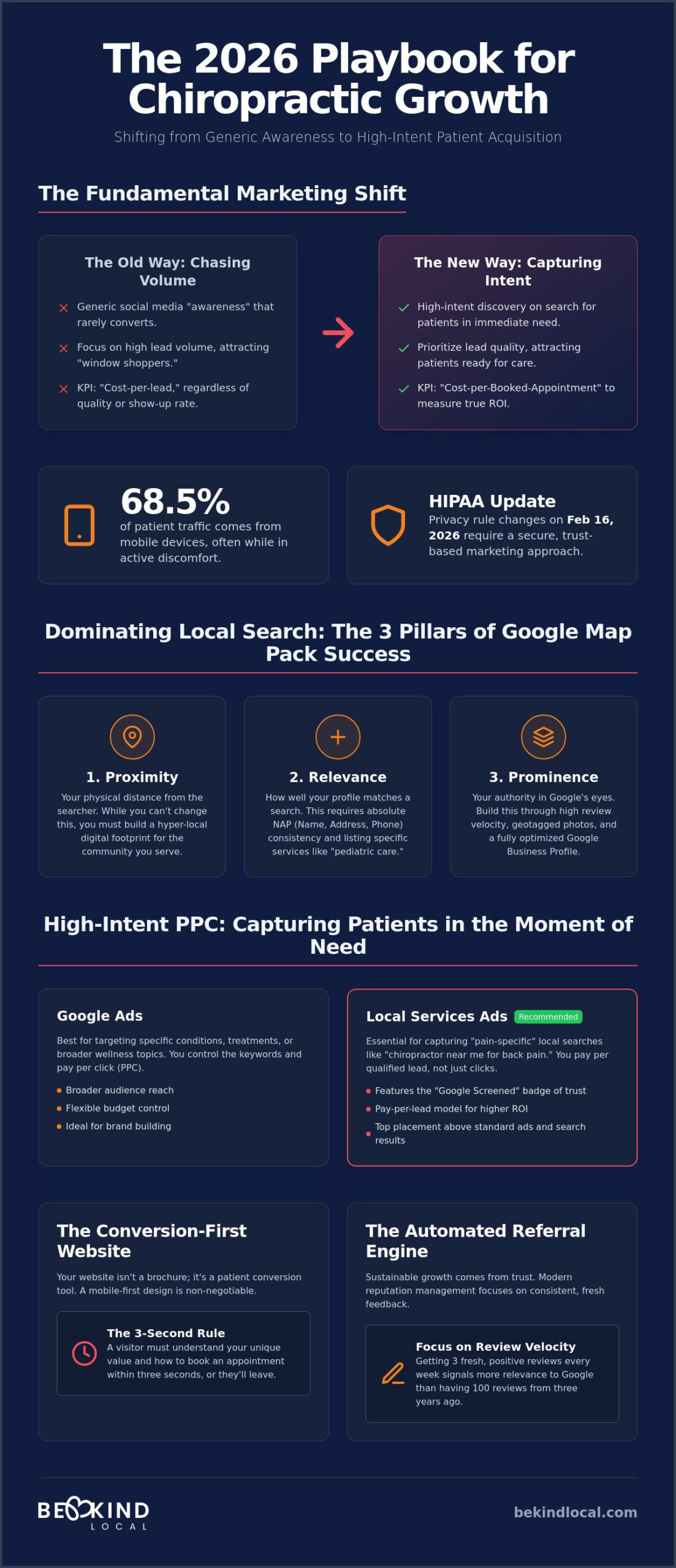
The days of passive scrolling leading to a full clinic are over. In 2026, patients aren’t looking for social media entertainment; they’re looking for relief. This shift requires a fundamental change in how we approach marketing strategies for chiropractors. We’ve moved from the era of general “awareness” into an era of high-intent, search-based discovery. When someone’s back goes out, they don’t wait for a Facebook ad to appear in three days. They grab their phone and search for an immediate solution.
Understanding the Chiropractic profession as a vital part of local healthcare helps us see why authority matters more than “likes.” Statistics show that 68.5% of traffic to chiropractic websites now comes from mobile devices. These users are often in physical discomfort and have a high “Patient Lifetime Value” (LTV). If a single patient represents thousands of dollars in long-term wellness care, your marketing budget should reflect the cost of acquiring that high-value relationship, not just chasing cheap clicks.
The ‘Volume vs. Quality’ Trap
Many practitioners fall into the trap of chasing lead volume. It feels good to see 100 new leads in a spreadsheet, but if those leads don’t show up for their consultations, they’re actually a net loss. Effective marketing strategies for chiropractors today must prioritize lead quality over raw traffic volume. Low-quality leads “window shop” for the lowest price. High-intent patients are in acute need of care and prioritize your expertise over a $20 discount. Your KPIs should focus on “cost-per-booked-appointment” rather than just “cost-per-lead.” This ensures your front desk isn’t wasting hours on the phone with people who have no intention of walking through your door.
Adapting to the 2026 Digital Landscape
AI-driven search results are changing how patients discover local clinics. Google now prioritizes authoritative, localized content that answers specific pain-related questions. At Be Kind Local, we’ve spent years perfecting lead generation for high-stakes local businesses like epoxy flooring and custom closet designers. The same principles apply here. You need a brand strategy that positions you as the local expert. Moving from transactional, “one-off” ads to a strategy of brand authority ensures you aren’t just a vendor. You become a trusted partner in your patient’s health journey.
Dominating Local SEO and the Google Map Pack
Dominating the local Map Pack is the single most effective way to capture patients in pain. When someone searches for “chiropractor near me,” they rarely look past the top three results. To secure one of those spots, you must master the three pillars of local search: proximity, prominence, and relevance. While you can’t change your physical distance from a searcher, you can certainly influence how Google perceives your authority. Modern marketing strategies for chiropractors require a proactive approach to these signals rather than a “set it and forget it” mentality.
Consistency is the foundation of trust. Your clinic’s name, address, and phone number (NAP) must be identical across every directory, social profile, and map listing. Even small discrepancies, like “St.” versus “Street,” can confuse search algorithms and hurt your rankings. For practices with multiple locations in competitive states like Florida or Texas, this localized focus is even more critical. Each office needs a distinct digital footprint that reflects its unique connection to the neighborhood it serves. This hyper-local approach aligns with broader healthcare marketing strategies that prioritize community trust and accessibility.
Google Business Profile Optimization Secrets
Your Google Business Profile (GBP) is your practice’s digital storefront. In 2026, a basic profile isn’t enough to stay ahead. You need to utilize the “Products” and “Services” sections to tell Google exactly what you offer. If you specialize in sports injuries or pediatric care, list those specifically. We also recommend uploading geotagged images of your clinic and team regularly. These photos signal to Google that you’re an active, physical part of the local community. Don’t forget about “Review Velocity.” It’s better to get three fresh reviews every week than to have 100 reviews from three years ago. Fresh feedback tells both Google and potential patients that you’re providing excellent care right now.
Local Link Building and Citations
Authority isn’t just about what you say; it’s about who vouches for you. Local link building should feel like digital community outreach. Securing links from local sports teams, community centers, or regional health organizations carries significant weight in local SEO. These niche-relevant citations often outweigh generic links from unrelated industries. You can learn more about our Strategic SEO services to see how we build this type of local authority for our partners. If your clinic isn’t appearing where it should, it’s often a sign that your local digital roots aren’t deep enough. You might want to reach out for a strategy session to see where your local presence is leaking potential leads.
High-Intent PPC: Capturing Patients in the Moment of Need
Paid search is the digital equivalent of an emergency room sign. When a local resident experiences a sudden disc flare-up or debilitating neck pain, they don’t browse social media for inspiration. They go to Google. Effective marketing strategies for chiropractors in 2026 rely on being visible at the exact second that “pain-point” search occurs. This requires a sharp distinction between generic awareness and high-intent advertising. If your ads are showing up for “what causes back pain” instead of “sciatica relief near me,” you’re likely paying for research rather than revenue.
Success starts with choosing the right platform. Google Ads (PPC) allows for granular control over specific conditions, while Local Services Ads (LSAs) operate on a pay-per-lead basis. We often see clinics waste their monthly budget by sending this expensive traffic to a generic homepage. A homepage is a map of your entire practice; a dedicated landing page is a direct path to a consultation. By focusing on specific pain-specific keywords and excluding “free” or “cheap” seekers through robust negative keyword lists, you ensure your spend is reserved for patients who value quality care. All claims made in these ads must align with FTC advertising and marketing guidance to maintain ethical standards and clinic credibility.
Strategy for Local Services Ads (LSAs)
Local Services Ads appear at the very top of the search results, even above traditional PPC ads. For chiropractors, the “Google Screened” badge is a powerful trust signal that builds instant rapport before a patient even clicks. This platform is ideal for driving call volume. To optimize your LSA profile, focus on responsiveness. Google rewards clinics that answer the phone and manage their leads quickly. For a deeper look at how these systems work in high-competition local markets, you can explore our Google Ads for Home Services: The 2026 Strategic Guide, which outlines similar intent-based bidding structures.
Retargeting: Staying Top-of-Mind
Most patients won’t book on their first visit. They might get distracted by a phone call or simply hesitate before committing to care. Ethical retargeting allows you to gently remind these visitors of your expertise as they continue their search. When combined with a thoughtful email marketing sequence, you create a cohesive journey from the first click to the first adjustment. You can see our approach to high-performance advertising to understand how we balance aggressive lead generation with the empathy required in healthcare. This multi-touch strategy ensures that when the patient is finally ready to book, your clinic is the only choice they consider.
The Conversion-First Website: Turning Clicks into Consultations
Getting traffic to your site is only half the battle. If your digital storefront doesn’t immediately build trust, those visitors will bounce back to the search results. Most marketing strategies for chiropractors fail here because they prioritize aesthetics over action. In 2026, your website must be a precision tool designed to convert. With over 80% of patients searching for care on their mobile devices, a “responsive” site isn’t enough. It has to be mobile-first. This means large, thumb-friendly buttons and a layout that remains clear even on the smallest screens.
You have exactly three seconds to capture a visitor’s attention. Before they even scroll, they need to know what you do, who you help, and how to book. We call this the 3-second rule. If your Unique Selling Proposition (USP) is buried at the bottom of the page, you’ve already lost them. High-quality video is a game-changer for building this instant rapport. Seeing the lead chiropractor’s face and hearing their voice helps demystify the treatment process. It transforms a cold business into a warm, inviting community space before the patient even steps through your door. Strategic placement of “Book Now” and “Call Today” buttons ensures the path to care is always visible.
Essential Elements of a High-Converting Page
Every headline on your page should focus on patient outcomes, not just your certifications. Instead of “Expert Chiropractic Care,” try “Get Back to the Activities You Love, Pain-Free.” Pair these headlines with strategic social proof. Video testimonials and fresh Google reviews should be woven into the design, not hidden on a separate page. Finally, simplify your booking process. Every extra field in a contact form is a reason for a patient to quit. Keep it lean, fast, and focused on the next step. Frictionless forms are the secret to turning late-night searchers into Monday morning appointments.
Technical Performance and SEO
Google’s Core Web Vitals are now a major ranking factor for local search. A slow site doesn’t just frustrate patients; it actively hurts your visibility in the Map Pack. You also need medical schema markup. This is a bit of “behind-the-scenes” code that helps search engines understand your clinic’s hours, location, and specific services. Investing in custom web design for local growth ensures these technical details are handled while you focus on patient care. If your current site feels like a hurdle rather than a help, you should schedule a discovery call with Be Kind Local to turn your website into a lead-generating asset.
Reputation Management and the Referral Engine
Good care is the foundation of any practice, but high-growth clinics don’t leave their reputation to chance. In 2026, “Review Velocity” is the metric that truly matters for local visibility. Google’s algorithms now prioritize clinics that receive a steady stream of fresh feedback over those with stale 5-star ratings from several years ago. Automating your review requests through your patient management software ensures that every person receives a gentle nudge to share their story while the relief they feel is still fresh. This steady pulse of activity signals to both search engines and potential patients that your practice is active, reliable, and trusted. It’s one of the most sustainable marketing strategies for chiropractors who want to build long-term authority without constant ad spend.
Negative reviews are an inevitable part of being in business, but they don’t have to be damaging. Responding ethically and strategically can actually build more trust than a perfect record. Never reveal patient information in a response. Instead, acknowledge the feedback with empathy and invite the conversation to a private phone call. This professional handling shows prospective patients that you’re a practitioner who values accountability. On social media, shift your focus from broadcasting generic health tips to highlighting “Community Proof.” Share photos of your team at local charity runs or small wins within the clinic. This humanizes your practice and builds a community-led referral engine that works even when you aren’t actively running campaigns.
Building a Professional Referral Network
Your reputation among other local health professionals is just as important as your online rating. Marketing to local PCPs, physical therapists, and massage clinics creates a reliable stream of high-intent referrals. Consider creating co-branded content, such as a joint guide on workplace ergonomics, that positions you as the regional expert. This collaborative approach mirrors the principles in our Home Service Brand Strategy: The 2026 Guide, where we emphasize building a brand that partners with the local community rather than just competing with it.
Reputation as a Ranking Factor
Google uses sophisticated sentiment analysis to determine where you land in the Map Pack. When patients use “keyword-rich” descriptions in their reviews like “best sciatica treatment” or “gentle neck adjustment,” it helps the algorithm understand your specific relevance for those searches. We offer strategic brand support for local clinics to help you cultivate this level of digital authority and trust. By encouraging detailed, honest feedback from your patients, you aren’t just managing your reputation; you’re actively fueling your local search rankings and ensuring your practice remains the first choice for those in need.
Taking the Lead in Your Local Health Community
Building a thriving practice in 2026 isn’t about having the loudest voice. It’s about being the most trusted answer when a neighbor is in pain. We’ve explored how shifting to high-intent search discovery and a conversion-focused website can transform your clinic’s growth. By prioritizing lead quality over raw traffic and maintaining a steady pulse of fresh patient feedback, you’re not just buying ads. You’re building a community-centered brand that lasts. It’s about showing up exactly when and where your patients need you most.
Effective marketing strategies for chiropractors require a partner who understands the nuances of high-ticket local lead generation. At Be Kind Local, we serve as strategic growth partners for clinics in CA, TX, FL, and across the country. We don’t believe in generic fluff or vanity metrics. We focus on the practical, ethical data that drives real consultations and a higher ROI on your marketing spend. It’s time to stop wasting your budget on low-intent clicks and start dominating your local Map Pack.
Schedule your strategic discovery call with Be Kind Local today. Your community is looking for the relief only you can provide. We’re ready to help them find you.
Frequently Asked Questions
How much should a chiropractor spend on marketing in 2026?
Most chiropractors in US metro areas should plan for a minimum monthly Google Ads budget of $1,500 to $3,000. This investment allows you to gather enough data to optimize your campaigns for high-intent leads. In highly competitive markets, this budget might need to increase to $4,000 or more. Your total marketing investment should generally stay between 5% and 10% of your gross revenue to ensure sustainable growth.
How long does it take to see results from Local SEO for a new clinic?
You should expect to see measurable results from Local SEO within three to six months of consistent effort. While you might see some quick wins in rankings, building the prominence and relevance needed to dominate the Map Pack takes time. This period allows search engines to verify your authority and community trust. It’s a long-term investment that eventually provides the most sustainable flow of new patients.
Is Facebook marketing still effective for chiropractors?
Facebook remains an effective tool for building community proof and running retargeting campaigns. It doesn’t capture the immediate “moment of need” like Google, but it’s perfect for staying top-of-mind with previous visitors. Sharing authentic stories and local events helps build the trust required in modern marketing strategies for chiropractors. It works best as a supporting channel to reinforce the authority you establish through search.
What is the difference between SEO and PPC for my practice?
PPC offers immediate visibility through paid ads, while SEO builds long-term organic authority. Think of PPC as a faucet you can turn on for instant leads and SEO as a well you dig for a permanent water source. A strategic partner uses PPC to fill your schedule now while SEO works to decrease your overall cost-per-lead over time. Both are necessary for a healthy, visible practice.
How can I get more Google reviews without sounding pushy?
The most effective way to get reviews is to ask for them immediately after a patient experiences physical relief. Automating these requests via text or email ensures the process is consistent and never feels forced. Simply explain that their honest feedback helps other local residents find the right care. This keeps your review velocity high and signals to Google that your clinic is active and trusted.
Do I really need a dedicated landing page for my ads?
You absolutely need a dedicated landing page to prevent your ad budget from leaking away. Sending paid traffic to a general homepage forces patients to hunt for information, which usually leads to them leaving. A landing page removes distractions and focuses on a single action, like booking a consultation. This streamlined experience directly improves your conversion rates and maximizes the ROI on your advertising spend.
What are the most important keywords for chiropractors to target?
The most profitable keywords are pain-specific and location-based, such as “sciatica relief near me” or “neck pain specialist [City].” Targeting these high-intent terms is a core part of successful marketing strategies for chiropractors. Avoid broad keywords like “back pain” because they often attract researchers rather than people ready to book. Specificity ensures your ads reach patients who are in acute need of your expertise.
Can I manage my own marketing or should I hire an agency?
While you can manage your own marketing, hiring an agency often saves money by preventing costly mistakes in competitive markets. Digital marketing in 2026 requires specialized knowledge of search intent, technical SEO, and conversion optimization. A strategic partner handles the complexity of lead generation so you can focus on patient care. Professional management ensures your practice stays ahead of algorithm changes and local competitors.