Flooring Contractor Leads: More Estimate Requests in 2026
The difference between a booked-out flooring company and a quiet one rarely comes down to installation skill. It comes down to how many homeowners ask for a price. A crew that finishes beautiful work but waits for the phone to ring lives at the mercy of slow weeks. A crew that treats estimate requests as a system it can build, measure, and repeat controls its own calendar.
In 2026, that system looks different from the one that worked a few years ago. Homeowners research longer before they call, collect two or three bids before they commit, and expect an answer fast. Building a predictable flow of flooring contractor leads means showing up where those homeowners already look, responding before they move on, and giving them a clear reason to pick you over the next name on their list.
Start With the Offer Homeowners Actually Want
Published guidance on flooring lead generation keeps returning to the same starting point: what you offer matters as much as where you advertise. Free estimates and consultations appear on nearly every list of ways to generate leads for a flooring business, because they lower the risk of a first contact. A homeowner who is not sure about spending money yet will happily accept a free measurement and a written number.
Make that offer specific. A free estimate covering hardwood, laminate, tile, carpet, and LVP gives someone more reason to raise a hand than a vague request to contact you for pricing. Say what the visit includes: measurements, material options, and a written quote. Ambiguity costs you form fills.
Build a Website That Converts Visitors Into Estimate Requests
A converting website shows up on almost every list of lead generation tactics, and for good reason. Traffic that cannot find your estimate form is traffic you paid for and then wasted. Three fixes handle most of the problem:
Put the estimate request form above the fold on every main page, and repeat it near the bottom.
Add real project photos with the flooring type named, so visitors recognize their own project.
Keep the form short. Name, phone, email, project type, and ZIP code are usually enough.
Mobile speed deserves attention too. Most homeowners browsing flooring ideas are doing it from a phone, often in the evening after work. A slow-loading form loses people who would otherwise have booked.
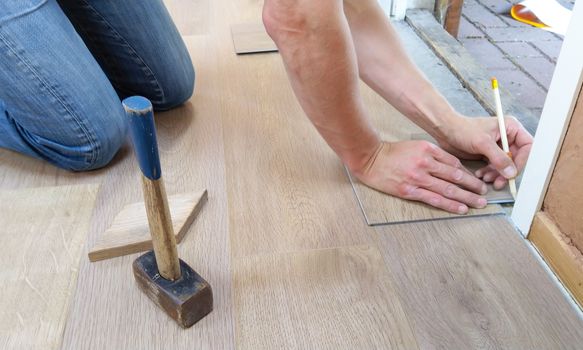
Photo by ClickerHappy on Pexels
Get Found Locally With SEO and Google Ads
Organic SEO and paid search work as a pair. Search engine optimization brings in homeowners researching materials and planning a project months out. Google Ads and Local Services Ads catch the ones who need a floor replaced this month.
Multi-channel advertising is the phrase flooring marketing platforms use to describe combining those channels rather than betting everything on one. For a local flooring company, the practical version looks like this: a service page for each flooring type you install, a Google Business Profile with current photos and accurate hours, and a modest paid budget aimed at your highest-margin work.
Programs marketed as Google Guaranteed leads fall under the Local Services Ads banner and typically place a screened badge next to your business. Confirm current eligibility, screening, and billing rules directly with Google before you build a plan around them, since those programs change.
Social Media and Before-and-After Photos
Flooring contractors who compare notes in community forums consistently mention the same low-cost tactic: post before and after pictures of projects. Flooring is visual work. A homeowner scrolling past a photo of a tired carpeted living room next to a finished oak floor understands your value in one second.
Reviews come up in those same conversations. Ask every satisfied customer for a review, then turn the ask into a habit rather than a favor. Local involvement helps too, including joining your local chamber of commerce, which puts your name in front of business owners who own buildings and know homeowners.
The Main Lead Sources Available to Flooring Contractors
There is no single best source. Each one trades money for time, or time for money. The table below outlines how the main options stack up.
Lead source
How it works
What it costs you
Best for
Organic SEO and content
Service and city pages earn traffic over time
Time plus a marketing budget, slower to produce results
Building a long-term pipeline you own
Google Ads and Local Services Ads
Pay per click or per lead through search
Ad spend plus management fees; verify current program rules with Google
Capturing homeowners ready to buy now
Exclusive lead vendors
Leads sold to one contractor, sometimes AI vetted
Reported rates range from about $13.87 to $33.99 per lead, and $50 to $200 per lead or $200 to $400 per booked appointment with a call center included
Past clients, builders, realtors, and other trades send work
Relationship time and a CRM to track it
Everyone, and usually the lowest cost per job
Those numbers come from lead providers marketing their own services, which means they reflect best cases rather than guarantees. Use them as a starting point for questions, not as a promise. Ask any vendor how its leads are generated, whether a lead is shared with other contractors, what happens when a homeowner does not answer, and what the refund policy says.
Photo by Valentin Ivantsov on Pexels
What Flooring Leads Are Reported to Cost
Lead pricing covers an enormous range because the underlying jobs cover an enormous range. One lead provider reports average revenue from its flooring leads at $5,000 per job, with recent partners closing jobs worth $50,000, $100,000, and even $250,000. Another advertises 30 to 50 leads per month to a flooring business, with campaigns in more than 27 U.S. cities across more than 20 states, and reports an average of $16.74 per lead across 226 leads in 60 days alongside a headline rate of $13.87 per lead.
Exclusive lead sellers commonly quote $50 to $200 per lead, or $200 to $400 per booked appointment when a call center is part of the package. Another provider advertises exclusive, AI-vetted flooring leads at $33.99, sent to one contractor only. The spread itself is useful information. Cheap leads usually mean shared leads, wide geographies, or lower intent. Expensive leads usually mean exclusivity and pre-qualification.
Run the math on your own close rate before you buy anything. If you close one in five leads and each lead costs $100, your cost per signed job is $500 before materials, labor, and overhead. With a $5,000 average job, that works. With a $900 average job, it does not.
Speed to Lead and Follow-Up Discipline
Generating a steady stream of flooring leads requires partnerships, digital marketing, targeted outreach, and a CRM system to manage follow-ups and referrals. That summary from one guide to generating flooring leads captures the operational half of the job. Leads do not turn into estimates on their own.
Habits that keep estimate requests from going cold:
Call within minutes, not hours. A homeowner who requested three quotes often books the first contractor who answers.
Text right after the call so the homeowner has your name in writing.
Log every lead in a CRM with the next follow-up date attached.
Pick a sequence instead of trying everything at once. Contractors who spread themselves thin across five channels usually finish the year with five half-built systems.
Sharpen the offer: free estimates and consultations, stated clearly on every page.
Fix the website so the estimate form is impossible to miss on a phone.
Complete your Google Business Profile and ask every customer for a review.
Post before and after project photos on social media weekly.
Start small paid search or Local Services Ads on your most profitable flooring type.
Test one exclusive lead source with a fixed budget, and measure cost per signed job.
Build referral relationships with builders, realtors, and other trades, and track them in a CRM.
Taken together, those steps move a flooring company from hoping the phone rings to knowing roughly how many estimate requests next month will bring. That predictability is what lets you hire with confidence, schedule materials in advance, and bid on larger work without guessing whether the pipeline can support it.
Frequently Asked Questions
How much do flooring leads cost in 2026?
Reported rates vary widely. Exclusive lead sellers commonly quote $50 to $200 per lead, or $200 to $400 per booked appointment when a call center is included. Other providers advertise rates around $13.87 to $33.99 per lead, with one reporting an average of $16.74 across 226 leads in 60 days. These are vendor figures, so confirm current pricing and refund terms directly with each provider.
Where do flooring contractors find leads?
Common channels include organic SEO, Google Ads, Local Services Ads, project marketplaces such as Houzz Pro, exclusive lead vendors, referrals from builders and realtors, social media posts with before and after photos, and local networking through a chamber of commerce. Reviews support every one of those channels. Most established contractors run two or three sources at once rather than relying on a single channel.
Are exclusive flooring leads better than shared leads?
Exclusive leads go to one contractor only, and some providers describe them as AI vetted. Shared leads reach several contractors at once, which usually means a lower price and a faster race to respond. Exclusivity generally costs more, so weigh the premium against your close rate. Ask how each lead is generated and what the refund policy covers before committing budget.
How many leads should a flooring contractor expect each month?
One provider markets 30 to 50 leads per month to a flooring business, while another reports 226 leads in 60 days. Realistic volume depends on your market size, service area, budget, and how many channels you run. Track your own numbers instead of benchmarking against vendor claims, since a smaller number of high-intent leads often outperforms a large volume of weak ones.
Do free estimates actually generate more flooring leads?
Free estimates and consultations appear on nearly every published list of ways to generate flooring leads, because they remove the risk of a first contact. Homeowners compare two or three bids before committing, so a free measurement and written quote keeps you in the running. Be specific about what the visit includes, and qualify early so free estimates do not eat your week.

 951-249-7500