
 951-249-7500
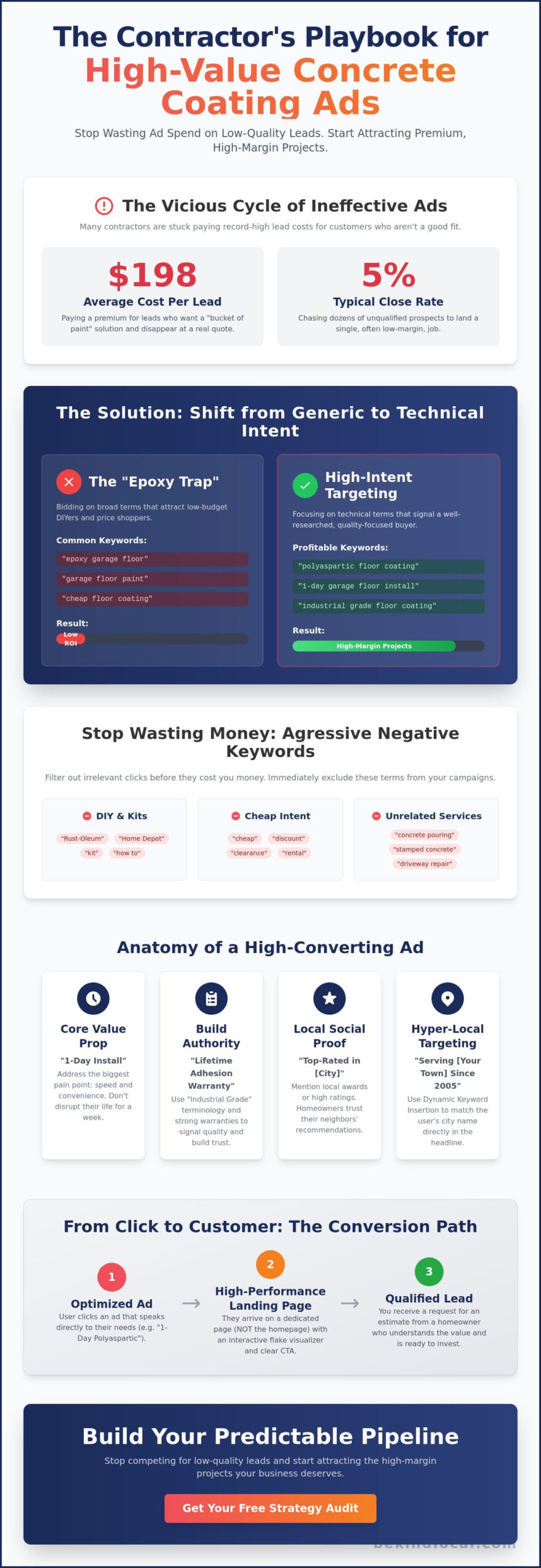
Why are you paying $198 for a lead that thinks a polyaspartic garage floor costs the same as a bucket of gray paint from a big-box store? In 2026, the average cost per lead for contractors has reached record highs, yet many owners still struggle with a 5% close rate because their marketing attracts the wrong crowd. You likely feel the exhaustion of chasing “cheap” leads that disappear the moment they hear a $5,000 quote. It is frustrating to compete with agencies that don’t know the difference between epoxy and polyurea, leaving you to pay for clicks that never turn into high-margin projects.
We believe your expertise deserves a predictable pipeline of customers who value quality over a bargain. This strategic guide to concrete coating ads shows you how to build and scale campaigns that prioritize high-intent polyaspartic and epoxy leads. We will cover how to use technical intent targeting to find homeowners seeking durability, the 2026 shift toward earthy matte finishes, and how to stay compliant with new regulations like California’s AB 1327. You will learn to lower your cost per acquisition by speaking directly to the homeowners who want a premium, 1-day transformation for their space.
Key Takeaways
- Target high-intent buyers by shifting your focus from generic flooring terms to technical polyaspartic and polyurea keywords.
- Build authority in your ad copy using industrial-grade terminology and the “1-Day Install” value proposition to attract serious homeowners.
- Optimize your conversion rate by replacing generic homepages with high-performance landing pages featuring interactive flake chart visualizers.
- Scale your concrete coating ads profitably by targeting high-value neighborhoods and measuring success through customer acquisition costs by project type.
- Navigate regional challenges effectively, using climate-specific messaging and 2026 regulatory updates to stay ahead of local competitors.
The Foundation of Concrete Coating Ads: Technical Keyword Strategy
Winning with concrete coating ads isn’t about appearing for every flooring search. It’s about appearing for the right ones. Many contractors fall into the “epoxy trap” by bidding heavily on broad terms like “epoxy garage floor.” While epoxy accounts for 49.7% of the market share as of 2025, it is also the term most used by DIYers and homeowners looking for a $500 budget fix. If you want to book $5,000 polyaspartic projects, you must stop competing for the same clicks as the local hardware store.
Modern online advertising requires a deep understanding of user intent. Someone searching for “garage floor paint” wants a weekend project. Someone searching for “polyaspartic floor coating” wants a professional, 1-day solution. We help our partners bridge this gap through strategic advertising management that focuses on chemistry over clichés. By shifting your budget toward technical terms, you naturally filter out price shoppers before they ever click your ad.
Segmenting by Coating Chemistry
Polyaspartic and polyurea keywords are the gold standard for high-margin lead generation. These terms signal a buyer who has done their research. They know about UV stability and rapid cure times. By targeting “moisture vapor barrier” or “industrial grade” keywords, you attract technical projects where your expertise justifies a premium price. You aren’t just selling a floor; you are selling a long-term asset. This approach ensures your concrete coating ads reach people who value durability over a low price tag.
Commercial vs. Residential Intent
Don’t ignore the B2B side of the market. The global concrete floor coatings market is projected to reach $1.94 billion in 2026, and a massive portion of that growth comes from the commercial sector. Keywords like “warehouse floor resurfacing” or “anti-slip retail flooring” carry significantly higher ticket values. Bidding strategies for these contracts require patience and higher daily budgets, but the ROI on a single 10,000 square foot showroom usually dwarfs a dozen residential garages. Focusing on “showroom floor coatings” or “commercial kitchen epoxy” allows you to build a diverse, high-value pipeline.
To keep your cost-per-lead under control, you must be aggressive with negative keywords. We recommend excluding the following terms immediately:
- DIY and Kits: “Rust-Oleum,” “Home Depot,” “kit,” “how to,” “do it yourself.”
- Cheap Intent: “Cheap,” “discount,” “clearance,” “rental.”
- Unrelated Services: “Concrete pouring,” “stamped concrete,” “driveway repair.”
By refining your list, you stop wasting money on clicks that will never convert. This technical precision is what separates a struggling campaign from a scaling business.
High-Converting Ad Copy for Specialty Contractors
The most effective concrete coating ads don’t just describe a product; they solve a massive inconvenience. Homeowners in 2026 are busier than ever. They don’t want a three-day construction project that leaves their cars on the street for a week. By leading with a “1-Day Install” value proposition, you immediately address their biggest pain point. This promise of speed, combined with “Industrial Grade” terminology, positions your service as a professional grade alternative to the weak, water-based epoxies found in big-box stores. It creates a clear distinction between a temporary paint job and a permanent flooring solution.
Trust is your highest currency in local service marketing. While a 20-year warranty is standard, offering a “Lifetime Adhesion Warranty” often carries more weight with skeptical buyers. You should also incorporate social proof through “Local Favorite” badges or mentions of being a “Top-Rated Installer” in your specific city. Effective Marketing and sales strategies for contractors rely on this blend of technical authority and local reliability. If you aren’t sure how to balance these elements, you can reach out to our team for a copy audit.
The Anatomy of a High-CTR Ad
To maximize your click-through rate, your headlines must be hyper-local. We use Dynamic Keyword Insertion (DKI) to ensure your ad matches the user’s search exactly, such as “Best Garage Floor Coating in [City Name].” This immediate relevance makes your business feel like the obvious local choice. Your callout extensions should then provide the technical proof: mention that your systems are UV stable, slip-resistant, and antimicrobial. These specific details attract the high-intent leads who are looking for more than just a gray floor; they are looking for a high-performance polyaspartic system.
Ad Extensions that Drive Calls
In the concrete coating industry, visual proof is mandatory. Image extensions allow you to showcase vibrant flake patterns and high-gloss finishes directly in the search results. This stops the scroll and drives higher engagement than text alone. Additionally, location extensions are vital for appearing in the local map pack, which is where most high-intent searches end. We also recommend using price extensions for “Starting at” transparency. While you don’t want to compete on price, giving a ballpark figure helps qualify leads and ensures your concrete coating ads aren’t wasting budget on “cheap” seekers who can’t afford a $5,000 transformation.
Landing Page Architecture: Converting Clicks into Estimates
A click on your concrete coating ads is only half the battle. If you send that high-intent traffic to your homepage, you are likely losing 60% of your potential estimates. Homeowners get distracted by your “About Us” page or your blog posts instead of booking a quote. You need a dedicated landing page that removes all exits and focuses solely on the transformation. This is where you turn a curious browser into a scheduled estimate. Your broader floor coating website design must also act as a technical validation engine that proves your chemical expertise before a prospect even picks up the phone.
High-quality lead generation requires a strategic amount of friction. While most agencies focus on raw lead volume, we prioritize lead quality. Your intake form should ask for specific details like estimated square footage and the project timeframe. This simple step filters out the “just looking” crowd and ensures your sales team spends time on $5,000+ garage projects rather than small repairs. In a market where the average cost per lead has reached $198, you cannot afford to chase unqualified prospects.
Visual engagement is a massive driver for conversion in 2026. Integrating a flake chart visualizer allows homeowners to explore the earthy tones and matte finishes that are currently trending. It makes the project feel real before you even step foot on their property. Since over 80% of local service searches happen on mobile devices, your landing page must be mobile-first and load in under two seconds. A slow site is a dead lead.
Trust Signals and Social Proof
Trust isn’t built with generic claims; it’s built with verifiable proof. Embed your Google Reviews directly so customers see recent, honest feedback from their neighbors. Pair these with a gallery of before and after photos that include specific project descriptions, such as the coating chemistry used and the city location. This level of detail aligns with a cohesive brand strategy that positions you as the local authority rather than just another contractor.
The “Low-Friction” Conversion Path
You must balance ease of use with lead qualification. Use a prominent click-to-call button for mobile users who want an immediate answer. For those not ready to talk, a multi-step form feels less intimidating than a long list of text fields. However, the most critical factor is your speed to lead. Data shows that responding to a prospect within 5 minutes increases the chance of conversion by 900%. If you don’t have a system to handle rapid follow-ups, your ad spend is essentially a donation to the search engines.
Local Targeting: Winning in California, Texas, and Florida
Effective concrete coating ads require more than a simple 50-mile radius around your shop. Success in 2026 depends on hyper-local precision and an understanding of regional pain points. A homeowner in Miami cares about humidity-induced delamination, while a property owner in Indianapolis worries about salt damage and spalling from freeze-thaw cycles. If your ad copy doesn’t reflect these specific environmental stressors, you are essentially throwing away your budget on generic clicks that don’t convert. A comprehensive approach to garage floor marketing in these competitive regions means aligning your technical messaging with the exact concerns homeowners in each climate are searching for.
While Google Search Ads allow for deep technical targeting, you should also leverage Local Services Ads (LSAs) to capture the “near me” market. The “Google Screened” badge provides immediate trust, which is vital as regulations tighten. For instance, in California, as of July 1, 2026, minimum civil penalties for unlicensed activity have started at $1,500. Showing your verified status through LSAs separates you from “trunk-and-trailer” operators who bypass these legal requirements. To truly dominate your market, we recommend pairing these paid efforts with Local SEO to build long-term authority and lower your blended cost-per-lead.
Regional Pain Point Messaging
Your messaging must pivot based on your geography. In Texas and Florida, your ads should highlight UV stability and heat resistance to prevent the “hot tire pickup” that plagues cheap epoxy. Florida contractors must also keep the August 31, 2026, continuing education deadline in mind to stay compliant and maintain their certified status. In California, the focus shifts toward eco-friendly, low-VOC formulations. Mentioning compliance with AB 1327 in your contracts and marketing materials isn’t just about legal safety; it is a signal of professionalism that high-end clients appreciate.
Geo-Fencing High-Value Areas
Don’t treat every zip code equally. We use data to identify and bid aggressively on new construction developments where homeowners are eager for garage upgrades. At the same time, we exclude low-income areas where the $5,000+ price point for a polyaspartic system is a barrier. This ensures your concrete coating ads only appear for people who can actually afford your services. By focusing your spend on metro hubs and affluent suburbs, you protect your margins and keep your sales team busy with qualified estimates. If you want to see how we map out high-value territories for our partners, schedule a territory analysis with us.
Measuring ROI: Beyond the Cost-Per-Lead
If you only track your cost-per-lead, you are missing the most important part of the story. In 2025, the average cost per lead for contractors sat around $145, and projections for 2026 show these costs continuing to rise alongside a global average of $198 across all industries. However, a lead that costs $80 but never picks up the phone is infinitely more expensive than a $200 lead that closes a $6,000 polyaspartic garage floor project. Successful concrete coating ads focus on the quality of the conversation, not just the volume of the clicks.
To truly understand your profitability, you must calculate your Customer Acquisition Cost (CAC) by coating type. You will likely find that while polyaspartic leads require a higher initial ad spend, their 1-day turnaround and higher average job value result in a much healthier margin. This level of insight is only possible through Professional Advertising Management that looks past the Google Ads dashboard and into your actual revenue. We believe in being partners in your growth, which means we care more about your bank account than your click-through rate.
CRM Integration and Lead Tracking
You can’t manage what you don’t measure. Connecting your ad account to a CRM like Jobber is the only way to see which specific ad groups are driving your highest-paying jobs. When you record calls and attribute revenue back to the original search term, you gain the power to stop wasting money on “cheap epoxy” searches and double down on high-intent technical terms. This data-driven approach is essential when the average close rate for home improvement leads is only 5%. Every piece of data helps you refine your sales process and improve that ratio.
Scaling Your Coating Business
Once your garage floor campaigns are profitable, it’s time to look at the broader market. The global concrete floor coatings market is expected to hit $1.94 billion in 2026, driven by a 7.7% compound annual growth rate. You can capture this growth by expanding your concrete coating ads to target patios, pool decks, and commercial kitchens during seasonal peaks. Scaling isn’t just about spending more; it’s about knowing when to push your budget into high-value neighborhoods and when to optimize for better lead quality.
Your business deserves a marketing strategy that is as durable and high-quality as the floors you install. We are here to help you navigate the complexities of local growth with honesty and expertise. If you’re ready to stop chasing raw volume and start building a predictable pipeline of high-margin projects, the next step is simple. Schedule a Discovery Call with Be Kind Local today and let’s discuss how we can grow your community presence together.
Take Control of Your Local Market and Scale Your Business
Building a sustainable flooring business in 2026 requires moving away from generic marketing tactics. We’ve explored how technical keyword precision and localized landing pages transform casual clicks into high-ticket estimates. By focusing your concrete coating ads on high-margin polyaspartic and epoxy systems rather than cheap DIY alternatives, you protect both your time and your bottom line. Success isn’t about the number of leads in your inbox; it’s about the quality of the projects on your schedule.
Our team specializes in the specific nuances of lead generation for this industry. We bring deep expertise in high-competition markets like Texas, Florida, and California, where regional pain points and regulations demand a strategic partner. We don’t just send you traffic; we help you build a predictable pipeline of customers who truly value your craftsmanship. Let’s shift your focus from raw volume to meaningful growth and job profitability.
Ready to dominate your local market? Schedule a discovery call with Be Kind Local today.
We look forward to helping you grow with heart and strategy.
Frequently Asked Questions
How much should a concrete coating contractor spend on Google Ads?
A monthly budget of $2,500 to $4,000 is a standard starting point for contractors in mid-sized markets. This allows your concrete coating ads to generate enough data for Google’s algorithm to optimize for high-margin projects. Smaller budgets often struggle to compete with the 2026 global average cost-per-lead of $198, making it difficult to maintain a consistent installation schedule.
What is the average cost-per-lead for epoxy floor ads in 2026?
The average cost-per-lead for home improvement services in 2026 is approximately $198, a significant increase from the $145 average seen in 2025. While third-party lead aggregators might offer lower upfront prices, those leads are often shared with multiple competitors. Investing in exclusive campaigns typically results in a more manageable $2,900 customer acquisition cost for high-end flooring projects.
Should I target “epoxy” or “polyaspartic” in my ad headlines?
You should use “polyaspartic” or “1-day coating” to attract high-intent buyers who value durability and speed. While “epoxy” has a higher search volume, it often pulls in budget-conscious homeowners looking for cheap garage paint. Segmenting your headlines ensures you are speaking to the 44.8% of the market that prioritizes professional-grade materials over big-box store alternatives.
How do I stop getting leads for DIY floor kits?
The most effective strategy is to build a robust negative keyword list that excludes brands like Rust-Oleum or terms like “Home Depot” and “DIY.” You should also use “Professional Installation Only” in your ad copy. This filters out the crowd looking for a $500 weekend project and saves your budget for the $5,000 transformations you actually want to book.
Are Facebook Ads or Google Ads better for garage floor coatings?
Google Ads are typically better for immediate lead generation because they capture people actively searching for a solution. Facebook is a powerful tool for visual retargeting, especially when showcasing the earthy terracotta and sand tones trending in 2026. For a predictable pipeline, start with Google to capture intent and use Facebook to stay in front of prospects who haven’t yet booked an estimate.
What is a good conversion rate for a concrete coating landing page?
A high-performing landing page should convert between 15% and 25% of its traffic into qualified leads. If your page is converting below 10%, you likely have too much “fluff” or a slow mobile load time. Integrating a CRM like Jobber allows you to track these conversions in real-time, ensuring you can attribute every dollar of revenue back to the specific ad that generated the click.
How long does it take to see results from a new ad campaign?
You will usually see your first leads within 72 hours, but it takes about 60 days for a campaign to reach peak efficiency. This window allows the algorithm to adjust to regional factors, such as Florida’s August 31 renewal deadlines or California’s AB 1327 contract requirements. Patience during this initial phase is what allows you to build a long-term, profitable presence in your local market.