
 951-249-7500
In 2026, chasing high search volume is the fastest way to drain your marketing budget without ever seeing a real return. You’ve likely felt the frustration of paying for generic home service keywords only to have your phone ring with DIYers asking for advice rather than a professional quote. It’s exhausting to watch your hard-earned ad spend disappear on broad terms like “garage floor ideas” when you’re actually trying to sell a premium polyaspartic system or a custom walk-in closet.
We understand that for a specialty contractor, the only metric that truly matters is searcher urgency mapped to technical solutions. This guide will show you how to pivot from chasing raw traffic to capturing high-intent leads that actually value your specific expertise and craftsmanship. We’ll explore how to dominate the local Map Pack by targeting specialized terms like slatwall systems and reach-in closet designs that signal a customer is ready to sign a contract. You’ll learn how to build a predictable pipeline of qualified leads by focusing on quality over quantity.
Key Takeaways
- Identify the specific buyer intent signals that distinguish high-ticket clients from budget-conscious DIY researchers.
- Master the use of high-intent home service keywords to stop wasting ad spend on broad, generic terms.
- Leverage the “Service + City” framework and Google Business Profile optimization to dominate your local Map Pack.
- Target technical keyword clusters like polyaspartic systems and custom pantry designs to attract leads who value quality craftsmanship.
- Learn how to integrate strategic keywords into your landing pages to turn organic traffic into a predictable pipeline of qualified leads.
Why Home Service Keywords are the Foundation of Contractor Growth in 2026
Think of home service keywords as the digital bridge connecting a homeowner’s specific frustration to your professional solution. In the past, ranking for broad, generic terms was enough to keep the phone ringing. In 2026, search behavior has shifted toward extreme precision. Homeowners no longer just look for “contractors”; they search for the exact technical result they want to see in their living spaces. This change means your keyword strategy must evolve from chasing raw traffic volume to mapping specific terms directly to your revenue goals.
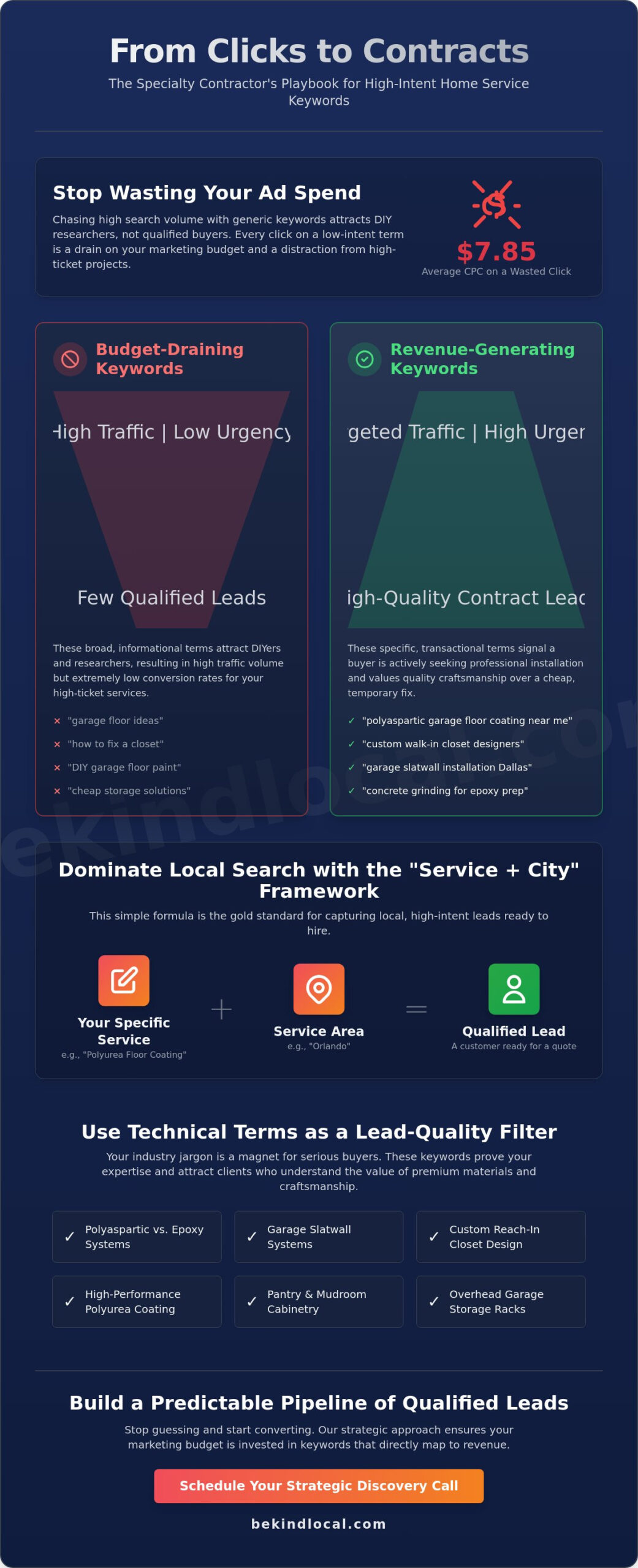
For specialty contractors in the floor coating or custom closet industries, the cost of a marketing mistake is high. The average cost per click in the home improvement category has risen to approximately $7.85 according to 2026 Google Ads data. Wasting that budget on “DIY garage floor paint” instead of “industrial grade polyaspartic coating” is a recipe for a thin profit margin. Understanding Keyword advertising fundamentals allows you to filter out the noise and focus on the high-intent queries that actually drive growth for your business. Success today requires a “keyword-to-revenue” map that ensures every click has the potential to become a high-ticket contract.
The Evolution of Search: From Keywords to Intent
AI and Large Language Models have fundamentally changed how your customers describe their problems. They aren’t just typing short phrases; they’re conversing with their devices. A term like “garage flooring” is just a keyword that often leads to window shoppers. However, a query like “polyaspartic garage floor coating near me” is a high-intent lead ready for a quote. Capturing these specific moments requires a sophisticated approach to Local SEO. It’s about being visible exactly when a homeowner decides their cracked concrete or disorganized garage is no longer acceptable.
Why Specialty Contractors Need a Different Strategy
Your business doesn’t operate like an emergency plumbing service. People don’t search for a custom walk-in closet in a panic at 2 AM. High-ticket services like garage remodeling or pantry design involve a longer, education-based sales funnel. You need a home service keywords strategy that builds authority over time. By targeting technical terms like slatwall systems or reach-in closet layouts, you establish a clear Brand Strategy. This positions you as the expert long before the customer ever picks up the phone. You aren’t just a vendor; you’re the specialist who understands the nuances between a standard epoxy and a high-performance polyurea system.
High-Intent vs. Informational Keywords: Identifying Real Buyer Signals
Not all home service keywords are created equal. Understanding search intent is the difference between a phone that stays silent and a predictable stream of high-ticket leads. Search intent generally falls into four categories: informational, navigational, commercial, and transactional. While a homeowner searching for “how to fix a closet” has informational intent, they aren’t looking to hire a professional. For specialty contractors, the goal is to capture commercial and transactional intent, where the user is comparing professional options or ready to book a consultation. A solid Beginner’s Guide to SEO often covers these basics, but in the world of luxury garage and closet remodels, the stakes are much higher.
Keywords like “DIY” and “cheap” are the ultimate budget killers for premium floor coating and closet businesses. If your business specializes in high-end polyurea systems or custom walk-in suites, you don’t want to pay for clicks from people looking for a temporary fix. Using technical terminology acts as a natural filter. Terms like “polyaspartic coating,” “reach-in closet systems,” and “concrete grinding” naturally attract a more sophisticated buyer. These searchers already understand that quality comes with a price, and they’re looking for the specialist who can deliver it.
Spotting the ‘Ready to Hire’ Keywords
The “service + city” framework remains the gold standard for local lead generation. There’s a massive gap between “garage storage ideas” and “garage slatwall installation Dallas.” The former is a researcher; the latter is a buyer. In competitive markets like Orlando or Dallas, ranking for “best custom closet companies” is incredibly valuable because it signals the user is at the final stage of their decision-making process. If you want to see immediate results while building your organic presence, using targeted Advertising is an excellent way to test which keywords actually convert into phone calls before you commit to a long-term SEO campaign.
The Danger of Vanity Metrics in Keyword Research
Traffic volume is a vanity metric that can lead you astray. It’s much better to have 5 visits from people searching for a “custom pantry designer” than 100 visits for “pantry organization tips.” One drives revenue; the other just inflates your analytics. To keep your marketing efficient, you must master the use of negative keywords. Negative keywords are specific terms you exclude from your campaigns to prevent your ads from appearing for irrelevant searches like “wholesale,” “used,” or “free.”
Focusing on intent over volume ensures that every dollar you spend is an investment in a qualified lead. If you’re tired of sorting through low-quality inquiries, we can help you identify the specific buyer signals that will move the needle for your business.
The Anatomy of Local Search Intent for Specialty Contractors
Local intent is the lifeblood of a specialty contractor’s digital presence. While broad home service keywords provide a glimpse into what people want, adding a geographic modifier tells you exactly where they are in the buying process. The “Service + City” framework is the gold standard for lead generation because it bridges the gap between a general interest and a localized need. If a homeowner in Tampa searches for “garage slatwall systems,” they might just be browsing. If they search for “garage slatwall installation Tampa,” they’re looking for a partner to start a project.
In states like Florida and California, the competition is fierce. With 79% of homeowners planning a repair or replacement in 2026 according to recent industry projections, being visible in your specific service area is non-negotiable. Effective local targeting means understanding that a homeowner in a high-end neighborhood like Buckhead has different expectations than someone in the broader Atlanta area. This geographic precision allows you to tailor your message to the specific needs and aesthetics of that community. It’s also vital to stay compliant with local regulations, such as the 2026 California law requiring contractors to provide an email address for contract cancellations; showing this level of transparency in your local presence builds immediate trust.
Mastering the Local Map Pack
Your Google Business Profile (GBP) is often the first touchpoint a potential lead has with your brand. To rank in the Map Pack, your profile must be optimized with technical terms like “polyaspartic garage floor coating” or “custom walk-in closet design.” This isn’t just about keywords; it’s about providing Google with the context it needs to trust your business as a specialist. High-quality Web Design that includes localized landing pages reinforces this authority by giving searchers exactly what they asked for in their specific city. Consistent signals from Social Media Marketing help prove that your business is an active, trusted member of the local community, which further boosts your visibility for home service keywords in your target area.
Geographic Targeting Strategy
A successful strategy requires more than just targeting a single city. Large markets require a granular approach where you target specific neighborhoods and suburbs. This is especially true for high-ticket services where your ideal client lives in specific zip codes. Managing this across multiple locations, whether in Texas or North Carolina, requires absolute NAP (Name, Address, Phone) consistency. Any discrepancy in your contact information across the web can confuse search engines and erode the trust you’ve built. By focusing on hyper-local intent, you ensure that you aren’t just getting traffic, but you’re getting the right traffic from people you can actually serve.
Building a Keyword Map for Niche Services: Closets, Garage, and Flooring
Mapping your home service keywords to specific technical solutions is how you stop competing on price and start competing on expertise. You need to group your terms into clusters that reflect how homeowners actually think about their spaces. This isn’t just about a list of words; it’s about understanding the buyer’s journey from their first inspiration to the final decision to hire a professional installer. When you align your content with these specific clusters, you guide a prospect naturally from “I have a problem” to “You are the specialist I need.”
The Floor Coating Keyword Blueprint
Epoxy is the term everyone knows, but it’s often a catch-all for low-budget DIYers. If you want the high-ticket leads, you must target technical clusters like polyurea, polyaspartic, and concrete grinding. A comparison guide targeting ‘polyaspartic vs epoxy’ serves as a high-authority content opportunity that educates the buyer while filtering for those seeking a premium, long-lasting solution. When homeowners search for “garage floor coating cost,” they’ve moved past the “is this possible” phase and into the evaluation phase. This is where your chip system and industrial-grade coating expertise needs to be front and center to capture their interest.
Custom Closets and Luxury Organization Keywords
For the closet industry, the search journey often starts with visual inspiration. Keywords like “walk-in closet ideas” are perfect for Social Media Marketing and Pinterest-driven search, capturing homeowners in the awareness phase. As they move closer to a purchase, they’ll use terms like “custom pantry designer” or “reach-in closet installation.” Don’t overlook secondary spaces like mudrooms, home offices, and laundry rooms. These often serve as entry-level projects that lead to larger, whole-home organization contracts. Focusing on “design” and “installation” keywords ensures you’re reaching people who want a professional result, not just a weekend project.
Garage Remodeling and Storage Keywords
The garage has evolved into a specialized storage zone. Using “garage cabinet installers” helps you find high-intent residential leads who are ready to invest in quality. Terms like “garage slatwall” and “overhead storage” are excellent entry-level service keywords that solve immediate organization pain points. While “garage makeover” is a broad search term, it holds high value because it signals a homeowner is ready for a complete transformation rather than a small fix. By targeting these specific home service keywords, you position your brand as the authority in total garage optimization.
Building a precise keyword map is the first step toward a predictable pipeline of high-value work. If you’re ready to stop guessing and start targeting the technical terms that drive real revenue, schedule a discovery call with our team to see how we can align your strategy with your growth goals.
Turning Keyword Strategy into Qualified Lead Generation
Selecting the right terms is only half the battle. To see a real return on your investment, you must weave your home service keywords into a website that converts. Many contractors make the mistake of treating SEO as a “set-it-and-forget-it” task, but search engines and buyer behaviors are constantly evolving. In 2026, simply ranking on page one isn’t enough; your digital presence must prove that you’re the most reliable, high-quality option in your local market. This requires a shift from chasing raw traffic to building a system that captures and nurtures qualified leads.
Measuring success should never be about vanity metrics like total impressions or keyword rankings. For a specialty contractor, the only numbers that matter are form submissions and recorded phone calls from high-intent buyers. A generic SEO vendor might celebrate a rise in traffic for “cool garage ideas,” but a strategic partner knows that traffic is worthless if it doesn’t lead to a signed contract for a polyaspartic floor or a custom mudroom. You need to track how your chosen keywords move the needle on your actual revenue.
Conversion-Focused Content Integration
Natural integration is the key to maintaining a professional brand image. Your H1 and H2 headings should speak to both Google’s crawlers and the human reader’s pain points. Instead of a generic “Our Services” header, use a specific, keyword-rich statement like “Custom Walk-In Closet Design and Installation in [City].” This provides immediate clarity for the visitor. Your call-to-action (CTA) buttons are also prime real estate for keywords. A button that says “Get Your Free Floor Coating Quote” is far more effective than a simple “Submit” or “Contact Us.” To build deeper trust, ensure your content aligns with a broader Home Service Brand Strategy that emphasizes quality over low-cost shortcuts. This technical authority is reinforced through smart Web Design that prioritizes the user experience on every landing page.
Next Steps for Your Business Growth
The first step toward dominating your market is performing a basic keyword audit on your current site. Look at your analytics and identify the top 5 “money keywords” that your competitors are ranking for, but you aren’t. These are often technical terms like “garage slatwall systems” or “reach-in closet organizers” that signal a ready-to-buy customer. In an era where over half of home service businesses use AI for quoting and invoicing, your marketing must remain grounded in ethical, no-fluff communication. People value honesty and local expertise more than ever. If you’re ready to stop wasting budget on generic home service keywords and start building a predictable pipeline, schedule a discovery call with Be Kind Local today. Let’s turn your technical skill into the local authority it deserves to be.
Dominate Your Local Market with Precision Search Intent
Success in the floor coating and custom closet industries requires more than just showing up; it requires being found by the right people at the right time. You’ve learned that volume is a vanity metric and that true growth comes from mapping technical home service keywords to high-intent buyer signals. By focusing on specialized terms like polyaspartic systems and reach-in closet designs, you filter out the noise and attract clients who value your craftsmanship. This strategic approach ensures your marketing budget is an investment in revenue, not just an expense for clicks.
At Be Kind Local, we don’t just generate traffic. We build predictable pipelines for specialty contractors by prioritizing lead quality over raw numbers. Our team of local SEO experts serves businesses across Texas, Florida, California, and beyond with a deep understanding of the flooring and organization niches. We’re ready to help you turn your digital presence into a high-performing asset that reflects the integrity of your work. Your expertise deserves to be seen by the homeowners who are ready to invest in quality.
Schedule your discovery call at bekindlocal.com to start capturing the leads your business deserves. Let’s grow your local authority together.
Frequently Asked Questions
What are the best keywords for a floor coating business in 2026?
The most effective terms today focus on technical superiority and specific results. You should prioritize phrases like “polyaspartic garage floor coating,” “concrete grinding and sealing,” and “garage floor chip systems.” These terms attract homeowners who are looking for a long-term professional solution rather than a temporary DIY fix. By targeting these specific technical terms, you naturally filter out low-budget leads and connect with people who value high-quality craftsmanship.
How do I find local home service keywords for my specific city?
Start with the “service + city” framework to capture immediate local intent. You can also look at your Google Business Profile insights to see the exact phrases neighbors use to find your business. Don’t forget to include specific neighborhood names or regional modifiers, especially in large markets. This hyper-local approach helps you dominate the Map Pack and ensures you’re reaching people within your actual service radius.
Should I target ‘epoxy’ if I only install polyaspartic floor coatings?
Yes, you should target “epoxy” but use it as an educational hook. Most homeowners use “epoxy” as a catch-all term when they first start their research. By ranking for “epoxy garage floors,” you get the opportunity to explain why your polyaspartic or polyurea system is the better investment for their home. This strategy allows you to capture a wider audience and then pivot them toward your premium, high-ticket services.
How many keywords should I target on a single service page?
Focus on one primary phrase and three to five closely related secondary terms per page. For example, a page about custom closets might target “walk-in closet design” as the main term, with “reach-in closets” and “closet installation” as supporting keywords. This structure helps Google understand your topical authority without making the content feel cluttered. It’s better to rank highly for a few relevant home service keywords than to rank poorly for dozens of unrelated ones.
What is the difference between short-tail and long-tail home service keywords?
Short-tail keywords are broad, high-volume terms like “closets” or “flooring” that often bring in window shoppers. Long-tail keywords are longer, more specific phrases like “custom walk-in closet designer in Dallas.” While long-tail terms have lower search volume, they carry much higher buyer intent. For specialty contractors, these specific phrases are the key to generating qualified leads who are ready to sign a contract for a professional project.
Can I use the same keywords for Google Ads and SEO?
You definitely should use the same terms across both strategies to create a cohesive digital presence. Google Ads is a fantastic way to test which home service keywords actually convert into phone calls and form submissions. Once you identify the high-performing “money keywords” through your paid campaigns, you can prioritize those same terms in your long-term SEO and content strategy. This data-driven approach removes the guesswork from your marketing budget.
How long does it take to rank for high-competition keywords like ‘custom closets’?
Ranking for highly competitive terms typically takes four to nine months of consistent effort. The exact timeline depends on your current website authority, the quality of your content, and how aggressive your local competitors are. It’s not a set-it-and-forget-it process; it requires ongoing optimization and local signal building. We focus on building a foundation of authority that delivers sustainable growth rather than chasing quick, temporary wins.
Why is search intent more important than search volume for contractors?
Search volume is a vanity metric that doesn’t always translate to revenue. A thousand people searching for “closet organization tips” might not result in a single sale, but ten people searching for “custom pantry installation” are likely ready to hire. For high-ticket specialty contractors, intent is everything. You want to reach the person who has a specific problem and is actively looking for a professional specialist to solve it today.