
 951-249-7500
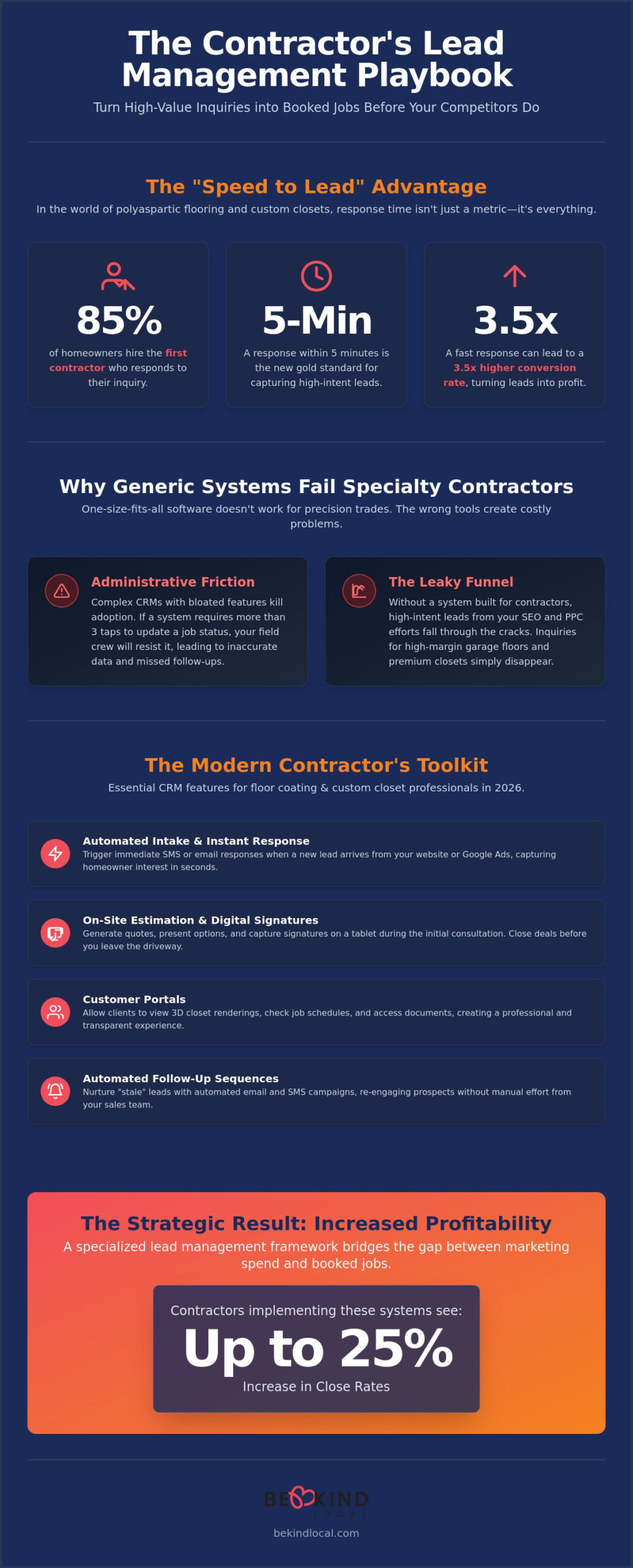
Did you know that 85% of homeowners hire the first contractor who responds to their inquiry? In the high-stakes world of polyaspartic floor coatings and custom walk-in closets, waiting even an hour to call back a prospect is essentially handing your profit to a competitor. Strategic lead management for contractors isn’t just about keeping a digital list of names. It’s the critical infrastructure that ensures your hard-earned SEO and PPC leads don’t fall through the cracks. When a 5-minute response time can lead to a 3.5x higher conversion rate, your speed to lead becomes your strongest competitive advantage.
It’s painful to watch a high-margin garage floor lead or a premium reach-in closet project vanish because of a missed notification or poor communication between your sales rep and the install crew. You’ve built your business on quality craftsmanship, and your systems should reflect that same level of care. This guide reveals the exact lead management frameworks and CRM tools that specialty trades are using in 2026 to increase close rates by up to 25%. We’ll explore how to automate your follow-ups, track which marketing channels drive actual revenue, and use job-site documentation to build lasting trust with your local community.
Key Takeaways
- Understand why “speed to lead” is the decisive factor in winning high-ticket projects and how to automate your first response.
- Explore leading CRM platforms for 2026 to find the ideal solution for your floor coating or closet business.
- Implement a strategic framework for lead management for contractors that bridges the gap between your marketing spend and booked jobs.
- Learn the essential two-step process for auditing your current workflow and cleaning your data before migrating to a new system.
- Discover how to use lead data to refine your brand strategy and focus your budget on the highest-intent flooring and closet inquiries.
Why Generic Lead Management Fails Specialty Contractors
Your business relies on precision. Whether you are applying a multi-layer polyurea coating or designing a custom reach-in closet, your success depends on getting the details right. Why should your sales process be any different? Many contractors treat their inquiries like a simple list of names, but that is a recipe for missed opportunities. To truly grow, you need to understand What is Lead Management? at its core. It is the intentional process of capturing, tracking, and nurturing prospects from the very first click on your website to the moment you send the final invoice. Without a framework for lead management for contractors, your marketing spend often turns into a guessing game.
The most common mistake is choosing a CRM that was built for a tech company rather than a field service business. Large platforms like Salesforce often create “Administrative Friction.” A five-person epoxy crew doesn’t have time to navigate twenty different screens just to update a job status. When a system is too complex, your team will simply stop using it. This leads to “Leaky Funnels,” where high-intent inquiries disappear because of slow follow-up or forgotten emails. By 2026, the industry has shifted away from basic contact lists. Successful specialty trades now use automated field service management to keep their pipelines moving without manual intervention.
The Cost of Complexity in Field Operations
If a system requires more than three taps to update, your crew will resist it. Feature bloat is a silent profit killer in the garage remodeling world. You don’t need complex forecasting tools; you need a way to see who needs a quote today. Mobile-first design is a non-negotiable requirement for on-site closet design consultations. Your reps should be able to upload photos of a pantry or mudroom and get a digital signature before they even leave the driveway. Simplicity is what actually drives adoption in the field.
Bridging the Gap Between Marketing and the Install Van
Connecting your Local SEO efforts to real-world revenue is the only way to justify your marketing budget. A specialized CRM proves which specific keywords drive the most profitable polyaspartic flooring jobs. Instead of wondering if your ads are working, you can see the direct line from a search term to a completed installation. This data also ends the “he said, she said” conflicts between sales reps and installation teams. When every detail is documented in one shared space, your crew arrives at the job site knowing exactly what the customer expects, protecting your reputation and your margins.
Essential CRM Features for Floor Coating and Custom Closet Pros
To win in the specialty trade market, your tools must match your craft. A generic CRM might handle basic contacts, but it won’t manage the nuances of a custom closet install or a multi-day epoxy job. Proper lead management for contractors requires features that bridge the gap between a digital inquiry and a signed contract on the job site. It’s about creating a seamless experience for the homeowner while keeping your backend operations lean. When your systems are tailored to your niche, you stop fighting with software and start focusing on the project at hand.
Automated intake is the starting point. When a lead comes from a Google Local Services Ad or a website form, it shouldn’t sit in an inbox for hours. It should trigger an immediate response. For high-ticket concrete coating contracts, having on-site estimation tools with digital signatures is a game changer. It allows you to close the deal while the homeowner is still excited about their new garage floor. Custom closet designers need more than just a calendar; they need customer portals where homeowners can view 3D renderings of their walk-in, reach-in, or pantry designs. If a lead goes quiet, automated SMS and email sequences can breathe life back into “stale” prospects without you lifting a finger. Integrating these systems with review management also ensures that every happy customer fuels your Google Business Profile rankings. Following effective lead management tips like these ensures your sales pipeline remains healthy and predictable.
Lead Nurturing: The “Speed to Lead” Advantage
The 5-minute rule isn’t just a suggestion. Research shows that 85% of homeowners hire the first contractor who responds to them. Speed to Lead is the specific metric that determines your conversion rate more than your final price. For garage storage prospects, automated SMS often converts better than email because it cuts through the digital noise. It’s the most direct way to build a personal connection before a competitor even sees the notification.
Technical Execution: Managing Specialized Inventory
Your CRM should handle the heavy lifting of your daily operations. This includes tracking polyurea and polyaspartic resin inventory across multiple crews to prevent last-minute shortages. Job-site photo uploads are essential for quality control and provide the “Before & After” social proof that wins future jobs. Within each project file, you should be able to manage specific hardware like garage slatwall and overhead storage. If you aren’t sure which features your business needs most, it’s helpful to discuss your specific workflow with a partner who understands the trade.
Top CRM Recommendations for Specialty Contractors in 2026
Selecting the right platform for lead management for contractors is a decision that impacts every part of your business, from your marketing ROI to your crew’s daily morale. The best software isn’t necessarily the one with the most features; it’s the one your team will actually use without constant friction. In the specialty trades, you generally have to choose between All-in-One platforms that handle everything from payroll to lead intake, or Best-of-Breed stacks where you connect specialized tools together to create a custom workflow. For a 5-person epoxy crew, the goal is simplicity. For a multi-location closet franchise, the goal is deep data integration that tracks every touchpoint of a long sales cycle.
Jobber and Buildertrend are the dominant players for contractors in 2026. While Buildertrend offers robust features for larger remodeling teams aiming for millions in revenue, Jobber remains a favorite for garage remodelers who need a streamlined way to get quotes out quickly. For high-end custom closet designers who manage premium walk-in projects with multiple design revisions, Pipedrive is often used as a Best-of-Breed sales tool. It allows you to visualize your pipeline and move high-ticket leads forward with precision. If your focus is purely on aggressive lead generation and automated nurturing, your requirements will look very different.
Jobber: The Leader in Field Efficiency
Jobber is particularly effective for crews of 1 to 10 people because it prioritizes field efficiency over complex administrative tasks. Its interface is clean and works intuitively on mobile devices, which is essential when your team is on-site at a floor coating job. The Grow plan, priced at approximately $349 per month, is usually the sweet spot for specialty contractors. It includes automated quote follow-ups and two-way text messaging to keep homeowners engaged throughout the process. Key integrations with QuickBooks and Google Ads platforms allow you to see which specific marketing efforts are turning into paid invoices. It’s a practical, reliable choice for businesses that want to professionalize their operations without a steep learning curve.
GoHighLevel: The Marketing Powerhouse
When aggressive growth is your primary focus, GoHighLevel is the preferred choice for many specialty trades. It handles complex automation for multi-step closet design funnels, ensuring every pantry or mudroom inquiry is nurtured through SMS and email. At Be Kind Local, we often recommend this platform for clients who want to scale their lead volume while maintaining a high-touch feel. Its reputation management features directly boost your Local SEO rankings by automating review requests as soon as a project is completed. This platform turns your lead management for contractors into a predictable engine that feeds your installation teams month after month.
How to Implement Lead Management Without Breaking Your Workflow
Implementation is often where good intentions go to die. Moving your business from a whiteboard or a messy spreadsheet to a structured system for lead management for contractors requires more than just a credit card and a login. It’s a cultural shift that starts with your leadership and ends with your lead installer. If you try to force a complex system onto a team that’s already stretched thin, they’ll find ways to bypass it. The key is to introduce changes in stages that provide immediate value to everyone involved.
Your first step is to audit your manual process. Don’t digitize a broken system. If your current method for tracking a walk-in closet inquiry is hoping the sales rep remembers to call, no software will fix that. Map out every touchpoint from the first click to the final payment. Once your workflow is clear, clean your data. Remove dead leads before importing into a new CRM. You should also set up Trigger Events so your software does the heavy lifting. For example; when a job is marked as Measure Complete for a mudroom project, an automated email should notify the homeowner of the next steps in the design phase.
Finally, you must connect your CRM to your Advertising dashboard. This visibility is the only way to know if your Google Ads are actually driving high-margin polyaspartic flooring jobs or just filling your inbox with tire-kickers. If you want to see how these systems can work together for your specific trade, you can schedule a workflow audit with our team.
Data Integrity: Garbage In, Garbage Out
Precision in your data allows for precision in your marketing. Categorize every lead by service type, distinguishing between epoxy flooring, polyaspartic systems, and garage slatwall projects. This level of detail lets you track your true Customer Acquisition Cost (CAC) for each niche. Use Tagging to organize your database for seasonal re-marketing. A customer who bought a reach-in closet in the fall might be the perfect candidate for a pantry upgrade during a spring cleaning campaign. Without tags, you’re just guessing who to email.
The 30-Day Crew Adoption Plan
Overcoming old school resistance requires showing, not just telling. Your installers might see digital job tracking as a burden. Show them how job-site documentation, like uploading high-quality photos, actually protects them from false damage claims and makes their work look professional. Incentivize the behavior by rewarding the crew that captures the best social proof each month. In the office, set clear KPIs for lead response times. When everyone understands that a 5-minute response is the standard, the entire culture of the business shifts toward growth.
Scaling Beyond Software: The Be Kind Local Strategic Advantage
A CRM is a powerful tool, but it’s essentially a hollow shell without a consistent influx of high-intent leads. Many contractors invest thousands in software only to find they’ve merely digitized their own inefficiency. True scale happens when you stop viewing software as a standalone solution and start seeing it as the foundation of your growth. Effective lead management for contractors isn’t just about organizing contacts; it’s about using that organization to inform every marketing dollar you spend. If your system isn’t telling you which leads are actually profitable, it isn’t doing its job.
When you partner with Be Kind Local, we don’t just look at how many people clicked your ads. We dive into your CRM data to see which of those clicks turned into a five-figure polyaspartic flooring job or a premium walk-in closet installation. This data-driven approach allows us to refine your home service brand strategy based on real-world outcomes rather than vanity metrics. We move beyond the role of a typical vendor to become a strategic partner. By identifying the specific traits of your highest-margin customers, we help you lower your cost-per-lead by focusing your budget on the prospects who actually convert.
Closing the Loop: Turning Lead Data into Marketing Fuel
The real magic happens when we close the feedback loop between your field operations and your marketing campaigns. By analyzing your “Closed-Won” data, we can identify patterns that improve your Google Ads targeting for high-ticket projects. If we see that your most profitable pantry and mudroom installs are clustered in specific zip codes, we shift your Local SEO focus to dominate those neighborhoods. Your CRM also holds valuable customer feedback that we can use to tweak your website’s messaging. This ensures your conversion rates continue to climb as your brand authority grows in your local market.
Next Steps: Ready to Dominate Your Local Market?
There’s a massive difference between “buying leads” from a generic aggregator and building a sustainable, local brand that homeowners trust. One is a temporary fix; the other is a long-term asset. Be Kind Local integrates directly with your lead management for contractors workflow to ensure every inquiry is captured, nurtured, and measured. We help you build a business that doesn’t just survive on the next lead but thrives on a reputation for excellence and professional communication. If you’re ready to stop losing leads and start closing more high-margin contracts, schedule your strategic discovery call with Be Kind Local today.
Mastering Your Pipeline for Long-Term Growth
Success in the specialty trades comes down to more than just a flawless polyaspartic finish or a perfectly installed walk-in closet. It’s about the systems that support your craftsmanship. By implementing a structured approach to lead management for contractors, you’re doing more than just organizing contacts; you’re building a foundation for predictable growth. You now understand that speed to lead is your greatest competitive advantage and that the right CRM is the bridge between a click and a signed contract. These aren’t just technical upgrades. They’re the tools that let you reclaim your time and focus on the quality of your work.
At Be Kind Local, we specialize in floor coating and custom closet marketing because we believe in the power of local craftsmanship. We don’t offer generic, fluff-filled growth plans. Instead, we provide strategic, data-driven roadmaps designed for 2026 and beyond. Our focus is always on lead quality and conversion ROI, ensuring that every dollar you spend on marketing works as hard as your crews do in the field. You don’t have to navigate this digital landscape alone. Ready to scale your specialty contracting business? Schedule a Discovery Call with Be Kind Local. We’re here to help you turn your vision into a sustainable, high-margin reality.
Frequently Asked Questions
What is the best CRM for a one-man floor coating business?
Jobber is often the best choice for solo operators in the epoxy and polyurea flooring space. It’s designed for field efficiency and allows you to send quotes, schedule jobs, and process payments directly from your phone. Since you’re managing everything yourself, you need a tool that reduces administrative friction rather than adding complex layers you’ll never use.
Can I use a free CRM like HubSpot for my custom closet company?
You can use HubSpot’s free version, but it’s rarely the right fit for specialty trades. While it’s great for tracking emails, it lacks the field-service features like on-site estimation, job-site photo storage, and customer portals for 3D renderings. You’ll likely spend more time trying to “hack” the software to fit your workflow than you would using a dedicated contractor tool.
How much should a small specialty contractor spend on a CRM in 2026?
Most small to mid-sized contractors should budget between $169 and $350 per month for a reliable CRM. While entry-level plans for solo pros start around $49 to $79, the mid-tier plans offer the automation needed to scale. Investing in this range usually provides the best balance of lead tracking, automated follow-ups, and professional invoicing for growing teams.
Does a lead management system help with Google Business Profile rankings?
Yes, it’s a powerful tool for boosting your local visibility. Modern lead management for contractors includes automated review management that sends a request the moment a project is marked as complete. By consistently gathering fresh, high-quality reviews for your floor coating or closet installs, you signal to Google that your business is active and trustworthy, which improves your rankings.
Should I choose a CRM that includes invoicing and payment processing?
Choosing a “lead-to-cash” system is highly recommended to keep your operations lean. When your invoicing and payments are integrated, you eliminate the need to double-entry data into separate accounting software. It ensures that once a custom walk-in closet is finished, the final invoice is sent automatically, which significantly improves your company’s cash flow and professional image.
How long does it take to fully set up a CRM for a garage remodeling business?
A basic setup can be done in about a week, but a fully optimized system usually takes 30 to 60 days to implement. This timeframe allows for cleaning your existing data, setting up custom automation for your specific sales cycle, and training your crew. Rushing the process often leads to low adoption rates and messy data that’s hard to use later.
Will a CRM integrate with my current website and Google Ads?
Most professional CRMs offer direct integrations or webhooks to connect with your digital marketing. This connection is vital because it enables “speed to lead” by pulling inquiries from your website forms or Google Local Services Ads directly into your pipeline. It ensures that no high-ticket flooring lead is ever lost in a cluttered email inbox.
How do I track which leads came from SEO versus PPC?
You track these sources by using UTM parameters and lead-source tagging within your CRM. By connecting your marketing analytics to your lead management system, you can see exactly which signed contracts originated from a search engine and which came from a paid ad. This data is essential for calculating your true ROI and deciding where to invest your future marketing budget.