
 951-249-7500
Why is your practice still spending upwards of $200 to acquire a patient who only shows up for a one-time discounted cleaning? You likely recognize that high-value cases like dental implants and full-mouth restorations don’t come from generic lead lists or cold outreach. They come from the trust built the moment a neighbor searches for help. It’s exhausting to watch your office stay invisible in the local 3-pack while competitors with lower clinical standards capture the most profitable inquiries in your city.
You deserve a digital presence that reflects the heart and expertise you put into your patient care every day. This guide shows you how to leverage local seo for dentists to dominate the local map pack and attract high-intent searchers who value quality over a bargain. We’ll preview the exact 2026 strategic shifts in Google’s proximity filters and show you how to build a local reputation that converts skeptics into lifelong patients for your practice.
Key Takeaways
- Discover how to navigate the shift from traditional search to AI-driven discovery to ensure your practice remains visible to high-intent patients in 2026.
- Learn a step-by-step audit for your Google Business Profile that prioritizes high-value services like dental implants over generic inquiries.
- Master local seo for dentists by building authority through specialized healthcare directories that go far beyond basic name and address consistency.
- Build high-converting “service + city” landing pages using advanced Schema markup to turn local searchers into scheduled appointments.
- Move past vanity metrics by setting up conversion tracking that focuses on actual patient revenue and phone calls rather than just keyword rankings.
Understanding Local SEO for Dentists in the AI-Search Era
Local SEO for dentists isn’t just about showing up on a map anymore. In 2026, it’s the strategic process of training search engines to recognize your practice as the most trustworthy solution for specific patient needs within your community. We’ve moved past simple keyword stuffing and basic directory listings. Modern local search engine optimization (local SEO) focuses on “entity-based” signals. This means Google views your practice as a verified entity with real-world relationships, clinical expertise, and local relevance.
The transition to AI-driven discovery means patients don’t always browse a list of ten blue links. They ask AI assistants for the “best dentist for dental implants in North Dallas” or “emergency dentist open now.” If your practice doesn’t have the structured data and specific content to answer these queries, you’re effectively invisible. While high-volume generic traffic might look good on a report, it doesn’t drive practice growth. We prioritize “Service + City” intent because it captures patients at the moment of decision. A user searching for “Invisalign cost in Austin” is a high-intent lead ready to book a consultation, whereas someone searching for “how to straighten teeth” is likely months away from a chair-side visit.
The Shift to Zero-Click Searches
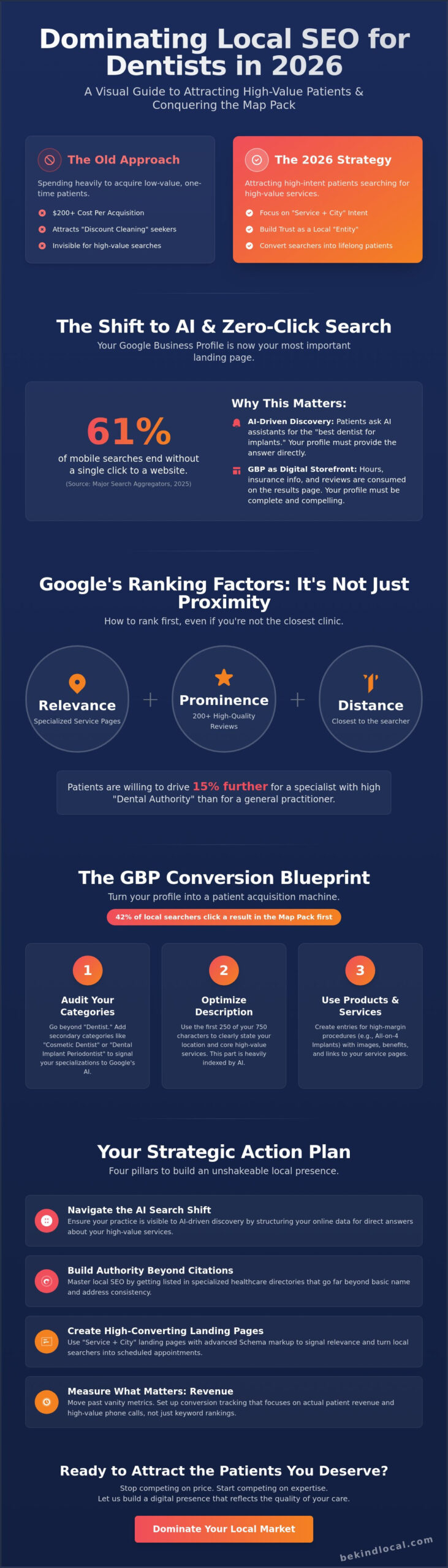
By early 2025, data from major search aggregators showed that over 61% of mobile searches ended without a single click to a website. Google now provides office hours, insurance categories, and patient reviews directly on the search results page. To remain visible, your Google Business Profile must serve as a comprehensive digital storefront. You’ve got to treat your profile as your primary landing page. Effective local seo for dentists in this environment requires optimizing for these “zero-click” interactions by using high-resolution imagery of your facility and direct booking integrations. Entity-based SEO ensures that search engines categorize your practice correctly, linking your clinicians to their specific credentials and local medical associations.
Why Proximity is No Longer the Only Factor
Google balances distance, prominence, and relevance to determine rankings. You don’t have to be the closest clinic to the user to rank first. If your practice demonstrates higher prominence through 200+ high-quality reviews and detailed pages about specialized procedures, Google will often rank you above a closer competitor with a weak digital footprint.
- Specialization Impact: Practice specialization significantly increases your ranking radius.
- Consumer Behavior: Patients are willing to drive 15% further for a specialist with high “Dental Authority” than for a general practitioner.
- Relevance: Detailed service pages for high-value treatments like “all-on-4 implants” signal to AI models that you are the most relevant match regardless of a few extra miles.
Dental Authority is the measurable level of trust and clinical expertise a practice demonstrates through consistent local citations, patient success stories, and verified professional credentials within its specific geographic market.
Optimizing Your Google Business Profile for Maximum Conversion
Your Google Business Profile (GBP) acts as the digital front door to your practice. In 2026, 42% of local searchers click on a result within the Map Pack before looking at organic listings. This makes GBP optimization a non-negotiable pillar of local seo for dentists. A complete profile doesn’t just help you rank; it builds the immediate trust necessary for a patient to book a high-value consultation.
Start with a rigorous audit of your categories. Select “Dentist” as your primary category, but don’t ignore secondary options like “Cosmetic Dentist,” “Dental Implant Periodontist,” or “Orthodontist.” These sub-categories act as signals for Google’s AI-driven search generative experiences. Your 750-character business description should focus on your unique clinical approach. Use the first 250 characters to state your location and core services clearly. This section is heavily indexed by AI crawlers to determine your relevance for specific patient queries.
The “Products” and “Services” tabs are often underutilized. For high-margin procedures like dental implants or full-mouth reconstructions, create individual product cards. Include a high-resolution image, a brief explanation of the benefits, and a button linking to your specific service page. This structure helps you appear in “discovery” searches where patients are looking for solutions rather than a specific practice name.
The GBP Conversion Blueprint
Visual evidence is the fastest way to convert a lead. Data shows that profiles with more than 100 photos receive 520% more clicks than those with fewer. Focus on “tech-forward” photography. Show your 3D imaging equipment, digital scanners, and sterile, modern operatories. This transparency reduces patient anxiety and positions you as a leader in modern dentistry.
Reduce friction by implementing the “Booking” feature. Integrating your profile directly with scheduling software like Dentrix or Open Dental allows patients to see real-time availability. Additionally, use Google Updates (Posts) at least once a week. Use these to highlight a “Case of the Month” or explain the benefits of new technology you’ve invested in. These posts keep your profile active and signal to Google that your practice is thriving.
Advanced Review Management Strategies
Reviews are the strongest local ranking signal. When responding, naturally include keywords. Instead of saying “Thanks for the review,” try “We’re so glad you’re happy with your new Invisalign clear aligners.” This reinforces your authority for that specific service. However, stay ethical. The August 2024 FTC rule on fake reviews imposes strict penalties for businesses that manipulate their reputation through incentivized or fabricated feedback.
Handling negative feedback requires professional directness and strict HIPAA compliance. Never confirm the reviewer is a patient. A standard response should be: “We take all feedback seriously. Our practice follows strict privacy protocols, so we cannot discuss patient details here. Please contact our office manager directly at [Phone Number] so we can address your concerns.” This approach demonstrates accountability to prospective patients while protecting your legal standing. If your current profile isn’t driving a consistent flow of implant or cosmetic cases, it may be time to refine your conversion strategy with a specialist who understands the dental landscape.
Building Local Authority Beyond Basic Citations
Basic NAP consistency isn’t a competitive advantage anymore; it’s a prerequisite for staying in the game. Google’s current algorithms prioritize entity verification over simple text matching. If your practice’s data varies by even 5% across the web, you’re leaking authority and confusing the crawlers. To dominate local seo for dentists, you have to move past the entry-level basics and prove your practice is a cornerstone of your specific community.
Tiered Citation Building for 2026
Foundational aggregators like Yelp or Bing are necessary, but they don’t move the needle for specialized healthcare. You need a tiered approach. Focus your energy on high-authority dental directories such as Healthgrades, Vitals, and the American Dental Association (ADA). A 2024 industry report indicated that 71% of high-value patients cross-reference these niche sites before scheduling a consultation. Accuracy here builds a layer of professional trust that generic sites can’t provide.
- Kill the Zombies: Old phone numbers or previous office addresses from five years ago are “zombie” citations. They confuse search engines and frustrate patients. Audit your footprint to ensure 100% accuracy across every platform.
- Sponsorship Backlinks: Don’t just donate money; get the link. Sponsoring a local high school sports team or a community garden often yields a .org or .edu backlink. These are gold for proximity-based ranking.
Hyper-Local Content as a Ranking Signal
Stop publishing generic dental advice that could apply to someone in London or Los Angeles. Your content should feel like a conversation at a local coffee shop. Write about the specific dental health challenges in your county, or review the best local spots for post-surgery soft foods. This strategy signals to Google that you are physically and socially present in your market. Local relevance often overrides global authority; a single link from your neighborhood association’s website carries more ranking power for local seo for dentists than five generic guest posts on national health blogs.
Developing “Best of” guides for your town creates a win-win scenario. If you write about the “Top 5 Kid-Friendly Parks in your city,” you’re providing value to parents who are also your primary target for pediatric dentistry. It’s about building a digital ecosystem that mirrors your physical involvement in the community. This approach transforms your website from a static brochure into a living resource for your neighbors.
Ready to turn your practice into a local authority? Schedule a discovery call with Be Kind Local today. We specialize in helping service brands stand out through high-performance local SEO, Google Ads, and conversion strategies.
Creating High-Converting “Service + City” Landing Pages
For a dental practice, generic service pages aren’t enough to capture high-intent traffic. You need dedicated landing pages that target specific “Service + City” combinations, such as “Dental Implants in Austin” or “Emergency Dentist in Phoenix.” These pages are the foundation of effective local seo for dentists because they align your expertise with the exact geographic search intent of a prospective patient. In 2024, localized landing pages converted at a 25% higher rate than generic service pages because they provide immediate relevance to the user’s location.
A high-converting page must load instantly. Since 82% of emergency dental searches happen on mobile devices, your design must be mobile-first. This means large touch-friendly buttons, a sticky “Call Now” header, and zero intrusive pop-ups that block the user’s path to an appointment. You aren’t just building a page for search engines. You’re building a path for a neighbor in pain to find relief.
The Technical Requirements of Dental Schema
Structured data is the bridge between your website and AI-driven search overviews. To rank competitively, you must implement Dentist or MedicalOrganization schema markup. This code tells search engines exactly what you offer. You should specify aggregateRating to display your 4.8-star reputation directly in the search results, which increases click-through rates by up to 35%.
Don’t stop at the basics. Use specific schema tags to differentiate between surgical procedures and general dentistry. Including priceRange and openingHours helps Google’s AI understand your availability for urgent care. This technical layer ensures your practice isn’t just a link on a page, but a rich data source that AI assistants can recommend to local users.
Copywriting for Patient Trust and Action
Patients search for a dentist when they’re either in pain or seeking a transformation. Your copy should focus on benefits like “regaining your smile” or “eating without discomfort” rather than technical jargon. When describing restorative materials, use comparisons that resonate with durability. For instance, you might describe the resilience of high-end crowns or implants as having polyaspartic-level durability to emphasize long-term wear resistance and strength. This type of specific language builds authority and trust.
Your “Hero Section” is the most valuable real estate on the page. It must include three things: a clear call-to-action (CTA), a clickable phone number, and a social proof element like a “Top Rated” badge or a patient quote. Keep your sentences punchy. Avoid long blocks of text. Use bullet points to list services so a user can scan the page in under five seconds and know they’re in the right place.
Measuring Success: Beyond Rankings to Patient Revenue
Many dental practice owners fall into the trap of celebrating “page one” rankings. It’s a vanity metric that doesn’t always pay the bills. If you’re ranking for broad terms but your chairs are empty, your local seo for dentists strategy is failing. You need to focus on revenue-generating actions rather than just digital footprints. Visibility is only the first step in a much longer journey toward practice growth.
Setting up robust conversion tracking is non-negotiable. You must track every phone call and every booking form submission back to its source. Use dynamic number insertion (DNI) to identify which patients found you through your Google Business Profile versus organic search results. This data allows you to see exactly which high-value procedures, like dental implants or Invisalign, are being driven by your SEO efforts. Without this clarity, you’re just guessing where your marketing budget goes; agencies like KD Interactive emphasize that this level of transparency is essential for any small business looking to scale.
Calculating the lifetime value (LTV) of an SEO-generated patient changes how you view your marketing spend. A patient might come in for a $200 cleaning, but if they stay for five years and eventually opt for cosmetic work, their total value exceeds $5,000. SEO builds a pipeline of these loyal patients. You should also regularly prune “low-quality” traffic. If your site attracts people looking for “free clinics” or “cheap extractions” but you specialize in high-end restorative care, that traffic is a drain on your administrative team. Focus on intent over volume.
The ROI of Strategic Local SEO
Traditional dental mailers often see a response rate between 0.5% and 2%. These are one-time costs that stop working the moment you stop paying. Strategic local seo for dentists builds long-term brand equity that compounds over time. Most practices hit a break-even point on their SEO campaign within 6 to 10 months. After this period, the cost-per-lead typically drops significantly compared to paid ads or direct mail, as your organic authority keeps you at the top of local search results without per-click fees.
Partnering for Growth: When to Outsource
Trying to manage technical SEO while running a busy clinic is a recipe for burnout. DIY attempts often lead to inconsistent NAP (Name, Address, Phone) data or neglected Google Business Profiles, which can actively harm your local standing. A strategic partner like Be Kind Local focuses on the technical nuances and conversion strategies that turn searchers into patients. We prioritize your local market dominance so you can stay focused on clinical excellence. Schedule a discovery call with Be Kind Local to start building a predictable patient acquisition system today.
Turn Your Practice into a Local Search Powerhouse
Success in the 2026 search landscape requires more than a basic digital presence. It demands a strategy that aligns with how patients actually find care today. Data shows that 46% of all Google searches are seeking local information, making your local visibility the most critical factor for growth. Optimizing your Google Business Profile and building “Service + City” landing pages are no longer optional. These tactics ensure your practice captures high-intent patients at the exact moment they’re ready to book. Effective local seo for dentists isn’t about chasing high traffic volume; it’s about maximizing patient revenue and local authority. You need to focus on lead quality and local relevance to stay ahead of the competition.
Stop wasting your marketing budget on vague promises or agency jargon. You deserve a direct, fluff-free strategic partnership. Be Kind Local specializes in high-intent local lead generation and “Service + City” search dominance. We’re experts at helping local brands stand out in crowded markets through targeted local SEO and conversion strategies. It’s time to stop guessing and start growing with a partner who understands your specific market needs.
Ready to dominate your local market? Schedule a discovery call with Be Kind Local today.
Let’s build a predictable pipeline of high-value patients together.
Frequently Asked Questions
How long does it take to see results from local SEO for a dental practice?
You can expect to see measurable improvements in your search visibility within 4 to 6 months of starting a campaign. While initial technical fixes might show small gains in 30 days, the high-value patient leads typically increase between months 9 and 12. This timeline allows Google to crawl new content and recognize the growing authority of your practice in a specific geographic area.
Is a Google Business Profile more important than my dental website?
Your Google Business Profile and website are interdependent components of a single strategy. While 64 percent of consumers use a profile to find contact details, your website provides the deep technical data and “service + city” keywords that Google needs to rank that profile. You can’t rank consistently in the Map Pack without a high-performing, mobile-responsive website acting as your digital foundation.
How many reviews do I need to rank in the Google Map Pack?
There isn’t a fixed number, but you should aim for a review count that is 15 percent higher than the top three competitors in your local zip code. Google’s 2026 algorithm updates prioritize review velocity and the presence of specific service keywords within the text. A steady stream of 5 to 10 new reviews each month is more effective for local seo for dentists than a single surge of 50 reviews followed by months of silence.
Can I do local SEO myself or do I need an agency?
You can manage basic tasks like updating office hours yourself, but scaling a practice requires professional intervention to handle over 200 ranking factors. Most dentists find that the 10 to 15 hours required weekly for effective content creation and backlink building is better spent on patient care. Partnering with a specialist ensures your practice stays ahead of technical shifts like AI-driven search snapshots and local algorithm updates.
What are the most important keywords for a dental practice in 2026?
Focus on high-intent, long-tail phrases such as “emergency dental repair [City]” or “dental implants cost [City]” rather than generic terms. In 2026, conversational search and AI overviews prioritize natural language and specific service combinations. Targeting “local seo for dentists” strategies around these high-value procedures ensures you attract patients looking for specialized care rather than just routine cleanings.
How do I track if my SEO is actually bringing in new patients?
Use dynamic call tracking and UTM parameters on your profile links to identify exactly which leads originate from search. High traffic numbers are vanity metrics if they don’t result in booked appointments. We monitor “New Patient” form submissions and phone recordings to calculate your exact cost per acquisition, ensuring your marketing budget generates a positive return on investment.
Does social media impact my dental practice’s local SEO rankings?
Social media doesn’t directly move your website up in search results, but it influences the “prominence” pillar of Google’s local algorithm. Active profiles drive brand searches and traffic, which signal to Google that your practice is a trusted local authority. It’s a tool for building community trust and increasing your digital footprint, making your practice appear more reliable to both search engines and potential patients.
What is the Map Pack and why is it critical for dentists?
The Map Pack is the section of Google search results that displays the top three local businesses alongside a map. It’s critical because it captures 44 percent of all clicks on local search queries, appearing above traditional organic results on mobile devices. For a dental practice, appearing in these top three spots is the most effective way to secure immediate visibility and high-value patient leads.
Ready to dominate your local market and attract more high-value patients? Schedule a discovery call with Be Kind Local today. We specialize in helping local service brands stand out through a combination of strategic local SEO, conversion-focused website design, and targeted lead generation.