
 951-249-7500
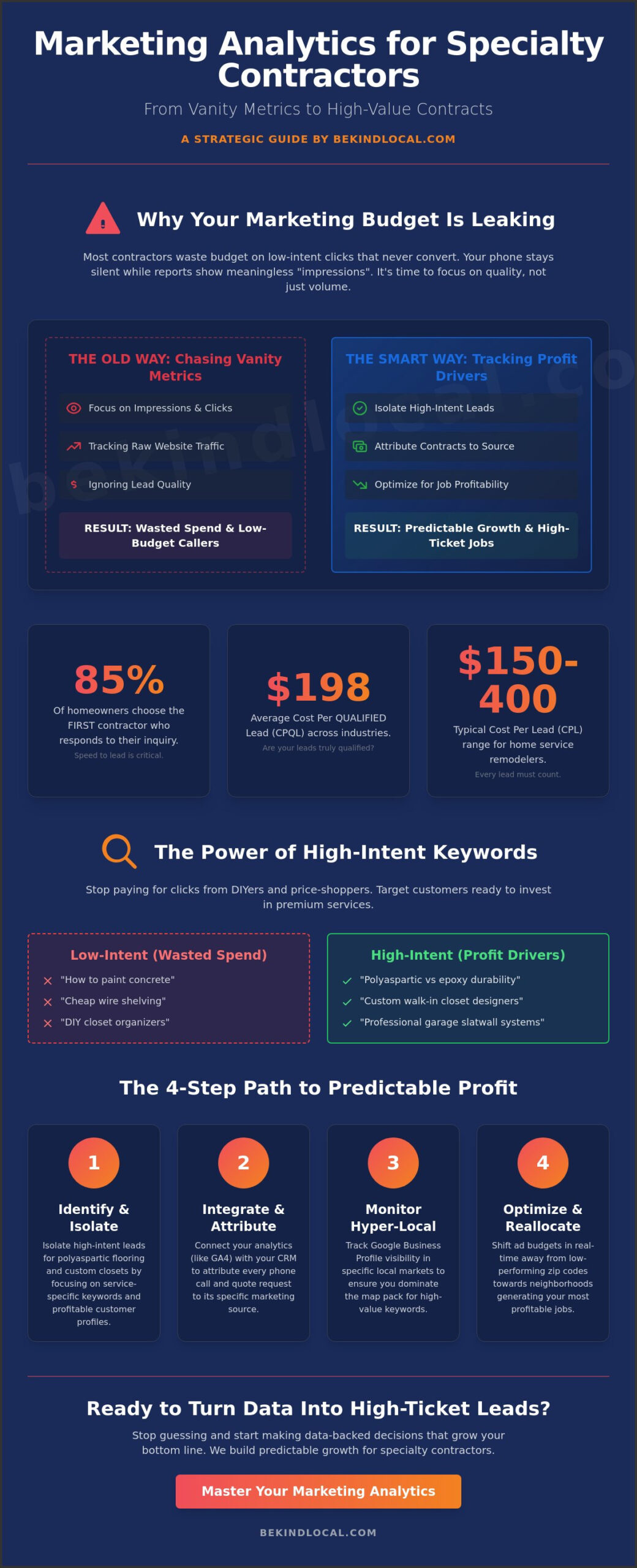
85% of homeowners choose the first contractor who responds to their inquiry, yet most floor coating and custom closet businesses are still wasting budget on low-intent clicks that never turn into a signed contract. You’ve likely felt the frustration of staring at a marketing report full of “impressions” while your phone stays silent or rings with callers who don’t have the budget for a premium polyaspartic garage floor. It’s exhausting to manage a business when you don’t have clear visibility into which zip codes or keywords are actually driving your highest profit margins. We understand that you need more than just traffic; you need a predictable way to grow your community impact and your bottom line.
We’re going to change how you look at your numbers. This guide will show you how to master marketing analytics for contractors so you can move beyond vanity metrics and start making data-backed decisions. You’ll learn how to leverage the January 2026 GA4 cross-channel budgeting updates and track leads from the first phone call to the final installation. We’ll dive into specific strategies for reducing your cost-per-acquisition, which currently averages $198 across industries, by focusing on lead quality over raw volume for your walk-in closet or epoxy flooring business.
Key Takeaways
- Identify why broad traffic metrics fail specialty contractors and how to isolate high-intent leads for polyaspartic flooring and custom closet projects.
- Learn to prioritize lead-to-sale conversion rates over raw lead volume to ensure your marketing spend translates into actual revenue and closed contracts.
- Master the essential setup of marketing analytics for contractors by integrating GA4 with your CRM to attribute every phone call and quote request to its specific source.
- Discover how to monitor Google Business Profile visibility in specific local markets to ensure you are appearing in the map pack for high-value service keywords.
- Understand the strategic process of shifting ad budgets in real-time away from low-performing zip codes and toward the neighborhoods generating your most profitable walk-in closet and garage storage jobs.
Beyond the Dashboard: Why Specialty Contractors Need Niche-Specific Marketing Analytics
Total website traffic often serves as a comforting but hollow metric. For a contractor specializing in polyaspartic floor coatings or custom walk-in closets, 5,000 monthly visitors mean nothing if they’re searching for “how to paint concrete” or “cheap wire shelving.” You aren’t selling a commodity; you’re selling a high-ticket transformation. Effective marketing analytics for contractors must look past raw clicks to identify the specific intent behind the data. If your reports don’t show you which neighborhoods are requesting premium garage cabinets, you’re essentially flying blind.
A lead for a simple reach-in pantry doesn’t carry the same weight as a lead for a full master walk-in suite. When your analytics don’t distinguish between these, you risk scaling the wrong campaigns. This is where a robust home service brand strategy becomes vital. It allows you to interpret data through the lens of your ideal customer profile. Custom closet projects often have a longer sales cycle, sometimes spanning several weeks from the first click to the final design consultation. Multi-touch attribution helps you see how a customer might find you on social media, read a comparison of closet types on your site, and finally call through a Google Business Profile. Without this data, you might mistakenly cut the very channel that started the journey.
The High-Ticket Lead Quality Gap
The gap between lead volume and lead quality is where most ad budgets go to die. In 2026, the average cost per qualified lead (CPQL) has reached $198. If you’re paying for leads that don’t meet your project minimums, your ROI will vanish. We focus on tracking service-specific keywords that signal high intent. A homeowner searching for “garage slatwall systems” or “polyaspartic vs epoxy durability” is far more valuable than one looking for “DIY closet organizers.” By defining “qualified” based on your specific service areas and project types, you can stop wasting spend on low-intent clicks that never intended to hire a professional.
Avoiding the “Generic Contractor” Data Trap
Generic benchmarks are dangerous. A marketing strategy for a floor coating business in Texas, where heat and humidity affect product choice, looks different from one for a garage remodeler in Indianapolis. You can’t rely on broad industry averages that lump you in with plumbers or roofers. Your focus should stay on high-margin services like overhead storage and custom cabinetry. Niche-specific marketing analytics for contractors allow you to see which neighborhoods are requesting “pantry organization” versus “garage flooring,” helping you deploy your sales team more efficiently. This granular visibility ensures you’re growing with intention, not just adding noise to your dashboard.
Key Performance Indicators (KPIs) for Floor Coating and Custom Closet Growth
Generic marketing reports often highlight Click-Through Rates (CTR) or bounce rates. While these help a technician diagnose a website issue, they don’t help you decide whether to buy another service truck. For your floor coating or custom closet business, marketing analytics for contractors must focus on metrics that correlate directly with bank deposits. You need to know if the $6.40 average cost per click you’re paying in the construction sector is actually yielding a project with a healthy margin.
Cost Per Lead (CPL) is your first major hurdle. In 2026, the average CPL for B2B companies sits at $230, while remodelers often see a range between $150 and $400. If you’re selling a $10,000 polyaspartic garage system, a $300 lead is manageable. However, if you’re only tracking lead volume without looking at the Lead-to-Sale Conversion Rate, you’re missing the final piece of the puzzle. This conversion rate is the ultimate ROI metric; it tells you how many of those expensive leads actually signed a contract for a custom mudroom or reach-in closet.
Your Average Contract Value (ACV) should dictate your advertising budget. A high-ticket walk-in closet system allows for a higher acquisition cost than a simple pantry shelving job. By analyzing the Return on Ad Spend (ROAS) for specific campaigns, such as “garage floor coating Florida,” you can see exactly where your dollars work hardest. If a specific city is producing a 5x ROAS while another barely breaks even, the data gives you the confidence to shift your resources immediately.
The Metrics That Actually Move the Needle
Distinguishing first-time callers from existing customers is essential for measuring true growth. If your “lead” count includes people calling for a warranty repair on an old epoxy floor, your data is skewed. We also look at keyword profitability. It’s not just about which terms get clicks, but which ones lead to closed polyaspartic contracts. Finally, monitor your sales velocity. Tracking how long it takes a homeowner to go from an initial closet inquiry to a signed installation agreement helps you forecast your cash flow with precision.
Setting Realistic Benchmarks for 2026
A healthy CPL for premium garage cabinets in 2026 often hovers around the $200 to $350 mark depending on your local competition. Don’t be discouraged if your conversion rate for luxury walk-ins is lower than for simple pantry remodels; higher price points naturally require more touchpoints and a longer consideration phase. Always fact-check industry “averages” against your own real-world data. If you’re ready to see how your current numbers stack up against these benchmarks, you can request a performance audit to find the hidden gaps in your funnel.
Measuring Local Search Impact Across California, Texas, and Florida Markets
Local search dominance isn’t a “set it and forget it” task. For specialty contractors, visibility in the local map pack for “epoxy flooring near me” is the difference between a booked calendar and a quiet shop. In states like California, where competition is fierce, marketing analytics for contractors must track more than just rankings. You need to measure high-intent actions like “Direction Requests” to your showroom or “Click-to-Calls” directly from your Google Business Profile (GBP). These metrics represent homeowners who are ready to move from browsing to bidding.
Localized content plays a critical role in driving SEO performance. By creating pages specifically for cities like Indianapolis, Charlotte, or Houston, you signal to both Google and the customer that you understand their local environment. For example, discussing how polyaspartic systems handle the specific humidity of Florida or the concrete conditions in Texas builds immediate authority. This isn’t just about keywords; it’s about building a digital footprint that reflects your real-world service area. When you track which city-specific pages generate the most quote requests, you can double down on the markets that actually produce revenue.
Regional Performance Tracking for Multi-Location Brands
If you operate across multiple states, you’ve likely noticed that lead costs aren’t uniform. A lead in the Florida market might cost significantly more than one in North Carolina due to local saturation. We use geo-grid tracking to visualize your map pack dominance. This tool shows exactly which neighborhoods you “own” and identifies “Dead Zones” where your visibility drops off. If you’re missing from the top three results in a high-income zip code, you’re leaving high-margin custom closet projects on the table. Analytics help you decide whether to increase your local reach or refine your existing presence.
The Impact of Local Reviews on Analytics
According to 2026 BrightLocal data, 98% of consumers read online reviews before contacting a local business. Review velocity, or how frequently you receive new feedback, directly correlates with higher conversion rates on your website. We track how your local reputation management impacts your cost-per-click in competitive markets like Texas and Georgia. As your “Trust Factor” grows, you’ll often see an increase in branded search volume. This means people aren’t just searching for “garage remodelers”; they’re searching for your company by name. This shift typically lowers your acquisition costs and improves lead quality simultaneously.
Setting Up Your Analytics Stack: From Google Business Profile to CRM Integration
Data without a cohesive system is just noise on a screen. To make marketing analytics for contractors actually drive growth, you need a technical stack where every tool communicates with the next. This starts with a five-step implementation plan designed to move you away from guesswork and toward precision bidding. First, implement GA4 with custom conversion events specifically for “Quote Request” forms. Tracking a simple page view isn’t enough; you need to identify the exact moment a homeowner decides they want a price for a new mudroom or pantry organization system.
- Step 1: GA4 Customization. Set up specific triggers for form completions and click-to-call buttons to isolate high-intent actions.
- Step 2: Call Tracking. Implement a system that attributes every dial to its original source, whether it was a Google Search or a Facebook ad.
- Step 3: CRM Integration. Connect your marketing data to platforms like Jobber or Houzz Pro to follow the lead from the initial inquiry to the final invoice.
- Step 4: Revenue Dashboards. Build automated reports that prioritize your total contract value and lead-to-sale rate over raw traffic numbers.
- Step 5: Monthly Data Audits. Regularly verify that your tracking codes are firing correctly across all service areas, especially if you operate in high-competition states like Texas or Florida.
Accuracy requires consistent maintenance. Your CRM is the bridge between a digital click and a physical installation. When these systems are linked, you can finally see the true cost of acquiring a polyaspartic garage floor customer versus a reach-in closet project. This level of detail allows you to stop overspending on low-margin services and focus your resources where they generate the most profit.
The Importance of Call Attribution
Since 70% of specialty contractor leads originate from a phone call, missing this data is like throwing away 70% of your marketing intelligence. We use Dynamic Number Insertion (DNI) to swap the phone number on your site based on how the visitor found you. This allows your team to tie a call for a “garage slatwall system” directly to the specific ad or keyword that prompted the inquiry. Training your office staff to tag lead sources in the CRM ensures your data remains clean and actionable.
Closing the Loop: Data-Back to Revenue
Closing the loop means knowing exactly which Facebook ad led to a $15,000 garage remodel. By setting up “Value-Based Tracking” in Google Ads, you can tell the algorithm to prioritize high-ticket walk-in closets over smaller pantry jobs. A custom website design is the foundation of this process; it provides the clean structure needed to capture and pass this data accurately. If you’re tired of wondering which ads are actually paying the bills, we can help you build a high-conversion analytics stack tailored to your specific niche.
Turning Data Into High-Ticket Leads: The Be Kind Local Strategic Approach
At Be Kind Local, we believe marketing analytics for contractors should be a catalyst for action, not just a monthly report that sits in your inbox. We don’t just look at how many people clicked an ad for polyaspartic floor coatings; we look at which of those clicks turned into a high-margin project. Our strategy is built on a foundation of transparency and ethics. We treat your marketing budget with the same respect you give to your craftsmanship, ensuring every dollar spent is working toward a measurable increase in your revenue.
Real-time optimization is what separates a thriving contractor from one that’s just getting by. By monitoring lead flow at the zip code level, we can shift your budget away from “Dead Zones” and toward high-intent neighborhoods where homeowners are actively seeking custom walk-in closets or garage slatwall systems. This granular control allows us to be proactive rather than reactive. For a garage storage company we partnered with in Texas, this exact approach led to a 30% reduction in their cost-per-lead within 90 days. We stopped the bleed on low-intent searches and doubled down on the keywords that were actually closing contracts.
Continuous Optimization and Strategic Pivots
We use monthly data reviews to refine your local SEO strategy and keep you ahead of the competition. Data allows us to predict seasonal trends before they happen. For example, historical models show us that while floor coating leads often peak in the spring, custom closet inquiries see a significant surge during the “New Year” organization rush. This foresight helps you scale your business into new markets like Georgia or Florida with a proven roadmap. You aren’t guessing where to expand; you’re following the data that shows where the demand is highest.
Your Next Step Toward Data-Driven Growth
There’s a fundamental difference between a vendor who sells you “impressions” and a strategic partner who focuses on your bottom line. “Set it and forget it” marketing simply doesn’t work in the 2026 contractor landscape. To stay competitive, you need a system that captures clean data and a partner who knows how to use it. If your current reports are confusing or don’t show real revenue, it’s time for a change. We invite you to schedule a discovery call with Be Kind Local today to audit your current tracking and build a data-driven strategy for your local market.
Mastering Your Data for a Profitable 2026
Building a sustainable flooring or closet business requires more than skilled labor; it requires a clear view of your financial horizon. You’ve seen how marketing analytics for contractors can transform a confusing dashboard into a strategic roadmap for local expansion. By prioritizing lead quality over raw volume and integrating your CRM with GA4, you ensure that every dollar spent on advertising is an investment in your company’s future. You don’t have to settle for vanity metrics when you can track real revenue from the first phone call to the final installation.
We’ve spent years developing specialized expertise in the floor coating and custom closet niches, providing transparent, revenue-focused reporting for local contractors. Our proven results in high-competition markets like California, Texas, and Florida demonstrate that a data-backed strategy is the only way to maintain a lead in 2026. Whether you’re installing polyaspartic systems or designing master walk-in suites, you deserve a partner who understands the technical nuances of your trade and the ethics of your community.
Stop guessing and start growing; schedule your strategy call with Be Kind Local today. We’re ready to help you turn your local data into your greatest competitive advantage.
Frequently Asked Questions
What are the most important marketing KPIs for a floor coating company?
Focus on your Cost Per Qualified Lead (CPQL) and your Lead-to-Sale Conversion Rate. While raw lead volume matters, knowing how many polyaspartic floor inquiries turn into signed contracts is what actually dictates your growth. You should also monitor your Average Contract Value (ACV) to ensure your marketing spend aligns with your profit margins on premium coatings.
How do I track if my custom closet leads are coming from Google or social media?
Use UTM parameters on all digital links and Dynamic Number Insertion (DNI) for your phone tracking. UTM codes tell GA4 exactly which Facebook ad or Google search prompted a click. DNI swaps the phone number on your site so you can attribute a call for a custom reach-in closet to the specific source that generated it.
Is Google Analytics 4 (GA4) enough for a local contractor business?
GA4 is a powerful tool for behavior tracking, but it isn’t a complete solution for marketing analytics for contractors. It tells you what happens on your website, but it doesn’t know if a lead actually paid their invoice. You must integrate GA4 with a CRM like Jobber or Houzz Pro to connect digital actions to real-world revenue.
Why is my cost-per-lead so high in competitive markets like California or Texas?
High competition and market saturation in states like California and Texas drive up the cost per click for buyer-intent keywords. As of early 2026, the average CPL for remodelers in these regions often exceeds $350. To combat this, focus on local search intent and Google Business Profile visibility to capture lower-cost organic leads alongside your paid campaigns.
How can I tell if my marketing agency is giving me “fluff” data?
Your agency is giving you fluff if their reports prioritize “impressions,” “reach,” or “clicks” over “cost-per-acquisition” and “revenue.” Practical marketing analytics for contractors should always focus on the bottom line. If you can’t see the direct path from an ad spend to a closed garage cabinet project, your data isn’t serving your business goals.
What is a good conversion rate for a garage remodeler’s website?
A healthy website conversion rate for a garage remodeler typically falls between 3% and 5% for qualified traffic. However, your Google Business Profile often sees much higher engagement rates. If your site is below 2%, you likely have a trust gap or technical issues with your quote request forms that are scaring away potential polyurea coating customers.
Do I need a CRM to track my marketing ROI effectively?
You absolutely need a CRM to close the loop between marketing spend and actual profit. Without a CRM, you’re just guessing which leads resulted in a $20,000 master walk-in closet installation. Connecting your CRM to your analytics stack allows you to see the exact ROI of every campaign by tracking the lead through the entire sales cycle.
How often should I review my marketing analytics reports?
Review your high-level dashboards weekly to catch any sudden drops in lead volume, but perform deep strategic reviews once a month. Monthly reviews allow you to see broader trends, such as seasonal shifts in pantry organization demand. This rhythm ensures you stay agile without overreacting to daily fluctuations in the 2026 digital landscape.