
 951-249-7500
Buying shared leads from national aggregators is essentially paying to compete in a race to the bottom where the only winner is the platform selling the data. You’ve likely experienced the exhaustion of calling a prospect within seconds, only to find out you’re the fifth person to ring their phone that morning. It’s a cycle that keeps your customer acquisition costs high and your margins thin. To find success with roofing lead generation in 2026, you need to stop renting your growth and start owning your local market presence.
We understand that you want a business built on steady, predictable work rather than the feast or famine cycles of seasonal storms. You deserve a marketing partner who treats your growth with the same care you give to a homeowner’s roof. This article promises to reveal how you can move away from low-quality lead pools and build a high-converting, multi-channel engine that works for you 24/7. We’ll explore the exact steps to secure exclusive leads, improve your lead-to-close ratios, and establish your brand as the trusted authority in your specific service area.
Key Takeaways
- Learn why relying on “rented” lead aggregators is a failing model and how to build a sustainable, owned system for roofing lead generation.
- Master the Google Map Pack by transforming your Business Profile into a high-authority asset that drives local proximity and trust.
- Discover the high-accountability “Pay-per-Lead” model of Local Services Ads to generate immediate volume without the waste of traditional PPC.
- Implement a strategic pre-qualification framework on your website to filter out tire-kickers and focus your sales team on high-profitability jobs.
- Identify the clear transition point where moving from DIY marketing to a strategic partnership is necessary to scale past the $1M revenue plateau.
What is Roofing Lead Generation in 2026?
In the current market, lead generation is no longer about simply buying a list of names or phone numbers. It’s a sophisticated, multi-channel system designed to attract high-intent homeowners who are ready to invest in their property. For a roofing business to remain sustainable in 2026, you must stop viewing leads as a commodity and start viewing them as the result of a deliberate conversion strategy. This means moving away from reactive marketing and toward a proactive pipeline that you own entirely.
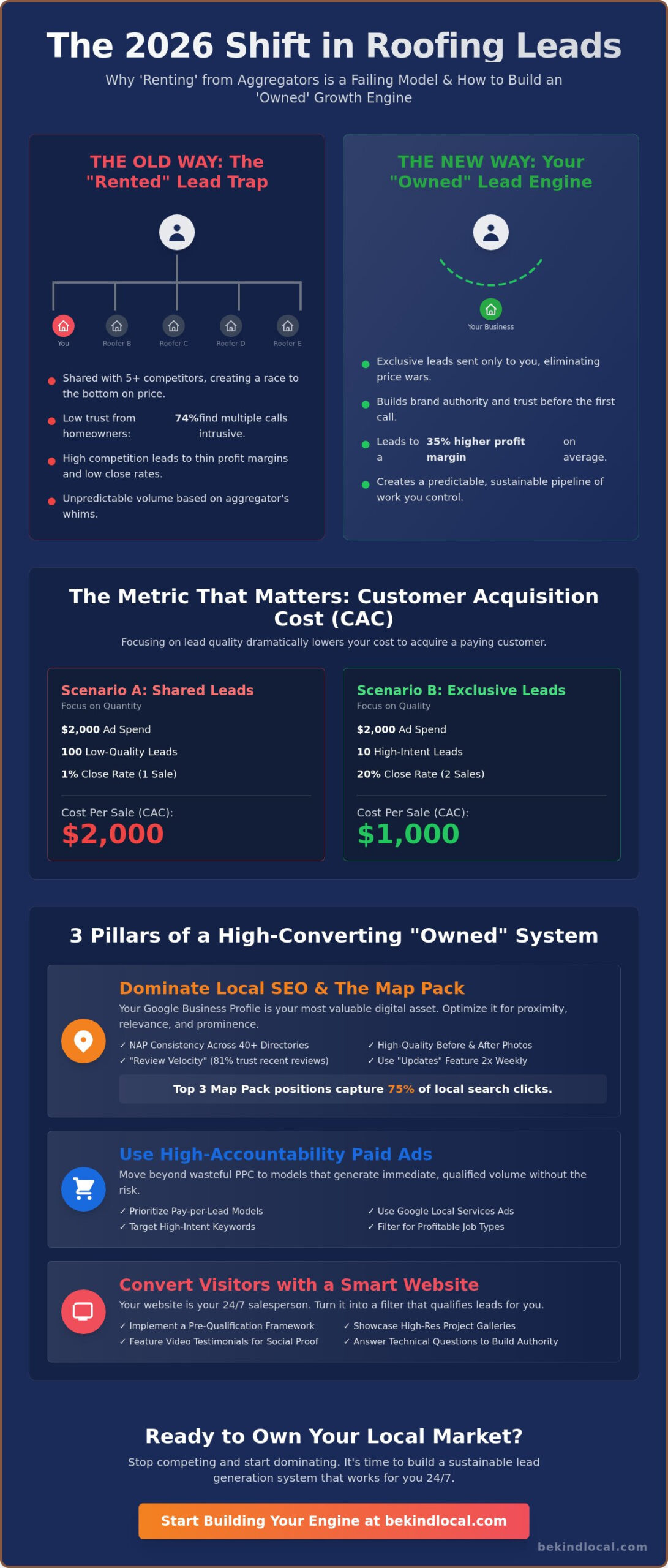
The traditional “rented lead” model dominated by platforms like Angi and HomeAdvisor is failing contractors in 2026. These platforms often sell the same homeowner’s data to five or more companies simultaneously. This creates a “race to the bottom” on price, where the first person to call usually wins, but often at the cost of profit margins. Data from 2025 showed that 74% of homeowners found these unsolicited multiple calls intrusive, leading to lower trust before you even step foot on the property. Exclusive leads, generated through your own assets, provide a 35% higher profit margin because you aren’t competing in a crowded digital auction for every single job.
Homeowner behavior has shifted toward AI-assisted search. Instead of typing “roofers near me,” users now ask AI tools for specific comparisons, such as “best impact-resistant shingles for high-wind areas in [City].” This shift requires a content strategy that answers technical questions and establishes your brand as a local authority before the first contact is ever made.
The Evolution of Home Service Search
Modern homeowners use visual search and social proof as their primary filtering tools. They expect to see high-resolution project galleries and video testimonials before they ever click a “Request a Quote” button. This behavior mirrors how consumers research high-end garage remodeling or custom closet systems; they want to see the specific aesthetic and technical quality of the work. A High-Intent Searcher is a homeowner who has identified a specific roofing problem and is actively seeking a local specialist with verified social proof to begin a project within 30 days.
Quantity vs. Quality: The ROI Metric That Matters
Successful roofing lead generation in 2026 focuses on the Customer Acquisition Cost (CAC) rather than the cost per lead. If you spend $2,000 on 100 cheap, shared leads and close 1%, your cost per sale is $2,000. However, if you spend $2,000 on 10 exclusive, high-intent leads and close 20%, your cost per sale drops to $1,000. The “Lead-to-Sale” ratio is now the primary KPI for growth-minded owners. A 10% closing rate on premium, exclusive leads is consistently more profitable than a 1% rate on low-quality volume. Focusing on quality ensures your sales team spends time in kitchens, not just on the phone chasing people who aren’t ready to buy. A well-defined home service brand strategy is what separates contractors who attract premium buyers from those who compete solely on price.
Dominating the Map Pack with Local SEO
Your Google Business Profile (GBP) is the most valuable asset you own. It’s the digital handshake that happens before you ever step foot on a driveway. For 2026, the “Map Pack” remains the primary driver of high-intent clicks for roofing lead generation. Google ranks your business based on three core pillars: proximity, relevance, and prominence. While proximity is determined by the user’s location, you have full control over relevance and prominence. Relevance is built through detailed service descriptions, while prominence grows as your brand gains mentions across the web.
Consistency in your Name, Address, and Phone number (NAP) across 40 or more local directories isn’t just a technical chore. It’s about building an unbreakable foundation of trust with Google’s crawlers. When your data matches perfectly on Yelp, the BBB, and local chamber of commerce sites, your authority rises. This organic equity lowers your long-term lead costs because you aren’t paying for every single click. While paid advertising strategies provide immediate volume, local SEO creates a sustainable pipeline that doesn’t disappear if you pause your ad spend. The same local SEO principles that drive roofing leads also power hvac seo services for contractors looking to build a durable, owned presence in their market. A 2024 industry report indicated that businesses in the top three Map Pack positions capture 75% of local search clicks, making this prime digital real estate.
Optimizing Your Google Business Profile
High-quality project photos are your best sales tool. Uploading clear before and after shots of a recent metal roof installation or a complex asphalt shingle repair builds immediate trust. Homeowners want to see your work in their own neighborhood. Focus on “Review Velocity,” which is the steady, consistent stream of new feedback. According to 2025 consumer data, 81% of homeowners prioritize contractors with reviews from the last 60 days. Use the “Updates” feature twice a week to share current project highlights. This signals to Google’s algorithm that your business is active, reliable, and ready for new jobs.
On-Page SEO for Service+City Intent
Structure your website with dedicated pages for each service, such as asphalt, metal, or tile roofing. Don’t hide these under a single “Services” tab. Include “Local Entity” signals by mentioning landmarks like the community high school or a specific historic district to anchor your business to the area. Specificity wins in the 2026 market. A keyword like “Roofing Repair in [Region]” is significantly more valuable than the generic term “Roofing” because it captures a homeowner in the middle of a crisis who’s ready to hire immediately. This targeted approach ensures your roofing lead generation efforts attract buyers, not just browsers. If you’re tired of chasing low-quality leads, it might be time to work with a strategic partner who understands how to make your local presence felt.
Paid Advertising Strategies for Immediate Lead Volume
Organic growth provides long-term stability, but paid advertising is the faucet you turn on when your crew needs work right now. For effective roofing lead generation, you must distinguish between Google Local Services Ads (LSAs) and traditional Pay-Per-Click (PPC). LSAs operate on a strict pay-per-lead model. You don’t pay for accidental clicks or window shoppers; you pay when a homeowner calls or messages you directly through the platform. This creates a level of accountability that standard search ads can’t match, as you can dispute leads that aren’t for your specific services.
Traditional PPC requires a more surgical approach to be profitable. We use extensive negative keyword lists to filter out “DIY roof patch” or “free roof tiles” searches. This prevents your budget from bleeding out on low-intent traffic that has no intention of hiring a professional. Because ad costs in the home service sector are rising, your landing page must be a conversion machine. If a user clicks your ad and lands on a generic homepage, they’ll likely bounce. We design pages that focus on a single, clear offer and immediate social proof to capture the lead before they move to a competitor.
Google Local Services Ads (LSAs) for Roofers
The “Google Guaranteed” badge is the cornerstone of LSA success. It signals to the homeowner that Google has verified your business licenses and insurance, which can increase lead conversion by 15% to 25% because it removes the initial barrier of distrust. During peak storm seasons, managing your LSA budget is a daily task. Competition for the top three spots is fierce after a hail event. You must respond to calls within 30 seconds. If you consistently miss calls or let them go to voicemail, Google will demote your ranking in favor of more responsive local contractors.
PPC and Retargeting: Closing the Loop
Most homeowners won’t book a $15,000 roof replacement on their first visit to your site. We use Facebook retargeting to follow those visitors with helpful, non-aggressive ads that highlight your recent projects or customer testimonials. This keeps your brand visible while they’re in the decision-making phase. We also deploy “Educational PPC” by bidding on informational queries like “signs of roof deck rot.” This allows you to build authority early in the buyer’s journey before they’ve even started looking for a quote.
This approach mirrors how we handle lead volume for polyaspartic floor coating or custom closet systems. While floor coating ads rely heavily on visual transformations, roofing lead generation relies on trust and technical authority. In both cases, the goal is to dominate the local search results and provide a frictionless path for the customer to reach out. If you’re ready to stop guessing and start growing, schedule a discovery call with Be Kind Local. We specialize in helping local service brands stand out through strategic Google Ads and conversion-focused design.
Lead Quality vs. Quantity: Filtering for Profitability
“I get leads, but they’re all tire-kickers.” This is the most common frustration in roofing lead generation. High lead volume looks great on a monthly report, but it’s a drain on your resources if your sales team spends 30 hours a week chasing homeowners who can’t afford a replacement or only want a free inspection for an insurance claim. You don’t need a bigger net; you need a better filter. Sustainable growth in 2026 requires shifting your focus from “how many” to “how profitable.”
Filtering for intent starts with your digital infrastructure. If your website makes it too easy to submit a fake name and number, you’ll spend your days playing phone tag with bots and browsers. By introducing “good friction” into your intake process, you verify that the person on the other end is a serious buyer with a real project. This approach protects your margins and keeps your sales team focused on high-ticket opportunities like full replacements and premium material installs.
The Power of the Multi-Step Contact Form
A single-field box asking for a phone number is an invitation for spam. Professional contractors use multi-step forms to pre-qualify prospects. When a user has to click through a few logical questions, they’re demonstrating intent. This process filters out low-intent users while building trust with serious ones. You must balance this friction carefully. Don’t ask for a social security number, but don’t settle for just an email address either. Use a clean, visual interface that feels helpful rather than intrusive.
Every roofing lead form should include these 4 essential questions:
- Project Type: Is this a full roof replacement, a minor repair, or a new construction project?
- Material Preference: Are they interested in asphalt shingles, metal, or specialized polyurea coatings?
- Timeline: Do they need help within the next 30 days or are they planning for next season?
- Ownership: Are they the legal homeowner or a property manager?
Speed-to-Lead: The 5-Minute Rule
Lead quality isn’t just about the person; it’s about your response. Data shows that responding to a lead within 5 minutes increases your chances of conversion by 391%. In 2026, homeowners won’t wait an hour for a callback. They’ll move to the next search result. Use automated SMS follow-ups to engage leads the second they hit “submit.” This isn’t about being pushy. It’s about being direct and helpful, which is the core of the BeKind philosophy. Use AI chatbots or instant estimators to provide value even at 2:00 AM, ensuring you’re the first person they talk to.
Finally, integrate your marketing with a CRM like Jobber or HubSpot. You need to track which specific keywords or ad campaigns lead to $15,000 contracts versus $500 repairs. If you don’t know your cost-per-acquisition for a closed sale, you aren’t running a marketing strategy; you’re just gambling. Stop chasing every click and start focusing on the leads that actually move the needle for your business.
Scaling with a Strategic Marketing Partner
DIY marketing often leads to a growth plateau for roofing companies hitting the $1M annual revenue mark. At this stage, the “hustle” that got you started becomes the very thing holding you back. Managing Google Ads between job site inspections or trying to figure out SEO on weekends isn’t sustainable. It’s a recipe for inconsistent lead flow. Real scaling requires a shift from being a technician who does marketing to a CEO who manages a strategic partner. You don’t need more busy work; you need a system that produces predictable results without your constant intervention.
There’s a massive difference between a lead vendor and a strategic marketing partner. Lead vendors sell you raw data, often the same names and numbers they’ve sold to four other contractors in your zip code. This creates a race to the bottom on price. A strategic partner builds your brand’s local authority so you aren’t just another bid. At Be Kind Local, we apply high-ticket home service expertise to the roofing niche, focusing on the quality of the lead rather than just the quantity. We prioritize ethical reporting and total transparency. You’ll always know exactly which campaigns are driving revenue and which ones need adjustment. The same vetting criteria that apply when choosing a hvac marketing agency — transparency, industry expertise, and a focus on high-margin jobs over raw lead volume — apply equally when selecting a roofing marketing partner. Contractors who invest in a cohesive home service brand strategy consistently outrank competitors in the Map Pack and command premium pricing because homeowners recognize them as the trusted local authority.
Beyond Roofing: Lessons from Custom Closets and Coatings
Our background in precision-heavy niches like polyaspartic floor coatings and custom home organization gives us a unique edge in roofing lead generation. We’ve learned that the same level of detail required to market a complex epoxy flooring system applies to home protection. If a strategy can successfully communicate the technical durability of polyurea or the lifestyle benefits of a custom pantry, it can certainly sell the security of a new roof. The BeKind philosophy is about growing your business by being a good neighbor. We position you as a trusted local expert, not a faceless corporation.
Next Steps: Your Discovery Call
Your growth shouldn’t be based on guesswork. During a discovery call with Be Kind Local, we dive deep into your current digital footprint. We analyze your Google Business Profile and local search visibility to find “quick wins” that can boost your lead flow immediately. We look at “service + city” intent to ensure you’re appearing when homeowners are ready to buy. Our goal is to provide a clear roadmap for sustainable growth through local SEO, conversion-optimized web design, and targeted search ads. Schedule your discovery call with Be Kind Local today.
Building Your 2026 Growth Foundation
Success in 2026 doesn’t come from buying shared leads or chasing vanity metrics. You need a system that prioritizes Google Business Profile dominance and filters for high-intent homeowners. Moving beyond basic tactics means implementing a multi-channel approach where local SEO and paid advertising work together to capture the most profitable jobs in your service area. According to industry data from BrightLocal, 42% of local searchers click on results within the Map Pack, making your local visibility the most critical factor for sustainable growth.
Effective roofing lead generation requires a partner who understands the nuance of high-ticket home services. We focus on ethical reporting and direct, fluff-free communication, ensuring you see exactly how your marketing budget translates into real revenue. It’s about building a sustainable pipeline that you own, not one you rent from a third-party lead provider. Our team specializes in helping service brands stand out through conversion-focused website design and aggressive local search strategies.
Ready to own your lead generation? Schedule a discovery call with Be Kind Local.
Let’s start building the visibility your business deserves today.
Frequently Asked Questions
How much should I expect to pay for a qualified roofing lead in 2026?
You should expect to pay between $150 and $300 for a high-quality roofing lead in 2026. This price range reflects the rising competition in digital auctions and the high lifetime value of a full roof replacement. According to industry benchmarks from 2024, lead costs have increased by roughly 10 percent annually. Investing in exclusive leads rather than shared ones ensures your sales team spends time on homeowners who aren’t already shopping five different quotes.
Is Google SEO better than Facebook Ads for roofing companies?
Google SEO is generally superior for capturing high-intent customers who need immediate help, while Facebook Ads work best for visual services or storm restoration awareness. When a homeowner has a leak, they search Google; they don’t wait for an ad to appear in their social feed. Long-term roofing lead generation relies on SEO because it builds a sustainable asset that produces leads without a daily ad spend. We recommend a balanced approach that prioritizes search visibility first.
How long does it take to see results from a new Local SEO strategy?
You’ll typically see measurable improvements in your local rankings and call volume within 90 to 180 days. Initial technical fixes to your website and Google Business Profile often produce small wins within the first month. However, building the local authority required to outrank established competitors takes consistent effort. Data shows that businesses stay consistent with their local posting and review acquisition see a 50 percent higher lead volume by the six-month mark.
What is the difference between Google Ads and Local Services Ads (LSAs)?
Google Ads operate on a pay-per-click model where you bid on keywords, while Local Services Ads charge you only when a customer actually calls or texts your business. LSAs appear at the very top of the search results page and include the Google Guaranteed badge, which provides immediate trust. While LSAs are simpler to manage, traditional Google Ads allow us to create custom landing pages that highlight specific services like polyurea floor coatings or custom pantry installations.
Do I really need a CRM to manage my roofing leads?
You definitely need a CRM if you want to stop losing money on unreturned phone calls and forgotten follow-ups. Research indicates that contractors who respond to a lead within five minutes are 21 times more likely to qualify that prospect. A CRM centralizes your communication and allows you to track exactly which marketing channels are driving the highest ROI. It’s the difference between guessing your numbers and actually owning your market growth.
Can I generate roofing leads for free without a marketing agency?
You can generate leads for free by maximizing your Google Business Profile and being aggressive about collecting customer reviews. Posting high-quality photos of your recent work, such as garage floor coatings or mudroom remodels, on local community groups also builds organic trust. While this “sweat equity” approach works well when you’re starting out, it’s difficult to scale. Eventually, the time you spend on DIY marketing becomes more expensive than hiring a professional partner to manage it for you.
How do I know if a lead generation company is selling me shared leads?
You’re likely buying shared leads if the price is under $100 or if the homeowner is frustrated because three other contractors called them first. Most national lead platforms sell the same data to 3 or 5 different companies simultaneously, which forces you into a race to the bottom on price. To avoid this, look for a partner that builds your own brand assets. Exclusive leads close at a significantly higher rate because the customer is specifically looking for your expertise.
Ready to build a predictable pipeline and stop competing for scraps? Schedule a discovery call with Be Kind Local today. We’re specialists in helping local service brands, from garage remodeling experts to home organization pros, stand out in crowded markets through strategic local SEO, high-performing Google Ads, and conversion-focused web design.