
 951-249-7500
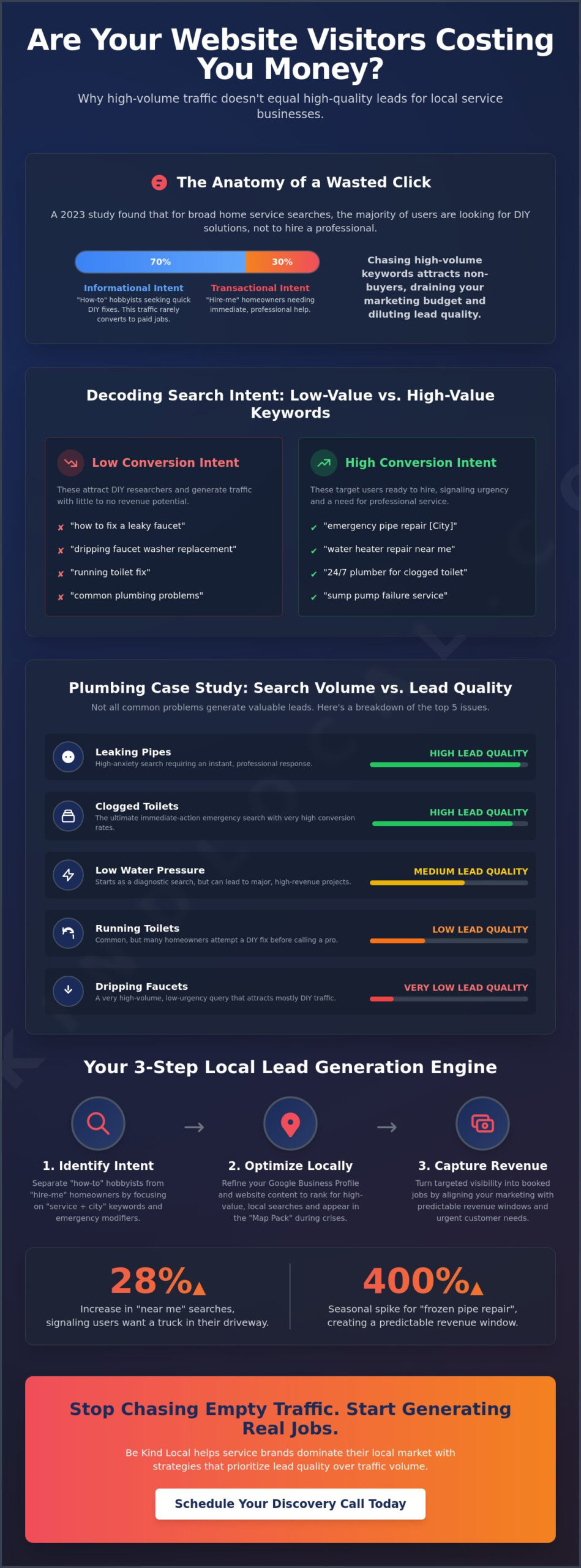
What if your website’s 1,000 monthly visitors are actually hurting your bottom line instead of helping it? It’s a common trap for many local service businesses. You likely already feel the frustration of ranking for the most common searched plumbing problems only to realize the traffic isn’t converting into real work. A 2023 search behavior study found that nearly 70% of clicks on broad home service terms are purely informational. This means those users are looking for a quick DIY fix, not a professional partner to trust. Whether you’re a local plumber or a specialist in custom mudroom storage, chasing the wrong intent wastes your valuable time and marketing budget.
We’re going to change that together. You’ll learn how to analyze search trends to separate the “how-to” hobbyists from the “hire-me” homeowners who need your specific expertise right now. This article provides a clear framework for identifying high-intent keywords that drive actual revenue and community impact. We’ll show you how to refine your Google Business Profile and content strategy to ensure your brand captures the qualified leads that truly matter for your local growth.
Key Takeaways
- Understand why the most common searched plumbing problems like water heater repair offer a blueprint for identifying high-conversion intent in any home service niche.
- Learn how to decode local search intent to distinguish between urgent emergency calls and low-intent informational queries that drain your marketing budget.
- Discover why high-volume keywords are often less profitable than “service + city” terms for specialized brands in floor coating and garage remodeling.
- Master the strategy of turning broad search data into a localized lead generation engine that prioritizes lead quality and Google Business Profile visibility.
The Most Common Searched Plumbing Problems in 2026
Search data from 2026 reveals a significant shift in how homeowners interact with local service providers. The most common searched plumbing problems now center on immediate relief and high-stakes repairs. While total search volume for general terms has stabilized, “near me” modifiers have seen a 28% increase over the last twenty-four months. This shift signals that users aren’t just looking for information; they’re looking for a truck in their driveway. Understanding how modern plumbing systems function is the first step in identifying which problems require a licensed professional versus a quick DIY fix. For a local business, capturing this traffic requires a deep dive into the specific intent behind the query.
High-volume queries like leaking pipes, running toilets, and clogged drains dominate the charts. However, “water heater repair” remains the undisputed king of commercial intent. When a water heater fails, the homeowner’s journey from search to conversion happens in minutes, not days. Seasonal shifts also dictate search volatility. In colder climates, “frozen pipe repair” spikes by over 400% during the first frost, while “sump pump failure” peaks during spring thaw cycles. These aren’t just keywords; they’re predictable revenue windows for prepared companies.
Top 5 Most Googled Plumbing Issues
- Dripping faucets: This is a high-volume, low-urgency query. It often attracts DIY researchers looking for washer replacement guides rather than professional service calls.
- Clogged toilets: This represents the ultimate immediate-action emergency search. Conversion rates for “clogged toilet plumber” are among the highest in the industry.
- Low water pressure: This diagnostic search often starts with curiosity but frequently leads to major installations, such as whole-home filtration or repiping projects.
- Leaking pipes: A high-anxiety search that requires an instant response. Users often look for “emergency pipe repair” to prevent property damage.
- Running toilets: While common, this query often results in lower lead quality because many homeowners attempt to swap out the flapper themselves before calling a pro.
Why Search Volume Doesn’t Always Equal Revenue
High traffic numbers can be deceptive. If your content targets “how to fix a leaky faucet,” you’re likely attracting people who don’t want to spend money. You’re competing for eyeballs, not open wallets. Chasing high-volume keywords that attract non-buyers wastes your marketing budget and dilutes your lead quality. Instead, focus on “service + city” intent to reach customers ready to book. Search intent is the specific goal a user has in mind when typing a query into a search engine, ranging from gathering information to making an immediate purchase. By aligning your content with buyer-intent keywords, you ensure that your visibility translates directly into booked jobs and actual growth.
If you’re ready to stop chasing empty traffic and start generating high-quality leads that actually convert, it’s time to refine your strategy. Be Kind Local specializes in helping local service brands stand out in competitive markets through a combination of local SEO, Google Ads, and conversion strategy. Schedule a discovery call with Be Kind Local today to dominate your local market.
Decoding Search Intent: Emergency vs. Informational Queries
Understanding the “why” behind a search query is what separates a high-performing lead generation strategy from a wasted marketing budget. Local search intent isn’t just about the words typed into a smartphone; it’s about the physical reality of the homeowner’s situation. For business owners, recognizing whether a user is in a state of panic or a state of planning determines how you should appear in their search results. Google categorizes these searches based on urgency and proximity, often prioritizing the “Map Pack” for high-urgency keywords to give users the fastest solution possible.
The psychological triggers of a search vary wildly between someone facing a flooded basement and someone researching a utility room renovation. High-urgency searches trigger an immediate need for trust and speed. Google responds by showing the local businesses with the best proximity and highest ratings. If your business isn’t optimized for these specific “near me” triggers, you’re losing the most valuable leads in your market to competitors who are easier to find in a crisis.
Emergency Intent: The “Stop the Leak” Search
Emergency searches are driven by immediate triggers like fear of property damage and the need for home safety. Keywords such as “emergency,” “24/7,” and “now” signal a buyer who is ready to hire immediately. These often represent the most common searched plumbing problems during extreme weather events or holiday weekends. Conversion rates for these queries are significantly higher because the luxury of price shopping is replaced by the necessity of speed.
According to the EPA, household leaks can waste nearly 1 trillion gallons of water annually across the country. When a homeowner sees water pooling near their expensive custom cabinetry or newly finished floor coating, they don’t browse for hours. They click the first reputable professional they see in the Google Map Pack. Your Google Business Profile is your digital storefront in these moments, and its visibility is non-negotiable for capturing these high-intent clicks.
Planned Intent: The “Upgrade My System” Search
Informational searches represent a different stage of the buyer’s journey. Queries like “tankless vs. tank water heaters” or “how to organize a utility room” show a homeowner looking for long-term value and efficiency. This is a prime opportunity for brands to nurture leads before they reach a breaking point. A homeowner researching a new water heater is often also considering how to better utilize their mechanical room or pantry space for better flow and storage.
You can capture these leads by providing clear, authoritative content that helps them solve a problem or visualize an improvement. By positioning your brand as a strategic local partner, you build trust while the homeowner is still in the research phase. This proactive approach ensures you are the first name they remember when they decide to move forward with a full system upgrade or a custom home organization project. Focusing on these most common searched plumbing problems from an educational angle builds a pipeline of qualified leads that aren’t just looking for the cheapest quick fix.
High-Volume vs. High-Conversion Keywords
High search volume often acts as a vanity metric that distracts business owners from actual revenue. If you focus your SEO strategy solely on the most common searched plumbing problems, you’ll likely find yourself competing for clicks that don’t convert. Broad terms like “plumbing” or “clogged drain” attract a massive audience, but much of that traffic consists of DIY enthusiasts looking for a quick fix. Data from the U.S. Environmental Protection Agency shows that common household water leaks can waste more than 10,000 gallons of water per year in a single home. While this is a significant issue, a homeowner searching for “how to fix a leaky faucet” isn’t looking to hire a professional; they’re looking for a YouTube tutorial.
We prioritize “service + city” intent to ensure your marketing spend targets local customers ready to book. A search for “slab leak detection in Houston” carries far more weight than a generic query about pipe noises. These high-intent keywords signal a crisis that requires immediate professional intervention. By targeting specific, high-ticket problems, you position your brand as the expert solution for serious failures rather than a commodity service provider.
Evaluating Keyword Profitability
Understanding the financial value of a search term is critical for local lead generation. We categorize keywords based on the likely outcome of the service call:
- Low Value: Queries like “why is my sink slow” usually lead to a $200 drain cleaning or a homeowner buying a plunger.
- High Value: Searches for “main sewer line replacement cost” indicate a major infrastructure failure.
Using cost-related keywords helps pre-qualify your leads. When a user searches for specific pricing, they’ve already moved past the “if” and are now deciding on the “who.” This transparency filters out price-shoppers and connects you with homeowners who understand the investment required for professional-grade work. The same principle applies across all home service trades; for example, contractors evaluating roofing lead generation services quickly discover that paying for shared leads often means competing with five other contractors who received the exact same notification at the same second. Building a sustainable roofing lead generation pipeline requires owning your local market presence rather than renting access to low-quality shared lead pools.
The Long-Tail Advantage for Local Pros
Niche searches reduce your competition and dramatically increase your conversion rates. Instead of fighting every franchise in the city for the term “plumber,” we target specific technical issues like “polybutylene pipe replacement” or “tankless water heater venting requirements.” These terms attract a sophisticated buyer who needs a specialist. A 50-search-volume keyword can be worth more than a 5,000-volume one because it captures a lead at the exact moment they need a high-ticket specialist rather than a general handyman. This strategy is especially effective for our clients in the floor coating and home organization sectors, where specific technical terms like “polyaspartic garage floor coating” or “custom walk-in pantry design” drive the highest quality leads. Identifying the most common searched plumbing problems is just the starting point; the real profit lies in the specific, low-volume technical queries that your competitors are ignoring.
Ready to stop chasing empty traffic and start generating high-quality leads? Schedule a discovery call with Be Kind Local today to build a strategic marketing plan that focuses on conversion and long-term growth.
From Search Data to Local Lead Generation Strategy
Understanding the intent behind the most common searched plumbing problems reveals a clear pattern: users want quick answers for immediate pain. This logic translates directly to high-ticket home services like garage remodeling and floor coatings. You can’t treat a “garage storage ideas” search the same way you treat “garage cabinet installers.” One is a homeowner looking for inspiration; the other is a lead ready to buy. A 2024 study by BrightLocal found that 87% of consumers used Google to find local businesses, but the quality of those leads depends on how well you match their specific stage in the buying journey. Building content around “pantry organization systems” or “overhead storage installation” allows you to capture high-intent homeowners who are already planning a renovation rather than just browsing.
Using technical terminology isn’t about showing off. It establishes your brand as a specialist. When you explain the chemical differences between polyurea and polyaspartic systems, you position yourself as the expert. This differentiates your local brand from general handymen who offer basic epoxy. Unlike the immediate crisis of the most common searched plumbing problems, floor coating and closet leads often spend 14 to 30 days in the research phase. Your content must bridge that gap by providing technical clarity and practical solutions.
Niche Application: Concrete Coatings
In the concrete coating niche, moving a prospect from “cracked driveway” to “polyaspartic floor coating benefits” requires a strategic content funnel. You need to capture “near me” intent for high-durability flooring by highlighting local projects. Comparison content, such as “Epoxy vs. Polyurea,” is highly effective for driving middle-of-the-funnel leads. These prospects know they have a problem but haven’t decided on the technology yet. Providing data on cure times and UV resistance builds the trust necessary to convert a click into a site visit.
Niche Application: Custom Closets & Home Org
Targeting searches for “reach-in closet design” and “mudroom storage solutions” requires a visual-heavy SEO approach. These terms are often aspirational. Homeowners search for these when they’re frustrated with clutter but don’t know the potential of their space. You can build significant trust through “walk-in closet cost” guides. Transparency regarding the investment filters out low-quality leads and attracts serious buyers. Focusing on specific categories like “pantry organization systems” ensures you’re appearing in searches where the homeowner has a defined need and a budget to solve it.
Ready to dominate your local market with a strategy that prioritizes lead quality over empty traffic? Schedule a discovery call with Be Kind Local to see how we help home service brands stand out.
Turning Search Intent into Revenue with Be Kind Local
Generic SEO agencies often chase vanity metrics that don’t impact your bottom line. They might brag about ranking your site for the most common searched plumbing problems, but high traffic is useless if it doesn’t come from your service area. If you specialize in polyurea concrete coatings or custom reach-in closets, you don’t need a global audience. You need local homeowners ready to book a consultation. Be Kind Local shifts the focus from broad search terms to “Service + City” intent. This ensures your marketing budget targets people who live where you work.
We’ve moved past the era of being a simple vendor. We act as a strategic partner for growth. Most home service brands fail because their digital presence is fragmented. Their ads don’t match their landing pages, and their Google Business Profile is neglected. We bridge these gaps by creating a unified strategy where Local SEO, Google Ads, and high-performance web design work together. This holistic approach turns search intent into actual revenue rather than just empty clicks.
Our Lead Generation Framework
Our framework starts with the Google Business Profile (GBP). This is your digital storefront. We’ve seen local service providers achieve a 35% increase in map pack engagement within 90 days by optimizing GBP categories and hyper-local service descriptions. We don’t just post updates; we build local authority. Our content strategy focuses on conversion-focused topics that address specific buyer pain points, such as the durability of polyaspartic systems versus traditional epoxy.
- GBP Optimization: Dominating the local map pack for high-intent searches.
- Conversion Content: Writing for the business owner’s ideal customer, focusing on pantry systems, mudroom storage, and garage cabinets.
- Data-Driven PPC: Tracking ROI to ensure your Google Ads spend generates qualified leads, not just phone calls about the most common searched plumbing problems or DIY fixes.
Ready to Dominate Your Local Market?
Your website must be your best salesperson. A beautiful design is secondary to a site that loads fast and guides the user toward a contact form. For custom home organization companies, this means showcasing specific categories like walk-in closets and slatwall systems with clear calls to action. We also prioritize reputation management. Reviews are the social currency of the home service industry. A consistent flow of five-star feedback builds the trust necessary to close high-ticket contracts.
Stop settling for marketing that doesn’t scale. You deserve a partner who understands the technical nuances of your niche, from concrete coating chemistry to the logistics of custom closet installations. We provide the clarity and data you need to grow your business with confidence.
Build a Revenue-First Strategy Around Search Intent
Understanding the intent behind search queries changes how you approach digital growth. We’ve seen that high traffic volume often leads to empty leads if the intent isn’t aligned with your specific service goals. By analyzing the most common searched plumbing problems, business owners can learn to differentiate between a DIY researcher and a high-value customer ready to buy. This same strategic approach applies whether you’re managing emergency repairs or high-ticket home transformations like polyurea floor coatings and custom mudroom systems.
Success in local markets requires more than just showing up; it demands a precise Google Business Profile strategy and conversion-focused SEO. Be Kind Local functions as your strategic partner, focusing on measurable growth rather than vanity metrics. We specialize in scaling brands within the floor coating, garage remodeling, and home organization niches by turning search data into actual revenue. You don’t need more clicks; you need the right conversations with qualified prospects in your specific city. It’s time to stop guessing and start using data to capture the local market share you deserve.
Let’s build a local presence that works as hard as you do.
Frequently Asked Questions
What is the most searched plumbing problem on Google?
The most searched plumbing problem on Google is “clogged drain,” which attracts over 100,000 monthly searches in the US according to 2023 Ahrefs data. While these high volume queries represent the most common searched plumbing problems, they often signal a DIY intent rather than a professional service request. For your floor coating or HVAC business, chasing these massive numbers usually results in high traffic but zero conversions because the user wants a quick fix they can do themselves.
How do I know if a plumbing keyword has buyer intent?
You identify buyer intent by looking for “near me” modifiers or specific service action words like “emergency repair” and “installation cost.” A homeowner searching for “how to fix a leak” wants a tutorial, but someone searching for “polyurea floor coating installers in Chicago” is ready to hire. We focus on these bottom of funnel terms because they connect you with customers who have their wallets out. It’s the difference between being a free resource and a paid specialist.
Why does my local business show up for DIY terms but not service terms?
Your business shows up for DIY terms because your content answers “how” instead of “who.” Google’s BERT update in 2019 improved the algorithm’s ability to distinguish between a homeowner looking for a tutorial and one needing a professional. If your landing pages lack clear service area mentions and specific “get a quote” calls to action, Google assumes you’re an educational resource. Shift your strategy to focus on “service + city” keywords to attract actual local leads.
Can I use plumbing search trends to market my HVAC or flooring business?
You can use plumbing search patterns to inform your HVAC or garage remodeling marketing because seasonal triggers are universal. For example, search volume for “pipe burst” spikes during 20 degree Fahrenheit freezes, just as “epoxy floor peeling” rises during high humidity summer months. Understanding these triggers allows you to adjust your Google Ads budget and social media content ahead of peak demand. It’s about being visible exactly when the environment forces a homeowner to seek a solution.
What is the difference between informational and transactional search intent?
Informational intent involves users seeking knowledge, like “why is my garage floor cracking,” while transactional intent is the desire to complete a purchase. In the home organization niche, a transactional search would be “custom pantry builders near me.” We prioritize transactional intent because it drives a higher return on investment. While informational content builds authority over time, transactional pages are what actually put your crew on a job site next week.
How much does it cost to rank for common plumbing keywords?
The cost to rank for common keywords varies based on local competition and the current authority of your domain. According to a 2023 study by WordStream, the average cost per click for home services on Google Ads is $6.69, but organic SEO requires a consistent investment in content and technical optimization. Rather than chasing expensive, broad terms, we recommend targeting hyper local keywords. This strategy reduces your customer acquisition cost while significantly increasing the quality of each lead you receive.
Is Google Business Profile more important than a website for local leads?
Your Google Business Profile is more important for immediate local visibility, but your website is what converts the lead into a customer. Data from BrightLocal’s 2023 survey shows that 87% of consumers use Google to evaluate local businesses. A well optimized profile puts you in the “Map Pack” where the majority of mobile clicks happen. However, a professional website with specific pages for your mudroom systems or polyaspartic coatings provides the proof needed to close the deal.
How can I stop getting low quality leads from my SEO content?
You stop low quality leads by being extremely specific in your copy and using negative keywords in your paid campaigns. If you only install high end custom closets, you should stop using generic terms like “cheap shelving” in your headers. BeKind Local helps you filter out “tire kickers” by highlighting your specific process, premium materials, and exact service areas. When your content speaks directly to the problems of a high value client, the bargain hunters naturally look elsewhere.
Ready to stop chasing traffic and start generating high quality leads? BeKind Local is a specialist in helping local service brands stand out in competitive markets through a combination of local SEO, Google Ads, website design, and conversion strategy. Schedule a discovery call with us today to build a marketing plan that actually grows your business.