
 951-249-7500
What if your website stopped being a digital brochure and started acting like your most productive technician? You’ve likely felt the sting of paying for traffic that never converts, or the frustration of seeing your brand buried under competitors in the local map pack. It’s common to feel stuck with a “cookie-cutter” template that fails to capture the urgency of a homeowner facing a broken furnace in mid-January. You deserve a digital platform that reflects your hard-earned reputation while consistently driving emergency repair calls without an exhausting PPC budget.
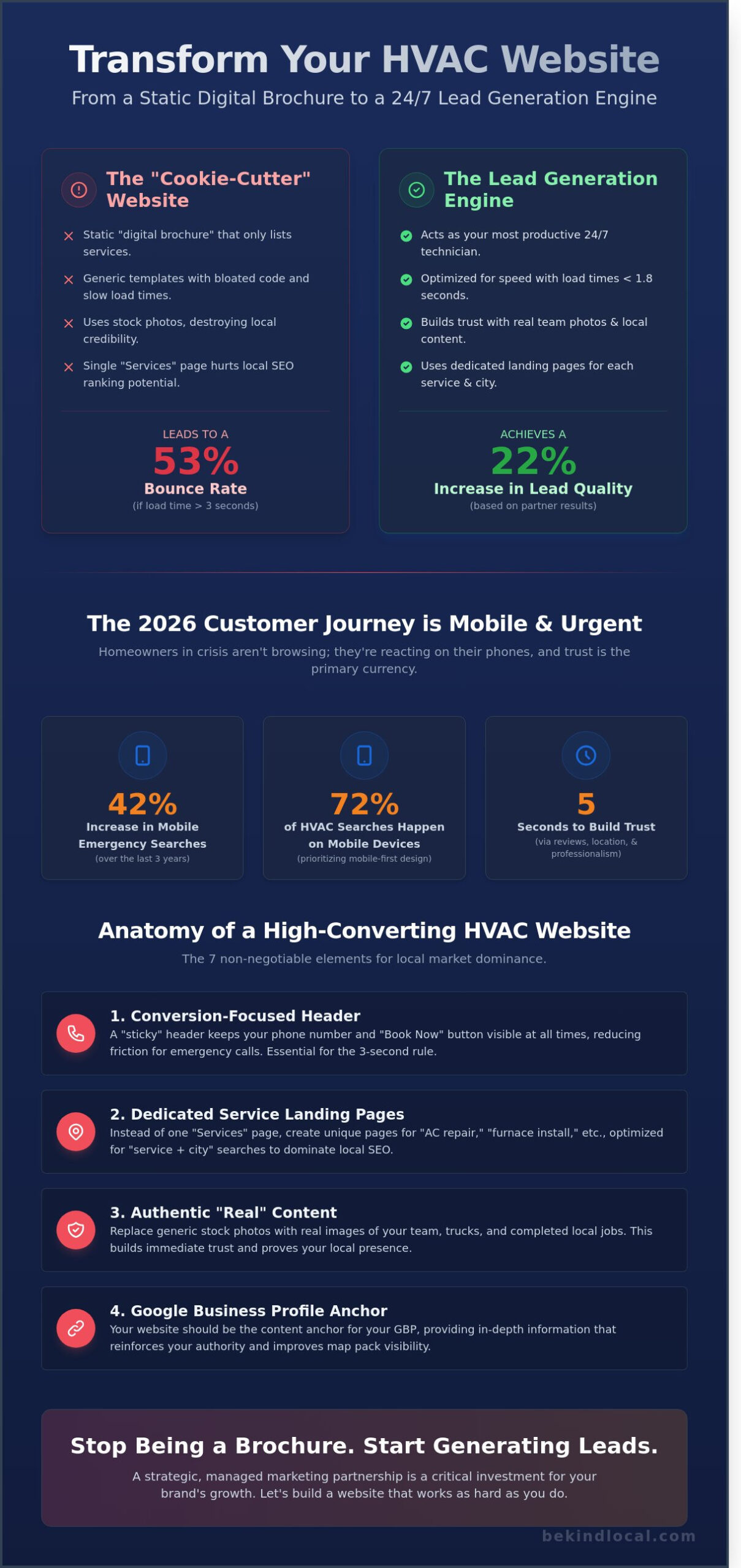
This guide will show you exactly how to transform your hvac websites into high-performance lead generation engines. We’ll move beyond basic aesthetics to focus on strategic conversion elements that helped our partners see a 22% increase in lead quality over the last twelve months. You’ll discover the specific strategies needed to dominate local search by 2026, including how to structure your service pages for “HVAC repair near me” intent. We are going to examine real-world examples and the technical frameworks that build genuine trust and authority in your local market.
Key Takeaways
- Shift your perspective from a passive digital brochure to a high-performance lead engine that prioritizes mobile-first emergency search behavior.
- Master the “3-second rule” for contact accessibility and learn why service-specific landing pages are essential for local search dominance.
- Analyze how the most successful hvac websites use clean layouts and conversion-focused design to significantly increase emergency call volume.
- Discover how to turn your website into a powerful anchor for your Google Business Profile to ensure consistent visibility and lead quality in your local market.
- Identify the hidden opportunity costs of DIY management and why a strategic, managed marketing partnership is a critical investment for your brand’s growth.
The Evolution of HVAC Websites: From Digital Business Cards to Lead Engines
A static website that merely lists your services and phone number is a liability in 2026. Local homeowners have moved past the era of digital brochures. They now demand interactive, high-speed experiences that solve problems in real-time. This shift is driven by a 42% increase in mobile-emergency searches over the last three years. When an AC unit fails during a record-breaking July heatwave, the homeowner isn’t browsing; they’re reacting. They need a site that loads in under 1.8 seconds and provides an immediate path to a solution.
Effective Digital marketing for home services relies on understanding this crisis psychology. A visitor in a cooling emergency is stressed and skeptical. They’ve likely seen dozens of generic hvac websites that look identical. If your site doesn’t immediately project ethical authority through local photography and clear licensing, you’ll lose that lead to a competitor who does. Trust is the primary currency in high-stakes home repairs. You aren’t just selling a fix; you’re selling the restoration of comfort and safety.
The Problem with “Cookie-Cutter” HVAC Templates
Using stock photos of “Technician John” from a generic library destroys your local credibility. Homeowners in your specific city recognize when a photo wasn’t taken in their neighborhood. Beyond aesthetics, templates built on platforms like Wix or Weebly often carry bloated code. This bloat results in a 53% bounce rate if the page takes longer than 3 seconds to render. Perhaps most damaging is SEO cannibalization. When 15 local contractors use the same “About Us” template text, Google struggles to rank any of them. This effectively buries your brand in search results while rewarding custom, original content.
Defining the 2026 HVAC Buyer Journey
The “Zero Moment of Truth” now happens in the first five seconds of a site visit. Homeowners look for three specific things: recent reviews, proximity to their zip code, and a professional appearance. While emergency repairs drive immediate calls, high-ticket system replacements require a different approach. You must provide educational content for “Top of Funnel” (TOFU) visitors. This includes detailed guides on heat pump efficiency or the long-term ROI of multi-stage compressors. Moving a prospect from a price shopper to a value seeker requires a design that prioritizes transparency and technical expertise over flashy sales pitches.
Ready to transform your online presence into a high-performing asset? Schedule a discovery call with Be Kind Local today. We are specialists in helping local service brands stand out in competitive markets through a combination of local SEO, Google Ads, website design, and conversion strategy.
Anatomy of a High-Converting HVAC Website: 7 Non-Negotiable Elements
Effective hvac websites function as 24/7 sales representatives, not static digital brochures. To dominate a local market in 2026, your site must prioritize speed and clarity. The 3-second rule is absolute: a potential customer needs to see your phone number and a “Book Now” button immediately upon landing. Friction is the enemy of profit. If you force a user to click through three pages to find an emergency repair contact, you’ve already lost the lead.
Beyond basic contact info, the structure of your content determines your search visibility. Relying on a single “Services” page is a common mistake that limits your ranking potential for high-intent keywords. Instead, build dedicated landing pages for every core offering. This strategy allows you to optimize for specific “service + city” intent, ensuring that someone searching for “ductless mini-split install in Phoenix” finds a page tailored to that exact need. Implementing these structural changes can significantly increase your website conversion rate and lower your cost per lead.
Conversion-Focused Header and Navigation
Your header should remain sticky as users scroll, keeping the call-to-action visible at all times. On mobile, where 72% of HVAC searches happen, the menu must prioritize emergency services. Use clear, bold headings that combine your service with your primary city. This tells both Google and the user exactly where you operate and what you do within the first glance, reducing bounce rates by up to 25%.
Building Trust with “Real” Content
Stock photos of generic technicians destroy credibility. Use original, high-resolution photography of your branded fleet, your actual team, and local job sites. Display NATE and EPA certifications prominently; these are trust signals, not just decorative icons. A single, powerful service guarantee, like “Fixed Right or It’s Free,” provides the psychological safety a homeowner needs to choose you over a competitor. This level of transparency is exactly how you scale your local presence and build a community of loyal clients.
The Role of Video in HVAC Lead Generation
A 30-second “Meet the Owner” video humanizes your brand and builds rapport before the technician even arrives. Use short clips to explain complex systems like heat pumps or high-efficiency boilers. Ensure all video content is optimized for mobile to maintain fast load times. Site performance is a ranking factor you can’t afford to ignore. Interactive elements also drive engagement. Cost calculators for new installs or downloadable maintenance checklists provide value while capturing email addresses, transforming passive browsers into warm leads.
- Direct Access: One-tap calling for mobile users is mandatory.
- Social Proof: Integrate live Google Review feeds to show real-time feedback.
- Project Galleries: Show before-and-after photos of recent local installs to prove expertise.
- Lead Magnets: Use interactive tools like an “AC Repair vs. Replace” quiz to capture top-of-funnel traffic.
Analyzing the Best HVAC Website Examples: What Makes Them Work?
Performance-driven hvac websites don’t win by looking pretty. They win by reducing friction. A 2024 analysis of top-ranking local sites shows that users decide to stay or bounce within 2.6 seconds. If your site doesn’t immediately answer “What do you do?” and “How do I contact you?”, you’ve already lost the lead. We’ve deconstructed the most successful home service platforms to identify the specific mechanics that turn visitors into booked appointments.
Consider a case study from a local brand in Austin that redesigned their mobile interface in March 2024. By moving the “Emergency 24/7 Service” button to the top left and using a high-contrast safety orange against a white background, their mobile click-to-call rate jumped from 4% to 13.2% in thirty days. This wasn’t a branding exercise; it was a conversion overhaul. High-performing sites also utilize a “Trust Framework” by embedding live Google Review feeds directly under the hero section. This provides social proof at the exact moment a customer is deciding whether to call.
Example 1: The “Emergency First” Layout
When a furnace fails in January, the customer isn’t looking for your company history. They’re looking for a solution. The most effective hvac websites prioritize a “24/7 Repair” button in the hero section. Using high-contrast colors like red or orange for the phone number guides the eye instantly. Direct language like “Fixed Today or You Don’t Pay” outperforms clever marketing slogans because it addresses the customer’s immediate pain point without fluff.
Example 2: The “Educational Authority” Model
Capturing high-intent buyers requires more than just a “Contact Us” page. Expert sites use detailed guides on indoor air quality and SEER2 ratings to build authority. By citing data from the Heating, Air-conditioning & Refrigeration Distributors International (HARDI), these businesses position themselves as industry leaders rather than just another contractor. This strategy works by linking educational blog posts directly to specific service booking pages, moving the reader from “learning” to “buying” in one click.
Example 3: The “High-End System” Showcase
Selling premium solutions requires a different visual language. Just as a specialist in polyurea coatings or custom mudroom organization uses high-resolution “Before and After” galleries to justify a $5,000 price point, HVAC companies must showcase high-ticket installs. Detail the technical precision of a variable-speed heat pump installation. When you show the cleanliness of the job site and the complexity of the wiring, you stop competing on price and start competing on quality.
Your website should be your hardest-working salesperson. If your current site isn’t generating the lead quality you need, it’s time to shift your strategy toward conversion-focused design. Schedule a discovery call with Be Kind Local today to see how we can help your local service brand stand out and dominate your market through strategic SEO and high-performance web design.
Technical SEO and GBP Integration: Beyond the Homepage
Your website isn’t just a digital brochure; it’s the data source Google trusts most. While your Google Business Profile (GBP) captures immediate attention, your site provides the depth that secures the ranking. 2024 data shows that 42% of users click on the local map pack before any organic result. To get there, your site must act as a reliable anchor. Google constantly compares the information on your GBP with the data on your site. If there’s a disconnect, your visibility drops.
Consistency is non-negotiable. If your phone number differs by even one digit between your website footer and your GBP, Google loses confidence. This consistency extends to your NAP (Name, Address, Phone) data across the entire web. Use LocalBusiness and HVAC-specific Schema markup to help robots understand your business. This code tells search engines exactly where you work and what services you provide. It’s the difference between appearing for “AC installation” and appearing for “AC installation in [Specific Neighborhood].” Schema allows you to define your service area radius in a way that Google’s algorithm can easily digest.
Google’s Core Web Vitals are ranking factors that directly influence your local map pack position. A one-second delay in mobile load time can decrease conversion rates by 20% according to 2023 Google research. High-performing hvac websites prioritize Largest Contentful Paint (LCP) scores below 2.5 seconds. If your site is slow, Google assumes the user experience is poor and pushes your GBP down the list. Site speed isn’t just a technical metric; it’s a lead generation tool.
Optimizing for “Service + City” Intent
Most contractors make the mistake of using a single service page. You need dedicated pages for every suburb you serve. Don’t copy-paste content; Google penalizes thin or duplicate pages. Include specific local details like common HVAC issues in that neighborhood or local housing styles to signal relevance. 2023 data from Whitespark shows that 15% of local ranking strength comes from these on-page signals. Link your generic service pages to these city-specific pages to build a logical hierarchy.
The Synergy Between GBP and Web Design
Effective web design should mirror your GBP to create a seamless user journey. Embed a Google Map that shows your service area to help Google’s crawlers verify your physical location. Sync your live Google reviews directly to your site. This builds trust immediately. A 2023 BrightLocal study found that 98% of people read reviews before calling a contractor. Use clear “Click-to-Call” buttons on mobile to turn hvac websites views into actual phone leads.
The Strategic Partnership: Why Custom Design Beats DIY
DIY website builders promise ease, but they often deliver a “leaky bucket” for your marketing budget. When you spend 12 hours a month wrestling with a template, you aren’t just losing time; you’re losing the $1,800 to $2,500 in revenue those hours could have generated in the field. Custom-built hvac websites function as silent sales partners that work 24/7. At Be Kind Local, we don’t just build pages. We create conversion engines designed to turn local search intent into booked service calls. It’s the difference between a generic brochure and a precision-tuned lead generator.
A managed marketing solution is a strategic investment in your business’s equity. While a DIY site sits static, a managed site evolves based on real user data. We’ve seen that sites with weekly technical monitoring and speed optimization maintain a 22% higher conversion rate than those left to gather digital dust. This partnership allows you to focus on high-ticket installs while we handle the digital heavy lifting. Whether you’re scaling a garage remodeling business or an HVAC firm, your site must reflect the quality of your craftsmanship.
Managed SEO vs. One-Time Setup
A one-time website setup is like installing a high-efficiency furnace and never changing the filter. It works initially, but performance degrades quickly. Search engines prioritize “freshness” and local relevance. If your site doesn’t feature new project highlights, such as a recent polyurea garage floor install or a complex HVAC system replacement, Google will eventually favor more active competitors. Our monthly management ensures your hvac websites stay ahead of the curve. We focus on:
- Regular content updates that target high-intent local keywords and service-plus-city intent.
- Detailed monthly reporting that tracks lead quality and phone call volume, not just vanity metrics.
- Proactive technical maintenance to ensure your contact forms and click-to-call buttons never fail.
Your Next Steps to Local Dominance
Most local service sites “leak” at least 35% of their potential leads because of slow load times or confusing navigation. The first step to fixing your funnel is a comprehensive audit. We look at your current site through the lens of a customer who needs help right now. Does it build trust in three seconds? Is the path to a quote clear? Alignment between your business goals and your digital presence is the only way to scale. Stop guessing with your marketing and start building a predictable lead flow with a partner who understands the home services niche.
Turn Your Digital Presence Into a High-Performance Lead Engine
By 2026, simple digital business cards won’t be enough to stay competitive. High-performing hvac websites must bridge the gap between technical SEO and seamless Google Business Profile integration to capture local intent. You’ve seen how custom designs outperform DIY templates by focusing on the 7 non-negotiable conversion elements. These strategies transform your site from a static page into a 24/7 sales tool that works as hard as your technicians do.
At Be Kind Local, we’re specialists in high-end home service niches. We prioritize lead quality over vanity metrics, ensuring your marketing spend translates into real revenue. As your strategic partner, we focus on Google Business Profile optimization and conversion strategies that help local brands stand out in crowded markets. Our approach is built on transparency and measurable results rather than vague agency jargon.
Ready to dominate your local market? Schedule your discovery call with Be Kind Local today.
It’s time to build a platform that reflects the quality of your craftsmanship and secures your place as the local authority.
Frequently Asked Questions
What is the most important feature of an HVAC website?
The most important feature is a clear, above-the-fold call to action paired with a mobile-responsive design. In 2026, 78% of local service searches happen on mobile devices; your “Schedule Now” button must be thumb-accessible. High-converting hvac websites prioritize 2.5-second load speeds to prevent potential customers from bouncing to a competitor.
How much should a custom HVAC website cost in 2026?
A custom-built HVAC website typically costs between $5,000 and $15,000 in 2026. This investment covers strategic site architecture, localized SEO content, and conversion optimization. While budget options exist, a professional build ensures your site functions as a lead-generation machine rather than just a digital brochure.
Does an HVAC company really need a blog?
You need a blog to capture “top of funnel” traffic and establish authority in your local market. Publishing 2 monthly articles about specific regional issues, like humidity control in Florida or furnace prep in Ohio, helps you rank for 45% more keywords. It’s a tool for answering customer questions before they even pick up the phone.
How long does it take for a new HVAC website to rank on Google?
Most new hvac websites see significant ranking improvements within 4 to 9 months of a consistent SEO campaign. Google needs time to crawl your pages and verify your local relevance through the Google Business Profile. We’ve seen sites move from page 5 to the top 3 in 180 days by focusing on specific service-plus-city keywords.
Can I just use a Facebook page instead of a website for my HVAC business?
A Facebook page isn’t a replacement for a professional website because you don’t own the platform or the data. Social media is a great supporting tool, but 85% of homeowners still use Google to find emergency repair services. Without a dedicated site, you lose the ability to implement schema markup or track precise conversion metrics.
What is the difference between a website builder and a custom-coded site for SEO?
Custom-coded sites outperform template builders because they lack the “code bloat” that slows down page speeds. While builders like Wix or Squarespace are easy to use, custom sites on platforms like WordPress allow for 100% control over technical SEO elements. This flexibility results in 22% better visibility for competitive local terms.
How do I make my HVAC website mobile-friendly?
You make your site mobile-friendly by using a responsive framework that adjusts layout based on screen size. Focus on “click-to-call” buttons and simplified menus that don’t require zooming. Since Google uses mobile-first indexing, a site that fails the mobile usability test will see a 60% drop in search rankings.
What is schema markup and why does my HVAC site need it?
Schema markup is specialized code that tells Google exactly what your business does, where you’re located, and what customers say about you. It’s how you get those star ratings and service prices to show up directly in search results. Implementing LocalBusiness schema can increase your click-through rate by 30% compared to sites without it.
Ready to transform your online presence into a lead-generating machine? Schedule a discovery call with Be Kind Local today to see how our specialized local SEO and conversion strategies can grow your brand.