
 951-249-7500
What if the decision to buy roofing leads from a major vendor is actually the most expensive mistake you’ll make this year? It’s frustrating to watch your project margins shrink because you’re paying for homeowners who won’t pick up the phone or, worse, are already talking to five other contractors. We know how it feels to gamble your hard-earned marketing budget on shared leads that feel more like a lottery than a business strategy. You deserve a pipeline that works as hard as your crew does on a job site.
You probably agree that the current model of chasing non-exclusive prospects is a race to the bottom. In this guide, you’ll discover how to shift from being a lead renter to a lead owner by comparing traditional vendors against custom generation strategies that build long-term assets. We’re going to analyze exactly why custom systems produced a 22% higher closing ratio for local service brands in 2025 and how you can reclaim your exclusivity in 2026. This isn’t about quick fixes; it’s about building a predictable flow of homeowners who actually want to work with your team. We’ll show you how to stop competing on price and start winning through authority.
Key Takeaways
- Understand why the rising cost of “rented” leads makes direct-to-contractor marketing a strategic necessity for sustainable growth in 2026.
- Master the financial math behind your pipeline by shifting focus from simple cost-per-lead metrics to true cost-per-acquisition and closing ratios.
- Compare the immediate results of choosing to buy roofing leads against the compounding value of building a permanent asset through Google Business Profile visibility.
- Learn the essential verification steps and TCPA compliance questions required to protect your business when evaluating any third-party lead vendor.
- Discover how to transition from low-quality shared inquiries to a custom lead engine that generates exclusive inbound calls for your specific local market.
Understanding the 2026 Roofing Lead Marketplace
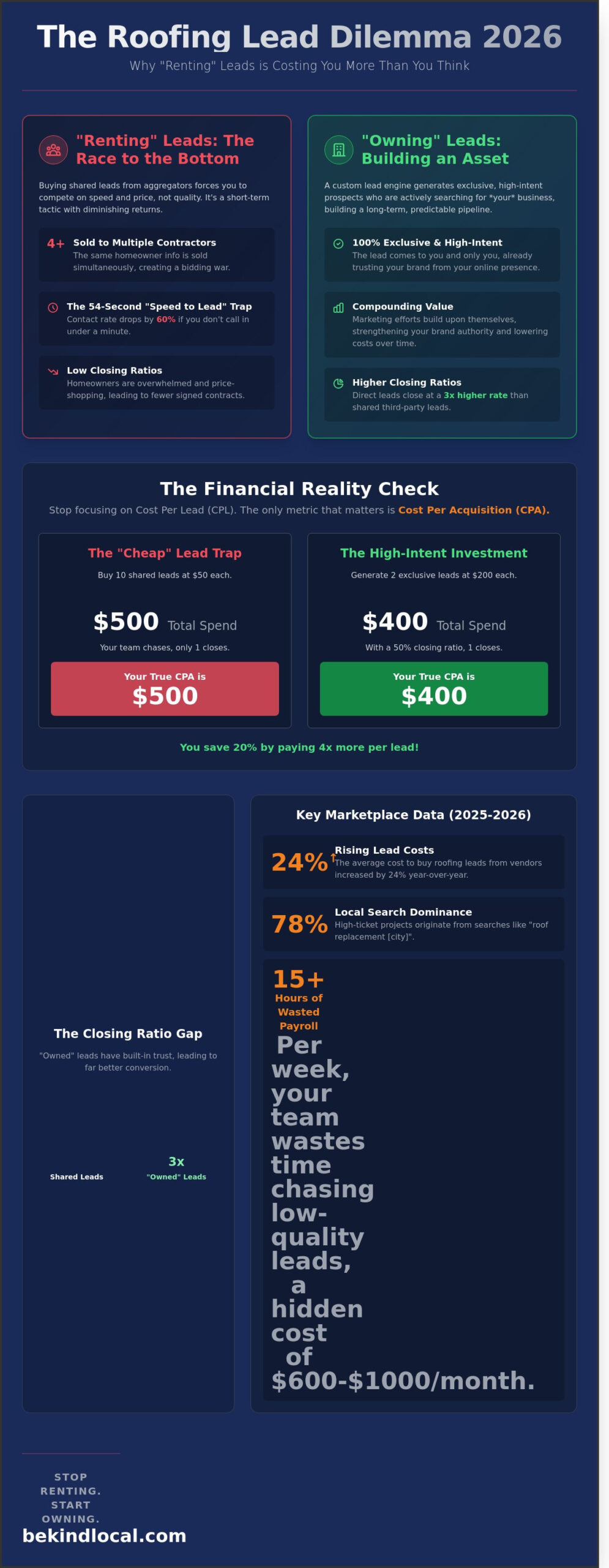
The marketplace for home service growth has shifted from simple volume to a battle for ownership. In 2026, contractors face a stark divide between lead aggregators and direct-to-contractor marketing. Aggregators act as digital landlords; they rent you access to homeowners they’ve captured through their own SEO and paid ads. Direct marketing allows you to own the asset. Data from 2025 shows that the average cost to buy roofing leads through third-party platforms has increased by 24% year-over-year. This inflation is driven by platform saturation and the rising cost of digital real estate.
Success now depends on capturing “service + city” search intent. 78% of high-ticket roofing projects in 2026 originate from localized, high-intent searches like “roof replacement Miami” rather than generic industry terms. This shift makes Lead generation a game of precision. You aren’t just looking for anyone with a leaky roof; you’re looking for the homeowner in a specific zip code who is ready to invest. Most providers categorize these opportunities into three distinct buckets: Shared, Exclusive, and Live Transfers.
Shared Leads: The Race to the Bottom
Shared leads are the most common and often the most frustrating. Platforms like Angi or HomeAdvisor sell a single homeowner’s contact information to four or more contractors simultaneously. This creates a “Speed to Lead” trap. If your sales team doesn’t call within 54 seconds, your contact rate drops by 60%. It’s an exhausting cycle that forces your staff to act like telemarketers. The hidden cost isn’t just the $50 to $90 per lead; it’s the 15 hours per week your team wastes chasing prospects who have already booked an appointment with a competitor who dialed faster. The same frustrating dynamic affects home service contractors across every trade — for example, contractors seeking high-quality HVAC leads face identical speed-to-lead pressure and shared contact pitfalls when relying on aggregator platforms.
Exclusive Leads: Buying a Direct Pipeline
Exclusive leads offer a higher ceiling for conversion because they’re sold to only one contractor. You pay a premium for this exclusivity, often 3 to 4 times the cost of a shared lead, but the math usually favors the investment. High-quality vendors in 2026 use TrustedForm or Jornaya certificates to ensure TCPA compliance and verify that the homeowner’s intent is genuine. These tools provide a “video” replay of the user filling out the form, protecting you from litigation and fraud.
While exclusive leads are superior to shared ones, they still carry a brand trust gap. The homeowner is responding to a generic “Get a Quote” landing page rather than your specific business. Even when you buy roofing leads that are exclusive, you’re still introducing your brand to a stranger. This is why these leads require a different sales approach than a direct referral or a lead generated through your own Google Business Profile, where the customer has already vetted your reviews and past projects.
Strategic growth requires moving beyond these “rented” models. If you’re ready to stop competing on speed and start competing on authority, schedule a discovery call with Be Kind Local. We specialize in helping local service brands, from roofing to polyurea floor coatings and custom closet systems, dominate their local markets through search intent and conversion-focused strategy.
The Financial Reality: Calculating Your True Cost Per Lead
Most contractors focus on the wrong number when they decide to buy roofing leads. They look at the upfront price tag, often choosing a $50 lead over a $200 lead without looking at the backend math. Cost Per Lead (CPL) is a vanity metric that tells you nothing about your bank balance at the end of the month. Instead, you must focus on Cost Per Acquisition (CPA), which is the total amount spent to put one signed contract on the board. Cost Per Acquisition is the only metric that determines roofing profitability.
The math rarely favors the cheaper option. If you buy 10 leads at $50 each and only close one, your CPA is $500. If you generate a high-intent lead for $200 and close it at a 50% rate, your CPA drops to $400. You’ve saved 20% on your marketing costs by paying four times more per lead. Beyond the ad spend, you have to account for admin overhead. When your team spends 15 hours a week chasing junk data or disconnected numbers, you’re paying for labor that produces zero ROI. This “hidden” payroll expense can easily add $600 to $1,000 to your monthly operating costs without adding a single roof to your schedule.
The Closing Ratio Gap
Leads generated through your own website typically close at a 3x higher rate than shared third-party leads. This happens because the homeowner has already interacted with your brand, read your reviews, and seen your local projects. There’s an established layer of trust before the first phone call. Conversely, buying shared leads often results in “Lead Burnout.” When a sales rep calls 25 leads and 20 of them are already working with a competitor or don’t remember filling out a form, their motivation plummets. This friction reduces the effectiveness of your entire sales department.
Hidden Fees and Subscription Traps
Many lead vendors hide their true costs behind platform fees and monthly minimums. You might sign a contract for $1,500 a month in leads, only to find an additional $300 “management fee” tucked into the fine print. Getting credits for bad leads is notoriously difficult. Vendors often require proof that a number was out of service, a process that takes more time than the lead is worth. When you vet a provider, ensure they follow truth-in-advertising standards regarding how they capture and sell homeowner data. Long-term contracts usually benefit the vendor’s cash flow, not your growth. Building a sustainable lead engine takes work, but it’s often more profitable than relying on shared pools; you can explore custom strategies that prioritize your brand’s unique local presence and long-term health.
Buying Leads vs. Building an Asset: A Comparison
When you decide to buy roofing leads from a third-party aggregator, you’re investing in a one-time transaction. It is a rental model. The moment you stop paying the vendor, your lead flow vanishes. Building a digital asset focuses on compounding growth that stays with your business for years. Research shows that 68% of all clicks in local searches go to the top three positions in the Google Map Pack. If your business isn’t there, you’re effectively paying a “middleman tax” to reach customers who are already looking for you.
High-margin niches like polyurea concrete coating or custom walk-in closets require deep consumer trust. A generic lead form on a shared platform rarely provides the authority needed to close a $5,000 garage floor project. Homeowners want to see your specific work, your local reviews, and your brand’s personality before they invite you into their home. Owning the top of Google allows you to control this narrative from the first click. Contractors who want to move beyond aggregator dependency can learn how to build a multi-channel roofing lead generation system that creates a sustainable pipeline rather than a recurring expense.
The Local SEO Advantage
Local SEO is about building authority in your specific service area without the constant drain of pay-per-lead costs. Your Google Business Profile (GBP) acts as a 24/7 digital storefront. When you optimize for “service + city” intent, you generate inquiries that are often 40% more likely to close than shared leads. Customer reviews on your own profile drive higher quality inquiries because the social proof is tied directly to your brand. For a deeper dive into these strategies, you can Boost Your Business with Local SEO to see how organic visibility creates long-term stability.
Google Ads (PPC) for Immediate, Exclusive Results
If you need leads today, Google Ads allows you to “buy” the top spot on your own terms. Unlike lead vendors who sell the same contact info to five contractors, PPC traffic is exclusive to you. You control the destination by sending traffic to a high-converting custom landing page designed for your specific services. This is particularly effective for targeting high-value keywords like “commercial roofing” or “emergency roof repair” where the intent is urgent.
- Control the Narrative: Use custom copy to highlight your lifetime warranty or 24-hour turnaround.
- Target High-Value Jobs: Filter your ads to only show for specific zip codes or high-income neighborhoods.
- Data Ownership: You keep all the data from every click, allowing you to refine your marketing over time.
Relying on a vendor means you’re building their business, not yours. By shifting your budget toward Local SEO and targeted PPC, you’re investing in an asset that increases the total valuation of your company. This strategic approach ensures you aren’t just surviving on the next lead, but thriving through a sustainable marketing ecosystem.
How to Evaluate a Roofing Lead Vendor Before You Sign
Choosing to buy roofing leads is a major capital investment, not just a line item expense. You’re trusting a third party with your brand’s first impression. Before you sign a contract or deposit funds, you must verify their sourcing ethics. Ask for a sample of the exact landing page they use. If they refuse to show you the funnel, they’re likely hiding low-quality “sweepstakes” tactics that burn through your sales team’s time. A vendor who won’t show you the front-end of their process isn’t a partner; they’re a middleman hiding a flawed product.
Verification of TCPA (Telephone Consumer Protection Act) compliance is non-negotiable. According to 2024 legal filings, TCPA litigation has increased by 12% year-over-year. Ensure your vendor uses tools like ActiveProspect or Jornaya to provide a “LeadID” for every contact. This certificate proves the homeowner gave express written consent to be contacted. Without this, one bad lead could result in a $1,500 fine per call. It’s your business on the line, so don’t take “we’re compliant” as a sufficient answer. Demand the documentation.
Don’t commit to a high-volume monthly spend immediately. Start with a pilot program of 20 to 30 leads. This small batch allows you to measure the “contact rate” and “appointment set rate” without risking five figures. A reputable vendor won’t shy away from a trial period; they’ll embrace it to prove their value. If a provider demands a long-term contract before you’ve seen a single homeowner’s name, that’s a clear signal to look elsewhere.
The Sourcing Red Flag Checklist
High-quality leads come from search intent, not “win a free roof” social media ads. These “incentivized” leads often result in a 0.5% conversion rate because the person wants a prize, not a contractor. Ask the vendor how old the data is. Leads older than 5 minutes lose 80% of their value. Demand the original URL where the homeowner submitted their info to verify the branding is consistent with your service area. If the lead is coming from a generic “Home Quotes Now” site, the homeowner has no connection to your specific brand.
Analyzing the Quality of the Funnel
A lead form that only asks for a name and phone number is a trap. Effective funnels use qualifying questions, such as “How old is your roof?” or “What is the primary material?”. These hurdles filter out “tire kickers.” When you buy roofing leads, you’re paying for the work the funnel did to qualify that person. Focus on “service + city” intent. For example, a homeowner searching for “concrete coating Orlando” or “pantry organization Dallas” is 4 times more likely to book than someone clicking a generic home improvement ad. This level of specific intent is what separates a profitable campaign from a wasted budget.
Transparency in the dispute process is your final safeguard. If a vendor doesn’t credit you for disconnected numbers or commercial properties when you paid for residential, walk away. You deserve a partner who values your ROI as much as their own. If you’re tired of guessing which leads will actually close, it’s time to schedule a discovery call and build a predictable growth engine that belongs to you.
The Strategic Alternative: Building Your Own Lead Engine
Relying on third-party providers to buy roofing leads is a short-term fix that often leads to long-term frustration. When you purchase a lead from a major aggregator, you’re usually buying a shared contact. You’re forced into a race to the bottom on price against five other contractors who received the same notification. Be Kind Local offers a different path. We build custom lead machines that generate exclusive inbound calls directly for your brand. This strategy shifts your business from a state of dependency to one of total market ownership.
Our approach integrates Local SEO, high-intent PPC, and conversion-optimized web design to capture homeowners exactly when they’re ready to buy. We don’t just focus on volume; we focus on intent. Whether you’re installing a new roof, applying a polyaspartic floor coating, or designing custom closets, the goal is the same. We want the homeowner to call you because they trust your brand, not because you were the first person to dial their number after they filled out a generic form.
Owning the Local Map Pack
The Google Business Profile is the most valuable asset for any local home service brand. Statistics show that the top three results in the Local Map Pack capture approximately 44% of all clicks. We optimize your profile to ensure you dominate these positions for “service + city” searches. This visibility creates a steady stream of inbound calls that bypass the “junk” lead cycle entirely.
We use content marketing to address specific homeowner concerns before they even pick up the phone. By answering technical questions about polyurea systems, slatwall durability, or pantry organization, you establish yourself as the local authority. Your website stops being a digital brochure and starts acting as a 24/7 salesperson. A site designed for conversion can increase lead quality by 30% compared to standard templates, ensuring the people contacting you are actually qualified for your services.
Scaling with Predictability
Custom lead generation ends the feast or famine cycle that plagues many contractors. When you own the engine, you control the dial. You can scale your PPC spend when you need more work for your crews or lean on your organic SEO during peak seasons. This predictability allows you to hire with confidence and invest in better equipment, like specialized spray rigs for epoxy floor coatings or high-end cabinetry tools for mudroom storage projects.
Building a brand that homeowners recognize creates a compounding effect. Over time, your reliance on paid ads decreases as your organic presence and word-of-mouth referrals grow. Businesses that transition to this model typically see a 15% to 20% reduction in their customer acquisition costs within the first year. You aren’t just getting leads; you’re building a sustainable business asset that increases in value every day.
Schedule a discovery call with Be Kind Local to build your lead engine
Stop Renting Your Growth and Own Your Local Market
Choosing to buy roofing leads often feels like the easiest path, but it leaves your business vulnerable to sudden price hikes and shared competition. By 2026, the gap between companies that rent their visibility and those that own it will widen significantly. You’ve seen how the true cost of a lead isn’t just the sticker price. It includes the 60% of your sales time wasted on homeowners who aren’t ready to buy or have already been called by five other contractors. Transitioning to a custom lead engine means you control the narrative and the quality of every conversation.
We specialize in high-margin niches like polyurea floor coatings and custom home organization, where precision matters more than raw volume. Our approach focuses on conversion ROI through tailored Local SEO and PPC strategies designed for your specific service area. You don’t have to settle for leftovers from a lead aggregator when you can build a sustainable asset that generates exclusive inquiries. It’s time to treat your marketing as an investment rather than a recurring bill.
Stop renting leads and start owning your market; schedule a discovery call with Be Kind Local today.
Your business deserves a strategy that builds long-term value and keeps your calendar full of qualified projects.
Frequently Asked Questions
Is it worth buying roofing leads in 2026?
Buying roofing leads is only worth it if you use them as a secondary volume source to fill gaps in your production schedule. Data from 2025 shows that 72% of contractors saw a decrease in ROI from third-party lead aggregators because of rising competition and lead fatigue. You’ll find better long-term value by investing in your own assets, but lead providers can provide a temporary boost during slow seasons like January or February.
What is the average cost of a roofing lead?
Expect to pay between $60 and $220 per lead in 2026 depending on the lead’s quality and exclusivity. Shared leads typically cost $45 to $90; however, exclusive leads for full roof replacements in competitive markets like Dallas or Atlanta often exceed $200. When you buy roofing leads, you must track your cost per acquisition rather than just the initial lead price to ensure the math actually works for your margins.
What is the difference between shared and exclusive roofing leads?
Exclusive leads are sold only to your company, while shared leads are sold to 3 to 5 contractors simultaneously. Shared leads require a “speed-to-lead” response time of under 120 seconds to maintain a viable 15% conversion rate. Exclusive leads allow your sales team to focus on a consultative approach because you aren’t racing against four other local competitors to pick up the phone.
How can I tell if a roofing lead vendor is legitimate?
A legitimate vendor will provide documented TCPA compliance records and show you the exact landing pages used to capture homeowner data. If a provider refuses to share their traffic sources or uses “bait and switch” ads promising free roofs, walk away immediately. Check their 2025 reviews on independent platforms and ask for a sample of their lead delivery timestamps to verify they’re sending real-time data.
How do I get roofing leads without using Angi or HomeAdvisor?
The most effective alternative is building a localized lead generation engine through Google Business Profile optimization and targeted Google Ads. Focusing on “service + city” search intent can drive 30% more qualified calls than generic directory listings. This strategy ensures you own the relationship with the homeowner from the first click, which builds much higher brand equity than a rented lead from a massive directory.
What is the best way to generate exclusive roofing leads?
Custom lead generation through a dedicated SEO and conversion-optimized website is the gold standard for exclusivity. When you build your own system, every lead is 100% yours and carries your brand’s authority before the first sales call. This approach typically results in a 25% higher closing rate compared to leads purchased from external vendors who don’t know your specific local reputation. The same principle applies across home service trades — contractors looking to generate exclusive HVAC leads through owned digital assets see comparable improvements in closing rates and customer acquisition costs.
How do I stop wasting money on bad roofing leads?
Stop buying from any vendor that has a lead-to-appointment rate lower than 20% or a refund rate higher than 10%. Implement a strict qualification process that filters out renters or people looking for minor repairs if your goal is full replacements. Redirect that wasted budget into high-intent search terms like “emergency roof repair” or “metal roofing contractor” to capture homeowners who are ready to sign a contract today.
Ready to stop renting your growth and start owning your market? Schedule a discovery call with Be Kind Local today. We specialize in helping local service brands stand out through strategic local SEO, high-performing Google Ads, and conversion-focused web design that turns clicks into profitable contracts.