
 951-249-7500
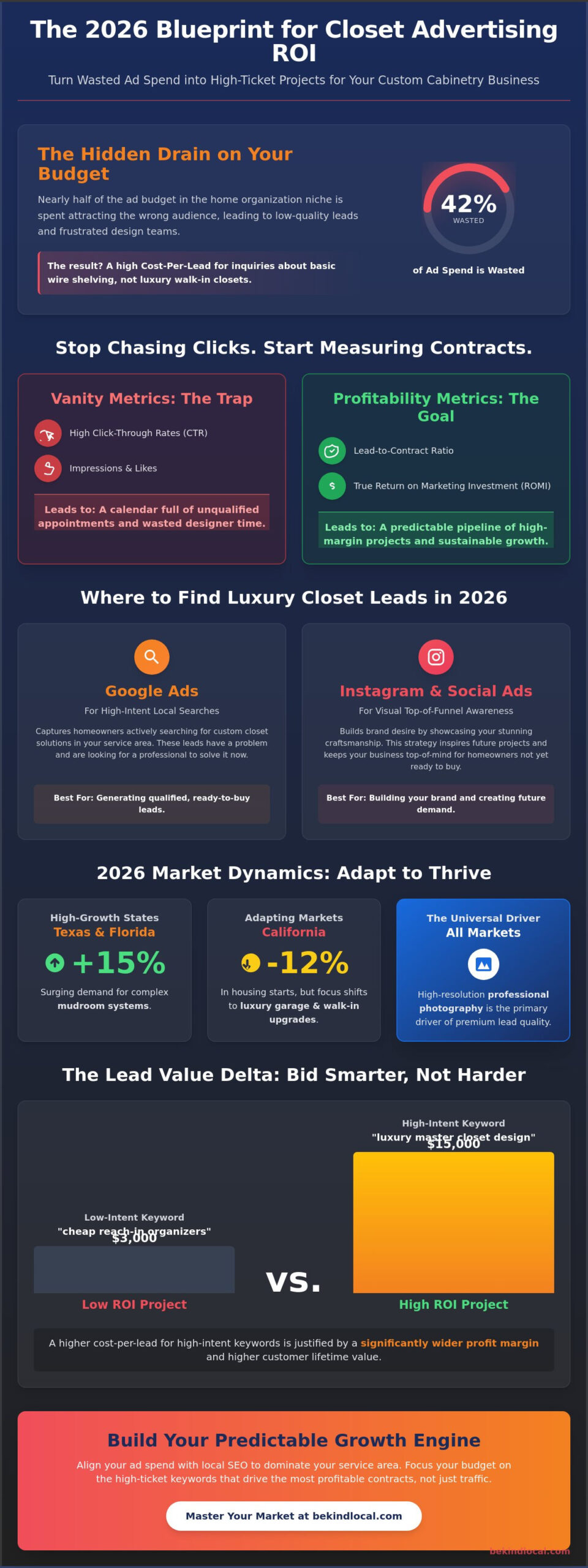
Nearly 42% of digital ad spend in the custom cabinetry and home organization niche is currently wasted on broad keywords that attract DIYers instead of high-ticket clients. You’ve likely felt the frustration of this every time a lead asks about basic wire shelving after you’ve paid for a premium click. It’s painful to watch your cost-per-lead climb and your closet advertising roi shrink while your designers spend their days driving to consultations for lookers who lack the budget for a luxury walk-in or mudroom system. We understand that you need more than just traffic; you need a pipeline of homeowners ready to invest in quality craftsmanship.
This guide will help you master the metrics of high-intent lead generation so you can turn ad spend into measurable revenue. You’ll discover how to stop the bleed on wasted spend and start measuring the data points that actually impact your bottom line. We’ll provide a clear ROAS framework, identify the platforms delivering the highest quality leads for 2026, and share strategies to improve your lead-to-close ratios for every custom project you bid on.
Key Takeaways
- Distinguish between ROAS and true business ROI by factoring in the specific customer acquisition costs of high-ticket multi-room installations.
- Master the “Closet ROAS” formula to accurately measure your closet advertising roi and stop wasting budget on low-intent keywords.
- Identify the optimal platform mix by leveraging Google Ads for high-intent local searches and Instagram for visual top-of-funnel awareness.
- Capitalize on regional market shifts, such as the surging demand for custom mudroom systems in high-growth states like Texas and Florida.
- Build a predictable growth engine by aligning your paid ad spend with local SEO strategies to dominate your specific service area.
The Reality of Closet Advertising ROI in 2026
Measuring your closet advertising roi requires looking past the surface level of your digital dashboard. Many manufacturers mistake Return on Ad Spend (ROAS) for actual business health. While ROAS tells you how many dollars you generated for every dollar spent on Google or Facebook, it doesn’t account for your labor, materials, or the overhead of your design team. To truly understand your performance, you must calculate your Return on Marketing Investment (ROMI); this metric provides the full picture of your profitability after all costs are considered. We view this as the difference between simply buying traffic and building a sustainable, high-margin business.
Your ad copy should leverage the “home value” narrative to drive higher intent. Industry data from 2024 suggests that custom storage solutions can provide a substantial return for homeowners at resale. When you highlight this in your paid advertising, you transform a luxury “want” into a strategic “need.” This shift in messaging filters out casual lookers and attracts serious buyers who view a new walk-in or pantry system as an asset rather than an expense. It’s about positioning your craftsmanship as a smart financial move for the homeowner.
Why Traditional Metrics Fail Closet Manufacturers
High click-through rates are often a trap for custom closet businesses. A low cost-per-click usually means you’re attracting people looking for cheap wire kits or DIY tips, not clients seeking premium reach-in renovations. Focusing on “vanity metrics” like likes or impressions hides a failing strategy that wastes your designers’ time on low-quality leads. Lead-to-Contract ratio is the percentage of initial inquiries that result in a signed installation agreement, serving as the ultimate pillar of your ROI.
The 2026 Landscape for Home Organization Marketing
The marketing environment has shifted significantly across different regions. In Texas and Florida, high-growth markets are seeing a 15% increase in demand for complex mudroom systems as families prioritize functional entryways. Conversely, manufacturers in California are navigating a 12% decrease in housing starts by focusing on high-end garage cabinets and luxury walk-in upgrades for existing homes. In all these markets, professional photography is no longer optional; high-resolution images of your actual craftsmanship are the primary driver of premium lead quality in 2026. Authentic, heart-felt storytelling through your project photos builds the trust necessary to close high-ticket contracts.
Calculating Your Return: Beyond the Click-Through Rate
Understanding your closet advertising roi requires a shift from tracking clicks to measuring actual revenue. The most direct metric for your digital campaigns is the Closet ROAS formula: Total Revenue from Ads divided by Total Ad Spend. While this gives you a snapshot of performance, seasoned manufacturers know that a single $15,000 walk-in project carries different weight than five $3,000 reach-ins. When measuring marketing ROI, you must account for the overhead of your design consultations and the specific labor costs associated with custom millwork.
Customer Acquisition Cost (CAC) becomes more complex when you scale to multi-room installations. A client might start with a primary walk-in but eventually add a pantry, mudroom, or garage storage system. This evolution increases the lifetime value of the lead significantly. Because luxury closet projects often have a 30 to 90-day sales cycle, your tracking must be patient. You aren’t just selling a product; you’re managing a relationship that matures over several months of design revisions and material selections. To maximize your closet advertising roi, you must track these long-term conversions rather than just immediate wins.
The Lead Value Delta: Walk-ins vs. Reach-ins
Strategic bidding means you’re willing to pay more for a lead searching for “luxury master closet design” than one looking for “cheap reach-in organizers.” The ROI on a $15,000 project justifies a much higher cost-per-lead because the margin is wider. We see this often when manufacturers pivot from broad keywords to high-intent phrases. If you’re ready to see how these numbers apply to your specific market, feel free to reach out to our team for a strategy audit. We help you focus your budget on the high-ticket keywords that drive the most profitable contracts rather than chasing raw traffic volume.
Tracking Attribution in a Local Market
Attribution is the bridge between a homeowner seeing an ad and your team finishing an installation. For contractors in growing hubs like Indianapolis or Charlotte, integrating your CRM with your advertising platform is non-negotiable. You need to know if a phone call originated from a Google Business Profile search or a targeted Instagram story. First-touch attribution often undervalues SEO because it fails to capture the weeks of organic research a homeowner does before finally clicking a paid ad to schedule their design visit. Using call tracking ensures that offline handshakes are correctly attributed to your online investment, giving you a truthful look at what’s actually driving growth.
Google Ads vs. Social: Where Luxury Closet Leads Originate
Choosing between search and social isn’t a matter of “either/or” but rather “when and why.” Google Ads excels at capturing high-intent “near me” searches in competitive markets like North Carolina and Georgia. When a homeowner in Raleigh or Atlanta types “custom walk-in closet designer” into their search bar, they’ve already identified a pain point and are actively seeking a professional solution. This is where your closet advertising roi is often highest because you’re meeting the customer at the peak of their intent. Your Google Business Profile visibility acts as your most potent “free” advertisement in these local searches, often serving as the final trust signal before a lead clicks your ad or website.
Social platforms like Instagram and Pinterest operate differently. These are visual discovery engines where homeowners find inspiration for their future pantry or mudroom renovations. While the intent is lower, the visual power of these platforms builds top-of-funnel awareness that search cannot match. Measuring Advertising ROI across these channels requires a nuanced approach, as social media often assists a conversion that eventually happens through a direct search weeks later. To fully leverage these platforms, a dedicated closet social media marketing strategy helps you build visual authority that keeps your brand top-of-mind during the long design decision phase, ensuring your brand is the one they call when they’re finally ready to commit. Retargeting ads play a vital role here; they keep your craftsmanship top-of-mind during the long design decision phase, ensuring your brand is the one they call when they’re finally ready to commit.
Search Intent: Capturing the ‘Ready to Buy’ Lead
The secret to a profitable Google campaign is a hyper-local keyword strategy. You shouldn’t just bid on generic terms; you need to target “closet companies in Charlotte” or “custom reach-in closets in Savannah.” This specificity helps you avoid “DIY” searchers who are looking for cheap plastic bins rather than custom-built cabinetry. Protecting your ad budget from these low-value clicks is essential for maintaining a healthy closet advertising roi. For manufacturers who want to skip the trial and error, our Be Kind Local Advertising Services provide the technical expertise needed to filter out the noise and focus on high-ticket contracts.
Social Proof and Visual ROI
Visual content is the heartbeat of social media marketing for specialty contractors. A simple 30-second video tour showcasing the smooth glide of a soft-close drawer or the organization of a custom pantry can do more for your conversion rate than a thousand words of copy. When you pair these visuals with authentic customer reviews, you lower your cost-per-acquisition by removing the friction of doubt. This synergy between your portfolio and your reputation is a core part of a winning Home Service Brand Strategy, positioning you as the only logical choice for a homeowner’s most personal spaces.
Local Market Dynamics: Driving ROI in High-Growth States
Your closet advertising roi is heavily influenced by where your installers are actually driving. A campaign that generates high-ticket walk-in leads in Los Angeles requires a different strategy than one targeting suburban homeowners in Indianapolis. In California, we focus on hyper-local targeting to navigate extreme competition; this ensures you aren’t paying for clicks from homeowners three hours away. Meanwhile, in high-growth states like Texas and Florida, the focus shifts toward new construction. These markets show a 20% higher demand for mudroom systems and “hurricane-ready” garage storage compared to the national average, allowing you to tailor your ad copy to specific regional needs.
In North Carolina and the Midwest, building authority in suburban markets often involves highlighting “basement organization” or comprehensive pantry upgrades. Homeowners in these areas value the practical, heart-felt craftsmanship of a local manufacturer over a big-box franchise. By adapting your messaging to reflect these local preferences, you increase your conversion rates and ensure your ad spend isn’t wasted on broad, irrelevant searches. This regional nuance turns a generic ad into a direct invitation to improve a homeowner’s daily life.
Geo-Fencing and Local Service Ads (LSAs)
Local Service Ads (LSAs) are a game-changer for custom closet manufacturers because they operate on a pay-per-lead model. Unlike traditional search ads where you pay for every click, LSAs guarantee a base level of ROI because you only pay when a homeowner actually calls or messages you. Setting up tight service areas is critical here. By using local zip code targeting, you avoid the frustration of out-of-range inquiries that drain your budget without any hope of a signed contract. This precision is essential for luxury organization marketing where your margins depend on efficient project management.
Seasonal ROI Fluctuations
Understanding the rhythm of the home organization industry helps you pace your budget effectively. You’ll see natural peaks during “spring cleaning” in March and the “back-to-school” rush in late August. During these times, increasing your ad spend can capture the surge in intent. Conversely, the holiday months often see a dip in new inquiries, making it a perfect time to focus on retargeting previous leads. The “January Surge” refers to the documented 35% spike in closet organization searches as homeowners resolve to declutter their lives for the new year. If you want to dominate your local market during these peak windows, schedule a discovery call with our team to build a custom growth plan.
Scaling Your Closet Business with Strategic Lead Generation
Moving your business from a feast-or-famine cycle to a predictable growth engine requires a shift away from “random acts of marketing.” Many manufacturers rely solely on word-of-mouth, but this lacks the scalability needed to fill a multi-month installation calendar. A truly strategic approach integrates the immediate visibility of paid campaigns with the long-term equity of Local SEO. When these two channels work in harmony, your paid data informs your organic content, revealing exactly which high-intent keywords for walk-ins or pantry systems are driving the most revenue. This synergy is the most effective way to stabilize your closet advertising roi over time.
A high-converting website serves as the foundation for all your advertising efforts. If your site is slow or fails to showcase your craftsmanship through high-quality project galleries, your ad spend is essentially a donation to Google. Your digital presence must do more than look pretty; it must guide a homeowner from inspiration to a booked design consultation. Auditing your current spend for waste is the first step toward optimization. We often find that 30% of contractor ad budgets are spent on broad terms that never result in a signed contract. Tightening these parameters ensures every dollar works toward a high-ticket installation.
Building a Multi-Channel Lead Pipeline
Immediate leads from PPC provide the cash flow needed to fund long-term growth, but they are only one part of the pipeline. Because luxury closet projects often involve a longer consideration period, you must implement email nurturing to stay connected with leads who didn’t buy on day one. Sharing stories of recent mudroom transformations or garage slatwall installations keeps your brand top-of-mind. Speed-to-lead remains a critical factor in this industry. Research indicates that responding to an inquiry within 5 minutes increases your chances of a successful contact by nearly 900% compared to waiting even one hour. In the competitive custom closet market, the first professional to provide a heart-felt, expert response usually wins the project. To go deeper on building campaigns that attract only high-value clients, our guide on custom closet ads and high-intent lead generation strategies walks through the exact framework for eliminating wasted spend.
Partnering for Strategic Growth
Generic marketing agencies often fail specialty contractors because they don’t understand the technical nuances of the trade. They might treat a custom closet manufacturer the same as a local plumber, missing the visual and emotional drivers that lead a homeowner to invest in a premium walk-in or overhead storage system. At Be Kind Local, we take a strategic and ethical approach that focuses on lead quality over raw volume. We believe in building a community of successful local businesses through honest data and proven results. If you’re ready to stop guessing and start growing, schedule a discovery call with our team at bekindlocal.com to optimize your lead generation funnel and maximize your closet advertising roi.
Building Your Predictable Growth Engine for 2026
Mastering your closet advertising roi is no longer just about bidding on keywords; it’s about shifting your focus from raw traffic to high-ticket contract value. You’ve learned that a successful strategy requires balancing high-intent search ads with visual social discovery while accounting for the specific dynamics of your local market. Whether you’re navigating the competitive landscape of California or capturing the mudroom demand in Florida and Texas, your success depends on a foundation of high-quality leads and strategic attribution. We’ve seen that manufacturers who prioritize lead-to-contract ratios over simple clicks consistently outperform their competitors.
We specialize in the custom closet and home organization niche because we know that a luxury walk-in project requires a different marketing approach than a standard service call. Our team focuses on lead quality and maximizing the value of every contract rather than chasing vanity metrics that don’t impact your bottom line. We have proven results in high-competition markets, helping designers turn their ad spend into a measurable, sustainable engine for growth. It’s time to stop wasting budget on broad searches and start investing in a partnership that understands your craftsmanship. Ready to maximize your closet advertising ROI? Schedule a Discovery Call with Be Kind Local today. We’re here to help you build a business that thrives on quality and integrity.
Frequently Asked Questions
What is a good ROAS for a custom closet business?
A healthy Return on Ad Spend (ROAS) for custom closet manufacturers typically ranges between 4:1 and 6:1. This means you should generate $4 to $6 in revenue for every $1 spent on ads. While luxury walk-in projects can occasionally push this higher, this 400% to 600% benchmark ensures you cover material costs and designer commissions while maintaining a profitable margin on your installations.
Should I focus on Google Ads or Facebook Ads for my closet company?
Google Ads is your best tool for capturing “ready-to-buy” intent, while Facebook excels at visual inspiration. If you need immediate design consultations, prioritize Google search terms for local intent. Use Facebook and Instagram to showcase finished mudrooms and pantries to homeowners who aren’t actively searching but are likely to be influenced by the sensory impact of high-quality cabinetry and organization systems.
How much should I spend on advertising to see a real ROI?
Most established closet companies allocate 5% to 10% of their gross revenue toward marketing to see a measurable closet advertising roi. For a manufacturer doing $1 million in annual sales, this equates to a monthly budget of roughly $4,000 to $8,000. Starting with a budget below this range often prevents you from gathering enough data to optimize your campaigns or compete in high-growth markets effectively.
How do I track which leads actually turned into closet installations?
Effective tracking requires a CRM integration paired with call tracking software. You must assign unique tracking numbers to your ads so you can follow a lead from the first “luxury walk-in closet” click to the final signed contract. This closed-loop reporting is the only way to prove which specific campaigns are funding your payroll and which ones are simply wasting your designers’ time on lookers.
Why is my cost-per-lead so high in markets like Florida or California?
High cost-per-lead in Florida and California is driven by intense competition and a 15% higher search volume than the national average. In these states, national franchises bid aggressively on broad terms, which inflates auction prices for everyone. You can combat this by focusing on hyper-local zip code targeting and specific niches like “custom garage slatwall installers” where the competition is often less fierce.
Can Local SEO provide a better ROI than paid advertising?
Local SEO often provides a higher long-term ROI because you don’t pay for every individual click, but it takes 6 to 12 months to build significant authority. Paid ads offer the immediate lead flow necessary for cash flow. The most successful manufacturers use SEO to capture the majority of their organic traffic while using paid ads to dominate the top of search results for their most profitable service areas.
What are the best keywords for high-end walk-in closet leads?
The best keywords for luxury leads focus on specific room types and premium materials rather than generic phrases. Terms like “custom master walk-in design,” “luxury reach-in renovations,” and “custom pantry cabinetry” attract buyers with larger budgets. Avoiding “cheap” or “wire shelving” keywords is essential to protecting your closet advertising roi from DIYers who lack the budget for professional custom work.
How long does it take to see a positive ROI from a new ad campaign?
You should expect to see initial lead flow within the first 48 hours, but a positive ROI usually takes 60 to 90 days to stabilize. This window allows the ad platforms to learn which audiences convert best and gives your sales team time to move leads through the design and proposal phases. Patience is vital because high-ticket home organization systems often have a 30 to 60-day sales cycle.