
 951-249-7500
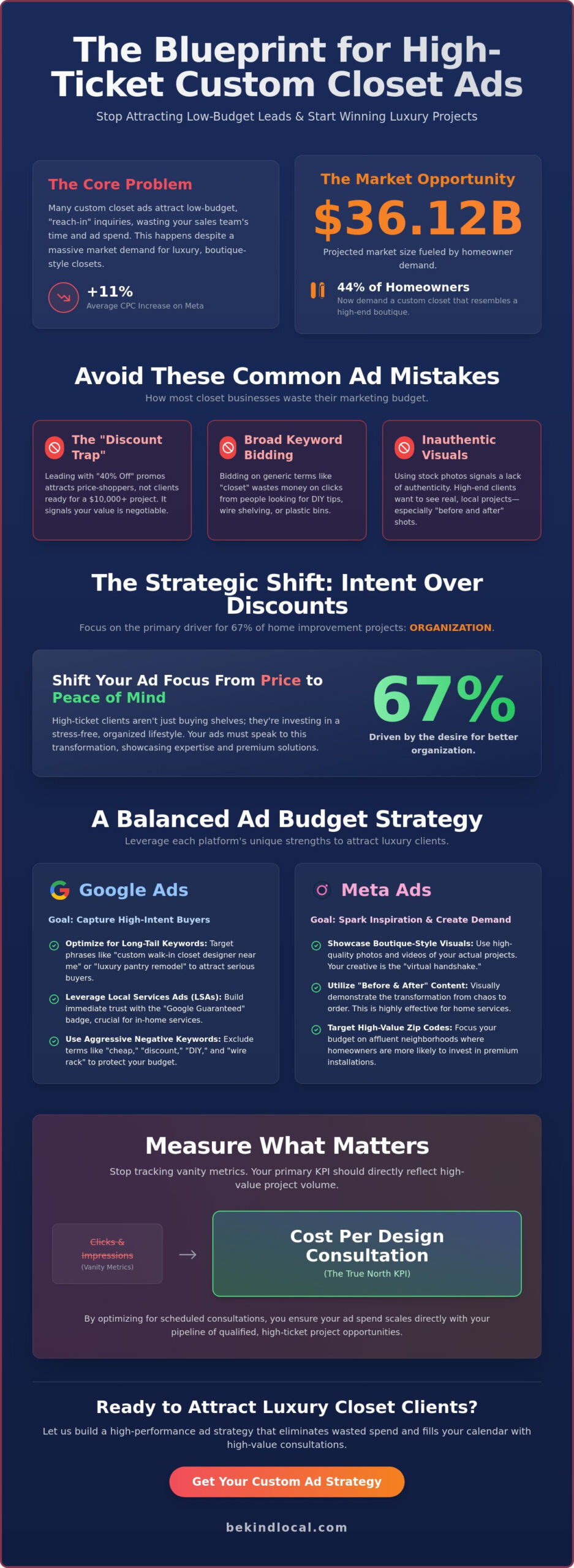
Did you know that 44% of homeowners in 2026 now demand a custom closet that resembles a high-end boutique? Despite this $36.12 billion market opportunity, many custom closet ads still attract low-budget “reach-in” inquiries that stall your growth and waste your sales team’s time. You’ve likely felt the sting of rising costs, as the average CPC on Meta has increased by 11% this year, making it harder than ever to reach high-value zip codes without draining your budget. It’s frustrating to offer a luxury, handcrafted product while your digital presence feels like a bargain bin service.
We understand that you value lead quality over raw traffic volume. You want a strategic partner who recognizes that “organization” is the primary driver for 67% of home improvement projects. This article will teach you how to build a high-performance ad strategy that attracts luxury closet clients and eliminates wasted ad spend. We will preview how to navigate Meta’s housing restrictions and leverage Google Ads to secure a lower cost-per-acquisition for your premium walk-in and mudroom installations.
Key Takeaways
- Avoid the “Discount Trap” by shifting your marketing focus from heavy promotions to “organization intent” to attract high-ticket walk-in closet clients.
- Capture high-intent buyers exactly when they are searching for solutions by optimizing your custom closet ads for long-tail storage queries and Local Services Ads.
- Balance your budget between Google Search for capturing immediate demand and Meta Ads for sparking inspiration with boutique-style visual creative.
- Build authority and trust through technical expertise by highlighting premium features like garage slatwall systems and custom pantry configurations in your ad copy.
- Measure what matters by tracking “Cost Per Design Consultation” as your primary KPI to ensure your ad spend scales alongside your high-value project volume.
Why Most Custom Closet Ads Fail to Generate Luxury Leads
Many closet business owners fall into what we call the “Discount Trap.” It’s tempting to follow the lead of mass-market franchises by pushing “40% off” promos, but these heavy discounts often attract price-shoppers rather than high-ticket walk-in closet clients. When you lead with a coupon, you’re signaling that your value is negotiable. Luxury homeowners aren’t looking for the cheapest option; they’re looking for the best solution for their $10,000+ storage project. Effective custom closet ads must prioritize brand authority and design expertise over bottom-of-the-barrel pricing.
Generic AI-generated ad copy often dilutes your brand’s perceived value in competitive local markets like Florida or Texas. These tools frequently churn out hollow phrases that fail to resonate with a homeowner’s desire for “peace of mind.” A professional advertising strategy needs a human touch to speak to the specific lifestyle benefits of a curated space. Relying on “fluff” instead of technical authority can make your premium service look like a generic hardware store installation.
The Problem with Broad Keyword Targeting
Bidding on the word “closet” is one of the fastest ways to waste your ad spend. It’s far too broad. You’ll end up paying for clicks from people looking for plastic bins, wire shelving, or DIY repair tips. High-intent digital advertising strategies focus on “buyer-intent” phrases like “custom walk-in closet designer near me” or “luxury pantry remodel.” You must also be aggressive with negative keywords. Excluding terms like “cheap,” “discount,” or “wire rack” ensures your budget is reserved for clients who appreciate high-end craftsmanship.
Visual Misalignment in Ad Creative
Your ad creative is the first “virtual handshake” with a potential client. Using stock photos is a common mistake that immediately signals a lack of authenticity. High-converting ads for local contractors rely on real project photography of reach-ins, pantries, and mudrooms. “Before and after” shots are particularly effective because they visualize the transformation from chaos to order. High-quality imagery of a completed project in a local neighborhood builds immediate credibility. Seeing a local project that mirrors their own home’s layout creates an immediate psychological bridge of trust that makes the initial consultation feel like a meeting with an old friend rather than a sales pitch. To ensure your project photos work harder for your business, learn how to build a closet marketing portfolio that generates high-ticket leads rather than just serving as a digital photo album.
Strategic Google Ads for Custom Closets: Capturing High-Intent Buyers
Google Ads remains the most efficient engine for capturing demand because it targets users at the exact moment they’re seeking a solution. When a homeowner searches for “custom walk-in closet design,” they aren’t just browsing; they’re inviting a professional into their home. To win in 2026, your custom closet ads must go beyond broad search terms. Success requires a layered approach that combines Local Services Ads (LSAs) with precision-targeted search campaigns. LSAs build immediate trust through the “Google Guaranteed” badge, which is essential for contractors entering a client’s private space.
Effective digital marketing strategies for luxury brands emphasize that exclusivity and precision matter more than raw reach. You can use your Google Business Profile data to boost ad relevance in specific neighborhoods. For example, if you’ve completed several high-end projects in Carmel, Indianapolis, or the coastal communities of California, your ads should specifically target those high-value zip codes. This ensures your budget isn’t wasted on areas where homeowners are more likely to choose a DIY hardware store solution over a professional installation. Learn more about our advertising services to see how we structure these high-intent campaigns.
Step-by-Step Google Ads Setup for Closet Leads
Organization is key to your internal campaign structure. Don’t lump all your services into one “closet” bucket. Isolate your campaigns by project type: walk-ins, garage cabinets, and pantries. Each category has a different buyer persona and price point. Use radius targeting to focus on high-income areas within 15 to 30 miles of your showroom. Most importantly, set up your conversion tracking for “Schedule a Consultation” rather than a generic “Contact Us” form. This allows Google’s machine learning to optimize for the actions that actually lead to design appointments and signed contracts.
Optimizing for Lead Quality Over Quantity
Generating 100 leads is useless if 90 of them want a $500 reach-in fix. Use qualifying questions on your landing pages to filter out low-budget inquiries. Ask about their project timeline or if they’re looking for professional installation versus DIY kits. In 2026, the speed of your follow-up is a major ranking factor for ad performance. The “Golden Hour” for responding to a new closet inquiry is actually the first five minutes; after that, your chances of qualifying the lead drop significantly. If you’re struggling to keep up with incoming inquiries, it might be time to reach out for a strategic consultation to automate your lead management.
Google Search vs. Meta Ads: Where to Invest Your Budget?
Choosing between search and social platforms isn’t about finding a single “winner.” It’s about understanding the specific intent of your audience at different stages of their journey. Google Search remains the gold standard for capturing immediate demand. When a homeowner realizes their morning routine is a mess, they search for specific solutions. With a Google Ads CPC averaging between $4 and $7 in 2026, you’re paying for the highest level of intent. These users aren’t just browsing; they’re looking for a professional to solve a problem today. Your custom closet ads on search must be precise to ensure you don’t waste budget on low-intent clicks.
Meta platforms like Facebook and Instagram operate differently by sparking inspiration. The average CPC on Meta is approximately $3.21, which allows for broader reach at a lower cost per click. This is where you target the 44% of homeowners who dream of a boutique-style closet but haven’t started searching for a local contractor yet. While Google captures the “now” buyer, Meta builds your future pipeline. You can learn more about how we manage these visual discovery campaigns by exploring our social media marketing services.
Allocating Budget Based on Business Goals
Deciding where to spend your first dollar depends on your current installation schedule and showroom traffic. If your designers have empty calendars, prioritize Google Ads for immediate lead flow. It’s the fastest way to put your brand in front of someone actively typing “closet company near me.” However, if you’re established in competitive markets like Georgia or North Carolina, you need a multi-channel approach to stay ahead. Meta Ads are essential for brand strategy because they allow for the visual storytelling that Google Search lacks. To understand how to turn those social channels into a consistent source of high-intent inquiries, explore our guide on closet social media marketing strategies for building visual authority.
- Use Google for high-intent queries like “walk-in closet designer” or “pantry remodel.”
- Use Meta to showcase luxury finishes and high-end reach-in transformations.
- Use Pinterest for long-tail brand awareness during the initial research phase.
The Role of Retargeting in the Sales Cycle
The journey from clicking an ad to signing a contract for a custom pantry or mudroom isn’t instant. Most custom closet sales cycles span 30 to 90 days. Retargeting is the glue that holds your strategy together. By serving ads to people who have already visited your website, you remain top-of-mind while they compare options. Video ads are particularly effective in this phase. They allow you to walk a prospect through your design process or show the technical installation of garage slatwall systems. This consistent, helpful presence builds the trust necessary to move a lead through the funnel. For a comprehensive look at how we structure these high-performance campaigns, visit our advertising services page.
Ad Copy and Creative for High-End Closets: Beyond the Hype
Luxury isn’t just a price tag; it’s the feeling of complete order and tranquility. When you write copy for custom closet ads, you must pivot your language from “storage” to “peace of mind.” High-ticket clients aren’t buying wood and hardware; they’re buying a morning routine that flows without friction. This requires a “Luxury Language” shift. Replace generic terms with words like “curated,” “bespoke,” and “integrated” to signal that your service is a premium experience. Developing your home service brand strategy around these emotional benefits is the first step in distancing yourself from discount competitors.
Technical authority is the second pillar of high-converting copy. If you’re marketing total garage transformations, don’t just talk about cabinets. Mention specific, high-performance features like garage slatwall systems or polyaspartic coatings. These terms show that you understand the durability requirements of a professional-grade space. This level of detail builds immediate trust with homeowners who have researched the difference between a DIY kit and a professional installation. Your ads should position you as the expert who knows which materials will actually stand the test of time. A well-structured closet marketing portfolio that highlights these technical details can serve as a powerful proof of concept that pre-qualifies prospects before they ever contact you.
High-Converting Ad Headlines for Closet Designers
Your headline is the most important part of your ad copy. It must address the specific room or pain point the homeowner is facing. Intent-based headlines like “Transform Your Master Suite into a Private Boutique” will always outperform “Cheap Closets” or “Free Estimates.” Focus on the psychological benefit. “Start Your Morning with Clarity” speaks to the lifestyle change your product provides. Test different headlines for specific applications like mudrooms, pantries, and reach-ins to see which “organization intent” resonates most with your local audience.
Visual Best Practices for 2026
Authenticity is the most valuable currency in 2026 creative strategies. While professional renders have their place, a raw, high-quality cell phone walkthrough of a finished job often generates more consultations. It feels real and attainable. Make sure your visuals highlight the premium details that justify a high-ticket price, such as jewelry inserts, soft-close drawers, and integrated LED lighting. Scaling your local reach becomes significantly easier when you repurpose user-generated content from happy clients into your social ad campaigns. Since 50% of high-end home organization buyers begin their inspiration process on social media, a strong closet social media marketing presence ensures your visual content reaches them before they ever start comparing competitors. If your current creative assets feel stuck in the past, book a discovery call with our team to modernize your ad strategy.
Measuring Success: ROI and Scaling Your Ad Campaigns
Vanity metrics like impressions or clicks won’t pay for your next warehouse expansion. To truly measure the success of your custom closet ads, you must focus on the Cost Per Design Consultation. This is your most vital KPI because it represents a qualified homeowner who has invited you into their home. With the average Cost Per Acquisition (CPA) for home services on Meta reaching $89.45 in April 2026, you need to know exactly what an appointment costs you. This clarity allows you to identify the “Sweet Spot” where your ad spend perfectly aligns with your production capacity.
Understanding the Lifetime Value (LTV) of a client is equally critical. A single walk-in closet installation often leads to future projects like custom pantries or garage storage systems. Satisfied clients in affluent neighborhoods become your best referral sources. At Be Kind Local, we specialize in helping contractors in competitive markets like Texas and California dominate their local search results. We ensure your marketing dollars are working to build a sustainable pipeline of high-ticket projects rather than chasing low-margin reach-in inquiries.
Analyzing the Data That Matters
Moving beyond clicks requires deep CRM integration. You need to see the entire lead-to-sale journey to understand which custom closet ads are actually driving profits. This data reveals which zip codes produce your most profitable jobs, allowing you to refine your radius targeting. If you notice that specific neighborhoods in your service area consistently close $15,000 projects, you can shift your budget to own those markets. Data-driven decisions eliminate the guesswork and protect your margins.
Scaling Without Breaking Your Budget
Scaling should be a controlled, incremental process. Never “set and forget” your ads or double your budget overnight. We recommend increasing spend by 10% to 20% every two weeks while monitoring your lead-to-consultation ratio. This approach allows you to test new markets, such as expanding from a single city to an entire neighboring county, without overextending your sales team. If you’re ready to stop wasting ad spend and start attracting high-intent luxury clients, Schedule a discovery call with Be Kind Local today.
Take Control of Your Local Market Growth
The global custom closet market is projected to reach $36.12 billion in 2026; yet, capturing your share of this growth requires a departure from generic marketing tactics. You’ve seen how successful custom closet ads rely on targeting “organization intent” rather than broad keywords that attract low-budget inquiries. By balancing the immediate, high-intent capture of Google Search with the visual inspiration of Meta, you build a resilient lead generation engine that respects both your production capacity and your profit margins.
We believe in a partnership built on transparency and results. Be Kind Local provides specialized expertise in home service marketing with a strict focus on lead quality over raw traffic volume. We offer transparent ROI tracking so you always know exactly how your ad spend translates into high-ticket design consultations. It’s time to stop settling for “reach-in” leads and start dominating the luxury walk-in and mudroom market in your service area.
Ready to generate high-quality closet leads? Schedule your discovery call with Be Kind Local.
We’re here to help you turn your craftsmanship into a consistent stream of high-value projects.
Expert Answers on Custom Closet Advertising
How much should a custom closet company spend on Google Ads?
Start with a daily budget that allows for at least 10 to 15 clicks to gather enough data for optimization. With the average CPC for home services ranging between $4 and $7 in 2026, a monthly budget of $1,500 to $3,000 is a standard baseline for most local markets. This ensures your custom closet ads appear consistently during peak search hours without exhausting your funds by mid-morning.
What is a good cost-per-lead for custom closet installations?
A healthy cost-per-lead (CPL) typically falls between $30 and $70 depending on the platform and project type. Verified data from 2026 shows the average CPL on Meta Ads for home services is $34.00. While Google Search leads might cost more due to higher intent, the conversion rate to a signed contract for a walk-in or mudroom project is usually higher, justifying the higher initial investment.
Do Facebook ads work for high-end closet designers?
Facebook and Instagram are highly effective for high-end designers because they capitalize on visual discovery and inspiration. Since 44% of homeowners desire a closet that resembles a high-end boutique, these platforms allow you to showcase the “dream” through high-quality video walkthroughs. They’re perfect for reaching users who aren’t actively searching yet but are deeply interested in home improvement and organization.
Should I mention pricing in my custom closet ads?
Avoid listing specific prices in luxury ads to maintain an air of exclusivity and bespoke service. If you do choose to include pricing to filter out low-budget inquiries, you must comply with the FTC’s Junk Fee Rule from May 2025, which requires total price transparency. Instead of a price tag, focus your copy on the value of peace of mind and professional organization.
How long does it take to see results from a new ad campaign?
You’ll see traffic within 24 hours, but true campaign optimization takes 30 to 90 days. This timeframe aligns with the typical sales cycle for custom storage solutions. During this period, machine learning algorithms analyze which users are clicking and converting, allowing your custom closet ads to become more targeted and cost-effective as the system learns your ideal buyer’s behavior.
Is it better to target ‘closets’ or ‘home organization’ keywords?
Focus on “home organization” and specific project types like “walk-in pantry” or “garage storage systems.” Targeting the broad keyword “closets” often leads to wasted spend on users looking for simple hangers or DIY hardware store kits. Since 67% of home improvement projects are driven by a need for organization, using these high-intent phrases connects you with serious buyers ready for a professional solution.
What is the best way to track leads from my closet ads?
The most effective method is integrating your ad platforms with a CRM to track the complete lead-to-sale journey. Don’t just count clicks; track the number of design consultations scheduled and the total revenue generated from those appointments. This level of transparency allows you to calculate your actual ROI and identify exactly which zip codes are providing the most profitable work.
Can I run ads for specific services like mudrooms or pantries separately?
You should isolate these campaigns to improve relevance and lead quality. A homeowner looking for a walk-in pantry has different needs than someone researching garage slatwall systems or reach-in upgrades. By creating separate ad groups with tailored copy and imagery, you speak directly to the client’s specific pain point, which significantly increases your conversion rates compared to a generic ad.