
 951-249-7500
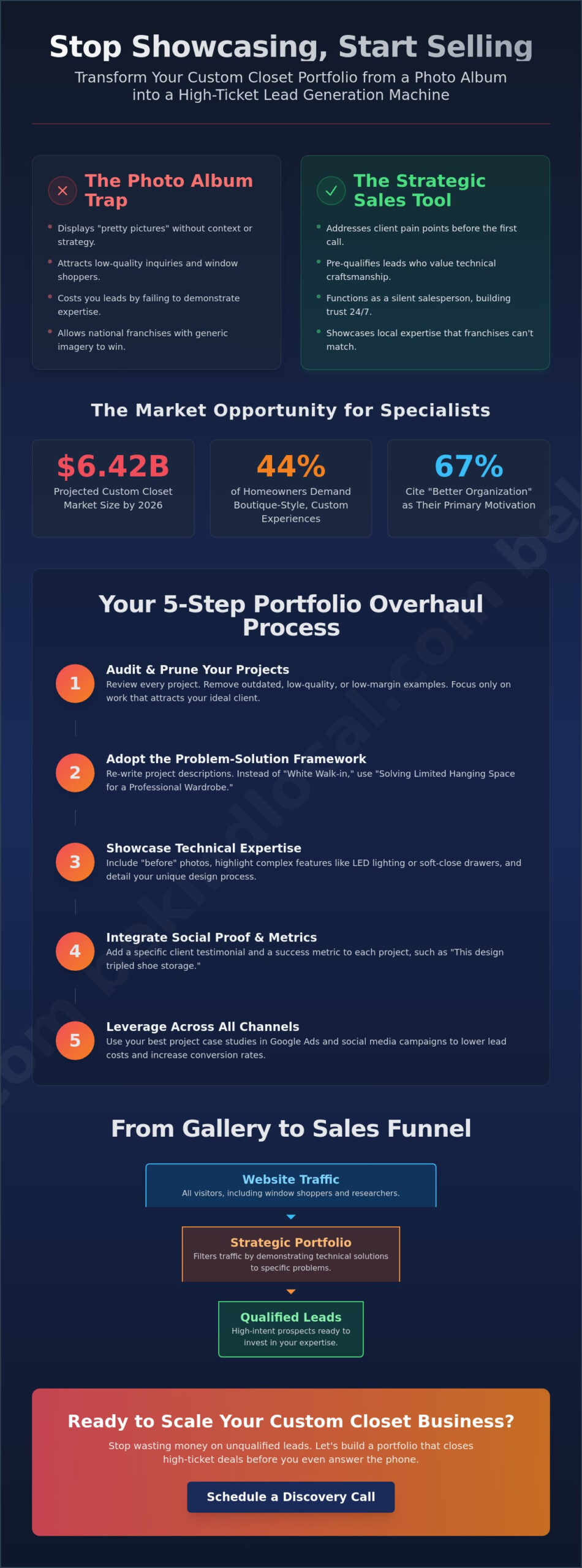
Your gallery of finished projects isn’t actually a portfolio; it’s just a digital photo album that’s likely costing you money. If your website is full of beautiful walk-in shots but your phone isn’t ringing with high-ticket leads, you’re falling into a generic trap that helps national franchises win. To stand out in a custom closet market projected to reach $6.42 billion by the end of 2026, a strategic closet marketing portfolio must do more than just look pretty. It needs to act as a technical proof of concept that solves organization pain points before a prospect even picks up the phone.
We understand the frustration of seeing steady traffic turn into low-quality inquiries that waste your time. You’ve mastered the craft of creating high-end spaces, so your digital presence should reflect that same level of expertise and care. This guide will show you how to transform your project gallery into a strategic sales tool that attracts high-intent leads and drives real business growth. We’ll explore how to showcase technical reach-in systems and highlight the boutique-inspired designs that 44% of homeowners now demand, ensuring your marketing efforts finally deliver the ROI your hard work deserves.
Key Takeaways
- Stop treating your website as a static photo album and start using it as a strategic sales tool that addresses client pain points before the first consultation.
- Learn how to structure your closet marketing portfolio using a problem-solution framework that highlights technical expertise in complex reach-in and walk-in systems.
- Master a five-step process to audit and prune your existing project entries, focusing on high-margin categories like luxury pantries and boutique-style master closets.
- Discover how to leverage your high-quality portfolio assets to lower lead costs and increase conversion rates across your Google Ads and social media campaigns.
- Position your business to compete with national franchises by showcasing the specific craftsmanship and local expertise that high-ticket leads prioritize in 2026.
The Strategic Role of a Closet Marketing Portfolio in 2026
Your closet marketing portfolio functions as a conversion-focused asset, not just a digital scrapbook. In 2026, simply posting “pretty pictures” won’t help you win against national franchises with deep pockets. These large corporations use polished, generic imagery that lacks the personal touch local clients crave. To stand out, your digital portfolio must bridge the gap between inspiration and authority. It’s about moving away from being a homeowner’s Pinterest board and toward becoming a strategic B2B tool that proves you can handle complex, high-end installations. In 2026, your portfolio must speak directly to the 44% of homeowners who want a boutique-style experience, showing them exactly how you’ll deliver it through local craftsmanship.
This strategic shift is essential because it pre-qualifies your leads. When a prospect sees that you’ve solved specific spatial challenges, they stop viewing you as a commodity. They start seeing you as the expert who understands their lifestyle. This reduces your sales cycle because the trust is already built before you even walk through their front door for a consultation. In a market where customer acquisition costs average $450 per lead, you can’t afford to waste time on window shoppers who aren’t ready to invest in quality.
From Gallery to Sales Funnel
A high-performing online presence should function like a silent salesperson. To attract high-intent luxury buyers, use project descriptions to address common organization objections. Instead of a caption that says “White Walk-in,” try “Custom Walk-in Suite: Solving Limited Hanging Space for a Professional Wardrobe.” This approach speaks to the 67% of homeowners who cite “organization” as their primary motivation, turning your closet marketing portfolio into a technical proof-of-concept that mirrors your actual sales presentation.
Establishing Authority in Niche Organization
True authority is built on technical proficiency. Use your portfolio to highlight expertise in specific closet types. A reach-in system requires different engineering than a boutique walk-in. Detail your design-to-installation process to build an ethical bond with your community. You’re a local craftsman who cares about functionality. This level of detail is exactly what Custom Website Design should prioritize to turn traffic into revenue and establish long-term trust.
Essential Elements of a High-Conversion Closet Portfolio
A high-conversion closet marketing portfolio is much more than a collection of finished project images. It’s a deliberate communication of value. According to the official definition of marketing, our job is to create and communicate offerings that have genuine value for our clients. In the custom closet industry, that value isn’t just the shelving; it’s the specific solution to a homeowner’s daily chaos. High-ticket leads look for technical excellence. They want to see how you handle complex LED lighting integration, soft-close jewelry drawers, and premium textured finishes that national franchises often gloss over.
Perceived value is directly tied to the quality of your presentation. If your photos are grainy or poorly lit, prospects will assume your craftsmanship is equally unrefined. High-resolution imagery allows you to showcase the precision of your miter joints and the rich texture of your wood grains. You should also integrate social proof directly into the project view. A testimonial from a homeowner describing how their new walk-in suite transformed their morning routine carries more weight than a generic review page. It connects the visual result to a lived experience.
The Power of the ‘Before and After’ Narrative
Don’t skip the “before” photos. They provide the emotional baseline for your prospects. While the “after” shot represents the dream, the “before” shot reminds them of the frustration they feel every morning. Document specific organizational challenges, such as a reach-in closet with wasted vertical space or a pantry that lacks visibility. Every project entry should conclude with a single, clear success metric. For instance, “This design tripled shoe storage while maintaining a minimalist aesthetic.” It’s punchy and proves you deliver results.
Technical Details: Showcasing Material Excellence
Luxury buyers in 2026 are highly sophisticated. They care about the difference between standard melamine and high-pressure laminates or textured veneers. Your closet marketing portfolio should include a mini-spec sheet for major projects. Detail the hardware finishes, the types of garage slatwall systems used, or the weight capacity of overhead storage. This transparency builds immediate trust with B2B partners and high-end homeowners alike. If you’re ready to turn your technical expertise into a lead-generating machine, it may be time to refine your digital strategy with a partner who knows the closet industry inside and out.
A 5-Step Template to Rebuilding Your Digital Portfolio
Rebuilding your closet marketing portfolio requires a surgical approach. It’s not about adding more content; it’s about refining what’s already there to attract the right eyes. Start by auditing your current gallery and pruning any low-value work. If a project doesn’t reflect the high-ticket leads you want to attract in 2026, it doesn’t belong on your website. Once you’ve cleared the clutter, categorize your remaining work by lead intent. Group luxury walk-ins together to speak to the boutique-minded client, and separate high-utility spaces like pantries or mudrooms for those seeking functional organization.
Consistency is what builds trust with sophisticated buyers. Develop a standard “Project Story” template for every entry. This turns a simple image into a strategic case study. Every project page should highlight the specific organizational challenge, the technical solution you provided, and the final result. Most importantly, ensure your custom website design is optimized for mobile performance. High-ticket leads have zero patience for slow-loading galleries. Every project page must end with a clear, direct call to action that tells the prospect exactly how to start their own transformation.
Curating for Profitability
Select projects that reflect the leads you actually want to install. If you excel at high-end finishes and motion-activated LED lighting, don’t bury those projects under basic wire shelf replacements. A lean collection of ten signature projects is far more effective than a cluttered gallery of fifty mediocre ones. You’re not just showing work; you’re establishing a signature style. This focus helps you maintain a premium brand image that national franchises can’t easily replicate with their mass-market approach.
Optimizing for Local SEO and Image Search
Most closet designers ignore the technical side of their imagery, leaving significant traffic on the table. Your photos are massive assets for local SEO when handled correctly. Use geo-specific keywords in your image alt text and headers, such as “Luxury Walk-in Closet Design in [City Name].” Structure your project URLs logically, like yoursite.com/portfolio/master-walk-in-city-name. This tells search engines exactly what the page is about. Implementing schema markup for home service portfolios further helps search engines display your work in local search results, making you the obvious choice for high-intent buyers in your area.
Leveraging Your Portfolio Across Digital Channels
A high-quality closet marketing portfolio is the fuel for your entire digital engine. It shouldn’t just sit on your website gathering virtual dust. Instead, use these assets to lower your custom closet ads costs by improving landing page relevance. When your ad copy matches the visual proof on the page, conversion rates naturally climb. This multi-channel approach ensures that every project you complete works twice as hard for your business. It turns a one-time installation into a recurring lead generation tool.
Repurposing your project photos for closet social media marketing is another high-impact move that builds long-term brand equity. Don’t just post a single image; tell the story of the build from the initial mess to the final, organized sanctuary. You can also create “Project Spotlight” emails for your existing lead database. Sending a monthly deep-dive into a recent luxury walk-in or mudroom installation keeps your brand top-of-mind for those who aren’t quite ready to buy yet. Additionally, integrating portfolio links into your Google Business Profile updates provides fresh, local content that search engines love. It shows Google that you’re active and serving your local community with consistent quality and care.
Portfolio Integration for Google Ads (PPC)
Precision is everything in paid search. If you’re running ads for “custom pantry design,” send that traffic directly to your pantry-specific gallery, not your homepage. This improves your quality score and helps you measure closet advertising ROI with much greater accuracy. Using authentic project photos in advertising display campaigns also builds immediate trust. People recognize local homes and real craftsmanship. Generic stock photos can’t replicate the warmth of a real local project.
Visual Storytelling on Instagram and Pinterest
Instagram and Pinterest are visual search engines, not just social apps. Use “Behind the Scenes” Reels to show the technical side of your builds, like the careful installation of garage slatwall systems or the precision required for automated wardrobe lifts. This transparency builds an ethical connection with your audience that national franchises simply can’t match. You aren’t just a logo; you’re a local expert. Optimize your Pinterest boards with specific organizational keywords to catch homeowners in the early research phase. Engaging with local followers through strategic social media marketing turns a digital gallery into a living, breathing community. It’s about showing the human hands behind the high-end finishes. If you’re ready to maximize your visual assets across every channel, schedule a discovery call to see how we can help you scale.
Scaling Your Closet Business with a Strategic Marketing Partner
Building a high-converting closet marketing portfolio is a significant milestone, but it’s only one component of a successful growth engine. You’ve likely spent years perfecting your craft, from mastering reach-in efficiencies to designing boutique walk-ins that resemble high-end retail spaces. However, managing a business and executing a technical marketing strategy are two different skill sets. Transitioning from “doing it all” to focusing on high-level growth requires a partner who understands the specific nuances of the custom closet industry. At Be Kind Local, we don’t just act as a vendor; we operate as a strategic extension of your team. We focus on building authority for specialty home contractors by combining your visual proof with data-driven systems that generate exclusive, high-ticket leads.
Many closet business owners get stuck in the technician trap. You’re the lead designer, the project manager, and the marketing coordinator all at once. This fragmentation limits your ability to scale your revenue. An ethical, B2B-focused agency takes the digital burden off your shoulders. We understand the technical differences between various shelving systems and the importance of showcasing premium finishes. This industry knowledge means we can write content and manage campaigns that resonate with sophisticated clients without you having to explain the basics to us every time we talk. We prioritize lead quality over raw traffic volume, ensuring your sales team spends time with serious buyers rather than window shoppers. To understand the full scope of what a data-driven approach looks like, explore our custom closet marketing strategic guide for attracting high-ticket leads in 2026.
Beyond the Portfolio: Full-Funnel Lead Generation
A strategic brand strategy ensures that your portfolio doesn’t exist in a vacuum. It must be supported by a robust reputation management system to close those high-ticket deals. In 2026, homeowners look for consistency across your gallery, your Google reviews, and your social presence. We help you automate lead follow-up processes so that no project inquiry slips through the cracks. This systematic approach ensures that the trust built by your closet marketing portfolio is maintained through every touchpoint until the contract is signed. It’s about creating a seamless experience that reflects the same care you put into your physical installations.
Measuring ROI and Lead Quality
Real growth is fueled by data, not guesswork. We track which specific portfolio projects generate the most revenue, allowing us to double down on the categories that drive your highest margins. Continuous optimization based on real-world performance is the hallmark of an ethical marketing partnership. We don’t just look at clicks; we look at the cost per booked lead and the final project value. If you’re ready to stop juggling marketing tasks and start scaling your operations, schedule a discovery call with Be Kind Local today. Let’s build a lead generation engine that truly reflects the quality of your craftsmanship.
Transform Your Craft Into a Lead-Generating Engine
Your craftsmanship deserves a digital presence that works as hard as you do on the job site. By shifting from a static gallery to a strategic closet marketing portfolio, you stop being a commodity and start being the authority in your local market. We’ve explored how technical narratives and “problem-solution” frameworks turn casual browsers into high-ticket leads. Now, it’s about taking those assets and making them the center of your multi-channel growth strategy. When your visual proof aligns with your local SEO and paid advertising, you create a seamless path for serious buyers to find your business.
Be Kind Local brings specialized experience to the custom closet and garage storage industry. We don’t just chase raw traffic; we focus on lead quality and high-intent conversions that actually move the needle for your revenue. As your strategic partner, we’ll help you master Google Ads and local search visibility so you can step away from the marketing grind and focus on scaling your operations. Schedule your discovery call with Be Kind Local today to scale your closet business. Let’s build a future where your digital presence finally reflects the high-end quality of your physical work.
Frequently Asked Questions
How many projects should I have in my closet marketing portfolio?
You should aim for 8 to 12 high-quality projects that represent your best work and the specific types of leads you want to attract. Having too many entries can overwhelm visitors and dilute your brand’s premium feel. It’s better to showcase ten signature walk-ins and boutique pantries than fifty average reach-ins. This curated approach ensures your closet marketing portfolio remains a high-impact sales tool rather than a cluttered archive.
Do I need professional photography for every custom closet project?
You don’t need professional photography for every single installation, but you absolutely need it for your top-tier projects. High-resolution images are essential for showcasing technical details like miter joints, textured finishes, and integrated LED lighting. For smaller projects, high-quality smartphone photos can work if the lighting is clear. However, your website’s main features should always use professional shots to maintain a luxury brand image.
What is the best way to categorize my closet design projects for SEO?
The most effective way to categorize your projects is by both system type and local intent. Group your work into clear sections like “Master Walk-in Closets,” “Reach-in Systems,” and “Custom Pantries.” To boost local visibility, include the city name in the project title and URL. This structure helps search engines understand your expertise while making it easy for prospects to find specific organization solutions in their area.
Can a good portfolio help me rank higher on Google Maps?
A strong portfolio indirectly improves your Google Maps ranking by increasing user engagement on your website. When visitors spend more time looking at your project stories, it sends positive signals to search engines. Additionally, you should upload your portfolio images directly to your Google Business Profile. Regular updates with real local project photos show Google that your business is active and relevant to local searchers.
How often should I update my marketing portfolio with new work?
You should aim to add a new project to your closet marketing portfolio at least once a month or once a quarter. Frequent updates keep your content fresh for both search engines and returning visitors. It also proves that your business is consistently busy and trusted by the community. Even if you don’t add a full case study, updating your gallery with new finishes and accessories keeps your brand current.
Should I include project pricing in my online portfolio?
Including exact project pricing in your online portfolio is usually not recommended because every custom design is unique. Instead, consider providing a price range or a starting at figure to help pre-qualify leads. This gives prospects a realistic expectation of investment without locking you into a specific number before a consultation. If you prefer not to list costs, focus on the value and materials used to justify the premium nature of the work.
What are the most important technical specs to include in a closet project description?
Focus on materials, finishes, and specific hardware choices in your project descriptions. Mention technical details like soft-close drawer glides, floor-mounted versus wall-hung systems, and the specific type of textured laminate used. High-ticket leads are often looking for these technical markers of quality. Detailing the integration of accessories like valet rods or jewelry drawers proves your expertise in high-end organization.
How do I use my portfolio to generate more leads from social media?
You can generate more leads by turning your portfolio case studies into behind the scenes content for social media. Use project photos to create short-form videos that explain how you solved a specific storage problem. Linking directly from your social posts to the corresponding portfolio page on your website creates a seamless conversion path. This strategy turns your social followers into high-intent website visitors who are ready to book a design consultation.