
 951-249-7500
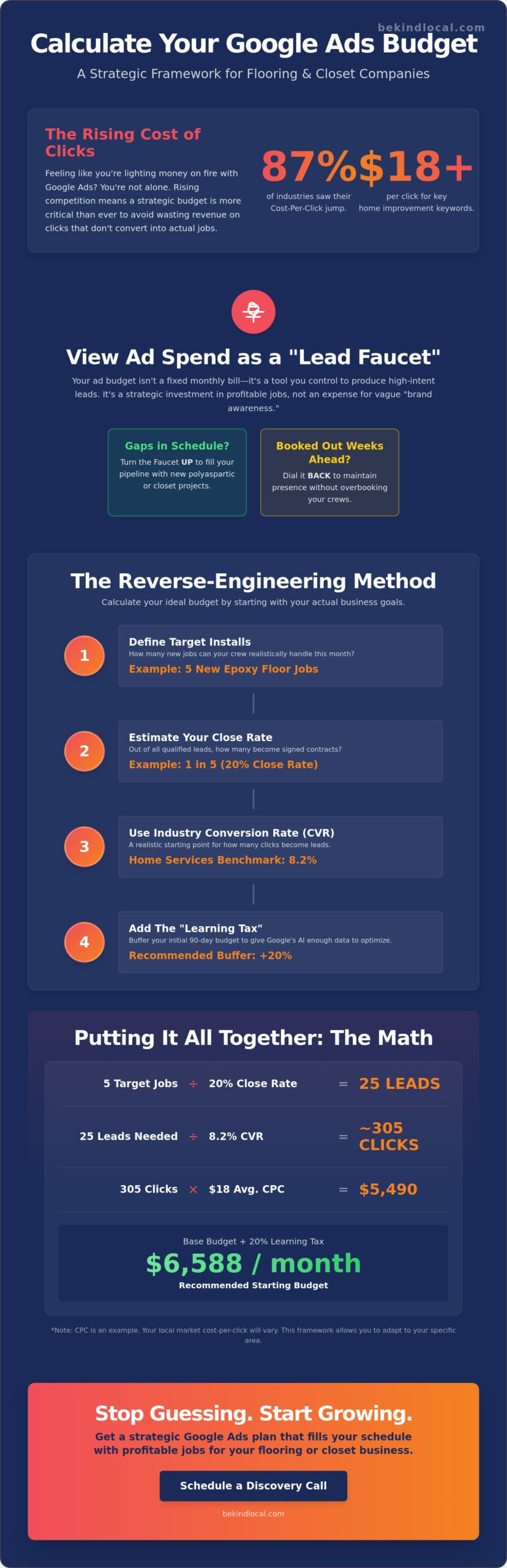
87% of industries saw their cost per click jump in 2026, with some home improvement keywords now reaching $18 per click. It’s a daunting reality that makes many owners wonder if they’re just lighting money on fire. If you’ve ever felt frustrated by “clicks” that don’t call or felt lost in a sea of jargon, you aren’t alone. Determining how much should a small business spend on google ads shouldn’t feel like a guessing game or a gamble with your hard-earned revenue.
You deserve a marketing partner who treats your budget with the same respect you give to a custom closet install or a polyaspartic garage floor project. We’re going to move past the generic advice and give you a clear, strategic framework to calculate a budget that actually generates high-intent leads. We’ll look at the current cost-per-lead reality for 2026 and show you how to set a spend that matches your capacity for new jobs without wasting a single dollar on low-quality traffic. By the end, you’ll have the confidence to stop guessing and start growing your local presence with precision.
Key Takeaways
- Learn to treat your ad spend as a lead faucet that you can scale based on your crew’s actual capacity for new polyaspartic or closet projects.
- Master the reverse-engineering formula to determine how much should a small business spend on google ads by starting with your target number of monthly installs.
- Get realistic cost-per-lead benchmarks specifically for high-ticket services like luxury walk-in suites and epoxy flooring systems.
- Discover why the first 90 days are critical for data gathering and how to balance your budget effectively between Search Ads and Local Services Ads.
- Understand how integrating your CRM allows you to track every dollar spent directly to a signed contract and a happy local customer.
The Strategic Shift: Why Ad Spend is an Investment, Not an Expense
Think of your Google Ads budget as a lead faucet. When your schedule has gaps or you’ve just hired a new crew for polyaspartic floor coatings, you can turn that faucet up to fill the pipeline. When you’re booked out six weeks in advance for custom closet installs, you can dial it back. This flexibility is why we view ad spend as a strategic investment rather than a fixed monthly bill. It’s a tool designed to produce a specific result: high-intent phone calls and form submissions from homeowners ready to buy.
Many business owners get caught in the trap of spending on “brand awareness.” While it’s nice for people to know your name, a specialty contractor needs direct response lead generation. You aren’t trying to be famous; you’re trying to be found at the exact moment a homeowner searches for “garage floor coating near me.” Understanding different online advertising models is the first step toward moving from a “cost” mindset to an “investment” mindset. This shift allows you to focus on the return rather than just the out-of-pocket expense.
We often see a common misconception regarding the “testing” phase. If you’re operating in high-competition markets like Dallas, Texas, or Orlando, Florida, a tiny budget won’t give you enough data to learn anything. When deciding how much should a small business spend on google ads, you have to consider that the AI needs a certain volume of clicks to optimize. Spreading a small budget too thin in a crowded market is like trying to heat a warehouse with a single candle; it’s not an investment, it’s just a waste of resources.
The Cost of Inaction in Local Markets
If you aren’t appearing in the sponsored sections of the search results, your local competitors are likely siphoning off the most motivated buyers. Relying solely on organic SEO for “near me” searches is risky because Google often prioritizes the Map Pack and paid ads on mobile devices. Ad Spend Efficiency is the ratio of qualified leads to total investment. By ignoring strategic advertising, you’re essentially leaving the digital “prime real estate” to companies that may offer a lower-quality product but have a louder online presence.
Understanding the Variables: CPC and CVR
Your Cost-Per-Click (CPC) for high-ticket keywords like “custom walk-in closets” will naturally be higher than for generic terms. However, a high CPC isn’t a bad thing if your Conversion Rate (CVR) is healthy. Your landing page plays a massive role here. If your ads promise luxury pantry remodels but your website looks outdated, you’ll pay for clicks that never convert. Avoid the trap of “cheap clicks” that attract people looking for minor repairs. Focus your budget on the phrases that signal a homeowner is ready for a full-scale transformation.
The Reverse Engineering Method: Calculating Your Ideal Starting Budget
Most general marketing advice suggests spending a flat percentage of your gross revenue. While Small Business Administration recommendations offer a baseline for traditional businesses, they don’t account for the aggressive growth goals of a specialized contractor. Instead of looking at what you spent last year, we look at what you want to earn next month. This reverse-engineering method ensures that when you ask how much should a small business spend on google ads, your budget is rooted in your actual shop capacity and local market reality.
To build your custom formula, follow these five steps:
- Define your target installs: Determine exactly how many new projects your crews can handle. If you want to add five new epoxy floor jobs to your monthly schedule, start there.
- Estimate your lead-to-close ratio: If you close one out of every five estimates, you need 25 qualified leads to hit your five-job goal.
- Identify local CPC: Research the current cost for specific niche keywords like “polyaspartic garage floor coating” in your service area.
- Calculate required click volume: Based on a standard 8.2% conversion rate for home services, you can determine the number of clicks needed to reach those 25 leads.
- Buffer for the learning tax: Add 20% to your initial monthly spend to cover the data-gathering phase as Google’s AI optimizes your bidding.
The Math of a $5,000 Custom Closet Project
If your average project value for a custom walk-in suite is $5,000, your budget must support that high-ticket return. In the Indianapolis market, data from early 2026 shows a realistic CPC range of $9.50 to $14.00 for premium closet keywords. If you need 10 leads to secure two $5,000 installs, your ad spend is a small, manageable fraction of the $10,000 in new revenue. This turns your marketing from an unpredictable bill into a calculated cost of acquisition.
Accounting for Local Competition Levels
Geography is the single biggest variable in your “Minimum Viable Budget.” A budget that works perfectly in rural North Carolina will be insufficient in hyper-competitive metros like Dallas or Miami. In large cities, the cost of entry is higher because more contractors are bidding for “near me” searches. If your spend is too low for your specific market, the AI won’t gather enough data to function, which actually lowers your ROI. We can help you navigate these variables with a local market analysis. If you’re ready to see the exact numbers for your specific service area, reach out for a custom audit of your local competition.
Industry Benchmarks: What Flooring and Closet Pros Actually Pay
Moving from formulas to the reality of the 2026 marketplace, the actual Cost-Per-Lead (CPL) varies significantly based on the specific system you install. For instance, leads for standard epoxy flooring typically cost less than those for high-performance polyaspartic or polyurea systems. This is because the latter signals a more educated buyer looking for long-term durability rather than a quick fix. In the current landscape, a healthy CPL for home improvement ranges between $150 and $400, depending on your service and market. While Forbes recommends starting with a small daily budget of $10 to $50 for general businesses, specialty contractors often need a more robust entry point to compete for high-intent keywords.
The difference between “reach-in” closet leads and luxury “walk-in” suite leads is also pronounced. A reach-in closet search might be price-sensitive, while a homeowner searching for a custom walk-in suite is looking for craftsmanship and design expertise. This distinction is vital when deciding how much should a small business spend on google ads. You’ll likely pay more for the walk-in lead, but the return on a $15,000 project justifies the higher acquisition cost. Seasonality also plays a role. Garage remodelers often see a surge in spring and fall, which can drive up auction prices as competitors flood the market. During these peaks, having a high Quality Score is your best defense against rising costs, as Google rewards relevant, high-quality ads with lower actual CPCs.
Floor Coating Ad Spend Benchmarks
Solo operators might start with a budget of $1,500 to $2,500 per month in smaller markets, while multi-crew companies in large metros often spend $5,000 to $15,000 or more. A critical part of preserving this budget is the aggressive use of negative keywords. You don’t want to pay for clicks from DIY searchers looking for “how to paint concrete.” For a deeper dive into these strategies, see our Floor Coating Leads Guide.
Custom Closet and Storage Benchmarks
For closet pros, focusing your spend on high-margin pantry, mudroom, and garage slatwall systems can maximize your ROI. Because these are visual-heavy industries, you may need an additional budget for Remarketing. This keeps your beautiful designs in front of prospects who didn’t book a consultation on their first visit. You can explore more niche-specific tactics in our Custom Closet Marketing Guide. By targeting these specific high-value areas, you ensure your ad spend converts into profitable contracts rather than just empty traffic.
Avoiding the ‘Money Pit’: How to Structure Your Initial Testing Phase
The biggest mistake most contractors make is judging their results too early. Google Ads campaigns require a learning period of 30 to 60 days where the AI gathers data on user behavior and auction dynamics. If you cut your budget after three weeks because you didn’t land a $10,000 polyaspartic floor project immediately, you’ve essentially paid for the data and then walked away before you could use it. We call this the 90-day rule. You need a full quarter to refine your bidding, weed out negative keywords, and let the algorithm identify which homeowners are actually ready to book a consultation.
When figuring out how much should a small business spend on google ads, you must also decide where those dollars go. We recommend a strategic split between traditional Search Ads and Google Local Services Ads (LSAs). LSAs appear at the very top of the search results and operate on a pay-per-lead model, which is excellent for immediate phone calls. However, Search Ads allow you to target specific high-margin niches like “custom walk-in closets” or “garage slatwall systems” with much more precision. A balanced budget uses LSAs for volume and Search Ads for high-ticket quality.
Don’t fall for the “set it and forget it” trap of fully automated bidding on a small budget. While Google’s AI is powerful, it needs significant conversion data to work effectively. If your budget only allows for a few clicks a day, the AI doesn’t have enough information to optimize. You need a human partner to guide the machine, ensuring your spend isn’t being swallowed by generic “how-to” searches or broad terms that don’t lead to signed contracts.
The 70/20/10 Budget Allocation Model
To protect your investment, we suggest a disciplined allocation of your monthly spend. Devote 70% of your budget to proven, high-intent keywords like “garage floor coating near me” or “closet designers in [City].” Allocate 20% to “competitor” or “luxury” terms to reach homeowners who might be considering other high-end options. Finally, reserve 10% for retargeting. This keeps your brand in front of people who visited your site but weren’t quite ready to schedule a quote on their first visit.
Red Flags That Your Budget is Being Wasted
High click volume without a single phone call is a major warning sign. This often happens when your ads are showing up for DIY-related searches like “epoxy floor paint kit.” Another common pitfall is a poor Custom Website Design. If your ad is perfect but your landing page is slow, confusing, or lacks clear photos of your work, you’re paying for clicks that will never convert. Your website must be as polished as the custom pantry or mudroom you’re trying to sell. If you’re concerned your current setup is leaking money, you can request a professional audit of your ad performance to identify exactly where your budget is going.
Beyond the Budget: Maximizing Lead Quality with a Strategic Partner
While we’ve spent time calculating formulas and benchmarks, the truth is that the dollar amount is only half the battle. When you ask how much should a small business spend on google ads, the answer depends heavily on who is behind the steering wheel. A $5,000 monthly budget can be a powerful engine for growth or a fast way to drain your cash flow. Strategic management ensures that every dollar is aimed at a homeowner who values your craftsmanship, rather than someone just looking for the lowest price on a bucket of epoxy.
One of the most vital components of a high-performing campaign is CRM integration. By connecting your Google Ads account to your sales pipeline, we can track a lead from the initial click on a “custom walk-in closet” ad all the way to a signed contract. This level of transparency allows us to optimize for profit, not just traffic. We believe in ethical marketing, which means providing you with honest, transparent reporting. We don’t hide behind “hypey” claims or vanity metrics like impressions. Instead, we focus on the numbers that actually move the needle for your local business.
Be Kind Local brings deep niche expertise to the table that generalist agencies simply cannot match. We understand the difference between a polyurea system and a standard epoxy floor. We know that a client looking for garage slatwall systems has different motivations than one seeking a reach-in pantry remodel. This industry-specific knowledge allows us to out-maneuver larger agencies by crafting ads that speak directly to the pains and desires of your specific customers.
The ROI of Strategic Management
We’ve seen how precise targeting can transform a business. For example, by refining the keyword strategy for a garage cabinet company and eliminating broad “storage” terms, we’ve successfully reduced their cost-per-lead while increasing the average project value. Choosing a partner based solely on “cheap” management fees is often a mistake. Low-cost providers often use “set it and forget it” tactics that lead to expensive, unoptimized spend. For a deeper look at how we handle these complexities, explore our Google Ads for Home Services Pillar.
Building a Sustainable Lead Machine
Your goal shouldn’t just be to survive; it should be to dominate your local market. As your crew capacity grows and your systems become more efficient, your budget should scale alongside them. You can move from a “survival spend” that keeps the lights on to a “market dominance spend” that makes you the first choice for every garage and closet project in your city. If you’re ready to stop guessing and start building a predictable lead machine, we’re here to help. You can schedule a discovery call at bekindlocal.com to build a custom budget model tailored specifically to your business goals.
Take Control of Your Local Market Growth
Deciding on your marketing budget shouldn’t feel like a shot in the dark. You’ve seen how reverse-engineering your install goals and respecting the 90-day learning period turns a “money pit” into a predictable lead faucet. By focusing on lead quality over raw traffic volume, you ensure your investment actually lands you in the garages and walk-in closets of your ideal local customers. This strategic approach moves you away from generic “clicks” and toward high-intent conversations.
When you finally determine how much should a small business spend on google ads, the success of that spend relies on a conversion-focused strategy and deep niche expertise. As specialists in floor coating and custom closet marketing, we provide data-transparent reporting that connects every ad dollar directly to a real contract. We’re here to help you move from a survival mindset to total market dominance with a plan built on ethics and proven results.
Ready to stop guessing? Schedule a discovery call with Be Kind Local to build a data-driven Google Ads strategy for your business. We’re excited to help you grow your local presence with confidence and clarity.
Frequently Asked Questions
Is $500 a month enough for a small business to spend on Google Ads?
$500 a month is rarely enough to compete effectively in high-ticket niches like garage remodeling or custom closet design. In most markets, this budget won’t generate enough clicks to provide Google’s AI with meaningful data for optimization. A realistic starting point for determining how much should a small business spend on google ads is typically between $1,500 and $2,500 per month to ensure you reach homeowners who are ready for a full installation.
How long does it take to see results from a new Google Ads campaign?
You should expect a learning period of 30 to 60 days before your campaign reaches peak efficiency. While you may see initial leads within the first week, the algorithm needs time to understand which users are most likely to convert. We recommend following a 90-day rule to allow for full optimization of your bidding strategy and negative keyword lists before making major changes.
Should I spend more on Google Ads or Local SEO first?
Most successful contractors use both simultaneously to create a balanced lead generation machine. Google Ads acts as a “faucet” you can turn on for immediate high-intent leads, while Local SEO builds long-term authority in the Map Pack. If you need jobs right away, prioritize ads; if you want to lower your future acquisition costs, invest in SEO alongside your paid campaigns.
How do I know if my marketing agency is wasting my ad budget?
A major red flag is a lack of transparent, conversion-focused reporting. If your agency only talks about “impressions” or “clicks” without showing you how those turned into phone calls or signed contracts, they may be wasting your budget. Check if they are bidding on generic “how-to” terms instead of high-intent keywords like “polyaspartic garage floor coating” or “custom walk-in closets.”
What is a good cost-per-lead (CPL) for the floor coating industry?
A healthy cost-per-lead for the floor coating industry in 2026 typically ranges between $150 and $400. This number varies based on your local market competition and whether you’re targeting standard epoxy or premium polyurea systems. Remember that a higher CPL is often justified if the lead quality results in a $5,000 project with a high profit margin.
Can I run Google Ads myself to save money on management fees?
You can manage your own ads, but it often leads to higher costs in the long run due to technical errors. Without deep knowledge of Quality Score, keyword match types, and landing page optimization, you risk spending thousands on clicks that don’t call. Professional management ensures your budget is protected through aggressive negative keyword management and strategic bid adjustments.
What happens to my leads if I temporarily stop my Google Ads spend?
If you stop your spend, your leads will stop almost immediately. Unlike SEO, which has a residual effect, Google Ads is a direct response channel that only functions while the budget is active. Pausing a campaign for too long can also reset the AI’s learning phase, making it more expensive to regain your previous performance levels once you restart.
Do I need a separate budget for Google Local Services Ads (LSAs)?
Yes, it’s best to treat Local Services Ads and traditional Search Ads as two distinct parts of your marketing budget. LSAs operate on a pay-per-lead model and are great for capturing homeowners looking for quick service. Traditional Search Ads require their own budget to target specific, high-margin projects like custom pantry or mudroom installations that require more design-heavy messaging.