
 951-249-7500
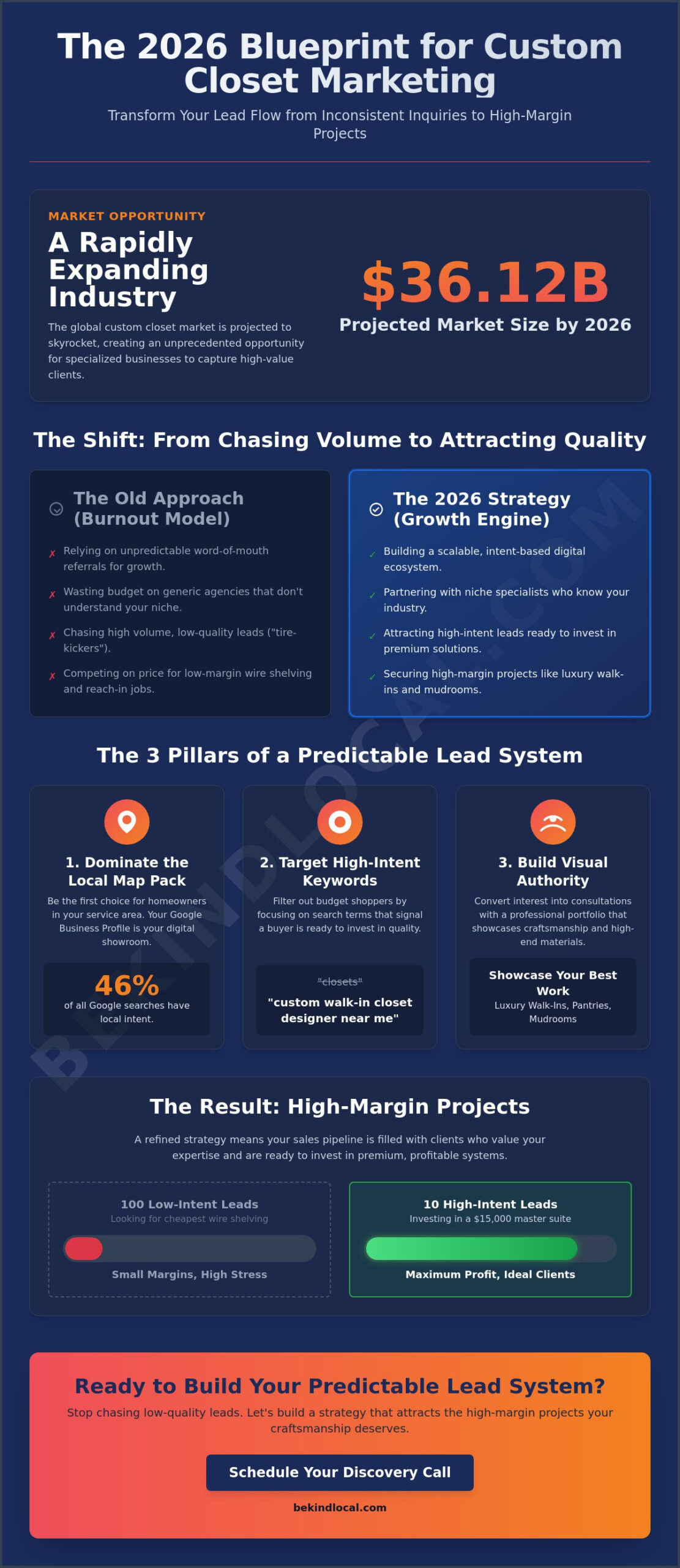
With the global custom closet market reaching a record $36.12 billion in 2026, there is more opportunity than ever to grow your business. However, we know it’s frustrating to watch your hard-earned budget disappear on “tire-kickers” while your expertise in custom closet marketing goes unnoticed in the local map pack. You’ve likely felt the stress of inconsistent lead flow, wondering why generic agencies can’t seem to distinguish a simple reach-in shelf from the luxury walk-in systems and mudrooms you take pride in building.
We believe your focus should stay on the craft of design and installation, not on chasing low-quality inquiries. This strategic guide will teach you how to dominate your local market and attract high-intent leads using a proven, B2B-focused digital framework. We’ll walk through the exact steps to build a predictable marketing system that highlights your craftsmanship and secures the high-margin projects your business deserves.
Key Takeaways
- Transition from stagnant word-of-mouth growth to a scalable, intent-based digital ecosystem designed for the 2026 market.
- Secure a dominant local presence by optimizing your Google Business Profile to capture homeowners searching for premium mudroom and pantry solutions.
- Refine your custom closet marketing by targeting high-intent search terms that attract luxury projects instead of budget-conscious shoppers.
- Convert visual interest into confirmed consultations by developing a professional portfolio strategy that emphasizes craftsmanship and organization.
- Understand why niche-specific marketing strategies outperform generic agency tactics in the competitive home organization space.
The Evolution of Custom Closet Marketing in 2026
The days of relying solely on a handshake and a referral are fading. While word-of-mouth reflects your craftsmanship, it doesn’t offer the predictability needed to scale a business in 2026. Modern custom closet marketing has transformed into a complex, intent-based digital ecosystem. It’s no longer enough to just “be online.” You have to meet homeowners at the exact moment their frustration with clutter turns into a search for a solution. We believe your marketing should be as organized and efficient as the systems you install for your clients.
We’ve seen a massive shift in how projects are perceived by the public. Homeowners aren’t just buying storage; they’re investing in a luxury lifestyle that promises peace and order. Looking back at the history of the walk-in closet, these spaces evolved from simple utility to status symbols of the modern home. Today, your marketing must reflect that elegance and the tactile quality of your work. AI-driven search engines now prioritize businesses that demonstrate deep niche expertise and local authority. If your digital presence feels generic, you’ll lose the high-ticket walk-in and mudroom projects to competitors who position themselves as specialists.
The 2026 Search Landscape for Home Organization
Search behavior is more visual and specific than ever. A homeowner doesn’t just type “closets.” They use phrases like “custom walk-in closet designer near me” or “luxury pantry organization systems.” These are high-intent queries that signal a buyer is ready to invest. To win these leads, your local SEO strategy must be airtight. You need to show up in the local map pack with a profile that highlights specific project types like reach-ins, pantries, and sophisticated mudrooms. AI search tools now “read” your portfolio images, making high-quality, tagged photography a non-negotiable part of your visibility.
Moving from Lead Volume to Lead Quality
Chasing every lead that comes through the door is a recipe for burnout. You know the feeling of spending hours on a design only to realize the client has a “big-box store” budget. Ten high-intent leads interested in a $15,000 master suite renovation are worth far more than a hundred people looking for the cheapest wire shelving. Chasing low-margin reach-in jobs often costs more in labor and overhead than they generate in profit. Success in 2026 requires a clear Ideal Client Profile (ICP). By refining your brand strategy, you can filter out the “tire-kickers.” This allows you to focus your energy on the homeowners who truly value your time, your premium materials, and your professional design eye.
Dominating the Local Map Pack: SEO for Closet Designers
Most homeowners start their journey with a local search. If your business doesn’t appear in the top three results of the Google Map Pack, you’re essentially handing high-margin projects to your competitors. Local search intent is massive. Research shows that 46% of all Google searches have local intent. For a boutique closet designer, this means your Google Business Profile is often more important than your actual website homepage. It’s the first thing people see when they look for a “closet designer near me.”
Optimizing your profile isn’t a “set it and forget it” task. You need consistent updates, high-resolution photos of your latest walk-in installs, and accurate contact information. This builds trust with both Google and your potential clients. When making claims about your materials or lead times, remember that the truth-in-advertising rules set by the FTC apply to your digital presence just as much as a print ad. Ethical custom closet marketing starts with transparency. Building local citations on platforms like Yelp or Houzz further solidifies your footprint, but only if your Name, Address, and Phone number (NAP) are identical across every site.
Technical Local SEO Signals for Closet Companies
To truly move the needle, you must look under the hood of your website. Implementing local schema markup helps search engines understand exactly where your showroom is located. It’s a technical signal that tethers your digital presence to your physical community. We also recommend creating dedicated landing pages for every major city you serve. Instead of a generic “Services” page, a page titled “Custom Closets in [City Name]” allows you to rank for hyper-local searches. This is where you can showcase specific projects, like a reach-in closet renovation in a historic district or a modern mudroom in a new development.
Review Management as a Ranking Factor
Reviews are the lifeblood of ranking. Google Business Profile signals account for 32% of the ranking influence in local map packs, and a large part of that comes from customer feedback. Don’t be afraid to ask for a review immediately after a successful installation. You might say, “We’d love to hear how your new pantry has changed your daily routine.” When you respond to these reviews, do it thoughtfully. Instead of a generic “Thanks,” try: “We’re so glad you love your new walk-in closet in [City]; it was a pleasure designing it.” This naturally weaves in keywords and signals to Google that you’re an active, local professional. If you aren’t sure where your current visibility stands, you can always request a local SEO audit to see what’s holding you back.
High-Intent Paid Search: PPC Strategies for Luxury Closets
While local SEO builds long-term authority, Google Ads provide the immediate visibility needed to fill your design calendar today. We don’t believe in just getting more clicks; we focus on getting the right clicks. In the world of custom closet marketing, the difference between a $15,000 project and a wasted lead often comes down to a single word in a search query. If you bid on generic terms like “closet organizers,” you’ll likely attract DIY enthusiasts looking for cheap plastic bins. Instead, we target high-intent phrases such as “custom walk-in closet design” or “professional pantry installation” to ensure your budget reaches homeowners ready to invest in quality.
A strategic approach to paid search is about precision. As you develop a marketing plan, you must view PPC as a tool for “jumping the queue” to reach the most affluent neighborhoods in your service area. By using custom closet ads, you can bypass the slow build of organic rankings and place your brand directly in front of active buyers. Protecting your ad spend is equally important. We implement aggressive negative keyword lists to filter out searches for “used closets,” “cheap repairs,” or “closet kits,” ensuring every dollar is spent on high-margin opportunities.
Eliminating Wasteful Ad Spend
Most agencies fail because they use broad match keywords that cast too wide a net. This leads to high traffic but low conversion. We prefer phrase and exact match targeting to maintain control over who sees your ads. Your landing page must also be hyper-relevant to the search. If someone clicks an ad for “luxury master suites,” they shouldn’t land on a generic homepage. They need to see a gallery of your best walk-in work. Tracking closet advertising ROI means looking at the final contract value, not just the cost per lead.
Retargeting the Luxury Buyer
High-ticket decisions don’t happen in a single afternoon. A homeowner might visit your site, admire your portfolio, and then get distracted. Retargeting display ads allow you to stay top-of-mind by showing beautiful project photos as they browse other sites. We suggest segmenting these ads by project type. If a visitor spent time on your laundry room page, show them ads featuring your custom cabinetry and slatwall systems for utility spaces. A compelling call-to-action (CTA) should invite them to a “Complimentary Design Consultation” rather than just a “Quote,” positioning you as a partner in their home’s transformation. If you also offer garage storage solutions, exploring proven garage cabinet advertising ideas can help you apply the same high-intent retargeting principles to that lucrative segment of your business.
Building Visual Authority: Social and Portfolio Strategy
Visual storytelling is the backbone of effective custom closet marketing. In 2026, homeowners don’t just want to hear about your quality; they want to see it in action. Closets are an inherently visual-first sell on social media, where platforms like Instagram and Pinterest act as the primary discovery engines. These visual channels allow you to capture interest during the early awareness stage, long before a homeowner even thinks about calling for a quote. We’ve seen that high-quality imagery combined with strategic placement can turn a casual browser into a high-ticket client.
Developing a closet marketing portfolio that closes deals requires more than just a few “after” shots. It needs to showcase the technical depth of your work. Use video walk-throughs to highlight the precision of your drawer glides or the versatility of your garage slatwall systems. Short-form video has become a top ROI-driving format this year, giving you the chance to explain the benefits of specific materials or hardware in a way that static photos simply cannot match. It’s about creating an emotional connection to the organized lifestyle you provide.
Converting Social Followers into Design Leads
Strategic use of closet social media marketing is a core pillar of custom closet marketing in a visual age. While professional photography is vital, “behind-the-scenes” installation content builds a unique layer of trust. Seeing your team carefully prepping a mudroom or organizing a complex pantry demonstrates your commitment to the craft. We always recommend including “before and after” shots in your feed. These posts provide the visual proof of transformation that homeowners crave. They allow potential clients to project their own clutter onto your “before” and see the peaceful, organized future you offer in the “after.”
The High-Converting Closet Website
Your custom closet website serves as your digital showroom, and it must be built for conversion. Essential elements include a clean design, fast loading times, and a prominent “Free Design Consultation” button. This call-to-action should be visible on every page, making it easy for a visitor to take the next step. Mobile optimization is no longer optional; it’s a requirement. Many homeowners browse for home organization solutions at night on their phones. If your site is difficult to navigate on a small screen, you’ll lose those leads to a competitor. Schedule a discovery call with Be Kind Local today to ensure your website is working as hard as you do.
Scaling with a Strategic Partner: The Be Kind Local Difference
Many marketing agencies treat your business like just another “home service” account. They apply the same cookie-cutter tactics to a custom closet designer that they would to a roofer or a plumber. We believe this approach is fundamentally flawed. Successful custom closet marketing requires a deep appreciation for aesthetics, an understanding of high-ticket sales cycles, and a respect for local craftsmanship. You deserve an ethical marketing partner who acts as a strategic extension of your team, not just a vendor sending a monthly bill.
Generic agencies often hide behind “vanity metrics” like impressions or raw click counts. While these numbers look good on a spreadsheet, they don’t pay the bills if they aren’t converting into high-margin projects. We prioritize lead quality over raw traffic volume every single day. Our goal is to ensure your phone rings with homeowners who value your design expertise and premium materials. By focusing on your specific local market, we build a roadmap to dominance that ensures you are the first choice for every walk-in, pantry, and mudroom project in your area.
Beyond the Vendor Model
We’ve built our reputation on transparency and results that impact your bottom line. We don’t believe in “set it and forget it” marketing. Instead, we provide proactive strategy adjustments based on the actual leads coming through your funnel. Our niche expertise in epoxy flooring, garage storage, and custom closets gives us a unique advantage. We already understand the value of polyaspartic systems and the importance of showcasing a well-organized reach-in closet. This specialized knowledge means we can hit the ground running without a steep learning curve, allowing you to stay focused on your designs and installations. For businesses looking to expand into the garage storage segment, our approach to garage cabinet advertising ideas follows the same high-intent, quality-over-quantity philosophy we apply to every niche we serve.
Starting Your Discovery Call
Taking the first step toward a predictable sales funnel shouldn’t be stressful. When you schedule your first strategy session, we focus on identifying the “low-hanging fruit” in your local market. We’ll look at your current Google Business Profile visibility and analyze where your competitors are capturing leads that should be yours. You can expect a direct, fluff-free conversation about your goals and the practical steps needed to reach them. We don’t use high-pressure sales tactics; we offer a clear path to growth based on data and industry experience. Ready to secure your local market? Schedule a discovery call with Be Kind Local at bekindlocal.com today and let’s start building your system.
Secure Your Future in the Custom Closet Market
Dominating your local market in 2026 requires more than just high-quality craftsmanship; it demands a precise, intent-based digital strategy. By prioritizing lead quality over raw traffic and mastering the technical nuances of the local map pack, you can move away from unpredictable word-of-mouth growth. We’ve seen how visual authority and high-intent paid search can transform a business, turning master suite and mudroom installs into a predictable stream of high-margin projects. Your custom closet marketing should be as meticulously designed as the organization systems you build for your clients.
At Be Kind Local, we bring specialized expertise in the custom closet and garage storage niches. We focus on generating high-intent, high-margin leads through transparent, ethical marketing strategies that respect your craft. You don’t have to navigate these digital shifts alone. We’re here to help you build a system that works while you focus on what you do best: design and installation. Schedule your strategic discovery call with Be Kind Local today. Let’s work together to make your local business the dominant force it deserves to be.
Frequently Asked Questions
How much should a custom closet company spend on marketing?
Most established custom closet companies find success by reinvesting 5% to 10% of their gross revenue into marketing. If you are in a highly competitive local market or aiming for aggressive growth, this figure often reaches 15%. This budget should be balanced between long-term authority building like SEO and immediate lead generation tools like Google Ads to ensure a steady pipeline of projects.
What is the best way to get high-end walk-in closet leads?
The most effective method is targeting high-intent search queries through Google Ads and local SEO. Homeowners looking for premium walk-in systems are usually searching for specific solutions rather than just browsing social media. By appearing at the top of search results for “luxury walk-in closet design,” you capture buyers who’ve already decided to invest in a high-ticket transformation for their home.
Does SEO really work for closet designers in a competitive market?
Yes, SEO is the most sustainable way to dominate a competitive market by building trust and local authority over time. While paid ads provide speed, organic rankings signal to homeowners that you’re a stable, established expert in your community. A focused custom closet marketing strategy that targets specific neighborhoods and high-value project types can carve out a dominant position even against national franchises.
How long does it take to see results from a custom closet marketing campaign?
You can expect to see immediate traffic from paid search campaigns, while organic SEO typically takes three to six months to show significant ranking improvements. Marketing is a compounding investment. Initial results often start with better lead quality, followed by a steady increase in lead volume as your Google Business Profile and website authority grow within your primary service areas.
Which is better for closets: Google Ads or Facebook Ads?
Google Ads are generally superior for high-ticket lead generation because they capture active search intent. Facebook Ads are excellent for building visual awareness and retargeting, but Google places you in front of someone actively looking for a solution. For custom closets, catching a homeowner when they’re searching for a “pantry designer” usually yields a much higher conversion rate than passive browsing.
How do I optimize my Google Business Profile for closet design services?
Start by selecting the most accurate primary category and uploading high-resolution photos of your actual installs. You should post weekly updates showcasing your latest work, such as a reach-in or mudroom project, and respond to every customer review. Consistent activity signals to Google that your business is active and relevant, which is a major factor in ranking influence within the local map pack.
What technical terms should I include in my closet marketing content?
Use industry-specific terminology like garage slatwall systems, overhead storage, and specific closet types such as reach-in, walk-in, and mudrooms. Including these terms in your custom closet marketing content helps search engines understand your niche expertise. It also builds immediate credibility with sophisticated homeowners who are looking for professional-grade materials and specialized design knowledge rather than generic shelving.
Why is lead quality more important than lead volume for closet businesses?
Lead quality is paramount because your time is your most valuable resource. Chasing a hundred low-intent leads who are looking for the cheapest possible option wastes your design and estimating hours. Focusing on high-intent leads ensures that your sales funnel is filled with projects that have the margins necessary to sustain and grow your business while maintaining high standards of craftsmanship.