
 951-249-7500
What if the very tool meant to grow your business is actually quietly draining your profit margins through a “black box” of automated clicks? With the average cost-per-click for home improvement services hitting $7.85 in 2026, there is no room for campaigns that target the wrong side of town or DIYers looking for cheap fixes. If you’re frustrated by high lead costs and a phone that only rings for low-ticket repairs, you need a clear strategy on how to stop wasting money on google ads. We have seen many talented specialty contractors lose heart because their budget is eaten by irrelevant searches before the high-value customers even wake up.
We understand that you’re looking for more than just traffic; you want a predictable pipeline of polyurea flooring and custom walk-in closet projects. This guide promises to reveal the specific technical leaks and strategic missteps currently sabotaging your ROI. We will walk through how to outmaneuver rising CPCs, leverage first-party data to find serious buyers, and transition your account from a source of waste into a high-ticket lead generation machine.
Key Takeaways
- Uncover the hidden technical settings, such as Search Network expansion, that often lead to your budget leaking into irrelevant mobile apps and distant geographic areas.
- Learn how to stop wasting money on google ads by refining your keyword strategy to target high-intent buyers rather than broad, educational searches.
- Protect your investment by building a robust list of negative keywords that filter out DIYers and “cheap” traffic looking for retail kits or big-box store products.
- Improve your lead quality by ensuring every ad for custom closets or polyurea coatings lands on a specific, conversion-focused page that matches the user’s exact needs.
- Pivot from chasing clicks to managing a predictable sales pipeline that focuses on high-ticket projects and sustainable business growth.
The Invisible Leaks: Why Your Contractor Ad Spend Evaporates
Google often designs its default settings to maximize clicks. This approach is great for their revenue, but it’s often devastating for your profit margins. When you’re trying to figure out how to stop wasting money on google ads, you have to look at the hidden settings that Google automatically enables during setup. These “Smart” features are designed to expand your reach, but for a specialty contractor selling high-ticket services like polyaspartic floor coatings or custom walk-in closets, broad reach is usually your enemy. You don’t need the whole world to see your brand. You only need the right homeowners in your specific service area to see it when they are ready to buy.
The Google Ads platform is complex, and many business owners fall into the trap of using “Smart” campaigns that prioritize easy clicks over qualified leads. These campaigns operate like a black box, giving you very little control over where your ads appear or who sees them. If you want a predictable pipeline of high-value projects, you must move away from automated “easy” buttons and start engineering friction that filters out low-intent traffic.
The Display Network and Search Partner Pitfalls
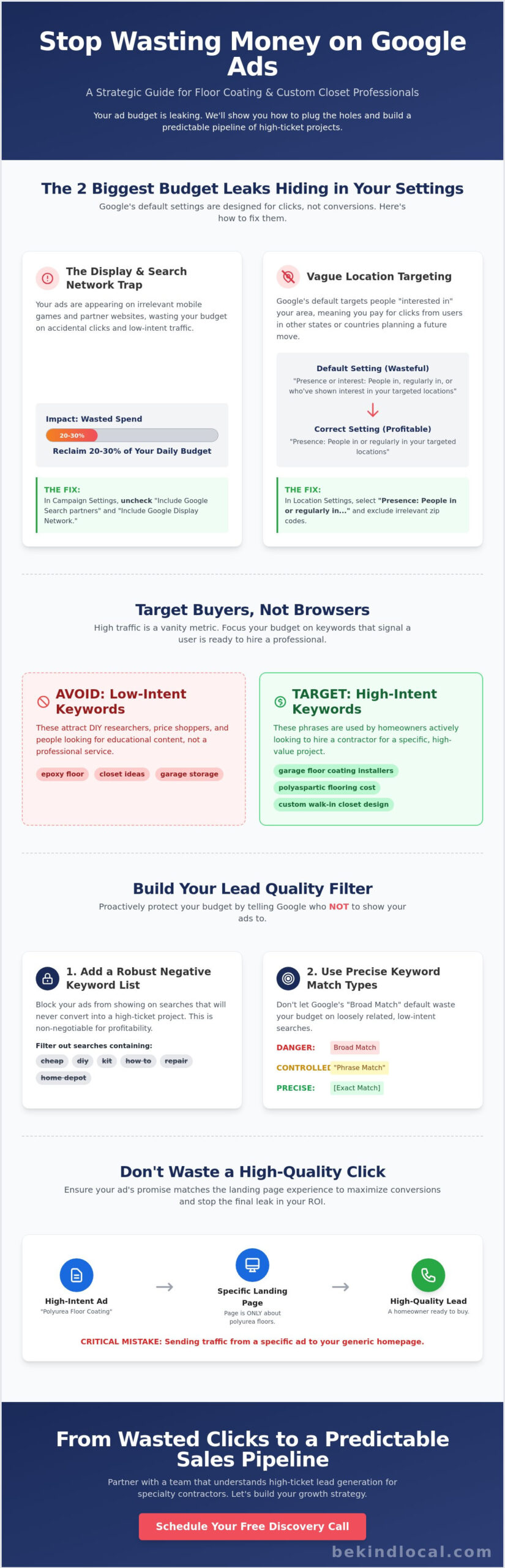
One of the biggest budget killers is the “Search Network Expansion” and the Display Network. These settings allow your ads to show up on third-party websites and mobile apps that have nothing to do with home improvement. Imagine a homeowner playing a mobile game or browsing a weather app. If your ad for a $5,000 garage floor system pops up there, any click you receive is likely accidental or extremely low-intent. We’ve seen floor coating pros reclaim 20% to 30% of their daily budget just by unchecking these two boxes in their campaign settings. You should audit your placement reports regularly to identify these trash traffic sources. If your spend is going toward mobile games, you aren’t building a business; you’re subsidizing Google’s bottom line.
Mismanaged Location Targeting in Local Markets
Location targeting is another area where contractors in competitive markets lose thousands of dollars every month. By default, Google targets people “in, or who show interest in” your targeted locations. This means someone in another state researching “custom closets in Dallas” for a move six months from now might trigger your ad. To truly master how to stop wasting money on google ads, you must switch your location settings to “Presence: People in or regularly in your targeted locations.” This simple change ensures you aren’t paying for clicks from people outside your service radius. We also recommend using location exclusions to block high-cost, low-conversion zip codes where your ideal “high-ticket” clients don’t live. If you want to refine your strategy further, our team at Be Kind Local can help you audit your advertising settings to ensure every dollar is focused on your local neighborhood.
Targeting Intent Over Traffic: Refining Your Keyword Strategy
High traffic volume is a vanity metric that often hides a failing strategy. If you want to understand how to stop wasting money on google ads, you must first distinguish between a researcher and a buyer. High-intent keywords are specific phrases that signal a homeowner is ready to open their wallet, not just browse for inspiration. For instance, a broad term like “epoxy floor” attracts DIYers looking for tutorials or cheap retail kits. Conversely, “garage floor coating installers” is a goldmine because it identifies someone looking for a professional service. By narrowing your focus to these commercial-intent phrases, you ensure your budget is reserved for the most valuable opportunities.
The match type you choose is just as critical as the word itself. Google often defaults to “Broad Match,” which is a dangerous trap for high-ticket services like custom walk-in closet design. Broad match allows Google to show your ad for loosely related terms, such as “closet cleaning tips” or “wire shelving units.” This lack of control is how small budgets evaporate. We recommend balancing “Exact Match” for your highest-performing terms to keep costs tight, while using “Phrase Match” to capture relevant variations without the total lack of discipline found in broad targeting. Aligning your keywords with what you actually provide also helps you stay compliant with truth-in-advertising standards, ensuring that the promise in your ad matches the user’s search reality.
Niche-Specific Keyword Selection
Precision in your vocabulary separates the experts from the amateurs. If you specialize in high-end finishes, your strategy should prioritize technical terms like polyaspartic and polyurea systems over generic “garage paint” searches. Homeowners looking for “garage paint” are rarely prepared for the investment of a professional coating. In the closet industry, targeting “custom reach-in closets” or “pantry storage systems” will yield a much higher lead quality than “cheap closet organizers.” Using long-tail keywords allows you to capture homeowners in the decision-making phase who know exactly what they want, whether it’s a mudroom locker system or a master walk-in renovation.
The ROI of Buyer Intent
The cost-per-conversion for informational keywords is almost always higher because these users aren’t ready to book a consultation. Bidding on competitor brand names is another high-waste strategy for local contractors; you’re often paying a premium just to reach someone who is already loyal to another firm. Buyer intent for a $5,000+ project is the specific search behavior that indicates a homeowner has moved past curiosity and is actively seeking a professional to solve a permanent storage or flooring problem. If you feel like you’re paying for clicks that never turn into contracts, it might be time to review your keyword list with a partner who understands the specialty contracting world.
The Lead Quality Filter: Mastering Negative Keywords
While choosing the right keywords is vital, knowing what to exclude is often the secret to how to stop wasting money on google ads. Think of negative keywords as a protective wall around your budget. They ensure your ads only appear for homeowners who value professional craftsmanship over a weekend project. For a specialty contractor, the most dangerous clicks come from the DIY crowd. If you’re a floor coating pro, you must block terms like “kit,” “Home Depot,” and “Rust-Oleum” immediately. These searchers aren’t looking for a high-performance polyurea system; they’re looking for a cheap fix that will likely peel in six months. You shouldn’t have to pay for their research phase.
By focusing on user intent, you can also filter out those seeking “cheap” or “discount” services. Your profit margins depend on working with clients who understand the value of custom closets or durable concrete coatings. You should also block “job,” “hiring,” and “employment” terms. This prevents your ads from being clicked by people looking for work rather than a quote. It’s a common leak that many agencies overlook, but it can drain hundreds of dollars from your monthly spend if left unmanaged.
The Essential Contractor Negative List
You can categorize your negatives into DIY terms, competitor brands, and unrelated services. Don’t let your ads show for “roofing” or “plumbing” just because Google thinks it’s a related home service. It’s helpful to check your Search Terms Report every 48 hours. This habit helps you catch new, irrelevant phrases before they eat more of your budget. If you see a click for “how to fix epoxy floor cracks,” add it to your list immediately. Using shared negative keyword lists across all your campaigns keeps your account clean and efficient. This focus on relevance is crucial because a higher Quality Score can lead to a 50% or more reduction in your cost-per-click.
Filtering for High-Ticket Projects
To protect your pipeline, exclude terms like “repair” or “patch.” You want full garage cabinet installations, not a one-hour fix that barely covers your travel costs. Blocking “rental” or “apartment” is another smart move for closet designers. These users rarely have the authority or the budget for a custom walk-in renovation. You want to speak directly to the homeowner who is ready to invest in their forever home. For a deeper dive into these tactics, read our Google Ads for Home Services guide. It’s designed to help you focus on high-value homeowners who are ready to invest in their property. We believe in being a partner in your growth, not just another vendor, and that starts with protecting your hard-earned revenue from low-quality traffic.
Conversion-Centric Landing Pages: Fixing the ROI Killer
You can have the most precise keyword list in the world, but if you’re sending that traffic to your homepage, you’re effectively throwing money away. A homepage is designed to be a generalist; it speaks to everyone and, therefore, speaks to no one. When a homeowner searches for “custom walk-in closets,” they don’t want to land on a page that also talks about mudroom lockers or garage cabinets. This disconnect is a primary reason why many contractors fail to see a return. To understand how to stop wasting money on google ads, you must master “Message Match.” This means the promise made in your ad must be the first thing the user sees on the landing page.
Mobile optimization is no longer optional. Data shows that mobile devices account for 65% of all Google Ads clicks in 2026. If your “Call Now” button is buried or your contact form is difficult to navigate on a smartphone, your conversion rate will plummet. Specialty projects like polyaspartic floor coatings are high-ticket investments. Homeowners need to feel immediate confidence in your professional capabilities. A landing page that loads slowly or looks dated on a phone sends a signal that your craftsmanship might be equally unreliable. Every click you pay for is a promise, and if you fail to fulfill that promise within seconds of a page loading, that potential lead is gone.
The Anatomy of a High-Converting Contractor Page
A successful landing page for a specialty contractor needs to do more than just look pretty. It must function as a silent salesperson. High-quality “Before & After” galleries are essential for garage storage and flooring projects because they provide tangible proof of your work’s quality. We also recommend adding a zip code field to your contact form. This simple step filters for your specific service area, ensuring your sales team doesn’t waste time on leads you can’t actually serve. By using “Be Kind” brand elements, such as transparent project timelines and local origin stories, you build immediate trust with homeowners who value community-focused businesses.
Reducing Friction and Building Trust
Trust signals are the currency of the digital world. Authentic reviews and video testimonials play a massive role in converting high-ticket leads. If a homeowner sees that their neighbor in the same city had a great experience with your pantry installation, the friction to reach out disappears. Speed also matters more than most business owners realize. A delay of just three seconds in page load time can significantly increase your cost-per-lead. If you want to see how a dedicated design strategy can improve your results, consider reviewing our custom website design services. Every second saved and every trust signal added helps you keep more of your ad budget. If your current website isn’t converting the traffic you’re paying for, it’s time to schedule a discovery call with our team to fix the leaks in your sales funnel.
Scaling with Strategy: Partnering for High-Ticket Growth
Fixing technical leaks is only the first step toward a healthy return on investment. Once you have plugged the holes in your budget, the focus must shift from simply “managing ads” to managing a robust sales pipeline. A sales pipeline is predictable. It provides the steady flow of high-ticket projects you need to keep your crews busy and your revenue growing. When you treat your marketing as a strategic asset rather than a monthly bill, you stop chasing every possible click. Instead, you start engineering a system that only invites your ideal customers to the table.
To truly master how to stop wasting money on google ads, you need a partner who understands the nuances of your specific craft. If an agency doesn’t know the difference between a basic epoxy and a high-performance polyaspartic system, they cannot communicate your value to a homeowner. They won’t understand why a slatwall system is a premium upgrade or why a master walk-in closet requires a different approach than a reach-in pantry. Niche expertise allows for sharper ad copy and higher lead quality, which ultimately lowers your cost-per-acquisition. We believe that every dollar you spend should be a seed planted in fertile soil, not a donation to a platform’s bottom line.
The Be Kind Local Difference
We approach Advertising with a deep respect for the specialty contractor’s journey. Our goal is to position your brand as the undisputed local authority in competitive markets like CA, TX, or FL. We don’t just look at click-through rates; we look at the quality of the conversation that happens after the click. By focusing on lead quality over raw traffic volume, we help you transition from seeing marketing as a “vendor” service to seeing it as a strategic growth partnership. We take the time to understand your local roots and your commitment to quality, ensuring your digital presence reflects the same integrity you bring to every job site.
Ready for Better Leads?
The first step in our partnership is often a thorough audit of your current account. It is common to find that nearly 50% of a contractor’s budget is being wasted on irrelevant searches or broad-match traps we have discussed. During a Be Kind Local discovery call, we’ll look at these numbers together with total transparency. We believe in ethical marketing that puts the producer first. We want to hear your story and understand your goals for the coming year. If you are ready to stop the waste and start building a predictable pipeline of high-ticket projects, we are here to help. Schedule your discovery call at bekindlocal.com and let’s discuss how to grow your business with intention and care.
Take Control of Your Digital Growth
Your ad budget should be an investment in your company’s future, not a recurring expense that yields little return. By addressing technical leaks, refining your keyword intent, and optimizing your landing pages for mobile users, you have already taken the first steps in learning how to stop wasting money on google ads. The difference between a struggling campaign and a thriving sales pipeline often comes down to these strategic refinements. We believe your marketing should be as durable and high-quality as the polyurea coatings and custom closets you install.
At Be Kind Local, we provide specialized expertise in floor coating and custom closet niches, focusing on lead quality and ROI over vanity metrics. Whether you are a contractor in CA, TX, FL, or beyond, we act as strategic partners to help you secure the high-ticket projects you deserve. You don’t have to navigate these complex platforms alone. We are here to help you build a more predictable and profitable business that serves your local community with integrity.
Frequently Asked Questions
Why is my Google Ads cost-per-click so high for epoxy flooring?
High competition and broad targeting are the primary drivers of rising costs. In 2026, the average cost-per-click for home improvement services is $7.85, but broad keywords like “epoxy floor” attract expensive, low-intent clicks from DIYers. Narrowing your focus to technical terms like “polyurea shop floor installers” or specific high-ticket phrases helps you manage these costs more effectively while reaching serious buyers.
Can I run Google Ads effectively with a small monthly budget?
You can certainly run a successful campaign with a smaller budget, but you must be extremely selective with your targeting. A limited budget requires you to use Exact Match keywords and tight geographic fencing to ensure your spend isn’t diluted across low-quality searches. This disciplined approach is a core part of how to stop wasting money on google ads while still generating high-value leads for your local business.
Should I use automated bidding or manual bidding for my closet business?
Automated bidding is often the best choice once you have enough conversion data, but manual bidding provides better control for newer accounts. With Google’s 2026 updates, AI-powered bidding strategies account for 78% of all ad spend. For a custom closet business, you should only switch to automation after your account has established a consistent history of high-quality lead generation.
How many negative keywords do I actually need to stop wasting money?
There is no fixed number, but a healthy contractor account typically requires hundreds of negative keywords to be effective. You need enough to block DIY terms, cheap retail competitors, and unrelated home services. Building this “wall” is a continuous process of auditing your search terms report every 48 hours to filter out the budget-sucking traffic that never leads to a signed contract.
Why am I getting clicks but no phone calls from my garage cabinet ads?
This disconnect is usually a sign of a “Message Match” failure or a poor mobile landing page experience. If your ad promises premium garage slatwall systems but your landing page is generic or slow, users will bounce immediately. Ensure your “Call Now” button is prominent, especially since mobile devices drive 65% of clicks but often have lower conversion rates if the page is difficult to navigate.
Is it better to target “near me” keywords or specific city names?
Specific city names generally produce higher-quality leads for specialty contractors because they signal a more intentional search. While “near me” keywords have high volume, city-specific terms often lead to better ad relevance. Using specific cities in your headlines also improves your Quality Score, which can lead to a 50% or more reduction in your average cost-per-click.
How long does it take to see a positive ROI from a new PPC campaign?
You should expect a learning phase of 30 to 90 days for a new campaign to stabilize and show clear results. During this time, the system gathers data on which keywords and audiences convert best for your specific niche. Consistency is vital; stopping a campaign too early prevents the AI from optimizing your bidding for high-ticket garage or closet projects.
What is a good conversion rate for home service landing pages in 2026?
A conversion rate between 5% and 10% is considered strong for specialty contractor landing pages. While the industry average for home improvement is 5.07%, high-performing pages with specific trust signals and “Before & After” galleries often reach much higher levels. Focusing on lead quality ensures these conversions actually turn into profitable, high-ticket jobs for your team.