
 951-249-7500
Why are you paying for “cheap garage paint” clicks when you sell premium polyaspartic systems? It’s frustrating to watch your hard-earned budget disappear on tire-kickers who have no intention of investing in a custom walk-in closet or a high-end floor coating. You’ve likely felt the sting of a confusing account layout that makes it impossible to see which ad actually drove that five-figure contract. Many specialty contractors struggle with this because they haven’t implemented local ppc campaign structure best practices that mirror their actual service lines. We believe your marketing should be as precise and reliable as your craftsmanship.
You deserve a lead generation machine that works as hard as you do on a job site. We’re going to help you master the strategic architecture required to generate high-quality leads without wasting a single dollar on irrelevant searches. This guide previews how to organize your campaigns by specific service types, use negative keywords to filter out the noise, and leverage the latest 2026 updates to lower your cost-per-lead. By the end, you’ll have the clarity needed to scale your business with confidence and see exactly how your ad spend turns into revenue.
Key Takeaways
- Stop wasting your budget on “maintenance” searches by learning why broad match keywords are the top budget killer for epoxy and closet businesses.
- Implement local ppc campaign structure best practices by segmenting your account by specific service lines, ensuring your budget supports high-ticket polyaspartic and custom closet projects.
- Identify “transformation intent” keywords to attract homeowners ready for a full garage remodel while filtering out irrelevant, low-value repair searches.
- Master the 1:1:1 rule to align specific search intent with tailored ad copy and landing pages that convert lookers into high-quality leads.
- Shift from simple ad management to a scalable growth strategy through geographic layering and consistent performance audits that identify your most profitable service areas.
Why Generic PPC Structures Fail Local Floor Coating and Closet Businesses
Many contractors treat Pay-per-click (PPC) like a digital lottery ticket. You put money in, hope for the best, and wait for the phone to ring. If you’ve tried this “Everything in One Campaign” approach, you’ve likely seen your budget vanish without a single polyaspartic floor lead to show for it. Generic structures fail because they ignore the nuance of your specific craft. When you lump garage cabinets, walk-in closets, and pantry remodels into one bucket, Google’s algorithm gets confused. It optimizes for clicks rather than high-value conversions. It doesn’t understand that a closet lead is fundamentally different from a garage storage lead.
Broad match keywords are often the primary culprit behind a drained bank account. For an epoxy flooring company, a broad match for “garage floor” might trigger ads for “how to clean garage floor oil stains” or “floor mats for garage.” These aren’t buyers; they’re researchers. Implementing local ppc campaign structure best practices means moving away from this volume-first mindset. Strategic advertising prioritizes lead quality over raw traffic. It ensures your message reaches the homeowner who is ready to invest in a premium transformation, not someone looking for a weekend DIY project. You need to tell the algorithm exactly who your ideal customer is through a tight, organized architecture.
The High-Ticket Sales Cycle Problem
Investing in a $5,000 garage floor or a $10,000 custom closet isn’t an impulse buy. It’s a significant home improvement. Generic ad copy that screams “Lowest Price” or “Fast Service” often attracts the wrong crowd. If you’ve felt that ads just don’t work for your industry, the flaw is likely in the funnel, not the platform. High-ticket services require a journey that builds trust from the first click. For 2026, the only way to win is through Intent-Based Architecture. This approach aligns your account structure with the specific stage of the buyer’s decision-making process, ensuring your ads speak to the value of a professional installation rather than a bargain-bin fix.
Avoiding the ‘DIY’ and ‘Repair’ Traffic Trap
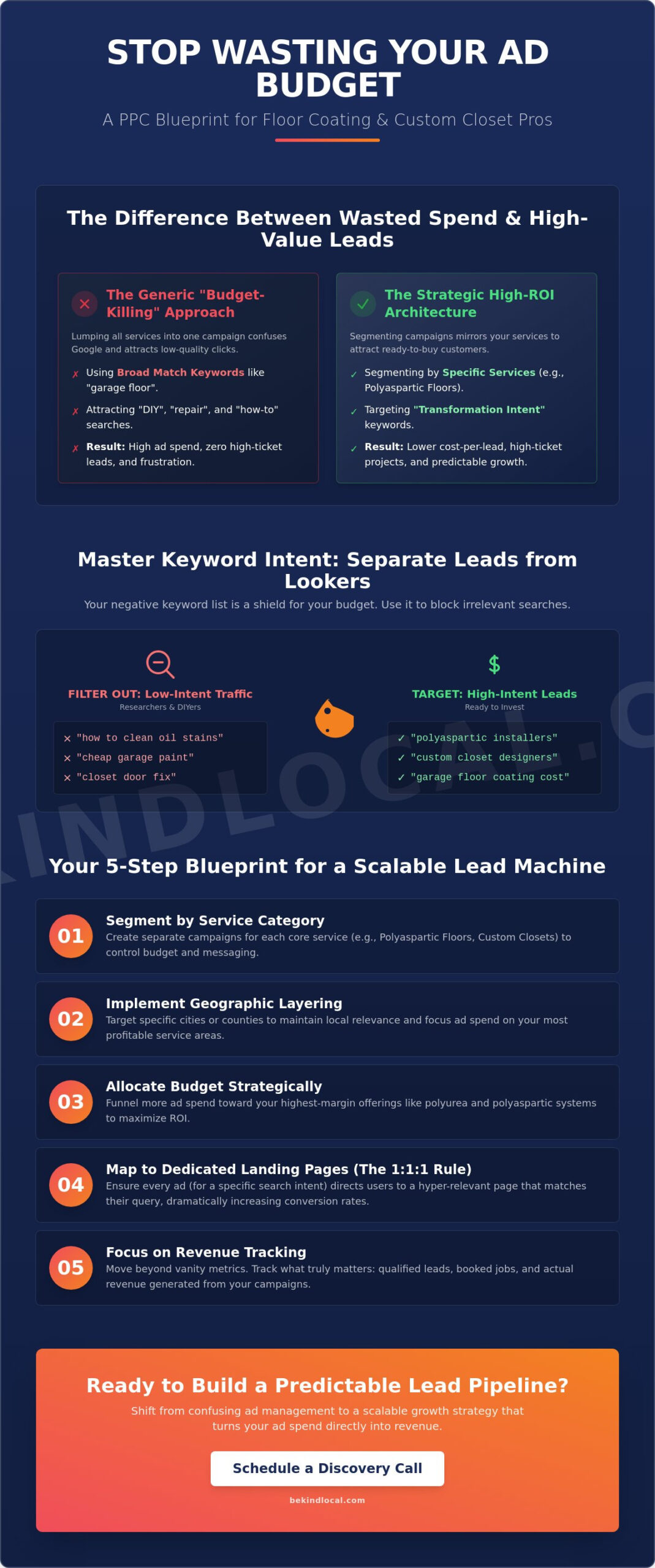
A common trap for specialty contractors is paying for traffic from people seeking “epoxy repair” or “closet door fix.” Unless you specifically want those low-margin service calls, your account structure must explicitly exclude them. This is where negative keyword lists become your best friend. They act as a shield for your daily ad spend, ensuring you only pay for high-intent queries like “polyaspartic installers near me” or “custom walk-in closet designers.” This level of structural clarity is a core component of a winning brand strategy. When your account architecture is clean, your marketing becomes a predictable engine for growth rather than a source of frustration. It allows you to focus on the projects that actually move the needle for your business.
The 5-Step Strategic Framework for Local PPC Campaign Architecture
Building a scalable lead machine starts with a blueprint. You wouldn’t pour a concrete floor without a solid base, and your digital marketing shouldn’t be any different. To move beyond basic ads, you must implement local ppc campaign structure best practices that prioritize high-margin services. This framework ensures every dollar spent is an investment in your company’s growth rather than a shot in the dark. It’s about creating a system that respects your budget and your time.
- Step 1: Segmenting by Service Category. Keep your garage cabinets separate from walk-in closets. These services attract different buyers with unique needs.
- Step 2: Geographic Layering. Structure your account by specific counties or cities in states like Florida, Texas, or California to maintain local relevance.
- Step 3: Budget Allocation. Funnel more spend toward your highest-margin offerings, such as polyurea and polyaspartic floor systems.
- Step 4: Landing Page Mapping. Every specific ad group needs a dedicated page. Don’t send custom closet traffic to your homepage.
- Step 5: Implementing ‘Be Kind’ Tracking. We focus on revenue and booked jobs, not just vanity metrics like click-through rates.
Following a proven guide to local PPC can help you avoid the common pitfalls that many contractors face. If you’re struggling to organize your service areas or feel like your budget is leaking, you might want to reach out to our team for a strategy session.
Geographic Layering for Local Dominance
Local relevance is your biggest advantage. If you serve a wide area like Indianapolis or parts of North Carolina, you shouldn’t use a single “catch-all” campaign. Effective structures use separate campaigns for different service radiuses. This allows you to control spend based on travel time and lead density. We recommend syncing your location extensions with your Google Business Profile to build immediate local trust. It shows neighbors you’re already working in their backyard.
Service-Specific Campaign Isolation
Floor coating and garage storage should never share a budget. They have different sales cycles and profit margins. During peak seasons, you might want to allocate more spend to high-ticket pantry or mudroom installs. By isolating these services, you can adjust bids independently as demand shifts. This level of control is exactly what we provide through our advertising services. It ensures your pantry ads aren’t competing for budget with your epoxy floor campaigns. This isolation allows the algorithm to learn faster, resulting in a lower cost-per-lead for your most profitable services.
Intent-Based Keyword Segmentation: Separating Leads from Lookers
Not all clicks are created equal. In fact, most of the traffic hitting your site from a generic setup is likely what we call “lookers.” These are people looking for a cheap fix or a DIY solution. To build a profitable business, your Local PPC Strategy must center on intent-based segmentation. This means identifying “Transformation Intent” keywords. Phrases like “custom closet design” or “epoxy floor installation” signal a homeowner ready to invest in a full-scale project. They aren’t just browsing; they’re looking for a professional to handle a significant home upgrade.
Conversely, you must filter out “Maintenance Intent.” Keywords like “epoxy repair” or “closet door fix” might get clicks, but they rarely lead to the high-ticket contracts you need. In competitive markets like Texas or Florida, dominating local search isn’t about bidding on the most popular terms. It’s about owning the long-tail queries that competitors overlook. A phrase like “polyaspartic garage floor installers in Austin” has lower volume but significantly higher conversion potential than a broad term like “garage flooring.” It targets the specific technical solution you provide to a buyer who knows exactly what they want.
The Power of Technical Terminology
Using technical terms is a secret weapon for specialty contractors. Bidding on “polyurea” or “garage slatwall systems” naturally filters out the bargain hunters. These terms are used by educated buyers who have done their research and are looking for quality over a low price. When you target specific closet types like walk-in, reach-in, or specialized mudrooms, you speak directly to the customer’s specific pain point. This level of precision is a key part of local ppc campaign structure best practices. It ensures your ads appear only when the search intent matches your premium offerings. For a deeper dive into this, see our guide on Floor Coating Leads and high-intent lead generation.
Negative Keyword Strategies for Contractors
Your negative keyword list is just as important as your target list. For garage remodelers and closet designers, this list should be extensive. You should proactively block terms like “DIY,” “kit,” “cheap,” “paint,” and “rental.” These searchers aren’t looking for a professional installation. We also recommend blocking “Residential Home Repairs” entirely. You aren’t a handyman; you’re a specialist. Negative keywords act as a vital filter for your profit margins, ensuring your daily budget isn’t eaten up by people with no intention of hiring a pro. By refining this list monthly, you continuously sharpen your account’s focus on high-ticket opportunities and keep your cost-per-lead low.
Ad Group Granularity and Technical Creative Best Practices
Success in local search isn’t just about the keywords you pick. It’s about how you organize them. We follow the 1:1:1 Rule as a core part of local ppc campaign structure best practices. This means one specific search intent, like “epoxy garage floors,” belongs in one dedicated ad group, leading to one perfectly tailored landing page. When a homeowner sees an ad that mirrors their exact search, they feel understood immediately. This tight alignment stops budget waste and ensures you aren’t paying for clicks that don’t convert. It’s the difference between a generic “handyman” approach and the professional precision your business provides.
Your ad copy needs to act as a filter. We use psychological triggers like “Industrial-Grade” for floor coatings or “Lifetime Warranty” for custom cabinetry to attract buyers who value quality over a low price. You should also lean into your status as a local expert. Including specific city names in your headlines, like “Custom Walk-in Closets in Raleigh,” builds immediate trust with your neighbors. Visual social proof is another game-changer. Use Google’s image extensions to show off high-resolution photos of your finished projects, like a shimmering polyaspartic garage floor or a perfectly organized mudroom, directly in the search results.
Writing Ads for the High-Ticket Buyer
If you’re selling a premium service, your language should reflect that quality. Stop using “Free Quote” as your primary call-to-action. High-ticket buyers are looking for expertise, not just a price. Try “Schedule a Design Consultation” instead. This positions your service as a professional experience from the very first interaction. At Be Kind Local, we believe in transparency and showcasing your deep local knowledge. For those in the cabinetry space, our guide on Custom Closet Marketing explores how to craft these high-intent messages in more detail. It’s about building a connection before they even pick up the phone.
Landing Page Mapping for Maximum Conversion
A common mistake is sending specialized traffic to a general homepage. If someone clicks an ad for “Polyaspartic Floor Coating,” they should land on a page that talks only about polyaspartic systems, not your general home services. For closet companies, your landing pages need to showcase specific solutions like walk-in vs. reach-in options with clear, tap-to-call buttons. High-converting pages require professional web design services to ensure they load fast and look great on mobile devices. If you want to see how a granular ad structure can transform your lead quality, schedule a discovery call with us today.
Scaling Your Lead Pipeline with a Strategic PPC Partner
Managing ads is a chore. Executing a growth strategy is an investment. Many contractors get stuck in the weeds of daily clicks, but the real power of local ppc campaign structure best practices lies in how they fuel your entire business. When your account is organized correctly, every dollar spent on a polyaspartic floor ad provides data that benefits your Local SEO efforts. You begin to see which neighborhoods are ready for custom cabinetry and which cities are saturated. This visibility transforms your marketing from a cost center into a predictable engine for revenue. It builds a foundation of brand authority that makes every other marketing effort work harder.
Monthly audits are non-negotiable. You wouldn’t leave a job site without checking the finish, so don’t leave your ads running without a thorough review. These audits allow you to trim the waste from irrelevant searches and double down on the locations that are actually booking jobs. It’s about being a good steward of your resources. By refining your structure for 2026, you ensure your brand stays ahead of the competition while maintaining high profit margins. The next step is a deep audit of your current account to identify where your budget is leaking and where your biggest opportunities for growth are hiding.
Data-Driven Decision Making
We believe in tracking the metrics that matter. Cost Per Click is a vanity number; what really counts is your Cost Per Qualified Lead. For contractors in Texas or Florida, this means having the flexibility to shift your budget between cities based on seasonal demand. If walk-in closet interest peaks in one county while garage remodels slow down in another, your strategy must be proactive in moving those funds. You need a partner who understands the technical difference between an epoxy repair and a full polyurea system installation. This niche expertise ensures your data is interpreted correctly and turned into actionable growth.
Your Path to Strategic Growth
The shift from a vendor-based relationship to a true partnership is where real scaling happens. You shouldn’t have to explain the value of a mudroom or a slatwall system to your marketing agency. They should already know how to position those high-ticket installs to the right audience. Moving forward requires moving away from “set it and forget it” marketing. It requires a commitment to excellence and a structure that reflects the quality of your craftsmanship. If you’re ready to stop guessing and start growing with a clear visibility into your ROI, we’re ready to help. Schedule a discovery call with Be Kind Local today to fix your account architecture and secure your local market for 2026.
Take Command of Your Local Market Growth in 2026
Your business is built on the quality of your finish and the strength of your reputation. Your digital marketing should reflect that same level of care. By moving away from generic account setups and embracing local ppc campaign structure best practices, you’ve taken the first step toward a more profitable future. You now understand how to isolate high-margin services like polyaspartic coatings and custom walk-in closets while filtering out the low-value repair traffic that drains your budget. This strategic shift from raw click volume to high-intent lead quality is what separates market leaders from those just getting by.
Whether you’re dominating a specific county in Florida or expanding across Texas, a clean account architecture gives you the visibility needed to scale with confidence. We specialize in these exact niches, acting as a dedicated partner for local businesses who value quality and ethics as much as growth. Ready to stop wasting ad spend? Schedule your strategic discovery call with Be Kind Local today. We look forward to helping you build a lead generation machine that truly honors your craft.
Frequently Asked Questions
What is the best Google Ads campaign structure for a local service business?
A segmented architecture that mirrors your specific service lines and geographic areas is the gold standard. Implementing local ppc campaign structure best practices involves moving away from a single, catch-all campaign. Instead, you should create separate campaigns for high-margin services like polyaspartic floor coatings and custom walk-in closets. This allows for precise budget control and ensures your ads are relevant to the user’s specific local search intent.
How many ad groups should a floor coating company have?
Most successful floor coating companies thrive with three to five granular ad groups per campaign. You should dedicate specific ad groups to technical terms like polyurea and polyaspartic systems while keeping commercial and residential inquiries separate. This level of granularity ensures that your ad copy and landing pages perfectly match the homeowner’s search. It prevents your budget from being diluted across unrelated services that have different profit margins.
Should I separate my closet installation campaigns by city or service type?
You should prioritize service type first to maintain high ad relevance and conversion rates. A homeowner looking for a pantry remodel has different needs than someone seeking a luxury walk-in closet. Once you’ve established these service-based campaigns, you can use geographic layering for high-volume markets like Houston or Miami. This dual approach allows you to adjust bids based on travel time and local competition levels without sacrificing lead quality.
How much should a local contractor spend on Google Ads in 2026?
Your budget should be determined by the number of leads required to meet your revenue goals while feeding Google’s AI enough data. Most campaigns need 30 to 50 conversions per month to optimize effectively. We recommend a daily budget that covers at least 10 high-intent clicks in your specific market. This ensures your ads remain visible during peak search hours and provides enough data to identify winning keywords and locations.
Can I target polyaspartic leads specifically without getting epoxy repair calls?
Yes, you can achieve this by using technical, high-intent keywords and a robust negative keyword strategy. Focus your bidding on terms like “polyaspartic garage floor installers” or “full garage floor transformation.” By aggressively blocking terms like “repair,” “patch,” or “fix,” you ensure your budget is reserved for high-ticket installations. This technical focus naturally filters out low-budget seekers and attracts educated buyers who value a premium, long-lasting finish.
What are the most important negative keywords for garage remodelers?
Essential negative keywords include “DIY,” “how to,” “cheap,” “paint,” “rental,” and “handyman.” You should also block brand names of big-box retailers and home repair services that don’t offer professional-grade installations. These terms act as a vital shield for your profit margins. Proactively filtering out researchers and bargain hunters allows you to focus your spend on homeowners ready to invest in premium slatwall systems and overhead storage.
How do I track the ROI of my local PPC campaigns?
The most effective way is to use offline conversion imports to link your Google Ads data with your CRM. This allows you to see exactly which keywords and ad groups lead to signed contracts rather than just form submissions. Understanding which local ppc campaign structure best practices are driving actual revenue helps you make smarter bidding decisions. It moves your focus from vanity metrics like click-through rates to the actual cost per booked job.
Is it better to use broad match or phrase match for custom closet ads?
Phrase match and exact match are generally superior for high-ticket services like custom walk-in and reach-in closets. Broad match often triggers ads for generic storage ideas or “how-to” content, which leads to wasted spend on tire-kickers. Using phrase match ensures your ads only appear for searches that include your core service terms. This control is essential for maintaining a low cost-per-lead and ensuring every click has a high probability of conversion.