
 951-249-7500
Is your $50-a-month website template actually costing you $50,000 in lost polyaspartic garage floor contracts every year? It’s a heavy question, but one we see many specialty contractors face as they struggle to stand out in a crowded local market. You’ve likely found yourself wondering how much does a custom website cost vs template and whether that extra investment is the key to finally attracting high-ticket closet or flooring clients.
We believe your digital presence should be as durable and high-quality as the polyurea systems you install. It’s common to feel stuck with a generic site that looks like every other competitor and fails to rank in the local map pack. This guide reveals the real financial and performance differences between off-the-shelf templates and custom builds to help you decide which path drives genuine growth. We’ll explore how a tailored digital foundation acts as a 24/7 salesperson, ensuring your business is ready to scale without needing a total rebuild every two seasons.
Key Takeaways
- Identify the structural differences between generic frameworks and custom sites designed to guide a prospect from a search query to a booked estimate.
- Get a clear breakdown of how much does a custom website cost vs template in 2026, including the hidden costs of “free” themes that require expensive third-party tools.
- See how site performance and technical SEO impact your visibility in local search results for high-intent keywords like “garage floor coating” or “custom pantry design.”
- Evaluate whether your current lead quality justifies a custom build by analyzing your local competitors in high-growth specialty contracting markets.
- Learn how integrating a dedicated brand strategy into your website build ensures your digital presence acts as a scalable foundation for your business.
Custom Website vs. Template: Defining the Strategic Difference
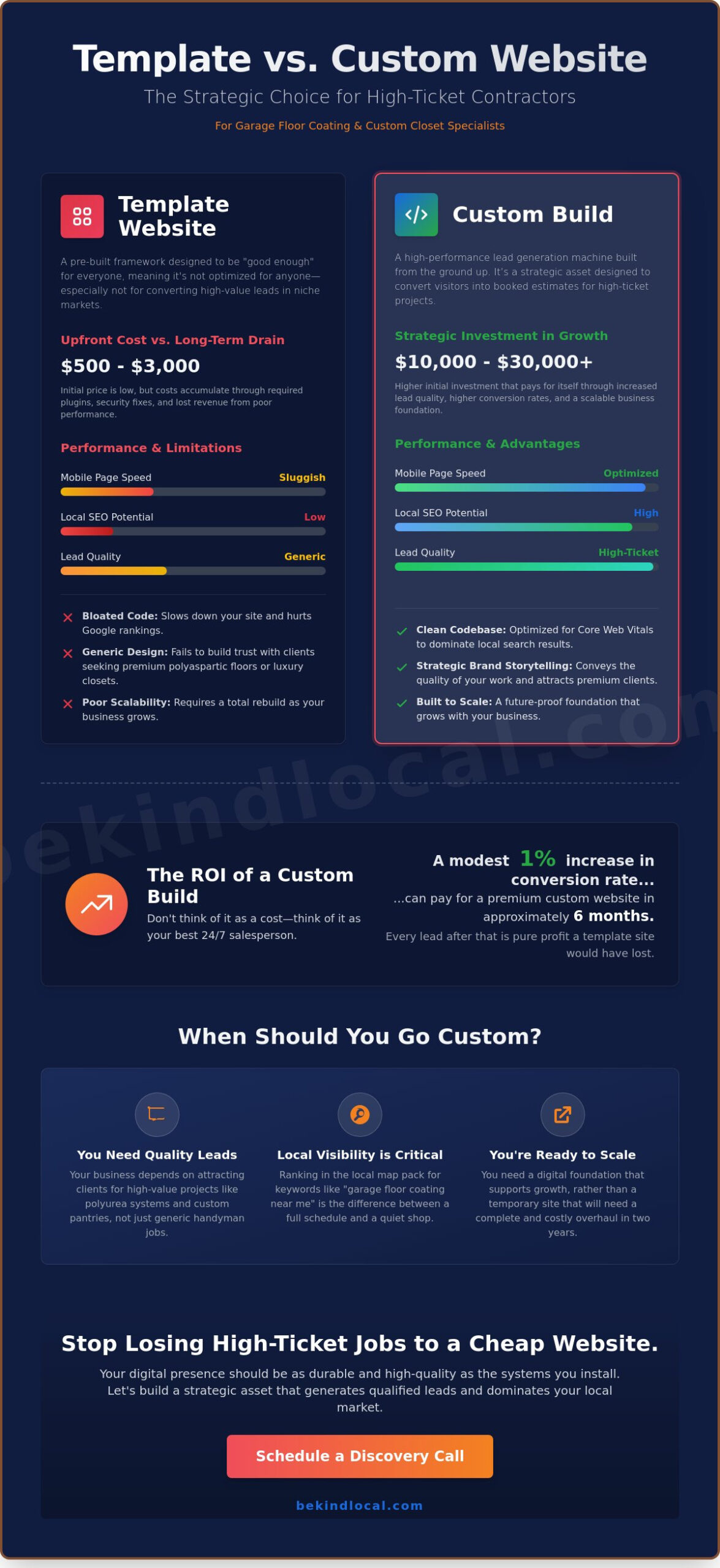
Choosing between a template and a custom build isn’t just about the initial invoice. It’s about deciding what role your website plays in your business growth. When you’re trying to figure out how much does a custom website cost vs template, you’re actually weighing the value of a digital business card against a high-performance lead generation machine. A template website uses a pre-designed framework. Platforms like Wix, Squarespace, or generic WordPress themes offer these ready-made boxes where you simply swap out text and images. They’re built to be “good enough” for everyone, which often means they aren’t optimized for anyone.
A custom website is built from the ground up. It’s a strategic asset designed to support specific user journeys and business goals. Instead of forcing your brand into a pre-existing mold, we build the mold around your expertise. This approach follows foundational Web design principles to ensure that every element, from navigation to page load speed, serves a single purpose: converting a visitor into a high-ticket lead. For contractors, the “brochure” approach of templates often fails. It doesn’t convey the premium, durable nature of polyaspartic systems or the sophisticated craftsmanship of luxury closets. There’s a world of difference between just getting online and truly dominating your local market.
The Limitations of the Template Ceiling
Templates often come with a hidden weight that many contractors don’t notice until their lead volume drops. They rely on bloated code to remain flexible for thousands of different users. This extra baggage slows down mobile performance, which is a major red flag for Google. If your site is sluggish, your Google Business Profile rankings will suffer. Homeowners looking for a garage remodel won’t wait for a heavy page to load; they’ll simply click the next contractor in the map pack.
Design constraints also create a “generic” feel. If your site looks like every other handyman service in town, you lose the trust of luxury clients who want custom walk-in pantries or mudrooms. Rigid structures in templates also make it difficult to integrate advanced lead-capture tools that qualify your prospects before they even pick up the phone.
The Scalability of a Custom Foundation
A custom build provides a clean, lightweight foundation. It’s optimized for Core Web Vitals, ensuring your site stays fast and visible in local search results. This technical edge is vital for concrete coating lead generation, where appearing at the top of local searches is the difference between a full schedule and a quiet shop. We treat your digital foundation with the same respect you give a perfectly prepped concrete floor.
Custom sites allow for unique visual storytelling. You can showcase the intricate details of a reach-in closet or a garage slatwall system with layouts that guide the eye toward a call to action. By integrating a dedicated brand strategy into your build, you create a scalable site. It won’t need a total rebuild in two years because it was built to grow alongside your business from day one.
The Real Cost: Upfront Price vs. Long-Term Value
Understanding how much does a custom website cost vs template requires looking far beyond the initial invoice. You’ll often see template sites priced between $500 and $3,000. On the other hand, a custom, high-performance build typically requires an investment ranging from $10,000 to $30,000 or more. While the lower entry price of a template is tempting, it often carries a hidden tax. This tax manifests as high bounce rates, poor mobile experiences, and the constant need for paid third-party plugins just to maintain basic functionality.
A website should be viewed as a 24/7 salesperson rather than a static expense. Even when you include essential website pages like your service gallery and contact form, a template often lacks the structural integrity to convert high-intent visitors. The math is simple. If your business closes four high-ticket polyurea projects a month at $5,000 each, a modest 1% increase in your conversion rate pays for a premium custom build in roughly six months. After that, every additional lead is pure profit that a generic site would have likely lost.
Why Templates Cost More in the Long Run
Templates often create “technical debt.” You might save money today, but you’ll eventually pay a developer to fix broken updates or security vulnerabilities caused by conflicting plugins. Slow-loading pages are another drain on your wallet. They drive frustrated prospects back to the search results, straight into the arms of your competitors. Most contractors eventually hit a “template ceiling” where the only way to grow is an expensive, total rebuild. It’s often better to build the right foundation from the start.
The Strategic Investment of Custom Design
Custom design focuses on long-term growth. We build a specialized architecture that supports your Local SEO from day one, reducing your future marketing costs. Instead of a generic layout, we create customized conversion paths specifically for high-ticket services like polyurea floor systems or walk-in closet installs. These sites also integrate directly with your CRM and project management tools. This streamlines your lead handling and ensures no inquiry falls through the cracks. If you’re ready to stop losing leads to technical friction, it might be time to discuss your digital foundation with a partner who understands your trade.
Performance and Lead Quality: Why Templates Struggle to Convert
Performance isn’t just a technical metric; it’s the first impression of your craftsmanship. When a homeowner searches for “epoxy garage floor near me,” Google’s Local Map Pack prioritizes sites that load instantly and offer a seamless experience. Templates often fail here because they’re weighed down by unnecessary features designed for other industries. If you’re weighing how much does a custom website cost vs template, consider that a slow site is essentially a “closed” sign on your digital front door.
Trust is fragile when selling a $15,000 custom walk-in closet or a full garage storage system. High-ticket clients look for cues that you’re a specialist, not a generalist. A generic template makes your premium brand look like a budget handyman service. Custom builds allow for industry-specific features like interactive visualizers for garage slatwall systems or reach-in closet configurations. These tools don’t just look good. They prove your expertise before you ever step foot in their home. Mobile-first design ensures these visual elements look stunning on a smartphone, which is where most homeowners start their search.
SEO and the Local Map Pack Advantage
Technical SEO becomes significantly more manageable on a custom build. You don’t have to fight against competing plugin code that often breaks during updates. This clean environment is essential for generating high-intent floor coating leads because it allows search engines to crawl your service pages without friction. Properly implemented schema markup on custom sites provides search engines with specific data about your service area and project types, directly improving your local visibility.
Converting High-Ticket Specialty Contracts
Your portfolio is your most valuable asset. Custom galleries handle high-resolution photos of polyaspartic systems better than templates, ensuring that the “flake” detail and high-gloss finish look crisp on every device. This level of detail is crucial for custom closet marketing, where the texture of the wood grain or the layout of a pantry can make or break a sale.
We also replace generic contact boxes with custom-engineered lead forms. Instead of just asking for a name and email, we capture the data that actually helps you price a job. This includes square footage, current surface type, and specific storage needs. This approach filters out the tire-kickers and ensures your sales team spends their time on qualified prospects. When analyzing how much does a custom website cost vs template, the value of receiving a lead that already includes project dimensions is hard to overstate. Strategic CTA placement then guides these users naturally from browsing your work to scheduling an on-site estimate.
Decision Framework: When Should You Go Custom?
Deciding on your digital foundation requires an honest look at your business goals and your local landscape. While the question of how much does a custom website cost vs template often starts with your current bank balance, the better question is: what is your market demanding? If you’re operating in highly competitive regions like Texas or Florida, your digital presence is being compared to some of the most sophisticated players in the industry. In these markets, a template often acts as a ceiling that prevents you from reaching the top tier of local search results.
Your service complexity also dictates your needs. A contractor offering simple concrete repairs might get by with a basic framework. However, if you provide full garage transformations involving polyaspartic coatings, slatwall systems, and custom cabinetry, your website must reflect that high-ticket value. It’s about matching the digital experience to the physical result you deliver. If your site feels “cheap,” prospects will assume your work is too. Expansion goals also play a role. Dominating a single small town is different from building a regional brand. If you plan to scale your custom closet business across multiple counties, you need a site architecture that supports location-specific landing pages without becoming a disorganized mess. Custom builds allow for this structural growth, whereas templates often break when you try to add too many moving parts. Investing in a partner like UK Web Works for professional web design ensures your site can handle this complexity and growth from the outset.
The “Stick with a Template” Checklist
There are times when a template is the right move. If you’re a brand-new business with a total marketing budget under $5,000, it’s better to have a clean, basic site than to overextend your finances. Templates also work for contractors who rely 100% on word-of-mouth referrals and don’t actually need their website to generate new leads. Finally, if you’re in a very low-competition market where your only rivals don’t even have a website, a basic presence is often enough to rank. In these cases, the answer to how much does a custom website cost vs template is that the lower cost of the template is a safe, short-term bet. If you are looking for an affordable yet professional entry point, you can discover Good Budget Website for tailored packages that help small businesses build a solid digital presence.
The “Invest in Custom” Red Flags
If you’re already established and looking to scale, certain “red flags” indicate that your template is holding you back. One of the most common signs is when you’re spending significant money on Google Ads but the traffic isn’t converting into booked estimates. This usually means your landing pages aren’t building enough trust or are too slow for mobile users. Another sign is when your site looks dated compared to the “big players” in your city. If you want to rank for high-intent keywords like “polyaspartic garage floor coating [City],” you need a site that Google recognizes as an authority. Ready to see if your market requires a custom edge? Request a strategy audit to evaluate your local competition and lead quality.
The Be Kind Local Approach: Custom Strategy for Contractors
At Be Kind Local, we don’t view a website as a standalone project or a simple digital flyer. We see it as the engine of your entire business. When you evaluate how much does a custom website cost vs template, you’re really looking at the difference between a static image and a functional, high-performing salesperson. Our approach is rooted in the belief that specialty contractors, like those in the epoxy flooring or custom closet industries, deserve a platform that respects the technical expertise they bring to every job site.
We prioritize lead quality over raw traffic volume. It doesn’t matter if a thousand people visit your site if none of them are looking for a premium polyurea garage floor or a high-end mudroom transformation. We build sites that filter out the “budget hunters” and attract homeowners who value craftsmanship. By integrating a dedicated brand strategy into every build, we ensure your messaging aligns with the luxury nature of your services. This strategic foundation makes your website the central hub for your entire digital marketing ecosystem, from social media to email campaigns.
More Than Just a Pretty Design
A beautiful site is useless if it doesn’t understand the home service sales cycle. Our layouts are data-driven and designed to guide a prospect through the specific questions they have about concrete coatings or reach-in closet installs. We include built-in tools for review management and social proof, making it easy to showcase your latest five-star projects directly on your most important service pages. As we move through 2026, we provide ongoing support to ensure your site remains optimized for the latest search engine shifts, keeping you ahead of local competitors who are still stuck on outdated frameworks.
Start Your Custom Growth Strategy
The first step in our process is identifying the gaps in your current digital presence. We look at why your current site might be leaking leads and how a custom build can provide a better return on investment. A tailored site isn’t just a design choice; it’s a tool that significantly boosts the effectiveness of your Local SEO and PPC efforts by providing high-converting landing pages for every campaign. If you’re ready to move past the limitations of generic themes and build a site that truly grows with you, it’s time to take the next step. Schedule a discovery call at bekindlocal.com to see the actual ROI potential for your specific market and trade.
Building a Digital Foundation for Your Trade
A template might put you on the map today, but a custom build keeps you there as you scale. We’ve explored how the real answer to how much does a custom website cost vs template lies in the long-term conversion of high-ticket projects like polyaspartic garage floors or luxury walk-in pantries. It’s about choosing a digital foundation that won’t crack under the pressure of a growing business.
Our team specializes in these specific niches, helping contractors in high-competition markets like Florida and Texas dominate their local search results. We don’t just chase raw traffic volume. We focus on high-intent lead quality that turns into signed contracts and actual growth for your shop. Your craftsmanship deserves a digital home that works as hard as you do on the job site.
Schedule your discovery call at bekindlocal.com to build a website that actually generates leads. We look forward to helping you reach your next milestone.
Frequently Asked Questions
Is a custom website worth it for a small local contractor?
A custom website is worth the investment if your average project value exceeds $3,000. For a garage floor coating business, the trust built by a professional, unique design often pays for itself through just a few closed polyaspartic jobs. If you’re selling high-ticket transformations rather than simple repairs, your site must reflect that premium quality to attract the right clientele and justify your pricing.
How long does it take to build a custom website vs. a template?
Templates can often be launched in as little as two weeks, while custom builds typically require eight to twelve weeks. This longer timeline accounts for the deep strategic brand development and custom coding required to build a scalable digital foundation. We spend that extra time ensuring your site architecture is perfectly aligned with the specific search habits of homeowners looking for custom closets or garage storage.
Will a custom website help me rank higher on Google Maps?
Custom websites provide a significant advantage in the Local Map Pack because they lack the technical friction of generic themes. Google prioritizes sites with clean code and fast load times, which are much easier to achieve when you aren’t fighting bloated plugin code. This improved performance signals to Google that your business is a reliable, high-quality option for local searchers.
Can I switch from a template to a custom site later?
You can certainly transition from a template to a custom site as your business grows and your budget expands. When considering how much does a custom website cost vs template, many contractors start with a basic framework and upgrade once their lead volume justifies a more strategic investment. This move usually involves a complete content audit to ensure your new site architecture supports your long-term growth goals.
Do custom websites require more maintenance than templates?
Custom sites actually require less ongoing maintenance because they don’t rely on dozens of third-party plugins to function. Templates frequently suffer from “plugin bloat,” where conflicting updates can break your site or create security vulnerabilities that require constant attention. A lean, custom-coded site stays stable and secure with much less intervention, allowing you to focus on your crews and project sites.
How does website speed affect my lead generation?
Website speed is directly tied to your conversion rate and lead quality. If your site takes more than three seconds to load on a mobile device, most homeowners looking for a walk-in closet or garage remodel will click away and call your competitor. A fast site keeps prospects engaged and significantly reduces the bounce rates that often plague slow, template-based contractor websites.
What is the most important feature a contractor website needs?
The most critical feature is a specialized lead capture form that qualifies your prospects before you ever pick up the phone. Instead of a basic “Contact Us” box, your site needs fields for project dimensions, current surface types, and specific storage needs. This ensures your sales team spends their time on high-intent leads rather than chasing people who aren’t ready to buy.
Why do templates often feel slow or “glitchy” on mobile?
Templates are built to serve thousands of different businesses, so they include massive amounts of code you’ll never use. This extra baggage causes the “glitchy” behavior and slow performance you often see when viewing contractor sites on a smartphone. Custom builds eliminate this bloat, ensuring that your gallery of epoxy floor projects or reach-in closet designs looks crisp and professional on every screen.