
 951-249-7500
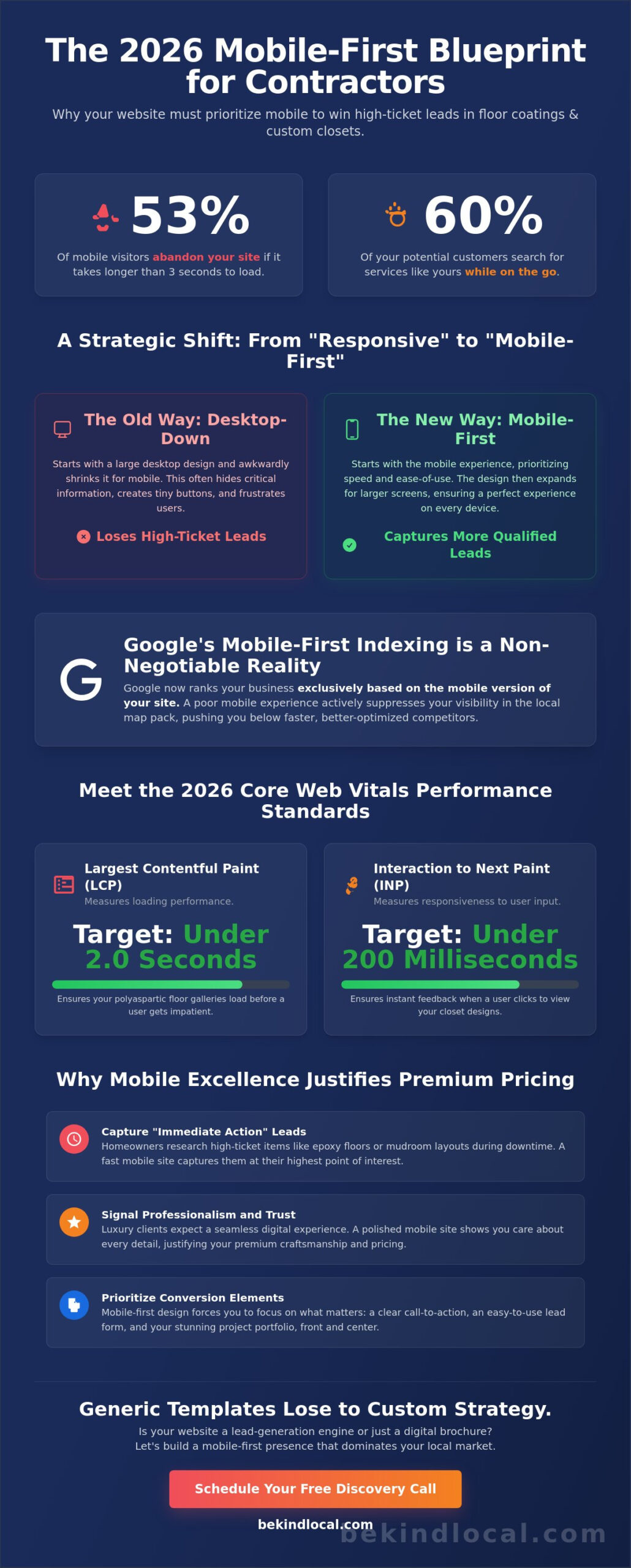
Did you know that 53% of mobile visitors will leave your page if it takes longer than three seconds to load, yet nearly half of all websites still fail to meet the 200ms threshold for Interaction to Next Paint? Implementing a mobile-first website design for local business isn’t just about looking good on a phone. It’s about surviving in a market where over 60% of your potential customers are searching for floor coatings or custom closets while on the go. You’ve likely noticed that your stunning portfolio of polyaspartic garage floors or reach-in pantries looks great on a laptop, but those difficult mobile lead forms are causing your bounce rates to skyrocket.
We understand how frustrating it is to lose high-ticket leads to competitors simply because their sites load faster. In this guide, you’ll learn how to transform your website into a mobile-first lead generation engine that dominates the local map pack and justifies your premium pricing. We will walk through the essential 2026 performance standards, including the new 2.0 second Largest Contentful Paint threshold, to ensure your digital presence is as polished and professional as the craftsmanship you bring to every job site.
Key Takeaways
- Understand why mobile-first website design for local business requires building for the smallest screen first to ensure your polyaspartic flooring galleries convert on any device.
- Learn how Google’s 2026 mobile-first indexing turns technical performance into a ranking factor that helps you dominate the local map pack.
- Discover how to adapt to modern vertical scanning patterns to keep high-ticket closet and garage storage clients engaged on their screens.
- Identify the critical performance thresholds that prevent lead abandonment and keep your bounce rates low in high-density markets.
- See why moving beyond generic website templates is a strategic necessity for contractors who want to justify premium pricing with a professional digital presence.
Defining Mobile-First Design for Specialty Contractors
For a floor coating contractor or custom closet designer, your website is often the first handshake with a potential client. Mobile-first design means flipping your perspective on how that handshake happens. Instead of starting with a wide desktop monitor, we start with the five-inch screen in your customer’s palm. For specialty contractors, mobile-first website design for local business is a strategic priority for 2026 local SEO because it ensures your digital presence is built for the specific way homeowners search for high-ticket home improvements today.
It’s a common mistake to confuse mobile-first with simple responsiveness. Traditional Responsive Web Design Principles often focus on shrinking desktop elements into awkward mobile stacks. This approach treats your mobile visitors as an afterthought. Mobile-first design does the opposite. It builds the foundation on the mobile experience and then scales up for larger screens. This ensures that your most important assets, like your polyurea floor galleries or reach-in closet transformations, are never compromised by a cramped layout.
The Shift from Desktop-Down to Mobile-Up
Designing for the thumb is fundamentally different than designing for the mouse. You need big, clickable buttons and simple navigation that doesn’t require precision. Many contractors fall into the “hidden content” trap where critical information gets buried. If a user has to hunt through three menus to find your service area or your latest reviews, they’ll likely leave. When we develop custom website designs, we prioritize the essentials. Your phone number, your lead form, and your best craftsmanship should be front and center without any friction.
Why Mobile is the Primary Entry Point for High-Ticket Services
Most high-ticket leads don’t start their journey at a desk. Homeowners are often scrolling through epoxy floor colors or mudroom layouts during their downtime. They might be on a lunch break or sitting on the couch when they decide it’s time to finally fix their garage floor. This “immediate action” mindset means they are much closer to the point of purchase. If your site is slow or the images of your slatwall systems don’t load correctly, you’re signaling a lack of professionalism. Luxury clients expect a seamless experience. A site that works perfectly on mobile shows that you care about every detail, just like you do when you’re on the job site.
In the competitive world of local contracting, your mobile site is more than just a digital brochure. It’s a lead generation engine. By focusing on a mobile-first website design for local business, you aren’t just following a trend; you’re building a bridge to your most valuable customers. You want to make it as easy as possible for them to see your work, trust your expertise, and click that call button.
The Direct Link Between Mobile Optimization and Local Search Visibility
Google has made it clear: the mobile version of your website is the only version that truly matters for your ranking. By 2026, mobile-first indexing is no longer a suggestion; it’s the default reality. If your site provides a poor experience on a smartphone, your local SEO performance will suffer, regardless of how well you’ve optimized your desktop pages. This is especially true in high-competition markets like Florida or Texas, where dozens of contractors are vying for the same “epoxy garage flooring” or “custom walk-in closets” keywords. A sluggish mobile site acts as a filter, actively suppressing your visibility and pushing you down the search results while faster competitors climb higher.
Mobile-friendliness is now measured through strict Core Web Vitals. Google uses real-world data to see how quickly your site responds to a user’s touch. In 2026, the threshold for Interaction to Next Paint (INP) is a demanding 200 milliseconds. If your site lags when a customer tries to click your gallery of polyaspartic floor coatings, Google notices. Implementing a mobile-first website design for local business ensures you meet these technical benchmarks, keeping you visible in the local search results where your most valuable leads are looking for help.
Google’s Mobile-First Indexing and Your Local Ranking
When Googlebot crawls your site, it evaluates your polyaspartic coating or custom pantry pages through the lens of a mobile user. If your best content is hidden or difficult to read on a small screen, Google assumes it isn’t valuable to the searcher. This shift mirrors broader trends in digital accessibility, much like the standards outlined in the memorandum on Delivering a Digital-First Public Experience. Desktop-only content is essentially invisible for ranking purposes today. To maintain local search authority, your mobile-first website design for local business must ensure that every technical element, from metadata to image alt-text, is fully accessible and optimized for mobile crawlers. If it doesn’t exist on mobile, it doesn’t exist for Google.
Integrating Google Business Profile with Mobile UX
Your website and your Google Business Profile (GBP) should work as a single, unified unit. When a homeowner finds you in the Map Pack, their next step is usually a “Click-to-Call” or a visit to your site to check your recent work. If your “Call Now” buttons are tiny or your “Get Directions” link fails to load, you’ve lost the lead before the conversation even starts. Seamless integration means your mobile site confirms the professionalism seen on your GBP.
Effective review management also relies heavily on mobile UX. If it’s difficult for a happy customer to leave a five-star review on their phone after you’ve finished a garage slatwall installation, you’re missing out on the social proof that drives local rankings. A mobile-optimized site makes this process effortless. If you aren’t sure how your current site measures up in the Map Pack, it might be time to audit your digital presence with a partner who understands the contractor space. High-intent mobile users are looking for your services right now, and a unified mobile strategy ensures you are the one they find and trust.
Core Elements of a Conversion-Focused Mobile Design
The way people interact with your business online has fundamentally changed. On a desktop, users often follow an “F-Pattern,” scanning horizontally across the top before moving down. On a mobile device, that behavior disappears. Users now scan vertically, focusing almost exclusively on the center of the screen. For a floor coating contractor or a custom closet designer, this means your most impressive transformations, like a high-gloss polyurea garage floor or a perfectly organized walk-in closet, must live in that central “sweet spot.” If your best work is tucked away in a corner, your mobile visitors will likely scroll right past it without a second thought.
Visual hierarchy is your most powerful tool for keeping prospects engaged. We prioritize a clean, uncluttered layout that guides the eye toward high-intent actions. This includes eliminating disruptive pop-ups that block the view of your craftsmanship. Google often penalizes sites with intrusive interstitials on mobile, and more importantly, they frustrate the very homeowners you want to impress. Designing for ease of movement with one hand is the most effective way to reduce bounce rates and keep prospects on your site longer. A successful mobile-first website design for local business treats every pixel as valuable real estate, ensuring that the path from “just looking” to “requesting a quote” is as smooth as a fresh epoxy finish.
Prioritizing Content for the “Thumb-Driven” User
The top 20% of your mobile screen is where the first impression is won or lost. We make sure your primary service, whether it is “Epoxy Garage Floors” or “Custom Mudroom Systems,” is immediately visible. Large, legible fonts are a requirement. Your customers should never have to use “pinch-to-zoom” to read your service descriptions or review your process. We also streamline navigation by keeping menus simple. The “hamburger menu” often becomes a graveyard for important links if it is overloaded. We focus on a few key pages that drive leads, ensuring your custom website design remains functional and intuitive.
High-Intent CTAs: Click-to-Call and Simplified Lead Forms
In 2026, mobile users expect immediate connection. A “sticky” footer that keeps a “Request an Estimate” button visible as the user scrolls ensures that the opportunity to convert is never more than a thumb-tap away. We also focus on reducing lead form fields to the bare essentials. Asking for too much information on a small screen is a guaranteed way to lower your completion rates. For homeowners seeking an immediate garage storage quote, one-touch calling is essential. By integrating these high-intent features, your mobile-first website design for local business becomes a proactive partner in your growth, capturing leads the moment they are inspired by your work.
When your website is built with these core elements, it does more than just look good. It builds trust. It shows your clients that you understand their needs and value their time. If you want to see how these conversion elements can be tailored to your specific market, you can reach out to our team for a strategic look at your current mobile performance.
Performance and Technical Standards for 2026
In high-density markets like California or North Carolina, page speed is no longer a luxury; it is a competitive requirement. If your site takes too long to load, you aren’t just losing visitors, you’re handing leads directly to your competitors. Data from early 2026 shows that 53% of mobile site visitors will leave a page that takes longer than three seconds to load. When we implement mobile-first website design for local business, we treat speed as a foundational feature rather than a technical footnote. A one-second delay in page load time can reduce your conversions by 7%, which can represent thousands of dollars in lost revenue for high-ticket epoxy flooring or custom closet projects.
Google’s 2026 Core Web Vitals thresholds are stricter than ever. Your Largest Contentful Paint (LCP) must be under 2.0 seconds to be considered “Good,” a benchmark that was tightened in the March 2026 core update. Technicalities in web design directly impact your bottom line. If your site is sluggish, your Quality Score in Google Ads will drop, meaning you’ll pay more for every click while your conversion rate withers. Speed and performance are now integral to the design process itself, ensuring that your digital presence supports your growth rather than hindering it.
Page Speed as a Competitive Advantage in Local Markets
High-resolution images of your polyurea floor coatings or walk-in closet transformations are essential for building trust, but they shouldn’t kill your site speed. We use Next-Gen image formats like WebP or AVIF to maintain crisp visual quality at a fraction of the file size. Beyond images, we focus on minifying code and leveraging browser caching to ensure that repeat visitors experience lightning-fast load times. We aim for a Time to First Byte (TTFB) under 500ms. These optimizations create a frictionless experience that keeps prospects engaged with your portfolio instead of staring at a loading screen.
Responsive vs. Adaptive: Choosing the Right Framework
In 2026, the variety of screen sizes is immense. Fluid layouts are essential to ensure your content looks intentional on everything from a compact smartphone to a large tablet. This is particularly important when displaying technical drawings, such as garage slatwall layouts or overhead storage diagrams. If these elements aren’t legible on a mobile screen, you lose the chance to demonstrate your expertise. We test every site across multiple iOS and Android versions to ensure consistency. A mobile-first website design for local business must be resilient, providing a seamless transition for the user regardless of the hardware they use.
Technical excellence is the silent partner of your sales team. When your site is fast, accessible, and reliable, it reinforces the high-ticket pricing you command for your craftsmanship. If you suspect your current site is failing the 3-second rule or dragging down your ad performance, it is time for a change. You can schedule a performance audit with Be Kind Local to see exactly where your site stands against 2026 standards.
Partnering for Growth: Beyond Generic Website Templates
Generic website templates are built for everyone, which means they aren’t truly optimized for anyone. When you use a “cookie-cutter” layout, you’re competing on the same level as the “truck and a bucket” operations that don’t share your commitment to quality. For a specialist dealing in premium polyurea coatings or custom reach-in closets, your digital presence must reflect the high-ticket nature of your craftsmanship. A custom mobile-first website design for local business is a strategic investment that pays dividends by positioning you as the clear authority in your market. It’s about building a foundation that supports your specific sales cycle rather than just checking a box for having a website.
Differentiating your business requires more than just nice photos. It requires a cohesive brand strategy that communicates why your overhead storage systems or pantry designs are superior to the big-box alternatives. We treat your website as a living part of your business. It’s not a one-time cost, but a lead generation engine that scales as you grow. By moving away from generic templates, you gain the freedom to tell your story and connect with homeowners on a personal level through a site that feels as bespoke as the closets you install.
Why Off-the-Shelf Templates Fail Specialty Contractors
The biggest issue with off-the-shelf templates is “bloat.” These themes include massive amounts of unnecessary code to accommodate every possible type of business. This hidden weight slows down mobile devices and kills your user experience. Templates also lack the flexibility needed for high-intent conversion elements. If you want to integrate a project calculator for epoxy flooring or a custom mudroom visualizer, generic themes often break or require messy workarounds. Most importantly, they fail to represent the luxury nature of your work. You can’t justify premium pricing with a website that looks like it was built in an afternoon.
Scaling Your Lead Pipeline with Be Kind Local
We don’t just build sites; we build pipelines. By combining mobile-first website design for local business with a targeted social media strategy, we ensure your work reaches the right eyes at the right time. Our goal isn’t just to increase raw traffic. We focus on closing high-quality leads that understand the value of a professional installation. We understand the nuances of the home service industry, from the initial inspiration phase to the final handshake. Ready to dominate your local market? Schedule a discovery call with Be Kind Local today and let’s build something that lasts.
Future-Proofing Your Contractor Business for Local Dominance
Your website is the digital equivalent of your finest showroom. It’s where potential clients first experience the quality of your polyaspartic floor coatings or custom pantry systems. By prioritizing a mobile-first website design for local business, you’re aligning your company with how homeowners actually search and buy in 2026. You’ve seen that technical excellence, from sub-200ms interaction times to fluid layouts, is the foundation for capturing high-ticket leads in competitive markets. These standards aren’t just technical hurdles; they are the keys to building immediate trust with luxury clients who value precision and professionalism.
We focus on lead quality over raw traffic volume because we know that a handful of qualified walk-in closet or garage storage inquiries are worth more than a thousand generic clicks. As a strategic partner for floor coating and closet professionals, Be Kind Local is dedicated to your growth through specialized high-ticket home service lead generation. It’s time to move beyond generic templates and build a digital presence that truly represents your craftsmanship. Schedule your strategic discovery call at bekindlocal.com and let’s start building your lead generation engine together. We’re excited to see what we can achieve for your business.
Frequently Asked Questions
Is a mobile-first design different from a mobile-friendly website?
Yes, mobile-first design is a fundamental shift from traditional mobile-friendly practices. While a mobile-friendly site often just shrinks desktop elements to fit a smaller screen, mobile-first design starts with the smartphone experience as the primary priority. It ensures your polyaspartic flooring galleries and reach-in closet layouts are built for vertical scanning and thumb-driven navigation from the very beginning of the development process.
How does mobile-first design affect my local SEO ranking in 2026?
Google primarily uses the mobile version of your content for indexing and ranking across all devices. A mobile-first website design for local business ensures you meet 2026 Core Web Vitals, such as the 200ms Interaction to Next Paint threshold. If your mobile site is slow or difficult to use, your visibility in the local map pack will drop, regardless of how well your desktop version performs.
Do I need a separate website for mobile and desktop users?
You don’t need two separate websites; in fact, having one unified site is much better for your brand and SEO. Modern web standards use fluid layouts that adapt to any screen size while maintaining a mobile-up architecture. This approach keeps your project portfolios and service pages consistent across all devices, ensuring a professional digital presence for your high-ticket flooring or closet business without doubling your maintenance work.
What are the most important features for a contractor’s mobile website?
The most critical features include high-visibility click-to-call buttons and streamlined lead forms that are easy to fill out with a thumb. You should also prioritize fast-loading images of your walk-in closets or garage slatwall systems using next-gen formats like WebP. Thumb-friendly navigation and a vertical visual hierarchy are essential for keeping homeowners engaged while they browse your services on their phones during their downtime.
How much does a mobile-first website design cost for a local business?
The investment for a custom site varies based on the complexity of your lead generation needs and the number of service areas you target. While generic templates might seem cheaper initially, a custom mobile-first website design for local business is a strategic investment that helps justify your high-ticket pricing. We focus on creating a lead engine that delivers lead quality over raw traffic, ensuring your marketing dollars work effectively.
Can I update my current website to be mobile-first, or do I need a new one?
It depends on your current site’s foundation, but most older websites require a fresh start to be truly mobile-first. Trying to “patch” a desktop-heavy template often leads to code bloat that significantly slows down mobile performance. A clean rebuild allows you to implement modern standards like AVIF image compression and optimized CSS, which are necessary to compete in high-density local markets today.
How do I test if my website is truly mobile-first?
You can test your site using tools like Google PageSpeed Insights to check your real-world performance data and Core Web Vitals. Look specifically at your Largest Contentful Paint and ensure it’s under 2.0 seconds. It’s also helpful to perform manual tests on various iOS and Android devices to ensure your garage storage diagrams and closet layouts are perfectly legible without any pinch-to-zoom required.
Will a mobile-first design help me get more epoxy flooring or custom closet leads?
Absolutely. A mobile-first design directly addresses the high percentage of users who leave a site if it takes longer than three seconds to load. By providing a frictionless experience, you’ll capture more high-intent leads for epoxy flooring and custom closets. When it’s easy for a homeowner to call you or request an estimate on their phone, your conversion rates and lead volume naturally increase.