
 951-249-7500
Why is your floor coating or custom closet website getting traffic but failing to ring the phone? It’s frustrating to see local homeowners land on your page only to bounce because they don’t immediately see the value of your premium polyaspartic systems or custom reach-in designs. You’ve worked hard to build a reputation for quality, yet your digital presence often feels like a generic template that doesn’t justify your high-ticket pricing. Understanding the key elements of a high-converting homepage is the difference between a site that just looks professional and one that actually builds immediate trust with qualified leads.
We know you care deeply about the craftsmanship you bring to every garage floor and pantry remodel. That’s why we want to help you align your online image with the actual quality of your work. We promise to share the strategic framework needed to transform your homepage into a high-performance lead generation engine. In this guide, we’ll preview the essential components of a high-converting layout, including mobile-first design and the specific trust signals that turn visitors into long-term partners. You’ll walk away with a clear blueprint to improve your conversion rates and finally stand out in your local market.
Key Takeaways
- Learn why your homepage must act as a “Central Trust Hub” to justify premium pricing for high-ticket services like epoxy flooring and custom closets.
- Master the “Three-Second Rule” to ensure visitors immediately identify your core service and location before they decide to scroll.
- Discover how to implement trust architecture by moving beyond generic reviews and integrating verified Google Business Profile ratings.
- Identify the key elements of a high-converting homepage that reduce friction and guide local prospects toward a clear call to action.
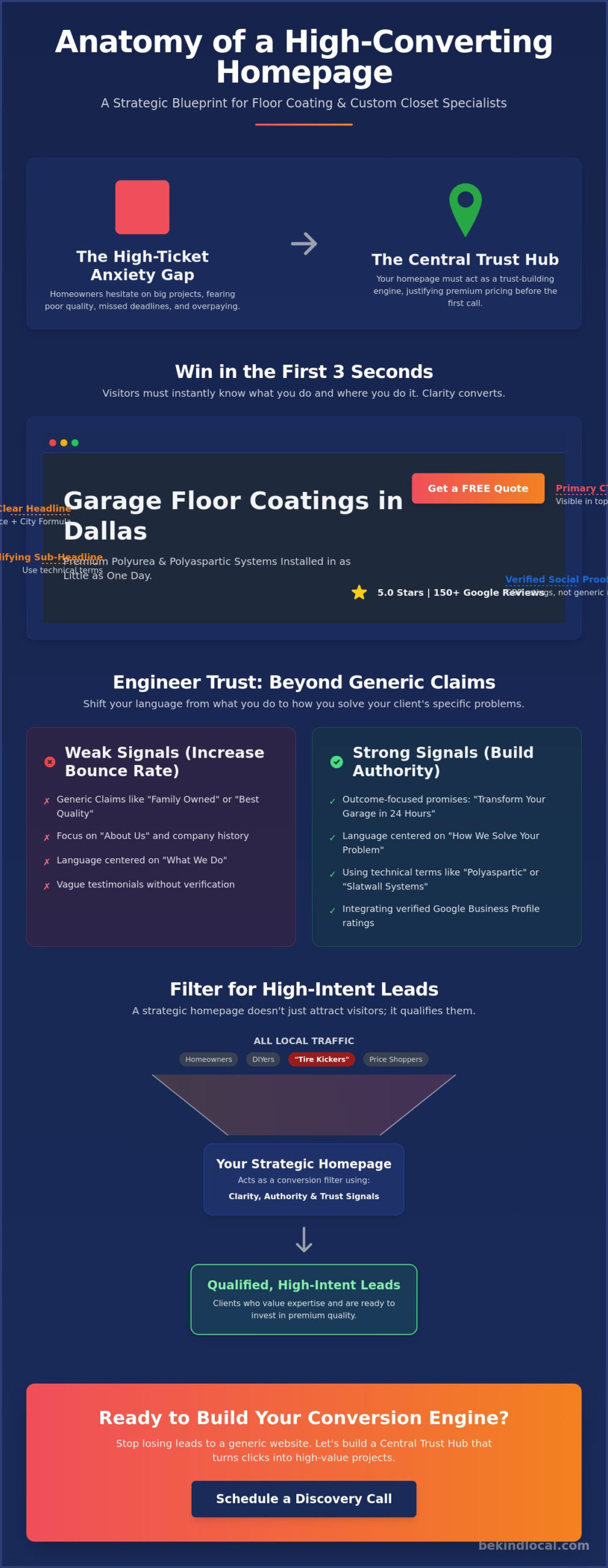
- Understand how a strategic website design filters out low-quality “tire kickers” so you can focus on high-intent leads that value your expertise.
The Strategic Role of a Contractor’s Homepage in 2026
Your homepage isn’t a digital brochure. In 2026, it serves as your “Central Trust Hub.” This is the space where high-intent homeowners decide if you’re a legitimate professional or just another generic contractor. Unlike SaaS companies that offer a “free trial” with zero risk, you’re asking people to let you into their homes for a five-figure project. This requires a completely different conversion path. One of the key elements of a high-converting homepage is recognizing that the visitor is looking for reasons to trust you, not just a list of services.
Many contractors make the mistake of treating their homepage as an “About Us” dumping ground. They fill it with photos of their trucks and long stories about their founding. While history matters, your prospects care more about their own problems. They want to know if you can fix their cracked garage floor or organize their chaotic mudroom. If you focus too much on yourself, you’ll lose them in seconds. You need to present immediate proof of local expertise to keep them on the page.
Homepage vs. Landing Page: Knowing the Difference
It’s easy to confuse these two, but they have different jobs. A landing page is usually built for a single ad and a single goal. However, your homepage must speak to multiple personas at once. You have new leads from search, returning clients checking your phone number, and referral traffic looking for social proof. To keep them engaged, use strategic internal linking. Direct them to deep-content pages for specific solutions like polyurea flooring or pantry systems. While landing page optimization (LPO) focuses on a narrow path, your homepage balances broad brand authority with these specific conversion triggers. You can see how we balance these elements in our custom website design approach.
The Psychology of the High-Ticket Home Service Buyer
Remodeling projects create an “Anxiety Gap.” Homeowners worry about poor quality, missed deadlines, and overpaying. Your homepage needs to close this gap immediately. Shift your language from “What we do” to “How we solve your problem.” Show them you understand their specific needs in markets like Texas or Florida, where heat and humidity affect concrete coating or closet materials. Demonstrating a strong local presence isn’t just about listing a city name; it’s about proving you’re a staple in the community. This is one of the most vital key elements of a high-converting homepage for specialty contractors who want to justify premium pricing and filter out low-quality leads.
Winning Above the Fold: The First 3 Seconds of Conversion
You have three seconds. That’s the window you have to convince a visitor they’re in the right place. If they have to hunt for your location or guess your specialty, they’ll click away. Mastering this immediate impression is one of the most vital key elements of a high-converting homepage. Your headline shouldn’t be clever; it should be clear. It must state your primary service and your city. For example, “Custom Closets in Indianapolis” or “Garage Floor Coatings in Dallas” tells the user exactly what you do and where you do it.
Your sub-headline then qualifies that lead. Instead of saying “we do floors,” specify that you offer “Premium Polyurea Floor Coatings.” This immediately signals to the homeowner that you aren’t a budget handyman; you’re a specialist. To drive action, place your primary Call to Action (CTA) in the top right corner. A “Get a Quote” or “Schedule Consultation” button should be the most visible item on the page. Research shows that focusing on these small adjustments leads to a higher website conversion rate because it removes the mental work for the prospect.
Crafting a Value Proposition for Specialty Professionals
Avoid generic claims like “Family Owned” or “Best Quality.” Every contractor says those things. Instead, focus on specific outcomes that solve a pain point. Use phrases like “Transform Your Garage in 24 Hours” or “Double Your Storage with Custom Reach-In Closets.” Using technical terms like “Polyaspartic Systems” or “Slatwall Systems” builds authority. It tells the visitor you know the science behind your craft. If you aren’t sure how to frame your expertise, you might want to talk with a strategist who understands your niche.
Visual Authority: Why Stock Photos Kill Lead Generation
Stock photos are a conversion killer. Homeowners can spot a generic, polished image from a mile away, and it feels dishonest. Real project photos show your actual work, your crew, and your branded trucks. This “human element” builds immediate trust. Seeing a local job site in a neighborhood they recognize is more powerful than any stock image. We prioritize this in our Custom Website Design, ensuring your visual portfolio proves your local expertise. Showing a walk-in closet you actually installed or a pantry you organized makes your value tangible and justifies your premium pricing.
Trust Architecture: Beyond Generic Reviews
Trust isn’t built by a single sentence. It’s an architecture. Most contractors bury their reviews on a separate page, but that’s a mistake. You need to weave social proof into the fabric of the page. This is one of the key elements of a high-converting homepage. Instead of a wall of text that visitors will skip, use dynamic widgets that pull your latest Google Business Profile ratings. Since 87% of consumers read online reviews before choosing a local service provider, showing your 4.8-star average right on the homepage is essential for immediate credibility.
Visual proof is just as important as written words. A “Before and After” slider allows homeowners to see the raw transformation of a cluttered garage or a cramped pantry. It makes the result feel attainable. When they can physically slide the bar to see a dull, cracked concrete floor become a polished polyurea masterpiece, they stop wondering if you’re good and start wondering how soon you can start. Institutional trust markers, such as industry certifications or local “Best of City” awards, should also be visible to prove you’re a recognized leader in your craft.
Showcasing Niche Expertise (Polyurea, Slatwalls, and Walk-ins)
Specific service blocks are vital for both user trust and Local SEO. Don’t just list “Closets” as a service. Break it down to show you understand the technical distinctions between reach-in, walk-in, and pantry systems. For floor coating professionals, highlighting the durability of polyurea and polyaspartic systems over standard epoxy is a chance to educate the buyer. This demonstrates that you’re a specialist who cares about long-term quality, which is one of the key elements of a high-converting homepage for premium contractors.
Strategic Placement of Social Proof and Guarantees
Where you place your trust signals matters as much as what they say. A “Trust Bar” featuring logos of professional associations or the brands you install (like specific slatwall systems) belongs right under the hero section. It acts as a secondary endorsement. You should also use clear guarantees to reduce buyer friction. Instead of a vague “satisfaction guaranteed,” use a specific “Lifetime Adhesion Warranty.” This level of transparency is a core part of a winning Floor Coating Leads strategy. It tells the prospect that you stand behind your work, making the decision to call you much easier.
Conversion-Focused Navigation and Frictionless Lead Capture
Navigation is the heartbeat of your site’s user experience. If it’s cluttered, you’ll lose prospects before they even see your work. One of the key elements of a high-converting homepage is a “Service-First” menu. Instead of hiding your expertise under a generic “Services” tab, list your core solutions directly in the main navigation. This helps both the user and search engines understand that you specialize in epoxy flooring, pantry organizers, or walk-in closets immediately. To keep your primary goal in sight, implement a persistent “Sticky Header.” This ensures that as a homeowner scrolls through your gallery of garage slatwall systems, the “Get a Quote” button remains just one click away.
Reducing form friction is equally critical. Every extra field you add to a contact form can decrease your conversion rate. Stick to the three-field rule for initial lead capture: Name, Phone Number, and perhaps a Zip Code or Service Type. You can always gather more details during the discovery call. Since most of your local traffic arrives via smartphone, your mobile-first optimization must be flawless. Ensure your “Call Now” and “Book Now” buttons are large and thumb-accessible at the bottom of the screen. If your current navigation is confusing visitors, it’s time to schedule a discovery call with our team to audit your layout.
Optimizing the Primary Call to Action (CTA)
Passive language like “Contact Us” often feels like a chore to the homeowner. It doesn’t promise any value. Instead, use active, value-driven language such as “Schedule Your Free Design Consultation.” This shift is a staple in custom closet marketing because it promises a specific, helpful outcome. Once they click that button, the next step must be crystal clear. Don’t just send them to a blank “thank you” page. Tell them exactly when they’ll hear from you and what they should have ready for the call.
Integrating Search Intent into Navigation
Your navigation should be a strategic extension of your Google Ads for Home Services campaigns. If someone clicks an ad for “garage overhead storage,” they shouldn’t land on a page where they have to hunt for that service. Create clear paths for different buyer stages. Some are ready to buy right now, while others need education on polyaspartic systems vs. standard epoxy. Finally, use your footer to reinforce local signals. Include your full business address, a local phone number, and links to your most popular service areas to help search engines confirm your local authority. These are the key elements of a high-converting homepage that turn casual browsers into scheduled appointments.
Building Your Conversion Engine with Be Kind Local
A generic website template is a liability for a specialty contractor. While it might look clean, it lacks the strategic depth required to turn a local homeowner into a high-ticket client. At Be Kind Local, we don’t just build websites; we build conversion engines. We understand that the key elements of a high-converting homepage for an epoxy flooring professional are vastly different from those of a retail store. Your business relies on trust, technical authority, and local proof. A cookie-cutter site can’t communicate the nuance of your polyaspartic systems or the craftsmanship in your custom mudroom designs.
Our primary goal is lead quality over raw traffic volume. It’s easy to get clicks, but it’s much harder to ensure those clicks come from people who value premium work. We design your homepage to act as a filter, helping to weed out “tire kickers” before they ever pick up the phone. By aligning your Brand Strategy with your digital presence, we ensure that every visitor understands you’re the local expert. We handle the technical heavy lifting, from lightning-fast load speeds to a secure SEO architecture, so your site performs as well as the floors you coat.
Our Approach to Custom Web Design for Specialty Contractors
We focus exclusively on the unique needs of epoxy, garage storage, and closet businesses. Your customers are looking for a transformation, not just a service. We use our Home Service Brand Strategy to differentiate your business from local competitors who are still relying on generic claims. We don’t just launch a site and walk away. We use real lead data to make iterations, ensuring your layout continues to reflect the key elements of a high-converting homepage as the market changes. Whether you specialize in reach-in closets or industrial-grade concrete coatings, your site will speak directly to your ideal buyer’s pain points.
Integrating SEO and Advertising for Maximum Growth
A high-performing homepage is the perfect destination for your Advertising traffic. When your Google Ads point to a page designed for conversion, your cost per lead drops and your ROI climbs. We help you scale from simple local visibility to regional dominance by ensuring your site supports your growth goals. Your digital presence should be as durable and well-organized as the garage slatwall systems you install. If you’re ready to stop settling for a generic site and want a strategic partner to help you grow, it’s time to take the next step. Schedule a Discovery Call with Be Kind Local today to see how we can transform your digital presence into a lead-generating machine.
Transform Your Digital Presence Into a Lead Engine
Your website shouldn’t just look professional; it should work as hard as you do on a job site. It needs to be a strategic tool that qualifies leads and builds immediate trust from the very first click. By mastering the first three seconds of a visitor’s experience and implementing a clear trust architecture, you ensure your digital presence justifies your high-ticket pricing. These key elements of a high-converting homepage work together to filter out the tire kickers and attract the high-intent homeowners you actually want to serve.
We specialize in lead generation specifically for the floor coating and custom closet industries. Our approach isn’t about chasing raw traffic volume. Instead, we focus on being a strategic partner that prioritizes lead quality and sustainable growth. We handle the technical SEO and strategic design so you can focus on the craftsmanship your clients expect. If you’re ready to move beyond a generic template and build a site that actually performs, we’re here to support you. Schedule a discovery call with Be Kind Local at bekindlocal.com. Let’s build a digital presence that truly reflects the value of your work.
Frequently Asked Questions
What is the most important element on a contractor’s homepage?
Clarity is the single most important factor for conversion. Within three seconds, a visitor must understand exactly what you offer and which areas you serve. A headline such as “Custom Closets in Indianapolis” paired with a clear sub-headline about your specific solutions, like reach-in or walk-in systems, removes all guesswork. If a homeowner has to hunt for your location or specialty, they’ll leave the page immediately.
Should I send my Google Ads traffic to my homepage or a landing page?
Dedicated landing pages are usually better for specific search intent, such as “garage floor coating cost.” However, your homepage must still be optimized for conversion because it handles all your organic, social, and referral traffic. When your site includes the key elements of a high-converting homepage, it acts as a powerful destination for broad brand searches and local discovery. A well-structured homepage ensures that even non-ad traffic turns into qualified leads.
How many calls to action (CTAs) should a high-converting homepage have?
You should focus on one primary goal, such as “Schedule a Free Design Consultation,” and repeat it strategically. Having too many different asks can confuse the visitor and lower your conversion rate. Use a persistent sticky header so your main CTA is always visible as the user scrolls through your portfolio of pantry organizers or polyurea floor samples. This keeps the next step simple and frictionless.
Is mobile optimization really that important for home service contractors?
Mobile optimization is absolutely critical because the majority of local home service searches happen on smartphones. If your site doesn’t load quickly or your buttons are too small to tap, you’re losing money. A high-performing site ensures that “Call Now” buttons are thumb-accessible and that technical details about your slatwall systems are easy to read on small screens. Fast loading speeds are also a major factor in how Google ranks your local business.
What kind of photos should I use on my homepage to increase conversions?
Use real photos of your own projects, your crew, and your branded trucks. Homeowners value authenticity and can easily spot generic stock images, which often feels like a breach of trust. High-quality before-and-after sliders of a garage floor transformation or a mudroom install provide tangible proof of your skill. Showing your team in action builds a human connection that stock photography simply can’t replicate.
How do I know if my current homepage is actually converting leads?
You need to track your conversion rate using tools like Google Analytics. If your conversion rate is below 3%, your site likely has a performance or trust problem. Look at your bounce rate to see if people are leaving as soon as they land on the page. Tracking phone calls and form submissions specifically from the homepage will tell you if your layout is successfully guiding visitors toward a discovery call.
Do I need a separate page for every service like polyurea and epoxy?
Yes, separate service pages are essential for both SEO and lead quality. While your homepage introduces your brand, individual pages allow you to go deep into the technical benefits of polyaspartic systems vs. standard epoxy. This structure helps you rank for specific local search terms and ensures that when a lead clicks through, they find exactly the information they need to justify your premium pricing. It also keeps your homepage from becoming cluttered with too much technical jargon.
How long does it take to see results from a homepage redesign?
User experience improvements and conversion rate increases are often visible almost immediately after launch. You’ll likely notice that the leads coming in are better qualified and have a higher intent to buy. From an SEO perspective, it typically takes 30 to 90 days for search engines to fully crawl and reward your new content architecture. Consistent growth follows as your local visibility improves and your brand authority grows in your target market.