
 951-249-7500
If you’re paying for clicks that only result in inquiries for cheap repairs instead of full polyaspartic systems, your marketing budget isn’t working; it’s leaking. Most specialty contractors feel the sting of high cost-per-click rates in competitive local markets like epoxy flooring or custom garage remodeling. It’s frustrating to see your hard-earned revenue disappear into a black hole of “junk” leads and vague agency reports that don’t translate to actual installations. Understanding the landscape of small business PPC management fees is the first step toward regaining control over your growth.
You deserve a clear picture of where your money goes and what it actually buys. We agree that transparency is the foundation of any local partnership. This guide will teach you how modern fee structures are built and how to identify a strategic partner who prioritizes high-ticket lead quality over raw traffic volume. We’ll explore the different pricing models used in 2026 and show you how to find a collaborator who understands the technical details of luxury closet design and high-performance coatings. By the end, you’ll know exactly how to measure ROI against your management costs to ensure your business remains profitable and visible.
Key Takeaways
- Understand the different tiers of small business PPC management fees to determine whether a flat monthly rate or a growth-focused model fits your current expansion goals.
- Learn how to avoid the “cheap management” trap that often results in low-quality leads for DIY products rather than high-ticket polyaspartic floor installations.
- Discover why niche-specific keyword research for walk-in closets and garage slatwall systems is vital for turning ad clicks into profitable projects.
- Identify the essential components of a high-value PPC package, including landing page optimization and transparent reporting that prioritizes lead quality over raw traffic.
- Gain insights on selecting a strategic partner who understands the unique technical demands of the specialty contracting industry without hidden ad spend markups.
Understanding PPC Management Fee Models for 2026
A PPC management fee is the investment you make to have an expert handle the technical heavy lifting of your digital advertising. It covers the high-level strategy, the day-to-day execution of campaigns, and the constant optimization required to keep your phone ringing with qualified prospects. Understanding PPC fundamentals is vital because it helps you see that you aren’t just paying for ad space. You’re paying for a filtered stream of high-ticket leads. When evaluating small business PPC management fees, you’ll find that agencies typically structure their costs to align with your specific growth stage and operational needs.
The Flat Fee Model: Stability for Local Contractors
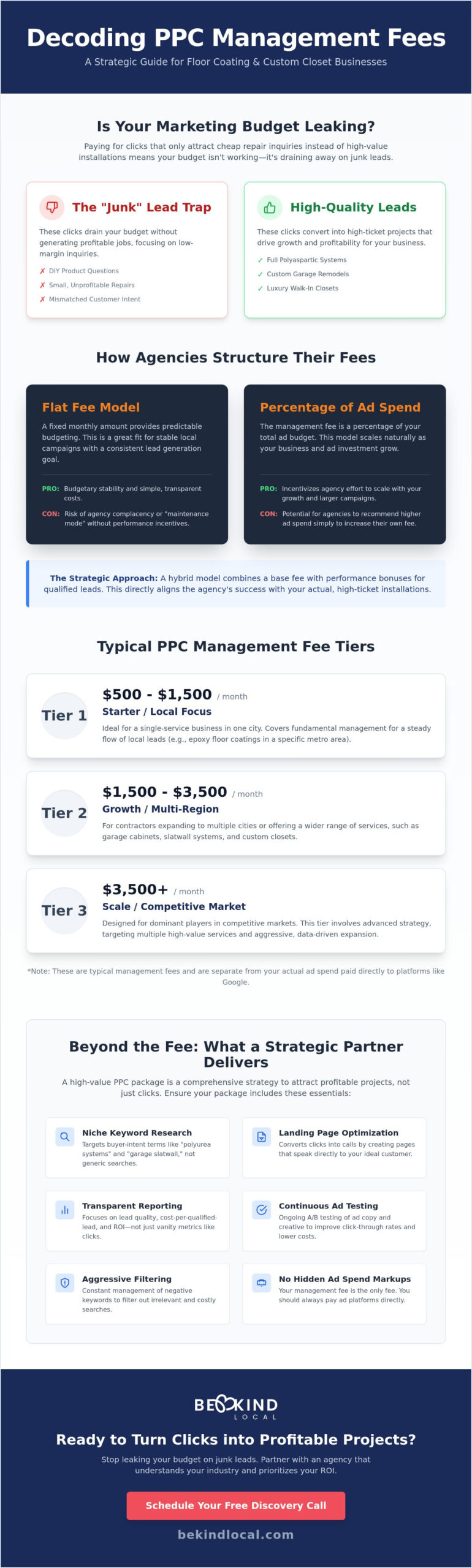
Many garage remodelers and closet designers prefer the predictability of a flat monthly fee. This model is straightforward; you pay a set amount every month regardless of how much you spend on the ads themselves. It’s often a great fit for stable local campaigns where the goal is a consistent flow of leads within a specific service area. In a standard agreement, you should expect a comprehensive set of services designed to protect your budget:
- Detailed monthly performance reporting and strategy calls.
- Regular bid adjustments to ensure you aren’t overpaying for clicks.
- Continuous keyword expansion and aggressive negative keyword filtering.
- Ongoing ad copy testing to improve click-through rates for epoxy flooring or custom cabinetry.
There is a subtle downside to watch for. If the fee remains the same regardless of performance, some agencies might slip into a “maintenance mode.” This means they do just enough to keep the account running without actively looking for ways to lower your cost-per-lead or find new opportunities in high-margin polyaspartic flooring markets. You want a partner who stays hungry for your growth, even when the billing is predictable.
Percentage of Spend: Pros and Cons
The percentage of ad spend model is another common industry standard. Here, the agency charges a fee based on the size of your total ad budget. This structure scales naturally. As your business grows and you invest more in Google Ads, the agency’s effort and resources increase alongside your budget. It’s a model built for expansion. For smaller budgets, however, this can be risky. If your monthly spend is low, a standard percentage might not cover the professional hours needed for deep keyword research into niche terms like “reach-in closet organizers” or “pantry shelving systems.” You must also ensure your partner isn’t recommending a budget increase simply to pad their own management fee. A strategic partner will always prioritize your ROI over their own short-term gains.
Some agencies are moving toward hybrid models to solve these issues. These combine a base management cost with performance-based incentives. This might look like a fixed fee plus a bonus for every qualified lead that meets your specific criteria, such as a full-garage polyurea coating inquiry. It aligns the agency’s success directly with yours. It encourages them to focus on lead quality rather than just raw traffic numbers. For a specialty contractor, this level of accountability is the most ethical and effective way to manage small business PPC management fees while ensuring every dollar works toward a high-ticket installation.
Typical Management Fee Ranges for Specialty Contractors
Budgeting for digital growth shouldn’t feel like a guessing game. When you’re deciding how to budget for PPC, it’s essential to separate your management investment from the actual ad spend paid to Google. The management fee is what you pay for the expertise to ensure your ads appear for “custom walk-in closet design” rather than “cheap closet bins.” Within the industry, small business PPC management fees for specialty contractors typically fall into three distinct tiers based on the complexity of the work.
- Tier 1: Starter/Local ($500 – $1,500/mo): This is ideal for a business focused on a single service in one city, such as local epoxy floor coatings. It covers basic management and steady lead flow.
- Tier 2: Growth/Multi-Region ($1,500 – $3,500/mo): This tier is built for contractors managing multiple high-ticket services like polyaspartic systems and garage slatwall installations across several counties or an entire state.
- Tier 3: Strategic/National ($3,500+/mo): At this level, you’re looking at comprehensive lead generation that includes CRM integration to track every lead from the first click to the final installation.
It’s vital to remember that these fees are separate from your ad spend. The management fee covers the brainpower, while the ad spend is the fuel for the engine. If you’re unsure which tier fits your current volume, we can help you identify the right strategy for your local market.
Cost Drivers: What Makes a Fee Higher?
Several factors influence where you land on the pricing scale. Managing a campaign across Google Ads, Microsoft Ads, and Meta requires more resources than focusing on a single platform. Your geographic reach also plays a role; targeting a single county is simpler than maintaining visibility across a multi-state region. High-ticket niches like luxury walk-in closet design require more sophisticated audience targeting and more frequent ad copy testing to attract the right clientele. These complexities demand more time from your strategic partner.
The Hidden ROI of Professional Management
Professional management often pays for itself by eliminating waste. A $1,000 management fee can easily save you $2,000 in wasted ad spend by aggressively filtering out “junk leads,” such as people searching for DIY floor paint. The Break-even Lead Cost for a closet installation business is the total gross profit of a project divided by the number of leads required to close a single sale. By understanding this number, your partner can make strategic bid adjustments during peak home improvement seasons. This ensures you’re aggressive when the market is hot and conservative when it’s not, protecting your margins year-round. Expertly handled small business PPC management fees are an investment in the health of your sales pipeline.
The “Cheap Management” Trap: Why Low Fees Cost More
Opting for the lowest quote when comparing small business PPC management fees might feel like a win for your overhead; however, it often triggers a cycle of wasted ad spend. Cheap management services typically rely on high-volume, low-touch automation. They “set and forget” your account, which is a disaster in high-competition niches like concrete coatings or custom cabinetry. According to university guidelines on PPC ad spend, local businesses should expect to allocate at least $1,000 to $2,000 per month just for the ad spend itself to see meaningful data. If you’re paying a vendor a tiny fee to manage that budget, they simply can’t afford the professional hours required to audit your search terms manually.
Automation vs. Human Strategy
Google’s “Smart Campaigns” are designed to be easy, but they often prioritize spending your budget over finding your ideal customer. For a specialty contractor, this is dangerous. A human strategist needs to vet your search terms to ensure you aren’t paying for clicks related to “garage sales” when you actually sell “garage storage systems” and slatwall. Automation struggles to understand the nuance between a homeowner looking for “cheap DIY floor paint” and a luxury client seeking “polyaspartic garage floor coating.” Without human oversight, your budget drains into clicks that will never convert into a signed contract. We believe the human element is what transforms a generic ad into a compelling invitation for a high-end walk-in closet consultation.
Lead Quality: The Only Metric That Matters
A high click-through rate means nothing if your inbox is full of “junk” leads. Low-cost providers often brag about raw traffic volume because it’s easy to generate. They don’t take the time to build the aggressive negative keyword lists required to filter out window shoppers. Professional management focuses on the “intent” behind the search. This involves creating specific ad groups for reach-in closets, pantries, and mudrooms rather than one broad “closet” category.
- We distinguish between a casual “click” and a “qualified estimate request.”
- Our strategy involves constant filtration to ensure your cost-per-lead remains sustainable.
- We prioritize high-ticket installations over vanity metrics like impressions.
If you want to understand how this filtration works in practice, our Floor Coating Leads: Strategic Guide breaks down the process of capturing high-intent inquiries. When small business PPC management fees are too low, this level of detail is the first thing to be sacrificed. At Be Kind Local, we treat your marketing budget with the same respect you give your craft, ensuring every dollar spent is an investment in a real, profitable project.
Beyond the Fee: What Should Be Included in Your PPC Package?
When you’re comparing small business PPC management fees, the most important question isn’t “what does it cost?” but “what is included?” Professional management is a comprehensive service that bridges the gap between a search query and a signed contract. It’s not a commodity; it’s a specialized set of tools designed to protect your margins. A high-value package should handle the technical heavy lifting so you can focus on the installation. This includes deep keyword research for terms like polyurea coatings, slatwall systems, and reach-in closet organizers. It also requires monthly strategic reviews where we don’t just dump data on your desk; we explain what those numbers mean for your upcoming project schedule.
Landing Pages: The Secret to Lowering Fees
Sending your paid traffic to your homepage is a common mistake that wastes your budget. Your homepage is for everyone; your landing page is for one specific person. If a homeowner clicks an ad for “pantry organization,” they should land on a page dedicated to pantries, not a generic gallery of every closet you’ve ever built. Dedicated pages for concrete coating or mudroom design create a seamless experience for the user. This relevance is exactly what Google looks for when calculating your Quality Score. A higher score lowers your cost-per-click, which means your small business PPC management fees are actually working harder for you. Better pages turn more clicks into leads, effectively lowering your overall cost of acquisition.
Lead Tracking and CRM Integration
Most agencies stop at tracking “conversions,” which could be anything from a button click to a newsletter sign-up. We believe in tracking revenue. True professional management involves knowing exactly which ad led to a phone call and, eventually, a closed-won project. Your agency should care about your closing ratio as much as you do. If we see that “polyaspartic garage floor” leads are closing at a higher rate than generic “floor paint” leads, we shift the budget to where the profit is.
If you want to dive deeper into how we structure these campaigns for maximum impact, read our Google Ads for Home Services Strategy. We build our systems to integrate with your sales process, ensuring no lead falls through the cracks. Ready to see how a strategic partner can refine your lead flow? You can schedule a discovery call with us today to audit your current performance and find those hidden opportunities for growth.
Choosing a Strategic Partner: The Be Kind Local Approach
Selecting the right agency is the final piece of the puzzle. We focus exclusively on specialty contractors like epoxy floorers and closet designers because we believe deep expertise is the only way to deliver true value. When discussing small business PPC management fees, transparency is our baseline. We never apply hidden markups to your ad spend; you pay Google directly, and you pay us for the strategy and execution that makes those dollars count. This ethical approach is the core of our “Be Kind” philosophy. It’s about building long-term local authority through honest, data-driven marketing rather than short-term tricks.
Our goal is to help you move from “spending on ads” to “investing in a lead machine.” We treat your budget with the same care you use when applying a decorative flake floor or installing a custom mudroom. By aligning our success with your growth, we ensure that every optimization we make is designed to increase your project volume and improve your bottom line. A strategic partner should be an extension of your team, not just another monthly expense on your profit and loss statement.
Why Niche Expertise Matters
Generalist agencies often struggle with the technical nuances of your industry. We know the difference between epoxy and polyaspartic systems, and so do your customers. We understand why a homeowner would choose a polyurea topcoat over a standard sealer. Our deep experience in the garage storage and custom cabinetry sectors means we don’t need a learning curve to understand your business. We already know which keywords attract high-ticket leads for walk-in closets and which ones just waste money. If you want to see how we apply this knowledge to the design world, explore our Custom Closet Marketing Guide for a breakdown of high-intent lead generation.
Ready for Better Leads?
Your journey toward a more profitable sales pipeline starts with a conversation. During a discovery call with Be Kind Local, we dive into your current goals and local market competition. We don’t just guess at small business PPC management fees; we perform a thorough audit of your current accounts and landing pages before suggesting a fee structure. This ensures that the plan we build is tailored specifically to your growth targets and service area. We want to make sure we’re a good fit for each other before we ever sign a contract. If you’re ready to stop settling for junk leads and start capturing high-ticket installations, schedule your discovery call at bekindlocal.com today.
Building a Sustainable Lead Machine for Your Local Market
Choosing the right investment level for your digital growth is a strategic decision that shapes the future of your business. As we’ve explored, small business PPC management fees are truly an investment in lead filtration and niche-specific expertise. By prioritizing high-ticket lead quality over raw click volume, you ensure that your budget reaches homeowners actually seeking polyurea coatings or luxury mudroom designs. A strategic partner doesn’t just manage ads; they optimize your entire sales funnel, from dedicated landing pages to deep CRM integration. This level of care protects your margins and builds lasting local authority.
At Be Kind Local, we combine specialized expertise in the floor coating and custom closet niches with a commitment to transparent, ethical growth. We focus on what matters most: turning ad clicks into profitable installations through strategic reporting and human oversight. You don’t have to navigate the complexities of digital advertising alone. We’re here to help you move from unpredictable results to a consistent, high-quality lead flow. You can schedule a discovery call to audit your PPC performance with our team today. Let’s build a lead generation system that reflects the craftsmanship you bring to every project.
Frequently Asked Questions
How much does PPC management cost for a small business in 2026?
Professional management costs are typically structured in tiers that reflect the complexity of your local service area and the number of services you offer. While industry averages for local retainers often range from $500 to $1,500 per month, your specific investment depends on whether you are targeting a single city or an entire region. Total monthly investments, including both the management fee and the ad spend, usually fall between $2,000 and $15,000.
Is a flat fee or percentage of spend better for a local contractor?
A flat monthly fee is often the better choice for local contractors who want predictable marketing expenses and stable lead flow. This model ensures that your costs remain consistent even as you increase your budget to capture more polyaspartic floor leads. It prevents the agency from being incentivized to simply spend more of your money, focusing instead on the quality and filtration of the leads you receive.
What is the average ad spend for a floor coating company?
Floor coating companies should generally plan for an initial monthly ad spend budget of $1,000 to $3,000 to gather meaningful performance data. This range provides enough “fuel” for the engine to test different audiences for polyurea and epoxy systems. A healthy budget ensures you can compete for high-intent search terms in your local market without having your ads turn off by mid-afternoon due to lack of funds.
Can I manage my own Google Ads to save on fees?
You can manage your own Google Ads, but it often leads to significantly higher wasted spend than the cost of a professional management fee. Most owners find that “Smart Campaigns” and automated settings prioritize spending the budget over finding high-ticket customers. The time you spend troubleshooting technical settings is often better spent on-site closing deals for custom walk-in closets or garage remodels.
How do I know if my PPC management fee is worth the investment?
You know your fee is worth the investment when your revenue from new installations consistently outweighs your total marketing costs. A healthy campaign should aim for a revenue-to-cost ratio of at least 2:1 while maintaining a high closing rate on leads. If you are receiving a high volume of calls but none of them turn into profitable projects, your fee isn’t working hard enough for you.
What is included in a typical small business PPC management agreement?
A typical agreement includes high-level strategy, keyword research for terms like reach-in closets, and ongoing bid optimization to protect your margins. It ensures that small business PPC management fees cover the technical oversight needed to filter out junk leads and window shoppers. You should also expect regular reporting that explains exactly how your ad spend is translating into qualified estimate requests for your business.
Why are PPC management fees for contractors higher than for other industries?
Contractor fees are often higher because of the extreme competition and high cost-per-click in the home service and renovation niches. Filtering out DIY “floor paint” searches to find luxury polyaspartic leads requires aggressive negative keyword management and constant human oversight. The complexity of high-ticket lead generation in specialized trades demands a higher level of strategic expertise than simpler, low-cost consumer products.
What happens to my ads if I stop paying the management fee?
Your ads will continue to run if your billing is set up directly with Google, but their performance will likely drop without active management. Bid adjustments, negative keyword filtering, and ad copy testing stop immediately, which often leads to a rapid increase in wasted spend. Over time, your cost-per-lead will likely rise as competitors who are actively optimizing their campaigns outbid you for the best local prospects.