
 951-249-7500
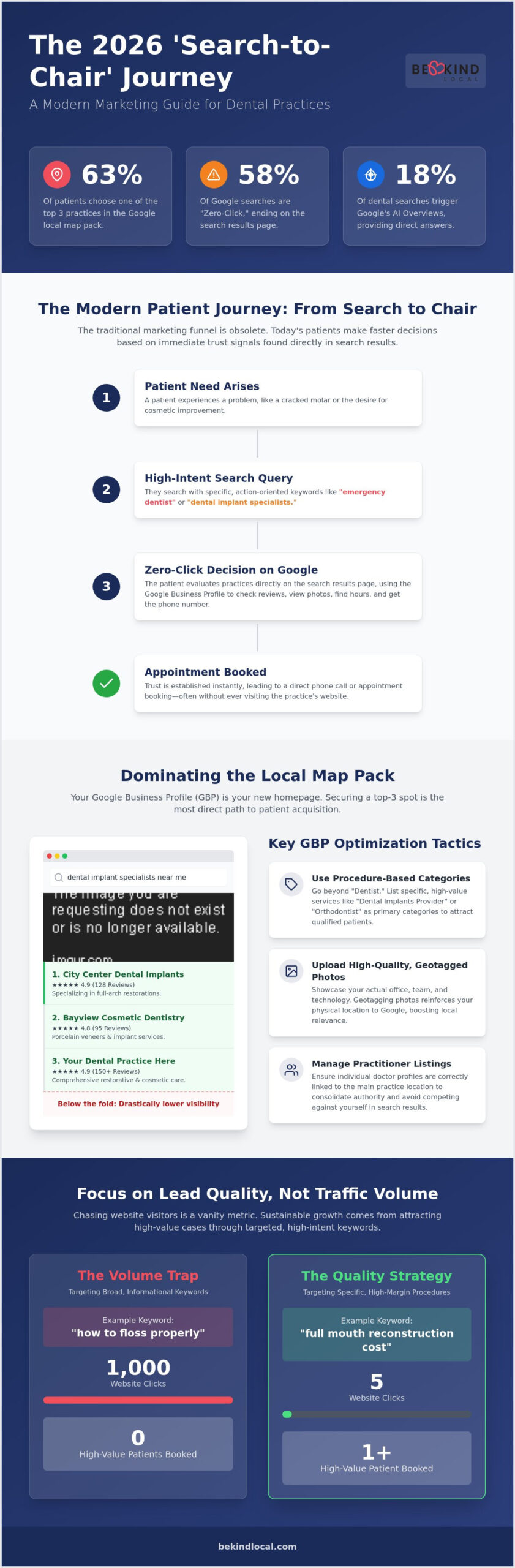
Did you know that 63% of dental patients choose one of the top three results in the Google local map pack, yet 58% of searches now end without the user ever clicking through to a website? It’s a significant shift that makes traditional marketing feel like a race to the bottom. You’ve probably felt the sting of high acquisition costs and the disappointment of low-quality leads who only want the cheapest cleaning in town. We believe you deserve a predictable flow of patients who truly value your expertise in restorative and cosmetic dentistry.
This guide reveals exactly how to get more patients for a dental practice by using a high-intent marketing framework designed for 2026. We’ll show you how to move past generic traffic and agency fluff to secure a dominant local search presence that actually converts. You’ll learn how to navigate the rise of Generative Engine Optimization and optimize your Google Business Profile to build a pipeline that treats growth as a strategic, community-focused endeavor.
Key Takeaways
- Identify why lead quality is more important than raw traffic by mastering the modern “Search-to-Chair” patient journey.
- Discover exactly how to get more patients for a dental practice by securing a top spot in the local map pack through advanced Google Business Profile tactics.
- Capture high-value restorative and cosmetic cases by structuring Google Ads around high-intent keywords and Local Services Ads.
- Turn website visitors into scheduled consultations with mobile-first design strategies that focus on driving phone calls and appointments.
- Establish a reliable reputation management system to generate consistent reviews and handle feedback within HIPAA compliance standards.
The 2026 Dental Patient Journey: Why Volume is a Vanity Metric
The traditional marketing funnel is dead. In 2026, the path from a Google search to a patient sitting in your chair is no longer a linear journey through your website’s homepage. We call this the Search-to-Chair journey. It’s a faster, more fragmented process where patients make decisions based on immediate trust signals. If you’re wondering how to get more patients for a dental practice, you have to stop chasing raw traffic. Total website visitors are a vanity metric. What matters is lead quality. A thousand clicks on a blog post about how to floss won’t pay the bills like five high-intent leads looking for full-mouth reconstruction.
Google’s AI Overviews now appear for approximately 18% of dental-related searches. These summaries provide direct answers, often recommending specific practices based on their reputation and relevance. This shift means your online presence must be optimized for machine understanding as much as human reading. It’s about applying core marketing management principles to a digital environment that prioritizes accuracy and local authority over generic brand awareness. Patients are moving away from broad terms like “dentist near me” and toward specific, procedure-based queries that indicate they’re ready to book.
The Rise of Zero-Click Searches in Dentistry
Recent data shows that 58% of Google searches end without a click. This isn’t a failure; it’s a change in behavior. Patients often find your phone number, office hours, and patient reviews directly on the search results page. Your Google Business Profile has effectively become your new homepage. To win the “Instant Answer” game, your profile needs to be robust, updated, and filled with the specific details patients need to book a consultation immediately. If you aren’t visible in those first few seconds of search, you don’t exist to more than half of your potential market.
Shifting Focus to High-Margin Procedures
Focusing on high-margin procedures is the key to sustainable growth. Routine cleanings are the backbone of any practice, but restorative and cosmetic cases drive the highest revenue. These patients search differently. They don’t just look for a general practitioner. They search for specific solutions like “dental implant specialists” or “porcelain veneers.” By leveraging targeted Local SEO, you can ensure your practice appears for these high-value keywords. Emergency dentistry requires a high-speed funnel focused on immediate availability, while cosmetic cases require a longer, trust-building narrative. Tailoring your strategy to these specific patient needs is how you move beyond generic leads and build a high-value pipeline that actually impacts your bottom line.
Dominating the Local Map Pack: Advanced SEO for Dental Practices
Winning the battle for the top three spots is the most direct way to grow your clinic. Research shows that 63% of dental patients choose one of the top 3 results in the Google local map pack. If you want to understand how to get more patients for a dental practice in 2026, you have to move beyond basic SEO. It’s no longer enough to just have a profile; you need to signal deep local authority and technical precision to stay ahead of competitors who are likely neglecting these nuances.
We often see a strategic parallel in local SEO for plumbers. In both industries, the searcher usually has a high-urgency need. Whether it’s a burst pipe or a cracked molar, the user isn’t browsing; they’re choosing. This high-intent behavior means your Google Business Profile (GBP) must be optimized to provide immediate answers and build instant trust.
Google Business Profile Optimization for Dentists
Your GBP is the digital front door of your practice. In 2026, Google rewards profiles that use specific procedure-based categories rather than just “Dentist.” If you specialize in implants or orthodontics, ensure these are listed as primary services. High-quality, geotagged photography of your actual office and team creates a human connection that stock photos can’t replicate. It’s also vital to manage practitioner listings correctly. While individual doctors can have their own profiles, they should be linked to the main practice to avoid internal competition in search rankings. This balance ensures you capture searches for specific names without diluting the authority of your clinic’s primary location.
Local Entity Building and Citation Hygiene
Google looks for signals that your practice is a pillar of the community. NAP (Name, Address, Phone) consistency is the bare minimum. To truly dominate, you need to build local entities by securing links from respected regional organizations. If you’re based in Texas, Florida, or California, focus on getting featured by local chambers of commerce, neighborhood associations, or state-specific health blogs. Securing citations from niche medical directories and local health boards signals to Google that your practice is a verified authority within the healthcare ecosystem. Combining this with stellar reputation management ensures that when patients find you, they see a practice that is both prominent and deeply trusted. If you’re ready to refine your local visibility, you can schedule a strategy session to see where your profile stands today.
High-Intent Paid Search: Capturing Patients Ready to Book
Paid search is the fastest way to see immediate growth. While SEO builds your long-term foundation, targeted Advertising allows you to bypass organic competition in even the most saturated markets. If you are learning how to get more patients for a dental practice, you must understand the difference between volume and intent. Generic keywords like “dentist” are expensive and often yield low-quality leads. High-intent keywords like “emergency tooth extraction” or “All-on-4 dental implants” connect you with patients who are ready to book an appointment right now.
Google Ads and Local Services Ads (LSAs) provide the most direct route to these patients. LSAs are a game-changer because they appear at the very top of the search results, even above traditional ads. You only pay when a patient actually calls or messages you through the platform. This shifts the risk away from your budget and onto the lead quality itself. Integrating these tools with proven dental practice marketing tips ensures your ads speak with authority and professionalism.
Beyond the “Free Cleaning” Trap
Many practices fall into the trap of promoting low-cost offers like “Free Cleanings” or “$59 New Patient Specials.” These ads often attract price-sensitive shoppers who have no intention of returning for restorative work. To attract high-value patients, your ad copy should focus on quality, comfort, and advanced technology. Use negative keywords to filter out terms like “low cost,” “discount,” or “Medicaid” if they don’t fit your business model. This ensures your budget is spent on patients who prioritize their oral health over the lowest price point.
Optimizing Landing Pages for Conversion
A high-performing ad is only half the battle. If your landing page is slow or confusing, you are throwing money away. We apply the same conversion logic used for floor coating leads: minimize friction and maximize trust. Your page must be mobile-first with a prominent click-to-call button and a seamless online scheduling tool. Patients in 2026 expect to book their consultation in three clicks or less. If your website makes them wait or search for a contact form, they will move on to the next practice in the search results.
Conversion-Centric Web Design: Turning Clicks into Consultations
A stunning website is a waste of resources if it doesn’t drive phone calls. When you’re looking at how to get more patients for a dental practice, your site must act as your most efficient salesperson. It needs to move beyond being a generic digital brochure. Most dental sites fail because they prioritize aesthetics over the specific psychological triggers that lead a patient to click “Book Now.” High-value patients looking for cosmetic or restorative work need to feel an immediate sense of trust. This is where a clear Brand Strategy becomes essential. It’s about telling a story through visual cues that position your practice as the only logical choice in your local market.
The “First 3 Seconds” Rule for Dental Sites
Patients make a decision about your practice within three seconds of landing on your page. They need to see three things immediately: your phone number, your location, and proof that you can solve their specific problem. Using “Before & After” galleries is one of the most effective ways to build this trust. However, you must ensure your web forms and communication channels are fully HIPAA compliant. Any feature that collects protected health information must use encrypted data and platforms that offer a Business Associate Agreement. We’ve seen many practices lose high-quality leads because their contact forms were too long or felt insecure. Frictionless online booking is a requirement in 2026, not a luxury.
Technical Performance and Local Relevance
Technical performance is no longer optional for ranking or conversion. Google’s mobile-first indexing means your site must be perfectly optimized for patients on the move who are often searching with one hand. We use advanced Web Design principles to ensure your site meets Core Web Vitals standards. This isn’t just for SEO; it’s for the patient experience. A one-second delay in page load speed can increase patient bounce rates significantly, as modern users have zero patience for slow-loading medical information. If your practice has satellite offices, you need localized landing pages that speak directly to the residents of those specific neighborhoods. This creates a sense of community and relevance that a generic homepage cannot achieve. If your current site is slow or failing to convert visitors, you can schedule a website audit to identify the specific friction points in your patient journey.
Reputation Management as a Growth Engine
Your reputation is the final bridge a patient crosses before they decide to trust you with their health. While previous sections focused on visibility and technical performance, this is where you solidify that trust. In 2026, Google accounts for 81% of all online reviews, making it the primary platform where your clinic is judged. If you’re struggling with how to get more patients for a dental practice, you have to realize that a passive approach to feedback is no longer viable. You need an ethical, proactive system that captures the voice of your most satisfied patients while remaining strictly compliant with industry regulations.
Responding to feedback is a delicate balance. You must never confirm that a reviewer is a patient in your public response, as this can lead to HIPAA violations. Instead, use a professional, templated approach that invites the individual to discuss their concerns privately. This level of ethical awareness is a core component of a sophisticated home service brand strategy, which we’ve successfully adapted for multi-location dental groups to ensure consistency across every office and provider listing.
The Review Velocity Factor
Frequency matters just as much as your overall rating. A practice with fifty reviews from three years ago looks stagnant compared to a competitor with ten fresh reviews from the last month. We call this “Review Velocity.” To maintain a healthy flow, you should automate review requests via text or email immediately following an appointment. Your front-desk staff plays a vital role here. Train them to identify “review-ready” patients, specifically those who have just completed a successful procedure and are expressing verbal gratitude. A simple, personal request in that moment often yields the most authentic and detailed feedback.
Strategic Social Proof
Video testimonials are the gold standard for high-ticket restorative and cosmetic cases. Seeing and hearing a neighbor describe their transformation builds a level of trust that text alone cannot reach. These stories should be the heartbeat of your social media strategy, moving beyond generic office photos to show real community impact. Showcasing your involvement in local events or sponsorships further signals that you aren’t just a business, but a dedicated local authority. When patients see that you’re invested in the community, they’re more likely to invest their health in you. If you’re ready to build a predictable pipeline of high-value cases through a strategic marketing framework, schedule a discovery call with Be Kind Local at bekindlocal.com.
Scaling Your Practice with Intentionality
Building a thriving practice in 2026 requires more than just clinical excellence. It demands a shift from chasing raw traffic to capturing high-intent patients who are ready to commit to their oral health. By prioritizing lead quality over vanity metrics and optimizing your digital presence for the modern patient journey, you position your clinic as a trusted local authority. Dominating the map pack and refining your website’s conversion path are the cornerstones of a predictable growth strategy.
We’ve explored how to get more patients for a dental practice by using a framework that values ethics and precision. Whether you’re managing a single office or a multi-location organization, the goal is to create a seamless path from search to chair. At Be Kind Local, we’re specialized in high-intent local SEO and conversion-focused lead generation. We act as a strategic partner for multi-location practices, helping you cut through the noise of generic marketing reports and fluff.
If you’re ready to move beyond hype and secure a consistent pipeline of high-value cases, let’s talk. You can Schedule a Strategic Discovery Call with Be Kind Local today. We’re here to help you build a practice that serves your community with integrity and strength.
Frequently Asked Questions
How much should a dental practice spend on marketing per month?
Most established practices invest between 5% and 10% of their gross annual revenue into marketing. If you’re in a highly competitive metro area or aiming for aggressive growth, that figure often rises to 15%. It’s vital to distribute this budget across high-intent channels like local SEO and paid search rather than generic awareness campaigns. Focusing your spend on high-margin procedures ensures a better return on every dollar invested.
Is SEO or PPC better for getting new dental patients quickly?
PPC is the best tool for immediate patient volume, while SEO is the most effective long-term strategy for reducing acquisition costs. Google Ads can put your practice in front of patients today, but the average cost per new patient typically ranges from $100 to $300. SEO takes longer to see results, but once established, it often brings that cost down to $50 or $150 per patient by building sustainable organic authority.
How do I improve my dental practices Google Maps ranking?
You can improve your ranking by prioritizing “Review Velocity” and ensuring your Google Business Profile is technically complete. Google rewards practices that regularly receive fresh, high-quality reviews and those that use procedure-specific categories. Since 63% of patients choose a practice from the top three map results, you must also secure local citations and upload geotagged photos. These signals tell Google your practice is a relevant, trusted pillar of the local community.
What are the best keywords to target for cosmetic dentistry?
The most effective keywords are procedure-specific terms like “porcelain veneers near me” or “Invisalign cost in [City].” These long-tail phrases indicate a patient is actively searching for a solution and is ready to book a consultation. Focusing on these high-intent terms is a core part of how to get more patients for a dental practice who prioritize quality. Avoid broad keywords like “dentist,” which often lead to high click costs with lower conversion rates.
Can I get more patients without offering deep discounts or free cleanings?
Yes, you can attract a consistent pipeline by positioning your practice as a high-quality, technology-focused provider. Patients seeking complex restorative or cosmetic work often value expertise and comfort over the lowest price. Instead of competing on cost, focus your marketing on your clinical outcomes, advanced equipment, and patient testimonials. This strategic positioning allows you to attract high-value leads who are looking for a long-term relationship rather than a one-time deal.
How do I handle negative patient reviews on Google?
Always respond with professional empathy and invite the reviewer to discuss their experience privately. You must never confirm a reviewer is a patient in your public response, as this violates HIPAA regulations. Provide a direct phone number for a manager to handle the situation offline. Since Google accounts for 81% of all reviews, the best defense is a proactive system that consistently generates new, positive feedback to maintain a strong overall rating.
What is the most effective way to market dental implants in 2026?
The most effective strategy combines Local Services Ads (LSAs) with high-quality video testimonials. LSAs place your practice at the absolute top of search results, and you only pay when a lead actually calls your office. Patients considering high-ticket procedures like implants need deep trust, which video stories provide better than text alone. This dual approach ensures you capture the patient’s attention and build the necessary rapport before they even step into your office.
Does social media marketing actually work for dentists?
Social media is a powerful tool for discovery and building trust, though it is rarely the primary source of high-intent leads. It works best for humanizing your team and showcasing your community involvement. Sharing “Before & After” cases and educational content keeps your practice top-of-mind when a follower eventually develops a dental need. It serves as a vital touchpoint in the patient journey, providing the social proof that confirms your practice is the right choice.