
 951-249-7500
In 2026, prospective therapy clients use an average of 2.7 different channels before booking their first session, proving that a single directory profile is no longer enough to sustain a modern practice. You likely entered this field to heal, not to spend your evenings wrestling with algorithms or feeling like you’re “selling” your soul for leads that don’t fit your clinical niche. It’s frustrating to watch your marketing budget vanish into generic platforms while your local competitors seem to capture all the high-intent clients. If you’re ready to move past the noise and master digital marketing for therapists, you’re exactly where you need to be.
We believe your practice deserves to be found by the people who truly need your specific expertise. This guide will show you how to move beyond the “post and pray” method of generic directories to build a sustainable, ethical presence through high-intent local search strategies. You’ll learn how to turn your website into a 24/7 clinical advocate that ranks number one for “therapist near me” in your local market. We’re going to dive into the exact steps to secure a consistent stream of private-pay clients without ever compromising your professional ethics or clinical integrity.
Key Takeaways
- Stop relying on “rented land” and discover how to reclaim your brand authority from generic directories that treat your expertise like a commodity.
- Learn how to optimize your Google Business Profile to act as a digital “front door” that welcomes local clients with warmth and professionalism.
- Master a strategic approach to digital marketing for therapists that connects you with high-intent clients who truly value your specific expertise.
- Apply the “3-second rule” to your website design to establish trust and lower the barrier to entry for those seeking help.
- Shift your focus toward sustainable, ethical lead generation that values the human connection over raw traffic numbers.
Why Generic Directories are Failing Your Private Practice
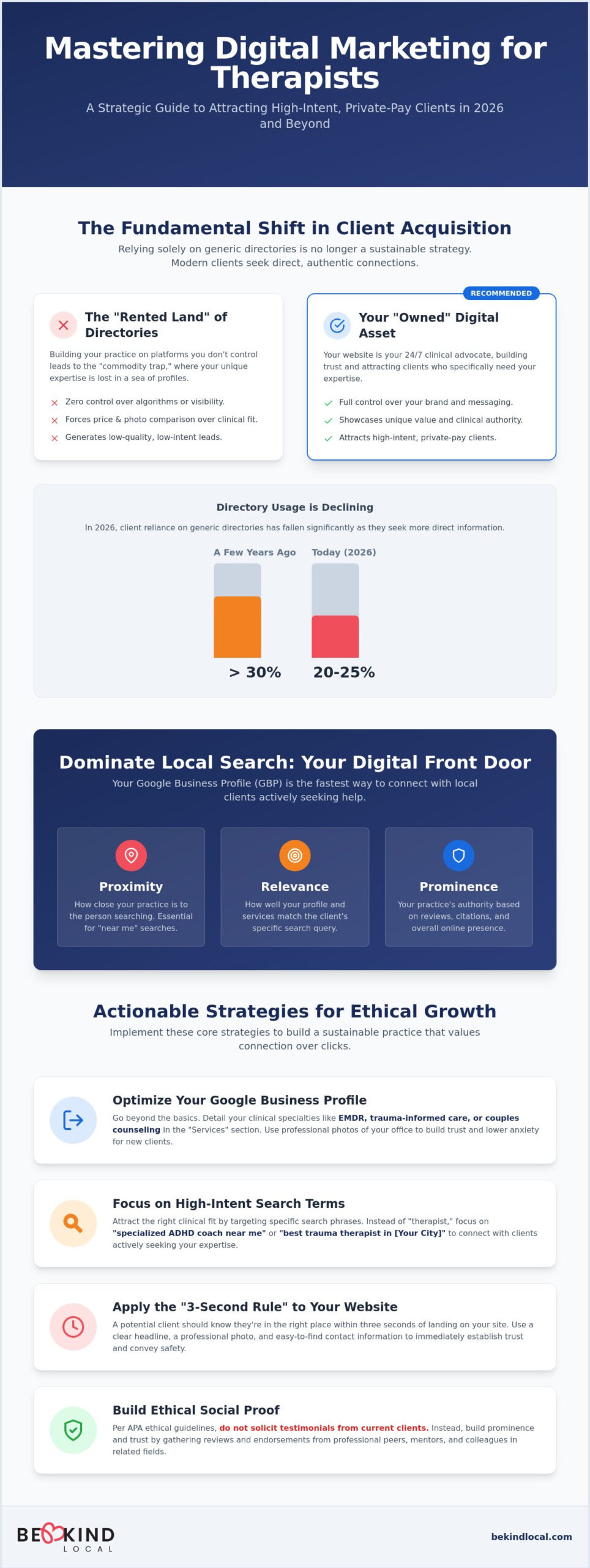
Directories like Psychology Today were once the primary way to get noticed. In 2026, relying solely on these platforms is a risky game. You’re effectively building your practice on “rented land” where you have zero control over the algorithm or how your profile is displayed. When you’re just one of 500 thumbnails in a sea of identical profiles, you fall into the “commodity trap.” This environment strips away your clinical authority and forces potential clients to choose based on proximity or a photo rather than your unique approach. It’s difficult to maintain a premium, private-pay practice when you’re being compared side-by-side with hundreds of others in a digital catalog.
Modern digital marketing has shifted. Statistics show that directory usage has dropped to about 20-25% in 2026, down from over 30% just a few years ago. Searchers are getting smarter. They’re skipping the middleman to find direct, authentic connections. It’s much better to have five high-intent leads from your own website than fifty generic clicks from a directory. Quality always beats raw volume in a private practice. If you want to build a sustainable business, you need a strategy for digital marketing for therapists that focuses on ownership and direct engagement.
The Psychology of the Modern Searcher
Search intent has evolved. People no longer just look for “therapist near me.” They search for “best trauma therapist in [City]” or “specialized ADHD coach near me.” They want to see your face, hear your voice, and understand your philosophy before they reach out. A directory profile can’t convey the warmth or safety that a dedicated website can. Searchers crave immediate trust. They want to know they’re in the right place within seconds of landing on your page. When they find you directly, they’re already more inclined to trust your expertise.
Moving from Passive to Proactive Growth
Standing out requires a clear brand strategy that defines your clinical niche. When you stop trying to be everything to everyone, you start attracting the clients you’re actually qualified to help. This proactive shift moves you from being a passive recipient of directory leftovers to a leader in your local market. You aren’t just another name on a list; you’re a specialist who solves specific problems. Strong brand authority creates a perception of unique value that makes specialized therapy fees a secondary consideration for clients seeking specific outcomes.
Dominating Local Search with Google Business Profile
Local SEO is the mechanism that connects your local practice with patients searching in your city. It’s about being visible exactly when someone needs help. Your Google Business Profile (GBP) is the new digital “front door.” When someone searches for “therapist near me,” Google presents the “Local Pack,” which are the top three results displayed with a map. Winning one of these spots is a cornerstone of effective digital marketing for therapists. It’s the fastest way to generate high-intent leads without spending a dime on ads.
Google ranks your practice based on three pillars: proximity, relevance, and prominence. Proximity is simply how close you are to the searcher. Relevance measures how well your profile matches the specific query. Prominence reflects your practice’s authority both online and offline. By focusing on these pillars, you ensure that your clinical expertise is the first thing a neighbor in distress sees. It’s not just about being found; it’s about being found by the right person at the right time.
Optimizing Your Profile for Clinical Authority
Go beyond the basic contact info. Use the “Services” section to highlight specific specialties like trauma-informed care, EMDR, or couples counseling. You can even use the “Products” feature to create visual cards for different therapy types. Building social proof is vital, but it must be done with care. According to the APA Ethical Principles, soliciting testimonials from current clients is unethical. Instead, focus on gathering reviews from professional peers or mentors to build prominence while maintaining confidentiality. Humanize your practice with local imagery of your office space to lower the barrier for someone feeling anxious about their first visit.
The Interplay Between SEO and Web Design
Effective Local SEO isn’t a standalone effort; it requires a technically sound website. Google uses mobile-first indexing, meaning it looks at the mobile version of your site to determine rankings. This is critical for users in crisis who often reach for their phones first. Your site must load quickly and be easy to navigate. Use internal linking to connect your service pages. For example, link your “Anxiety Treatment” page to a blog post about “Managing Panic Attacks.” This builds topical authority and helps Google understand your depth of expertise. If you’re feeling overwhelmed by these technical requirements, you can always reach out for a strategic conversation about your practice’s growth.
High-Intent Google Ads: Attracting the Right Clinical Fit
Google Ads isn’t about shouting into the void. It’s about being the steady hand that appears when someone is searching for a way out of the dark. In the world of digital marketing for therapists, we distinguish between awareness and intent. Social media might build awareness over time, but search intent is where the immediate action happens. When someone types “EMDR therapist near me” into a search bar, they aren’t just browsing; they’re ready for change. Pay-per-click (PPC) advertising is the most efficient tool to fill a caseload quickly because it places your practice at the very top of those high-intent searches.
Writing your ads requires a “Kind” approach. You aren’t just selling a service; you’re offering a path to healing. Your copy should lead with hope and empathy rather than just a list of certifications. To protect your budget, you must use negative keywords. Terms like “free,” “low cost,” or “non-profit” should be excluded if you’re a private-pay practice. This ensures your investment is focused on clients who are a clinical and financial fit for your specific model. It’s about quality over quantity every single time.
Strategic PPC for Specialty Practices
Specialized modalities like Polyvagal theory or the Gottman Method are perfect for targeted Google Ads. These searchers are often looking for a specific type of expertise and are willing to pay for it. While long-term SEO is vital, PPC allows you to bypass the typical six-month wait for organic visibility. Always look at your Customer Acquisition Cost (CAC) in relation to the Lifetime Value (LTV) of your clients. A single client might stay with your practice for months, making the initial cost of an ad click a very small fraction of the total revenue they bring to your practice.
Landing Pages that Convert
A common mistake is sending ad traffic to a generic homepage. This creates too much friction. Instead, use a dedicated landing page designed with a “Single Goal” framework: the initial consultation. You want to make the next step as easy as possible for someone who might be in a state of distress. We also recommend following established digital marketing strategies for therapists that prioritize HIPAA-compliant tracking. Standard pixels can be a liability in 2026. Use secure, encrypted contact forms to ensure that your marketing remains as safe and ethical as the work you do inside the therapy room.
Conversion-Focused Web Design for Private Practices
Your website is more than just a digital business card. It’s often the first step in a patient’s healing journey. In the context of digital marketing for therapists, the “3-Second Rule” is paramount. Within three seconds of landing on your page, a visitor must feel a sense of safety, professionality, and hope. If your site looks dated or cluttered, you’re inadvertently adding to their mental load. We use “Kind” design principles, focusing on calming color palettes and intuitive layouts that lower the barrier to entry for those seeking help.
Strategic placement of your call-to-action (CTA) is equally vital. Passive phrases like “Learn More” often lead to dead ends. Instead, use direct, supportive language such as “Schedule a Discovery Call.” This gives the visitor a clear, actionable path forward. We also advocate for a “Specialty Page” framework. Instead of a single “Services” page, create deep-dive content for every modality you offer. This not only helps with search rankings but also ensures that clients find the specific clinical fit they need before they ever pick up the phone.
Building Trust Through Content
Your “About Me” page is frequently the most visited page on a therapy site, yet many clinicians make the mistake of focusing entirely on their own credentials. To build true connection, your bio must mirror the patient’s experience and show them that you understand their pain. Video is another powerful tool to break the “fourth wall.” A short, welcoming video allows a prospective client to hear your tone and see your mannerisms, which significantly reduces the anxiety of the first session. A custom web design allows a boutique practice to project a unique, human-centric identity that a cookie-cutter franchise site simply cannot replicate.
User Experience (UX) as a Clinical Tool
Accessibility is an ethical imperative in mental health. Ensuring your site is ADA compliant means that individuals with varying needs can access your services without frustration. You should also simplify the intake process by integrating HIPAA-compliant booking tools directly into the user experience. When you link your Brand Strategy to your site’s visual identity, you create a cohesive experience that builds trust from the first click to the first session. Digital marketing for therapists is most effective when the technology supports the clinical mission rather than getting in the way. Ready to build a site that acts as your 24/7 clinical advocate? Let’s talk about your vision.
Be Kind Local: Your Partner in Ethical Growth
Building a private practice isn’t a numbers game. It’s a relationship game. At Be Kind Local, we’ve always believed that raw traffic volume is a vanity metric that distracts from what truly matters: lead quality. You don’t need a thousand clicks. You need five people who are ready to sit on your couch and do the work. Our approach to digital marketing for therapists is rooted in this understanding. We focus on connecting you with high-intent individuals who are actively looking for your specific clinical expertise. By filtering out the noise, we ensure your time is spent on healing rather than answering emails from people who aren’t a fit for your practice.
Our philosophy is simple. We’re strategic, direct, and deeply human-centric. We don’t view your practice as a set of keywords or a spreadsheet of conversion rates. Instead, we see it as a vital community resource that needs the right visibility to thrive. We move beyond the role of a traditional vendor. We act as a strategic partner, working alongside you to scale your practice in a way that feels ethical and sustainable. This means we prioritize long-term growth over quick wins that might compromise your professional integrity.
Why Specialty Matters
The mechanics of high-ticket, high-intent local services are remarkably consistent across different industries. We’ve seen how the strategies in custom closet marketing translate perfectly to the needs of private-pay therapy. Both require a deep understanding of local market research and a commitment to building immediate trust. Whether a client is investing in a home transformation or their own mental health, they’re looking for a specialist, not a generalist. We provide fluff-free reporting and total transparency. You’ll always know exactly how your investment is performing without having to decipher agency jargon.
Taking the Next Step
Your practice deserves a digital presence as thoughtful as your clinical work. The first step is a Discovery Call. This isn’t a high-pressure sales pitch. It’s a strategic audit of your current digital footprint to see where you’re losing potential clients and where you’re already winning. We’ll look at your local search visibility, your website’s conversion potential, and your current ad performance. From there, we create a customized growth plan tailored to your specific clinical goals. It’s time to build a practice that supports you as much as you support your clients. Schedule your discovery call at bekindlocal.com and let’s start growing your practice with intention.
Growing Your Practice with Intention and Authority
Reclaiming your practice from generic directories is the first step toward a sustainable, private-pay future. By mastering local search intent and creating a website that acts as a 24/7 clinical advocate, you ensure that your expertise is the first thing a neighbor in distress finds. Effective digital marketing for therapists isn’t about chasing raw traffic volume. It’s about building a bridge of trust between your specific clinical niche and the people who are actively searching for the healing you provide.
At Be Kind Local, we don’t believe in hypey claims or generic strategies. We act as a strategic partner, bringing deep local search expertise and a commitment to no-fluff, conversion-oriented results. Our goal is to help you scale your practice in a way that remains deeply rooted in your professional values. You deserve a marketing strategy that works as hard as you do for your patients. We are ready to help you navigate this digital landscape with clarity and confidence.
Schedule a Discovery Call to grow your practice ethically
Frequently Asked Questions
Is digital marketing for therapists ethical according to licensing boards?
Digital marketing for therapists is ethical as long as it adheres to the guidelines set by major licensing boards like the APA and HIPAA regulations. Standard 5 of the APA Ethics Code specifically governs advertising and public statements. You must avoid making false claims or soliciting testimonials from current clients. Ethical growth focuses on providing clear, honest information about your specialties to help patients make informed decisions.
How long does it take to see results from Local SEO for a new practice?
You should expect to see significant movement in your local search rankings within three to six months of consistent effort. While technical fixes to your website might show minor improvements sooner, building the authority needed to rank in the “Local Pack” takes time. This process involves optimizing your Google Business Profile and creating high-quality content that proves your relevance to local searchers.
What is the best way to handle negative reviews on a Google Business Profile?
The most effective way to handle a negative review is to respond professionally and promptly without confirming the person was ever a patient. Violating HIPAA by disclosing a clinical relationship is a much larger risk than a single bad review. State that you take all feedback seriously and provide an offline way to resolve the issue. Focus on building prominence through ethical peer reviews instead.
Should I focus on Google Ads or SEO first for my therapy practice?
Focus on Google Ads if you need to fill a new clinician’s caseload immediately, but start SEO simultaneously for long-term health. Ads provide instant visibility for high-intent keywords, while SEO builds the foundational authority that reduces your cost-per-lead over time. A balanced approach ensures you aren’t perpetually dependent on a daily ad budget to keep your practice running and your caseload full.
How much should a therapist spend on digital marketing per month?
A solo therapist earning $100,000 per year should typically invest between $416 and $833 per month in their marketing efforts. This 5-10% range of gross revenue is a standard benchmark for healthy growth. While 79.5% of therapists spend under $100 monthly, those who invest more strategically often see a much higher return through consistent private-pay referrals and a more stable, predictable income.
Can digital marketing help me attract more private-pay clients instead of insurance?
Attracting private-pay clients is a primary goal of digital marketing for therapists, as it allows you to target specific high-intent searchers. When you rank for specialized terms like “EMDR for trauma” or “Gottman Method couples therapy,” you attract individuals looking for a specific expert rather than just someone on their insurance list. This strategy positions your practice as a premium choice based on clinical fit.
Do I really need a blog for my therapy practice in 2026?
A blog remains essential in 2026 because it establishes your topical authority and answers the specific questions patients ask before booking. Each well-researched post acts as a clinical advocate that works 24/7 to build trust. It also provides fresh content for Google to index, which supports your overall local search strategy and helps you stay ahead of competitors who rely on static pages.
How do I track the ROI of my digital marketing efforts?
Track your ROI by measuring the lifetime value of a client against your total acquisition cost. Use encrypted, HIPAA-compliant contact forms and dedicated call tracking to see exactly which channels are driving inquiries. By comparing your monthly marketing spend to the revenue generated from new sessions, you can clearly see the social and financial impact of your digital growth strategies over time.