
 951-249-7500
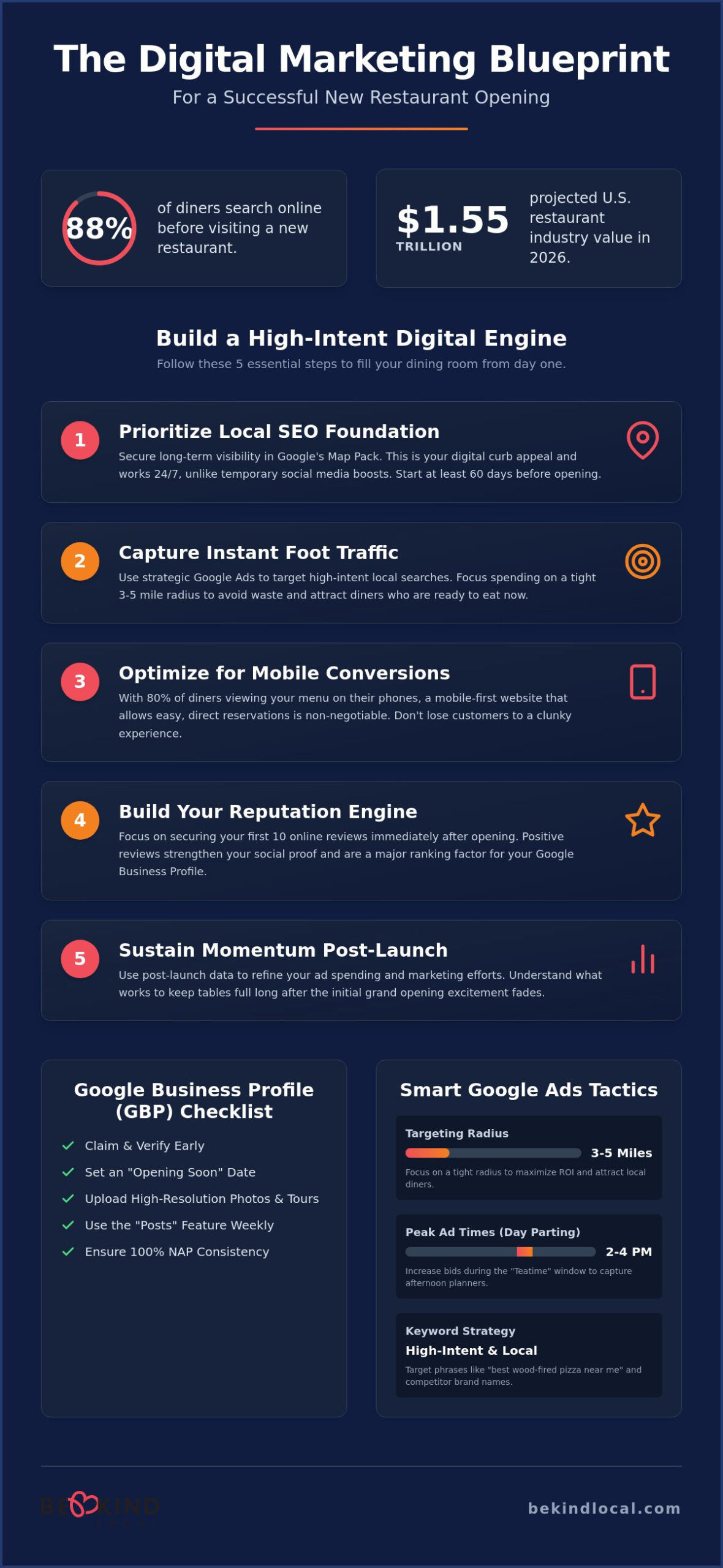
Did you know that 88% of diners now search online before they ever step foot in a new establishment? With the U.S. restaurant industry projected to hit $1.55 trillion in 2026, the competition for those hungry eyes is fiercer than ever. Effective marketing for a new restaurant opening isn’t about hope or expensive flyers. It’s about building a technical engine that captures local intent. You’ve poured your heart into the menu and the decor, so you shouldn’t have to watch your opening week profits get swallowed by third-party delivery fees or invisible “near me” search results.
We understand that launching a business is both an emotional journey and a massive financial risk. You likely feel that a great meal should speak for itself, yet you’re worried about empty tables or wasting your budget on ads that don’t convert. This guide will show you how to build a high-intent digital marketing engine that fills your dining room from day one without relying on unsustainable discounts. We will walk through the essential steps for optimizing your Google Business Profile, leveraging short-form video on TikTok, and creating a website that drives direct reservations.
Key Takeaways
- Build a sustainable digital foundation by prioritizing Local SEO over temporary social media boosts to secure long-term visibility in the Google Map Pack.
- Capture instant foot traffic through strategic Google Ads that target high-intent local searches rather than broad, low-converting brand awareness campaigns.
- Optimize your restaurant website for mobile users to ensure that the 80% of diners viewing your menu on their phones can easily book a direct reservation.
- Focus on securing your first ten reviews immediately to strengthen your reputation engine and improve your Google Business Profile ranking.
- Master the technical side of marketing for a new restaurant opening by using post-launch data to refine your spending and keep tables full long after the grand opening.
The Pre-Launch Local SEO Foundation
Think of Local SEO as your digital curb appeal. Just as you wouldn’t leave a pile of construction debris in front of your new entrance, you can’t afford a messy online presence. When neighbors search for a place to eat, Google’s Map Pack is the window they look through. If you aren’t appearing in those top three spots, your restaurant is effectively invisible to the 88% of diners who research online before visiting. Successful marketing for a new restaurant opening requires a foundation that exists long before you fire up the grill.
While “boosting” a post on social media might give you a temporary spike in likes, organic visibility is a far more sustainable investment. Social posts have a shelf life of hours; a well-optimized search presence works for you around the clock. This strategy aligns with fundamental food marketing principles that prioritize placement and promotion where your audience is already looking. You also need to ensure your NAP (Name, Address, Phone) data is identical across every directory. Even a small discrepancy in how your street name is abbreviated can confuse search engines and hurt your rankings. We recommend starting these efforts at least 60 days before your doors open to allow Google time to index your information and build authority.
Optimizing Your Google Business Profile (GBP)
Your GBP is often the first interaction a guest has with your brand. Claim and verify your listing early so you can set an “Opening Soon” date. This allows you to start appearing in local searches while you’re still in the build-out phase. Don’t settle for grainy smartphone photos. Upload high-resolution images of your signature dishes and 360-degree interior tours to let people feel the atmosphere of your space. Use the “Posts” feature weekly to share behind-the-scenes updates or countdowns. It builds a sense of community and anticipation before the grand opening event.
Local Keyword Research for Menus
People don’t just search for “restaurants.” They search for specific cravings. You need to identify high-intent phrases like “best wood-fired pizza near me” or “authentic street tacos in Houston.” By mapping these keywords to specific pages on your website, you capture long-tail traffic from diners who know exactly what they want. It’s about being the answer to a local neighbor’s question. Many successful operators utilize professional Local SEO services to identify these niche opportunities and dominate neighborhood search results early on. This technical approach ensures that when the community is ready to eat, your name is the one they see first.
Capturing Day-One Demand with Google Ads
While Local SEO builds your long-term presence, Pay-Per-Click (PPC) advertising acts as the faucet you turn on for immediate foot traffic. For a new brand, waiting for organic rankings can feel like watching water boil. Google Ads allows you to bypass the queue and place your menu directly in front of neighbors who are hungry right now. In 2026, the average cost per click for restaurants sits at approximately $2.05. This makes it a highly efficient way to buy your way into the local conversation while your organic authority matures.
Success in marketing for a new restaurant opening depends on your ability to differentiate between broad brand awareness and high-intent local searches. Many owners waste their budget on “awareness” campaigns that reach people 20 miles away. Instead, focus your spend on users within a tight three to five mile radius of your front door. This targeted approach is a cornerstone of any essential restaurant marketing guide because it prioritizes conversion over vanity metrics. You also need to master “Day Parting.” There is no sense in paying for ads at 3 AM if you aren’t a late-night diner. Instead, increase your bids during the “Teatime” window between 2 PM and 4 PM to capture the growing trend of afternoon small-plate diners.
Mobile-only targeting is another non-negotiable tactic. Since 88% of diners search online before choosing where to eat, and most of those searches happen on the go, your ads must be optimized for the palm of their hand. If you find the technical setup of these campaigns overwhelming, you can always reach out for a quick strategy chat to ensure your budget is being used effectively.
High-Intent Search Campaigns
One of the most effective ways to fill tables is by targeting competitor brand names. If a local favorite is fully booked or has a long wait time, your ad for a fresh, nearby alternative can win that guest. Use location extensions to show exactly how many feet or miles you are from the user’s current position. By implementing strategic advertising strategies, you ensure that every dollar spent is focused on driving a specific action, like a click-to-call or a reservation booking.
Landing Page Optimization for PPC
Your homepage is often the wrong place to send paid traffic. It’s usually too cluttered with story-telling elements that distract a hungry user. A dedicated landing page should be lean and focused on three things: a “Book Now” or “Order Direct” button, a clear link to your menu, and your grand opening date. Speed is everything. If your page takes longer than 2 seconds to load on a mobile device, you’ve likely lost that customer to the next result on the list.
Designing a Conversion-First Restaurant Website
Your website is the digital front door of your business. In the high-stakes environment of marketing for a new restaurant opening, you can’t afford a site that simply looks pretty while failing to convert visitors into diners. It’s time to stop thinking of your website as a digital brochure and start treating it as your most hardworking salesperson. Every element must be engineered to move a hungry neighbor from “just looking” to “booking a table.”
We live in a mobile-first reality. Current data shows that 80% of diners will view your menu on their phones before deciding to visit. This is why the common mistake of using PDF menus is so damaging. PDFs are difficult to read on small screens, they require an unnecessary download, and they’re invisible to search engines. A truly effective site uses responsive, text-based menus that are easy to navigate and fully indexable. As you develop a marketing plan for your launch, ensure your digital infrastructure reflects the same quality as your ingredients. Investing in professional custom web design ensures that your first impression isn’t your last.
Frictionless Reservations and Ordering
Every extra click is an opportunity for a guest to change their mind. To maximize your revenue, you should prioritize direct booking systems that bypass the heavy commission fees of third-party delivery apps. Keep your “Order Now” or “Reserve a Table” buttons in a persistent header so they’re always visible, no matter how far a user scrolls. Consider these essential features for your site:
- One-Tap Calling: Let mobile users reach your host stand with a single click.
- Direct Integration: Connect your POS or reservation system directly to your site.
- Search-Friendly Menus: Ensure your signature dishes appear in local search results.
Visual Brand Identity and Storytelling
Diners eat with their eyes first. High-resolution, professional photography is non-negotiable for conveying your “vibe” and price point. Use a cohesive brand strategy to differentiate yourself from local chains and generic competitors. Don’t be afraid to share the “why” behind your restaurant. Whether it’s a family recipe passed down through generations or a commitment to local farmers, these stories build the emotional connection that turns a first-time visitor into a lifelong regular. People don’t just buy food; they buy into the community you’re creating.
The Reputation Engine: Reviews and Social Proof
Public trust is the most valuable currency you possess. In 2026, 94% of diners read online reviews before deciding where to eat. A single-star increase in your Yelp or Google rating can lead to a 5 to 9% revenue boost, which makes reputation management a core pillar of marketing for a new restaurant opening. You cannot leave your public image to chance. You must actively build a reputation engine that generates consistent, high-quality feedback from the moment your first guest sits down.
The first 10 reviews are the most critical for your Google Business Profile. Google uses these initial data points to determine your relevance and reliability in the local Map Pack. Beyond the score itself, review velocity, or how frequently you receive new feedback, signals to search engines that your business is active and popular. If your ratings dip below a 4-star average, you risk losing 33% of potential diners who simply won’t consider an establishment with a lower score. Early negative reviews are often the result of “opening jitters” like slow service or kitchen timing. Respond to these professionally and promptly. An ethical, transparent response can often turn a frustrated critic into a loyal supporter.
Strategic Review Acquisition
Waiting for guests to leave reviews on their own is a slow strategy. You need a systematic approach to capture feedback while the experience is still fresh. Place QR codes on your tables or at the bottom of receipts that link directly to your GBP listing. This reduces friction and increases the likelihood of a response. You can also use email marketing to follow up with guests after their visit. Most importantly, train your staff to mention reviews as part of their service. A simple “We’re a new local business, and your feedback helps us grow” creates a personal connection that guests are usually happy to honor.
Social Media for Discovery
Social media is no longer just for “likes”; it’s a discovery engine. 74% of diners use these platforms to decide where to eat, and 38% of Gen Z discover new spots specifically through TikTok. Use short-form video to showcase behind-the-scenes prep, the sizzle of a signature dish, or the face of the chef. This humanizes your brand and builds community trust. Many operators leverage professional social media marketing to run local contests or collaborate with micro-influencers who live in your specific zip code. These hyper-local partnerships carry more weight than broad celebrity endorsements because they come from trusted neighbors. If you want to build a community that lasts beyond the grand opening, book a discovery call to discuss a tailored reputation strategy.
Beyond the Grand Opening: Sustaining Momentum
The honeymoon phase of a new launch is fleeting. Once the initial “opening soon” hype settles, your strategy must evolve. Marketing for a new restaurant opening is about more than just a big first week; it’s about establishing a presence that lasts for decades. You need to shift your focus from chasing newness to fostering loyalty and operational consistency. The goal is to turn those first-time diners into regulars who wouldn’t dream of going anywhere else for their Friday night meal.
Data is your best friend during this transition. Now that you have real-world results from your initial campaigns, it’s time to refine your spending. Analyze which keywords drove actual reservations and which ones just resulted in wasted clicks. In 2026, the average cost per lead for restaurants is $30.27. If your costs are higher, it’s a sign that your targeting needs adjustment. Marketing isn’t a one-time event you “finish” after the grand opening. It’s an ongoing investment in your community’s trust and your restaurant’s future.
Data-Driven Growth Strategies
Profitability depends on your ability to track and optimize. By monitoring your Cost Per Lead (CPL), you can ensure that your marketing budget is actually contributing to your bottom line. Many of the most successful local businesses use home service brand strategy principles to scale. These involve focusing on high-intent local search and building authority through consistent content updates. Don’t let your website go stale. Regularly update your blog with stories about your local suppliers or seasonal menu changes to maintain your search engine rankings. Remember, a 5% increase in customer retention can lead to a profit boost of up to 95%.
Partnering for Long-Term Success
Running a restaurant is exhausting enough without having to worry about algorithm changes or negative keyword lists. This is why local businesses need a strategic ally who understands the local landscape. At Be Kind Local, we don’t believe in generic AI-generated fluff or hypey claims. Our approach is ethical, direct, and focused on your specific growth goals. We treat you as a partner in a shared mission to strengthen the local economy. If you’re ready to move beyond the launch and start scaling your brand, scheduling a discovery call at bekindlocal.com is the first step toward achieving long-term stability and growth. We are here to help you master the technical side of marketing for a new restaurant opening so you can focus on what you do best: serving incredible food to your neighbors.
Securing Your Place at the Local Table
Launching a restaurant is a monumental achievement, but your culinary vision needs a technical engine to thrive. We have explored how a verified Google Business Profile and a mobile-optimized website act as your digital front door, ensuring you’re visible to the 88% of diners who search online before choosing where to eat. By prioritizing high-intent search ads and a systematic approach to reviews, you can move past the opening jitters and build a community that lasts. Success isn’t just about the first week; it’s about the systems you put in place to stay relevant.
Effective marketing for a new restaurant opening requires more than just a grand opening event. It demands a strategic partner who values lead quality and long-term ethics. As strategic Local SEO specialists, we focus on conversion-focused web design and transparent reporting to ensure your marketing spend translates into full tables and direct reservations. You don’t have to navigate the complexities of 2026 digital trends alone.
Schedule a discovery call with Be Kind Local to build your restaurant launch strategy. We’re excited to help you share your passion with the neighborhood and build a legacy that stays vibrant for years to come.
Frequently Asked Questions
How soon should I start marketing for a new restaurant opening?
You should begin your marketing efforts at least 60 to 90 days before your scheduled opening date. This window gives Google enough time to index your location and allows you to build a local following through “Coming Soon” updates on your Google Business Profile. Starting early with marketing for a new restaurant opening ensures you aren’t opening your doors to an empty room on day one.
What is the most effective social media platform for restaurants in 2026?
TikTok and Instagram Reels are the most effective platforms for restaurant discovery in 2026. Verified research shows that 38% of Gen Z diners discover new restaurants specifically on TikTok. Short-form video content allows you to showcase the sensory experience of your food and the “vibe” of your space far more effectively than static photos.
How much should a new restaurant spend on digital marketing?
Most successful new restaurants allocate between 5% and 10% of their projected gross sales to their marketing budget. This investment should be balanced between long-term Local SEO and immediate lead generation through Google Ads. Focusing on lead quality over raw traffic volume helps you keep your cost per lead manageable while filling tables during those critical first months.
Do I really need a website if I have an active Instagram page?
Yes, a dedicated website is essential because you don’t own your social media audience or the platform’s algorithm. A website serves as a conversion-focused sales tool where you can drive direct reservations and orders without paying high third-party commission fees. It’s also the only way to rank for high-intent local search terms that social media profiles can’t capture.
How do I get my restaurant to show up on Google Maps?
You must claim and verify your Google Business Profile to appear in Google Maps and the local Map Pack. Ensure your Name, Address, and Phone number are consistent across the entire local ecosystem to build trust with search engines. Once verified, you can upload high-resolution photos and set an “Opening Soon” status to build neighborhood anticipation.
Can I run Google Ads for my restaurant before it actually opens?
You can and should run Google Ads before your doors open to build an early reservation list or an email database of local fans. Use a specific landing page that highlights your grand opening date and offers a reason for neighbors to sign up. This strategy creates a “warm” audience that is ready to dine the moment you fire up the grill.
What is the best way to handle a negative review during opening week?
Respond professionally and promptly to every negative review by acknowledging the feedback and offering to make it right. Opening week often comes with technical jitters, and most diners are understanding if you show genuine care and a commitment to improvement. An ethical, transparent response can often turn a frustrated first-time guest into a loyal regular.
Should I use third-party delivery apps for my grand opening?
Use third-party apps as a discovery tool for reach, but prioritize direct ordering through your own website to protect your profit margins. While these apps can introduce your brand to a wider audience, the high fees can be unsustainable for a new business. Focus on building a direct relationship with your community so you can own the customer data and the full revenue from every meal.