
 951-249-7500
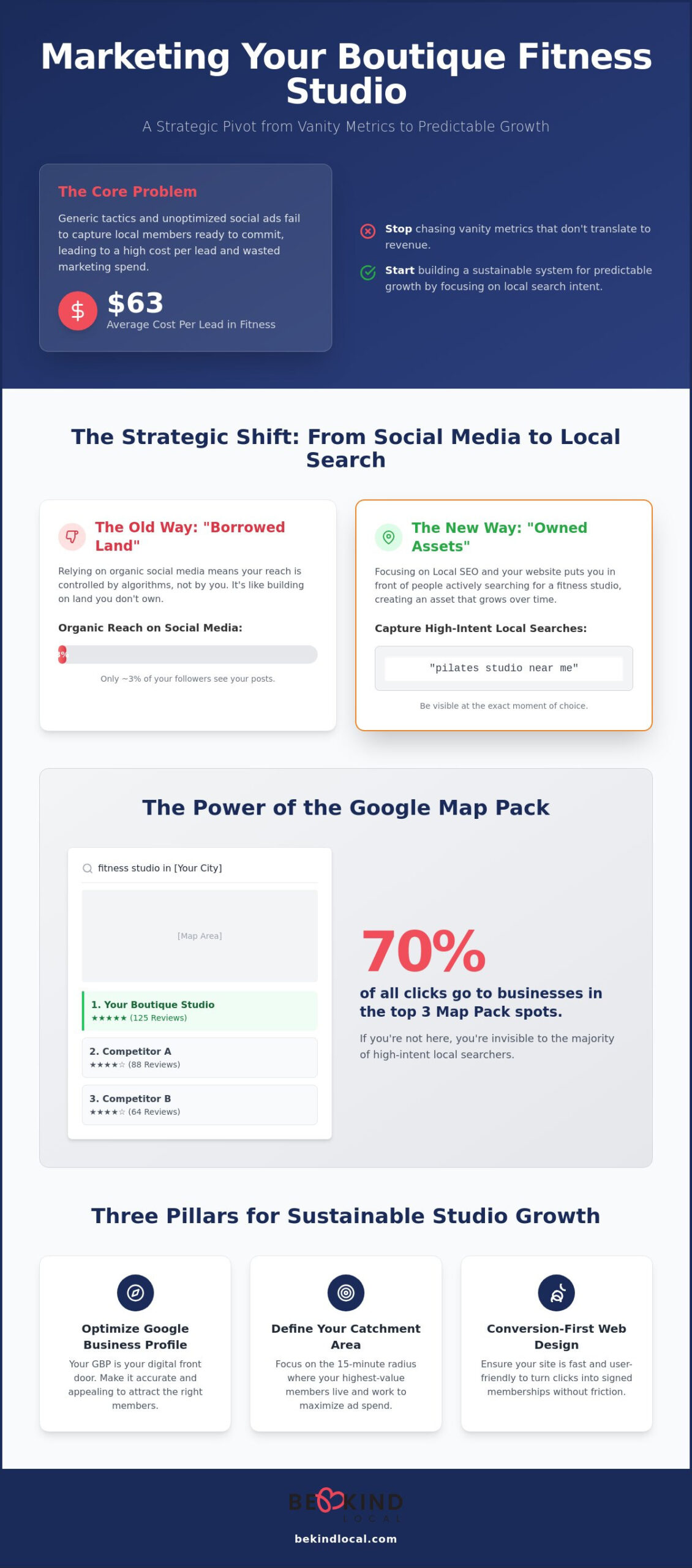
With the average cost per lead in the fitness industry now reaching nearly $63, it’s easy to feel like your marketing budget is disappearing into a void of unoptimized social media ads. You’ve built a premium space with a dedicated community, but generic tactics often fail to capture the local neighbors who are actually ready to commit. Understanding how to market a boutique fitness studio in 2026 requires a shift away from vanity metrics and toward dominating local search intent.
We know the frustration of seeing your studio’s visibility lag behind competitors who don’t offer half the quality you do. You deserve a marketing engine that reflects your brand’s ethics and justifies your premium membership rates. This guide will show you how to build a sustainable system for predictable growth. We’ll cover everything from mastering local search results to optimizing your conversion bridge so you can stop chasing raw traffic and start welcoming dedicated members into your community.
Key Takeaways
- Stop chasing vanity metrics on social media and pivot to intent-based strategies that drive actual revenue.
- Secure a spot in the Google Map Pack to capture the lion’s share of local “fitness near me” searches.
- Discover how to market a boutique fitness studio by using Google Ads to reach potential members during their “moment of choice.”
- Optimize your website’s speed and user experience to ensure clicks turn into signed memberships without friction.
- Shift from viewing marketing as a chore to treating it as a high-conversion investment for sustainable studio growth.
Beyond the ‘Gram’: Why Boutique Fitness Marketing Requires a Strategic Pivot
Many studio owners spend hours every week filming Reels and perfecting their grid aesthetic. It’s rewarding to see those heart icons pop up, but those likes don’t always translate into a full 6:00 AM class. Vanity metrics feel good, but they don’t pay the studio rent. If you want to know how to market a boutique fitness studio effectively, you’ve got to pivot from purely awareness-based tactics to intent-based strategies.
Big-box gyms rely on massive volume and low-cost memberships. Your boutique studio relies on a premium experience and a dedicated local community. This means your marketing needs more precision. In 2026, a “Local-First” mentality is essential. You aren’t competing with the entire internet; you’re competing for the attention of people within a specific drive-time of your front door. Effective digital marketing strategies prioritize the people most likely to walk through your doors, not just those who enjoy your content from three states away.
The Limitations of Organic Social Media
Organic reach on platforms like Instagram and Facebook has seen a steady decline. Currently, it’s estimated that only about 3% of your followers actually see your posts in their feed without paid promotion. Building your entire business on these platforms is like building a house on borrowed land. If the algorithm changes tomorrow, your connection to your audience could vanish. You need a platform that you control.
Rather than just posting for the sake of activity, focus on a cohesive brand strategy that works across multiple channels. This moves you away from the “post and pray” method. It allows you to build an asset you actually own, such as a high-converting website and a robust email list. When you own the data, you own the relationship with your members.
Defining Your Local Catchment Area
Success in the boutique space is often determined by a 15-minute radius. Most people won’t travel much further than that for a workout, especially during busy morning or evening commutes. You need to identify exactly where your highest-value members live and work to maximize your impact. This isn’t just about guessing; it’s about using local data to drive your decisions.
Don’t just target a whole city. Use data to find micro-neighborhoods where your ideal demographic clusters. By narrowing your focus to these specific pockets, you can make your digital ad spend go much further. This hyper-local targeting ensures you aren’t wasting money showing ads to people who will never realistically visit your studio. It’s about being the big fish in a very specific, high-intent pond.
Mastering Local SEO: Dominating the ‘Fitness Near Me’ Search
Most fitness enthusiasts don’t start their journey on social media. They start on Google. When someone types “yoga studio near me” or “best pilates class [City Name],” they aren’t looking for inspiration; they’re looking for a place to sweat. Mastering how to market a boutique fitness studio requires more than just a pretty website; it requires visibility at the exact moment of choice. This is where Local SEO becomes your most valuable employee.
The “Map Pack” is the holy grail of local search. These are the three businesses that appear at the top of Google’s search results alongside a map. Research consistently shows that these top three spots capture approximately 70% of all clicks. If your studio isn’t there, you’re essentially invisible to the majority of high-intent searchers in your area. This geographic dominance is a proven framework we use across various specialty sectors, much like the precision required for generating floor coating leads. In both cases, the goal is to own the local neighborhood before the competition even gets a look.
While paid ads provide an immediate boost, the ROI of organic search compounds over time. Unlike “rented” traffic from ads that stops the moment you stop paying, a strong organic presence is an asset you own. Implementing effective local marketing strategies ensures that your studio remains the top choice for months and years to come without an ever-increasing ad bill.
Google Business Profile (GBP) Optimization
Your Google Business Profile is often the first interaction a potential member has with your brand. Accuracy is vital. Start by choosing the most specific primary category possible. If you’re a specialized Pilates studio, don’t just settle for “Fitness Center.” Use “Pilates Studio” as your primary and add relevant secondary categories to help Google understand your specific niche.
Visuals tell a story that text cannot. Upload high-resolution, geotagged photos of your facility, your equipment, and your instructors in action. This helps build trust and allows potential members to “feel” the atmosphere before they visit. Additionally, focus on review velocity. Encourage your community to leave detailed reviews that mention specific classes or instructors. When you respond, use natural, keyword-rich language to further signal your relevance to Google’s algorithm.
Building Local Authority with Citations
Google looks for consistency to verify that your business is legitimate and trustworthy. This is achieved through NAP consistency: ensuring your Name, Address, and Phone number are identical across every corner of the web. Even a small discrepancy, like “St.” versus “Street,” can dilute your local authority.
Local citations are mentions of your business on other websites and directories that act as trust signals for Google’s ranking algorithm. Beyond the major players, seek out fitness-specific aggregators and local community directories. Each accurate listing strengthens your digital footprint. If you’re ready to stop guessing and start ranking, we can help you build your local presence through a dedicated Local SEO strategy.
High-Intent Lead Generation: Google Ads vs. Social Media Spend
Social media is a fantastic tool for brand awareness, but it often targets people who aren’t ready to buy yet. They’re scrolling for entertainment, not searching for a workout. When you’re figuring out how to market a boutique fitness studio, you have to understand the “Discovery vs. Intent” framework. Social media is discovery; Google is intent. Google Ads (PPC) allow you to capture potential members at the exact moment of choice, placing your studio in front of them when they’re actively looking for a solution.
Generic keywords like “fitness” or “exercise” are expensive and attract low-quality traffic. You’ll find much better success by targeting high-intent phrases like “Pilates classes [City]” or “HIIT studio near me.” These searchers have already decided what they want; they just need to decide where to go. To ensure these clicks turn into members, you must direct them to dedicated advertising landing pages rather than a cluttered homepage. A focused page with a single, clear call-to-action significantly increases your conversion rate. To maximize these efforts, you should develop a strategic marketing plan that treats every ad dollar as a calculated investment in growth.
Calculating Your Customer Acquisition Cost (CAC)
In 2026, the average cost per lead in the fitness industry is roughly $62.80. While that number might seem high, it’s vital to weigh it against the lifetime value (LTV) of a boutique fitness member. If a member stays for twelve months at a premium rate, a $63 lead is a bargain. Don’t fall into the trap of the “race to the bottom” by offering deep discounts or free months. These often attract “deal seekers” who churn immediately. Instead, focus your marketing on the value and community your studio provides to attract members who are willing to pay for quality.
Retargeting: Staying Top-of-Mind
Most people won’t sign up for a membership the first time they see your brand. The “7-touch rule” suggests that a prospect needs multiple interactions before they feel comfortable committing. This is where retargeting becomes essential. By using the Meta Pixel or Google Tag, you can follow “window shoppers” who visited your site but didn’t book a class.
Retargeting ads shouldn’t just repeat your name. They should solve specific objections. If someone looked at your pricing page but didn’t buy, show them an ad highlighting your flexible membership options. If they spent time on your “Beginner” page, show them a testimonial from a member who started exactly where they are. This personalized approach builds trust and keeps your studio at the top of their list when they’re finally ready to commit.
Conversion-First Web Design: Turning Clicks into Memberships
Your website should be more than a static digital brochure; it’s your most hardworking salesperson, operating 24/7. When considering how to market a boutique fitness studio, many owners focus solely on driving traffic through ads or social media. However, if your site is slow, confusing, or lacks a clear path to purchase, you’re essentially pouring water into a leaky bucket. Professional web design does more than just look pretty; it signals authority and justifies the premium pricing of a boutique brand. It builds the bridge of trust between a stranger and a committed member.
Technical performance is the bedrock of conversion. In 2026, mobile speed is non-negotiable, as most users will book their classes while on the move or during a quick break. Your site must be secured with an SSL certificate and offer an intuitive user experience (UX) that guides visitors toward a booking without friction. Integrating your management software, whether it’s Mindbody, Walla, or PushPress, should be seamless. If a potential member has to jump through hoops just to see a schedule or sign a waiver, they’ll likely head back to Google to find a competitor who makes the process easier.
The Anatomy of a High-Converting Studio Page
The most critical real estate on your site is “above the fold,” which is the area visible before a user even starts to scroll. This space must clearly state your unique value proposition and offer a singular call-to-action. Don’t clutter this section with too much text or competing offers. Instead, use high-impact visuals of your actual studio and place social proof, such as “As Seen In” badges or brief video testimonials from your community, where they are easily seen. A ‘Book Now’ button must be visible within 3 seconds of page load to ensure you don’t lose high-intent visitors who are ready to commit right now.
Automated Lead Nurture Sequences
Not everyone who lands on your site is ready to buy a full membership immediately. You can capture this “ghost traffic” by offering high-value lead magnets, like a “7-Day Studio Prep Guide” or a “What to Expect” video, in exchange for an email address. Once you have their contact information, the first 48 hours are critical for conversion. Immediate follow-up via email or SMS keeps the momentum alive and addresses any lingering objections regarding skill level or class types. Building a sustainable email marketing engine isn’t just about driving new sales; it’s a vital tool for long-term member retention and building the “third space” community feel that boutiques thrive on. If your current site isn’t converting clicks into memberships, you can request a custom website audit to see exactly where you’re losing potential members.
Scaling Your Studio: The Strategic Partner Approach
Many studio owners view marketing as a heavy chore that pulls them away from their clients and their craft. It’s time to shift that mindset. When you understand how to market a boutique fitness studio as a strategic investment rather than a monthly expense, your growth becomes predictable. You’ve built a space that changes lives; your marketing should be the engine that brings those lives through your doors. This requires moving beyond “post and pray” tactics and embracing a level of professional rigor usually reserved for high-ticket service industries.
In fact, the most successful studios apply the same data-driven discipline we see in custom closet marketing. Both industries rely on capturing high-intent leads in a local market to justify premium pricing. If your digital presence doesn’t reflect the quality of your in-studio experience, you’re leaving revenue on the table. Transitioning to a managed SEO and lead gen strategy ensures that your technical foundation is solid while you focus on building your community. DIY tutorials often claim you can manage multi-channel growth in ten minutes a day, but that’s a myth that leads to wasted ad spend and missed opportunities.
Monthly Reporting and Performance Tracking
Data shouldn’t be intimidating; it should be your roadmap. We focus on the KPIs that actually impact your bank account, not just your ego. You need to know your Cost Per Acquisition (CPA) to understand if your marketing is profitable. We also track Return on Ad Spend (ROAS) and Lead-to-Member conversion rates. If we’re driving high traffic but your membership numbers aren’t budging, we can identify exactly where the bottleneck is in your sales funnel. Transparent communication with a strategic partner allows you to make 2026 growth decisions based on facts, not feelings.
Your 2026 Marketing Roadmap
Scaling a studio happens in stages. You can’t skip the foundation and expect the penthouse to stay up. We look at growth through a three-phase lens:
- Phase 1: Foundation. This focuses on your digital storefront. We optimize your website and Local SEO so you’re visible when neighbors search for fitness solutions.
- Phase 2: Acceleration. Once the foundation is set, we turn on the high-intent engines like Google Ads and automated lead nurture sequences to fill your classes.
- Phase 3: Optimization. Here, we refine your brand authority and focus on member retention. This is where your studio becomes a true local “third space” with a waitlist for every session.
Building this engine takes time and expertise. When you treat your marketing with the same respect you treat your programming, you stop chasing leads and start leading a thriving business. If you’re ready to see how to market a boutique fitness studio with actual precision, it’s time to look at the data and build a plan that lasts.
Build Your Studio’s Future on Intent
The transition from chasing social media likes to dominating local search results is the defining factor for sustainable growth in 2026. By focusing on intent-based marketing through Local SEO and Google Ads; you ensure your studio appears exactly when your neighbors are ready to commit. A high-performing website then acts as your 24/7 salesperson, converting that visibility into a loyal community. Mastering how to market a boutique fitness studio isn’t about following every viral trend; it’s about building a data-driven engine that justifies your premium pricing and protects your time.
At Be Kind Local, we bring a strategic partner mindset to your growth. Our expertise in local-intent lead generation and no-fluff, data-driven execution means you can stop worrying about marketing chores and focus on your members. We’re here to help you build a professional brand presence that reflects the quality of your craft and the values of your community. Schedule a discovery call with Be Kind Local today to build your studio’s growth engine. We look forward to helping your local community thrive.
Frequently Asked Questions
How much should a boutique fitness studio spend on marketing?
Most established studios invest between 5% and 10% of their gross revenue into marketing to maintain growth. If you’re a new studio in the launch phase, you may need to increase this investment to build your initial community. The key is to focus on lead quality rather than just raw volume to ensure your budget drives actual memberships.
Does social media marketing actually work for fitness studios?
Social media is a powerful tool for brand awareness and community building, but it’s rarely a standalone solution for high-intent leads. It works best as a discovery platform to showcase your studio’s culture and instructors. To drive consistent revenue, you should pair social media with intent-based strategies like Local SEO and Google Ads.
How long does it take for Local SEO to show results for a gym?
You can typically expect to see measurable improvements in your local search rankings within 3 to 6 months. SEO is a compounding investment that builds authority over time. While it’s slower than paid advertising, the long-term ROI is significantly higher because you aren’t paying for every individual click once you rank.
What is the best way to get more reviews for my fitness studio?
The most effective strategy is to ask for a review immediately after a member has a positive class experience. You can automate this process through email or SMS follow-ups. Responding to every review with personalized, keyword-rich language also signals to Google that your business is active and trustworthy, which helps your ranking.
Should I use Google Ads or Facebook Ads for my studio?
Google Ads are generally better for capturing high-intent leads because they reach people who are actively searching for a place to work out. Facebook Ads are excellent for building awareness and retargeting people who have already visited your site. Using both allows you to cover the entire member journey from discovery to the moment of choice.
How do I market my boutique studio to a luxury clientele?
Marketing to a luxury audience requires a focus on exclusivity, high-end brand authority, and personalized service. Your digital presence must reflect the premium experience you provide in your studio. High-quality web design and professional photography are essential to justify your pricing and stand out from generic, big-box gym competitors.
What are the most important SEO keywords for fitness studios?
Focus on hyper-local, niche-specific phrases like “Pilates studio [City]” or “yoga near me” rather than broad terms like “fitness.” Understanding how to market a boutique fitness studio effectively means targeting the specific words your neighbors use when they’re ready to join. These high-intent keywords bring in leads that are much more likely to convert.
How can I improve my studio’s website conversion rate?
Start by ensuring your site loads quickly on mobile devices and has a clear call-to-action visible within seconds. Integrating your booking software seamlessly is also vital to reduce friction during the sign-up process. Including social proof, like video testimonials from current members, builds the trust necessary to turn a casual visitor into a new member.