
 951-249-7500
You’ve spent years perfecting your polyurea application techniques and building a reputation for stunning garage transformations. Then, you check your phone to find a scathing one-star review from a “customer” whose name isn’t in your CRM. It’s a gut-punch that unfairly lowers your rating and scares away high-quality leads. Learning how to remove fake google reviews isn’t just about clicking a flag icon; it’s about protecting the local brand you’ve worked so hard to build. We know how frustrating it feels when competitor sabotage or bots threaten your livelihood while Google’s automated enforcement feels increasingly aggressive.
We’re here to help you handle this with a clear, ethical strategy. You’ll learn the exact professional protocol for identifying violations and flagging content that breaches Google’s 2026 policy updates. In 2025, Google removed 292 million reviews for policy violations, proving that a systematic approach works. We’ll walk you through the official reviews management tool and the one-time appeal process to help you restore trust in your brand. By the end of this guide, you’ll have a repeatable system to manage your reputation and keep your focus where it belongs: on your craftsmanship and your community.
Key Takeaways
- Understand why fraudulent reviews act as a primary filter that blocks high-ticket home service leads from contacting your business.
- Learn the professional protocol for how to remove fake google reviews by identifying specific violations within Google’s prohibited content policies.
- Discover how to use your CRM data to document evidence and prove a reviewer was never a customer of your garage or closet company.
- Follow a strategic, step-by-step process for flagging content and utilizing the official Google Business Profile Management Tool for appeals.
- Build a long-term defense by automating your review generation process to ensure your local brand remains insulated against competitor sabotage.
The Impact of Fraudulent Reviews on High-Ticket Contractor Leads
When a homeowner considers a $15,000 polyaspartic garage floor coating or a custom walk-in closet system, they aren’t just looking for a price. They’re looking for proof that you won’t ruin their home. In the specialty contracting world, your Google Business Profile is often the first and final filter. A high-ticket client will rarely invite a contractor into their home if they see a string of unaddressed, suspicious one-star ratings. This makes learning how to remove fake google reviews a vital skill for protecting your bottom line. It’s the difference between a calendar full of qualified leads and a phone that stops ringing because of a single malicious click.
There is a fundamental difference between a genuine bad customer experience and a fraudulent review. A real customer might complain about a delay in your slatwall installation. A fake review, however, is often a targeted attempt to damage your online reputation management strategy. These fraudulent posts violate Google’s 2026 policy updates because they don’t represent a real consumer journey. Because Google’s algorithm prioritizes star ratings and review frequency for the “Map Pack” rankings, these fakes don’t just hurt your feelings. They actively push your business down the search results, making you invisible to local homeowners.
Why Specialty Contractors are Targets for Sabotage
The local epoxy and concrete coating markets have become incredibly competitive. Sadly, some competitors resort to “review bombing” instead of improving their own service. You might also face the “wrong business” phenomenon. This happens when a frustrated homeowner leaves a scathing review on your profile intended for a different garage remodeler with a similar name. Bot attacks are another growing threat. These automated scripts can dump dozens of low-quality ratings onto your profile in minutes, triggering Google’s automated enforcement and potentially leading to profile suspension if you don’t act quickly.
Calculating the Real Cost of a 1-Star Rating
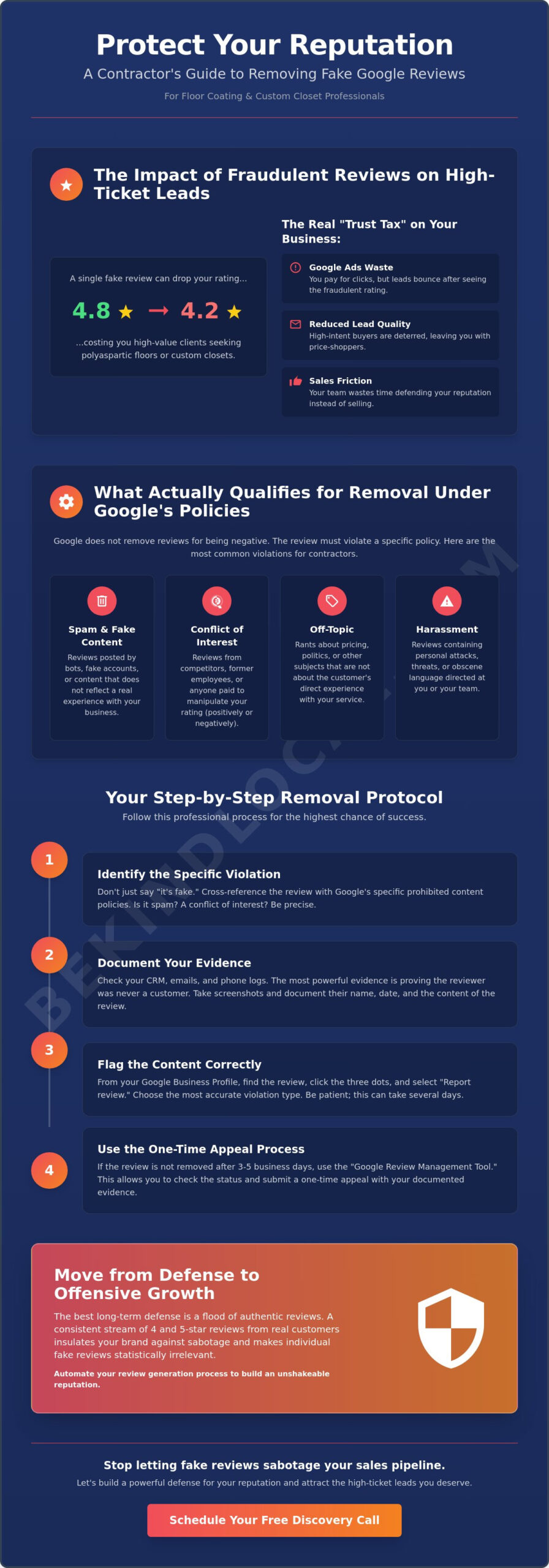
The financial damage of a fake review is measurable. When your rating drops from a 4.8 to a 4.2, the psychological impact on luxury clients is immediate. They don’t read the details; they simply move to the next contractor in the list. This “trust tax” affects every part of your business:
- Google Ads waste: You pay for the click, but the lead bounces the moment they see the fraudulent rating.
- Sales friction: Your sales team spends the first twenty minutes of a consultation defending your reputation instead of discussing closet designs.
- Lead quality: High-intent buyers avoid you, leaving you with price-shoppers who don’t value your craftsmanship.
If you’ve noticed a sudden drop in your visibility or conversion rates, it’s time to audit your profile. Our team focuses on Local SEO strategies that help specialty contractors reclaim their digital space and ensure their hard-earned reputation remains untarnished by fraudulent activity.
Google’s Prohibited Content: What Actually Qualifies for Removal?
Google doesn’t remove reviews simply because they are harsh or unfair. To protect your business, you must map the fraudulent content to a specific policy violation. Understanding these guidelines is the foundation of how to remove fake google reviews without wasting time on dead-end disputes. Google’s 2026 policy updates have made their AI-driven moderation more aggressive, but it still requires your strategic input to catch the nuanced attacks that slip through the cracks. The legal landscape has also shifted, with the FTC’s Final Rule on Fake Reviews now providing a federal backbone against deceptive testimonials and competitor sabotage.
There are four primary categories that specialty contractors should focus on when auditing their profiles for removal:
- Spam and fake content: This covers reviews that don’t represent a genuine service experience. If a bot or a paid service dumps a generic one-star rating on your garage storage profile, it falls here.
- Conflict of interest: Google prohibits reviews from people who have a financial or personal stake in the business. This includes your direct competitors or former employees who left on bad terms.
- Harassment and hate speech: If a review uses profanity, makes personal threats against your installers, or uses discriminatory language, it is a candidate for immediate removal.
- Off-topic reviews: This is a common “loophole” for contractors. It applies when a reviewer complains about a service you don’t even provide, like roofing or plumbing, on your epoxy flooring profile.
Decoding the ‘Spam and Fake Content’ Policy
In 2026, Google defines “non-authentic” experiences as any content created to manipulate a business’s rating. Their AI now tracks the IP addresses and behavioral patterns of reviewers to spot automated attacks. If you notice a sudden spike in low ratings from accounts with no local history, you’re likely a victim of spam. Conflict of Interest occurs when a review is posted by someone with a vested interest in harming your reputation, such as a rival floor coating company owner or a disgruntled ex-staff member.
The ‘Off-Topic’ Loophole for Contractors
Specialty contractors often suffer from “mistaken identity.” We’ve seen custom closet designers receive one-star reviews complaining about “leaky shingles” or “bad pipes.” Since you focus on reach-in closets and pantry organizers, a review about roofing is a clear policy violation. You can prove the reviewer is confused by highlighting the lack of niche terminology; if they don’t mention your polyurea systems or slatwall installations, you have a strong case for an off-topic removal. If you’re struggling to navigate these technical appeals, it may be helpful to talk with a specialist who understands the nuances of contractor reputation management.
How to Spot and Document Malicious Review Activity
Identifying a fraudulent review requires looking past the star rating. You need to examine the timing, the lack of project specifics, and the reviewer’s history. Genuine customers usually mention specific details like your polyaspartic topcoat or the way your team handled the garage slatwall installation. Fake reviews often use vague, emotionally charged language like “terrible service” or “stay away” without explaining what actually happened. Your first move should be cross-referencing the reviewer’s name with your CRM, whether you use Jobber, Houzz, or a custom database. If there’s no record of a contract, a site visit, or even a lead inquiry, you’ve found strong evidence of a non-authentic experience. This documentation is crucial for your appeal.
Understanding how to remove fake google reviews starts with building a bulletproof case. When a “John Doe” claims your concrete coating is peeling after two days, but you have no record of that name, you’ve identified a primary discrepancy. You should also look for “review bombing” clusters. This is when multiple one-star reviews appear in a very short window, often within hours of each other. These attacks are frequently coordinated by competitors or automated bots designed to tank your local search visibility. Gathering metadata, such as the exact timestamp of the post, helps you prove to Google that these aren’t isolated incidents but a concentrated attack.
Red Flags in Reviewer Profiles
Look for geographic inconsistencies. If your business operates in Phoenix, but the reviewer’s profile shows they’ve left ten one-star reviews for epoxy companies in six different states over the last week, you’ve likely identified a bot. Check if the account has any local history or if it was created on the same day the review was posted. These profiles often lack a photo and have no other activity in your city. These are clear red flags that Google’s AI sometimes misses, but a human moderator will recognize if you point them out clearly.
Building Your Evidence Folder
Don’t just flag the review and hope for the best. Create a dedicated folder for each case. You’ll need high-quality screenshots of the review itself and the reviewer’s public profile before they have a chance to change it. If the reviewer mentioned a specific project type you don’t perform, like residential plumbing, document that discrepancy. Your final step is drafting a concise “Statement of Fact.” This isn’t an emotional plea. It’s a professional summary stating that the individual is not in your customer records and the review violates Google’s “Spam and Fake Content” policy. This level of detail makes your Local SEO efforts much more resilient against malicious attacks.
The Step-by-Step Protocol for Flagging and Appealing Reviews
Once you’ve identified a fraudulent post on your garage flooring or custom closet profile, you must act with precision. Learning how to remove fake google reviews is a multi-stage process that requires patience and a strict adherence to Google’s internal logic. Most contractors fail because they treat the report button like a complaint box rather than a legal filing. In 2026, Google’s AI-driven moderation is faster, but it’s also more rigid. If you don’t categorize the violation correctly in the first round, you’re significantly less likely to win on appeal. You only get one shot at a formal appeal, so every detail in your documentation counts.
The Initial Flag: Don’t Rush the Category
The first step is simple but critical. Navigate to the specific review on your Google Business Profile, click the three dots, and select “Report review.” Many business owners reflexively choose “Spam,” but if you suspect a rival epoxy company is behind the attack, “Conflict of Interest” is the more effective choice. If the reviewer is complaining about a service you don’t offer, such as residential roofing, select “Off-topic.” Once you submit, Google enters a 72-hour waiting period. During this window, their systems analyze the reviewer’s metadata and behavioral history to see if it matches known patterns of fraudulent activity.
The Appeal: Winning the Second Round
If Google sends an automated email stating the review doesn’t violate their policies, you must move to the Reviews Management Tool. This is the official channel for submitting a manual appeal. Unlike the initial flag, this stage allows you to present the evidence folder you’ve built, including CRM logs and screenshots of the reviewer’s suspicious history. When drafting your appeal, remain clinical and professional. Avoid mentioning how much the review hurt your feelings or your sales; instead, cite the specific policy from Google’s Prohibited and Restricted Content list that the review breaches. To structure an appeal for a competitor review, clearly state the name of the rival business and provide evidence showing the reviewer’s professional connection to that entity.
If the attack is large-scale or involves persistent “review bombing” from bots, you may need to escalate the issue through the Google Business Profile Community or seek professional help. Managing these disputes while trying to finish a high-end pantry install or a polyaspartic floor project is a heavy lift. If you’d rather focus on your craftsmanship than fighting with algorithms, you can reach out to our team to discuss a comprehensive review management strategy that keeps your reputation clean and your leads flowing.
Reputation Management: Moving From Defense to Offensive Growth
Successfully learning how to remove fake google reviews is a major win, but it is only half the battle. You can’t spend your entire career playing whack-a-mole with bots or disgruntled non-customers. The real victory comes from building a “wall of five stars” that makes a single fraudulent rating look like an obvious outlier. When your profile is packed with genuine photos of polyaspartic garage floors and detailed testimonials about your meticulous reach-in closet installs, high-ticket leads will trust the consensus over a lone dissenter. A dominant reputation is the most effective way to insulate your business from future attacks.
Dilution as a Strategy
Think of your star rating as a mathematical average that requires constant protection. If you only have ten reviews and one is a fake 1-star, your rating takes a massive hit. If you have one hundred reviews, that same fake only nudges your average by a fraction. This is why automation is your best friend. Don’t wait until you get back to the office to ask for feedback. Use a QR code on-site the moment your crew finishes a garage remodel or a mudroom project. Integrating this social proof directly into your custom closet marketing pages ensures that prospective clients see your best work before they even browse your Google Business Profile.
Even if a suspicious review stays up during a lengthy appeal process, your response serves as a powerful marketing tool. Write for the next customer, not the troll. A professional, calm response that highlights your commitment to quality proves your brand’s integrity. It shows luxury clients that you are a stable, reliable partner who takes their craftsmanship and community reputation seriously. This transparency often builds more trust than a perfectly curated profile ever could.
Strategic Growth with Be Kind Local
Your reputation isn’t a separate entity from your search visibility. At Be Kind Local, we believe that Local SEO and review management must work in tandem. A profile with high engagement and a steady stream of fresh, keyword-rich reviews signals to Google that you are the dominant authority in your local market. This resilience protects you from competitor sabotage and ensures you stay at the top of the Map Pack where the highest-quality leads are searching. We focus on lead quality over raw traffic, ensuring every review and search result reflects the premium nature of your specialty contracting services.
Building a business that consistently attracts high-intent leads requires a proactive stance on digital growth. You’ve worked hard to master your trade; let us help you master your local market. If you’re ready to protect your reputation and scale your flooring or closet company, schedule a discovery call with Be Kind Local today. We’ll help you implement a repeatable system that turns your hard-earned reputation into a permanent competitive advantage.
Take Control of Your Digital Reputation Today
Your craftsmanship deserves a digital profile that reflects the true quality of your work. Protecting your business from malicious attacks requires a combination of policy knowledge and a proactive growth strategy. By documenting discrepancies and understanding how to remove fake google reviews through the official appeal process, you can reclaim your star rating and restore trust with high-ticket leads. Remember that your best defense is a consistent “wall of five stars” generated through automated review requests after every successful project.
We specialize in supporting epoxy flooring and custom closet companies by focusing on lead quality rather than just raw traffic volume. Our strategic reputation management ensures your local brand remains resilient against competitor sabotage and automated bot attacks. You don’t have to manage this burden alone while running your crews and finishing installations. We are here to act as your strategic partner in growth.
Scale your specialty contracting business with a strategic partner; Book a Discovery Call
Your expertise is the foundation of your success, and we’re here to help you protect it. Let’s build a brand that stands strong in your local community and continues to attract the clients you deserve.
Common Questions About Managing Fraudulent Reviews
How long does Google take to remove a fake review?
Google typically takes 3 to 5 business days to process an initial flagging request. If the request is denied and you move to a formal appeal through the Reviews Management Tool, you can usually expect a decision within 72 hours. It’s important to monitor your dashboard during this time, as Google’s automated systems may occasionally require additional clarification regarding the policy violation.
Can I sue someone for leaving a fake Google review?
You can technically pursue legal action for defamation, but this is often a slow and expensive route for a specialty contractor. Most business owners find that learning how to remove fake google reviews through Google’s internal policy framework is much more efficient. To win a legal case, you must prove the statement is factually false and caused documented financial harm to your floor coating or closet company.
Does responding to a fake review make it harder to remove?
Responding to a review does not negatively impact your chances of having it removed. In fact, a calm and professional response can protect your brand while the appeal is pending. Use your response to state clearly that you have no record of the individual in your CRM, which signals to both Google and prospective clients that the review is likely non-authentic.
Will Google notify the reviewer if I flag their post?
Google does not notify the user when you flag their review for a policy violation. The flagging process is kept confidential to prevent further harassment or retaliation against your business. The reviewer will only realize the post is gone if they manually check their own profile or if Google specifically asks them to edit the content to comply with community standards.
Can I pay a company to guarantee Google review removal?
No legitimate company can guarantee the removal of a Google review because the final decision always rests with Google’s moderation team. Be cautious of services that make “guaranteed” claims, as they often use tactics that violate Google’s terms of service. This can lead to your entire Google Business Profile being suspended, which is a far greater risk than a single fake rating.
What if the fake review is on a competitor’s profile praising them?
You can report fraudulent reviews on a competitor’s profile if they violate the “Conflict of Interest” or “Spam and Fake Content” policies. If you have evidence that a rival is buying fake five-star ratings to artificially boost their local search visibility, flagging those posts helps maintain a fair marketplace. Google’s 2026 updates have become more aggressive in catching these coordinated “astroturfing” attempts.
How many times can I appeal a Google review decision?
Google generally allows only one formal appeal after your initial report is rejected. Because you only have one shot at this manual review, you must ensure your evidence folder is complete before submitting. If your appeal is denied, your last remaining option is to escalate the case through the Google Business Profile Help Community, where product experts can sometimes provide additional assistance.
Does having fake reviews removed affect my local SEO ranking?
Removing fraudulent one-star reviews positively impacts your local SEO by improving your overall star rating and sentiment score. A higher rating is a key factor for ranking in the Google Map Pack, especially in competitive niches like garage remodeling and custom closet design. Successfully executing a strategy for how to remove fake google reviews ensures that your profile remains a high-quality destination for local homeowners searching for your expertise.