
 951-249-7500
Why does your service page look exactly like your cheapest competitor’s, yet you’re the one struggling to justify your premium polyaspartic system price? If you feel like your website is just a digital brochure that attracts low-budget tire-kickers, you aren’t alone. Most floor coating and custom closet pros find it difficult to explain why their craftsmanship is worth more than a DIY kit or a basic epoxy job. This guide will show you exactly how to write service page copy that converts by mapping your technical expertise to the specific problems your local customers face.
We believe that your online presence should reflect the same integrity and care you bring to a garage floor or a walk-in closet installation. You deserve a platform that positions you as a local specialist rather than a commodity. It’s frustrating to see your hard work overshadowed by generic marketing, but we’re here to help you change that narrative. In this article, we’ll provide a clear blueprint for your service page structure. We will explore how to turn technical details into trust-building assets and how to optimize your content for both high-intent buyers and the latest AI search trends. It’s time to stop chasing raw traffic and start generating the qualified leads your business deserves.
Key Takeaways
- Learn how to shift from “commodity” writing to “authority” copy that positions your specialty contracting business as the only logical choice for high-end projects.
- Use the “So What?” test to translate technical specifications, like polyaspartic durability or slatwall versatility, into the emotional benefits that drive high-ticket sales.
- Master the structural blueprint for how to write service page copy that converts, focusing on a high-impact hero section and a compelling problem-solution bridge.
- Strengthen local search visibility by weaving neighborhood-specific landmarks and hyper-local details into your content to build immediate trust with your community.
- Future-proof your website for 2026 by optimizing for AI-driven search overviews and conversational voice queries that prioritize direct, authoritative answers.
The Strategic Foundation: Why Most Contractor Service Pages Fail
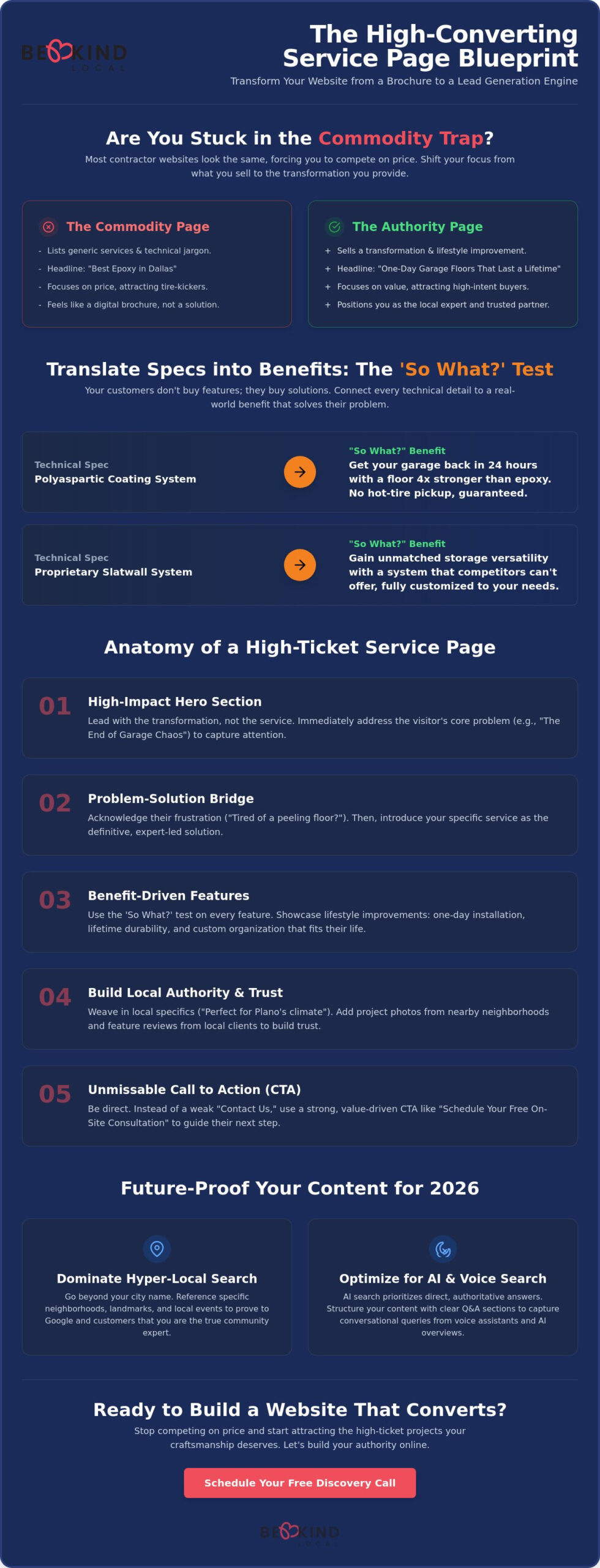
Most contractor websites read like a technical manual or a generic directory ad. You list your services, mention your city, and hope for the best. This approach creates a commodity page where the only thing a visitor can compare is your price. When you’re selling high-ticket items like custom closet systems or polyaspartic floor coatings, being the cheapest is a losing game. Understanding how to write service page copy that converts starts with a shift in perspective. You aren’t just selling a product. You’re selling a transformation of a homeowner’s environment.
There’s a significant gap between what you know as an expert and what your buyer needs to hear. While the foundational principles of copywriting emphasize clear calls to action, many contractors get bogged down in technical over-explanation. They describe the chemical bond of the resin but forget to mention that the homeowner will never have to worry about hot-tire pickup again. Learning how to write service page copy that converts requires you to bridge this gap by focusing on the “So What?” factor. Every technical feature you mention should be tied directly to a solution for a specific pain point. Before you write a single word, decide on your primary goal. Do you want a direct phone call, a quote request form submission, or a discovery call?
The Commodity Trap in Home Services
Using headlines like “Best Epoxy in Dallas” might have worked ten years ago, but today’s homeowners are more sophisticated. This type of copy signals that you’re just another vendor in a crowded market. To break out of the commodity trap, you must lead with your unique selling proposition. Are you the only local installer using a multi-day curing process that ensures maximum durability? Do your custom closets feature a proprietary slatwall system that competitors can’t match? Value-based positioning helps you move away from price-based competition and toward becoming a trusted partner.
Defining Your High-Intent Audience
Not all traffic is good traffic. If your service page is too broad, you’ll attract people looking for a minor repair rather than a full garage remodel. High-intent copy speaks directly to the homeowner who is ready to invest in quality. These individuals are often in a state of transition, like moving into a new home or finally tackling a long-overdue renovation. They care about reliability, craftsmanship, and the long-term value of their investment. By tailoring your language to these specific desires, you filter out the tire-kickers and focus your local SEO efforts on leads that actually grow your bottom line.
Mapping Technical Specs to High-Intent Benefits
Technical specifications are the backbone of your craftsmanship, but they shouldn’t be the lead in your sales copy. If you want to master how to write service page copy that converts, you must apply the “So What?” test to every feature you list. When you tell a customer your floor coating has a high solids content, they’re likely thinking, “So what?” You need to answer that immediately. It means their garage floor won’t peel under hot tires. It means a lifetime of durability. It means they’ll never have to spend another weekend scraping up failed DIY paint.
Homeowners today do their homework. They’ve spent fifteen minutes on Google and now believe they understand the difference between epoxy and polyurea. Your job is to validate their research while providing the professional context they lack. Use technical terms correctly to build authority, but always pivot back to the lifestyle improvement. Following core web writing principles, keep your technical explanations scannable and direct. This balance shows you’re a specialist who respects their intelligence without burying them in jargon.
Case Study: Floor Coating Terminology
Don’t just list “Polyaspartic System” as a bullet point. Instead, translate it into “one-day installation and four times the durability of standard epoxy.” This tells the reader they can use their garage by dinner time. When discussing polyurea, explain its moisture-wicking technology as the reason your floors won’t bubble or flake. This technical accuracy justifies a higher price point because it solves a long-term problem. If you’re struggling to articulate these advantages to improve your concrete coating lead generation, focusing on these high-intent benefits is the first step toward better conversion rates.
Case Study: Custom Closet and Storage Solutions
For walk-in or reach-in closets, stop counting the number of shelves. Sell the “peace of mind” that comes with a morning routine where every shoe and shirt has a designated home. Describe garage slatwall systems as “infinite organization” that evolves as their family’s hobbies change. It isn’t just a plastic panel; it’s a way to keep tools off the floor and within reach. Frame overhead storage as “reclaiming your floor space” so they can finally park their car where it belongs. By focusing on the emotional relief of a decluttered home, you turn a simple storage product into a high-ticket solution.
Building Local Authority Through Specificity and Social Proof
Trust is the primary currency for local contractors. When a homeowner considers a high-ticket investment like a full garage remodel or a custom pantry system, they aren’t just buying materials. They’re buying the assurance that you understand their specific environment and will be there to stand by your work. Learning how to write service page copy that converts means moving beyond generic “About Us” fluff and showing deep roots in your community. Local authority is built when your copy reflects the reality of the streets and neighborhoods where you actually work.
Your service page should act as a bridge between your digital presence and your physical reputation. Research indicates that customers who interact with reviews are 108.3% more likely to convert. This data highlights why your copy must do more than just exist; it needs to facilitate trust. Integrating your local SEO strategy directly into your service descriptions ensures that both search engines and humans recognize your regional expertise. This isn’t about repeating your city name fifty times. It’s about proving you are a local fixture through specific, lived-in details.
Hyper-Local Copywriting for Contractors
Generic copy ignores the unique challenges of your service area. If you’re a floor coating specialist in a high-humidity region like Florida, your copy should explain how you manage moisture levels during the polyurea application process. Mentioning specific neighborhood home styles, such as the walk-in closet needs of mid-century modern homes in a particular district, shows you aren’t a national franchise using a template. Use city-specific project examples to ground your expertise. Instead of saying you do “garage storage,” describe a project where you installed a heavy-duty slatwall system for a family near a well-known local park or landmark.
Strategizing Social Proof
Most contractor testimonials are too vague to be useful. A review that says “Great job!” doesn’t kill objections. An objection-killer testimonial sounds like this: “I was worried about the smell of the epoxy, but the team used a low-VOC system and finished my three-car garage in just one day.” These specific details address the hidden fears of your high-intent audience. Encourage your clients to mention specific services like reach-in closets or overhead storage in their feedback. Since users who engage with Q&A content are 194.2% more likely to convert, consider adding a hyper-local FAQ section to your service pages. Address common questions about local permits or how your coatings handle the specific temperature swings of your region.
The Structural Blueprint: Anatomy of a High-Ticket Service Page
The layout of your page dictates how a visitor feels about your brand before they even read your first paragraph. A high-ticket service page isn’t a static document; it’s a guided journey that leads a homeowner from frustration to a solution. While the median conversion rate across industries is 2.35%, the top 10% of performers reach rates near 11.45%. This gap is often bridged by a logical, persuasive structure. Understanding how to write service page copy that converts requires looking at your page as a conversion funnel that respects the user’s time and intelligence.
The hero section is your digital storefront. It must be sharp. You have approximately five seconds to capture a high-intent lead before they bounce. Your headline should lead with the primary benefit, like “Reclaim Your Garage with Industrial-Grade Polyurea Floors.” This immediately tells the visitor what you do and what’s in it for them. Beneath this, a social proof bar featuring local awards or a 5-star rating summary provides instant credibility. This structure ensures that the visitor feels they are in the right place to solve their specific problem, whether it’s a peeling floor or a cluttered mudroom.
The Five Pillars of Service Page Structure
A successful page follows a specific hierarchy that builds trust incrementally. A well-executed custom website design ensures that your copy is easy to scan and digest. Every high-converting page should include these five pillars:
- Benefit-driven headline: Focus on the transformation, not just the service.
- Social proof bar: Use trust signals early to reduce skepticism.
- The “Pain Point” narrative: Agitate the frustration of a cluttered pantry or a stained garage floor.
- The “Expert Solution”: Explain why your specific system, like a multi-layer polyaspartic coating, is the answer.
- The Frictionless CTA: Make the next step obvious and easy to take.
The “Process” section is often the most underrated conversion tool for contractors. It reduces the “unknown” factor by explaining exactly what happens next. When you outline your three-step installation process for a reach-in closet or a garage slatwall system, you eliminate the anxiety of a messy, drawn-out renovation. This clarity transforms you from a vendor into a professional partner.
Crafting High-Intent Calls to Action
Generic buttons like “Submit Request” or “Contact Us” are conversion killers. They sound like more work for the homeowner. Instead, use high-intent language that promises immediate value. Phrases like “Get My Free Floor Audit” or “Design My Dream Closet” are much more compelling because they focus on the outcome. Integrating your advertising strategy with these specific CTAs ensures a seamless transition from a Google Ad to your landing page. When the promise in the ad matches the button on the page, trust increases and friction disappears. If you’re ready to build a page that turns visitors into high-ticket leads, let’s discuss your custom website strategy.
Optimizing for 2026: Beyond the Initial Draft
Your service page is a living asset, not a static document. Search engines aren’t just lists of links anymore. By 2026, the rise of Search Generative Experience (SGE) means that Google often provides the answer before a user ever clicks through to your site. Research shows that traffic from AI search platforms like ChatGPT and Perplexity converts at an average of 3.49%, which is 22% higher than traditional organic search. Mastering how to write service page copy that converts in this new environment means your content must be structured for both human readers and AI crawlers.
To stay ahead, you must treat your website as the core of your SEO strategy. This requires moving beyond a “set it and forget it” mindset. High-ticket lead generation for garage remodelers and closet designers depends on your ability to adapt to shifting buyer behaviors and technical search updates. If your copy doesn’t provide direct, authoritative answers to specific questions, you’ll lose visibility to competitors who do. You aren’t just writing for a ranking; you’re writing to be the definitive source of truth for your local market.
Answer-Based Copywriting
AI search engines prioritize content that answers specific, conversational queries. Instead of just listing “winter installation,” use an H3 like “Can polyaspartic floor coatings be applied during a cold winter?” This structure allows AI to easily extract your expert advice for a featured snippet. Write concise, fact-dense sentences that address the “Uninformed Expert” mentioned earlier. For example, explain that polyaspartic systems cure effectively at temperatures as low as -20°F. This level of technical specificity wins the trust of both the algorithm and the homeowner who needs a solution right now.
Continuous Conversion Audits
The gap between the top 10% of performers and everyone else is widening. Top-tier contractors use heatmaps to identify exactly where visitors lose interest in their garage slatwall or walk-in closet descriptions. If users stop scrolling before they reach your CTA, your narrative needs tightening. Your brand strategy should guide these updates to ensure your voice remains consistent as you scale. We recommend auditing your service page copy every six months. This allows you to reflect new industry trends, such as the growing demand for specialized mudroom storage or the latest moisture-wicking concrete technologies. Staying relevant is the only way to maintain a high-converting lead engine.
Transform Your Website into a High-Performance Lead Engine
Writing effective copy isn’t about filling space or using clever marketing jargon. It’s about showing local homeowners why your specific craftsmanship is the superior choice for their home. By mapping your technical expertise to the emotional relief of a transformed garage or closet, you move from being a simple vendor to a trusted local authority. Mastering how to write service page copy that converts ensures that your digital presence works just as hard as your installation crew.
Be Kind Local is your strategic partner, specialized specifically in the floor coating and custom closet industries. We combine conversion-focused custom web design with a deep understanding of local search to help you capture the high-intent leads you deserve. It’s time to stop settling for low-budget tire-kickers and start building a brand that commands respect. If you’re ready to improve your digital growth and secure better visibility in your local market, we’re here to guide you. Schedule a Discovery Call with Be Kind Local today. You have the skills to build beautiful, functional spaces; let’s make sure your website reflects that same excellence.
Frequently Asked Questions
What is the most important element of a service page for a contractor?
The most critical element is a clear, benefit-driven headline that passes the five-second rule. Visitors need to know exactly what you do and what’s in it for them the moment they land on the page. This clarity, combined with a strong trust signal like a review summary, anchors the visitor’s attention. Without this immediate value proposition, even the most technical descriptions won’t stop a potential lead from bouncing to a competitor’s site.
How long should a service page be for a floor coating or closet business?
Most high-performing service pages for specialty contractors fall between 500 and 1,000 words. You need enough space to agitate the customer’s pain, explain your technical solution, and outline your installation process. However, word count is secondary to relevance. If you can explain the benefits of a walk-in closet or a polyaspartic floor system thoroughly in 600 words without using fluff, that is far more effective than a long page filled with generic filler.
Should I use technical terms like ‘polyaspartic’ if my customers don’t know them?
You should absolutely use technical terms like polyaspartic or slatwall systems to establish your authority as a specialist. These terms signal that you aren’t a generalist. The key is to immediately follow every technical term with a layman’s benefit. For example, mention that polyaspartic coatings offer one-day installation. This approach respects the homeowner who has done some research while clearly demonstrating your superior industry knowledge and craftsmanship.
How do I optimize my service page for local SEO without it sounding robotic?
Focus on hyper-local specificity rather than just repeating your city name. Mentioning local climate challenges, like how your epoxy cures in high humidity, or referencing specific neighborhood home styles creates natural relevance. This is a core part of learning how to write service page copy that converts because it builds trust. Using landmarks or project examples from nearby districts signals to Google and your customers that you are a genuine local fixture.
What is the best call to action for a high-ticket home service page?
The best call to action is outcome-focused and low-friction. Avoid generic buttons like “Submit” or “Contact Us.” Instead, use phrases that promise immediate value, such as “Get My Free Floor Audit” or “Start My Custom Closet Design.” These CTAs shift the focus from the work the homeowner has to do to the transformation they’ll receive. This small change in language significantly reduces psychological friction and encourages more high-intent discovery calls.
Can I use AI to write my service page copy?
AI can be a helpful tool for outlining or brainstorming, but it shouldn’t be your final author. Generic AI tools often lack the technical nuance required for the floor coating and custom closet industries. They tend to produce fluff and repetitive structures that fail to address specific local pain points. To truly convert, your copy needs the human touch of an experienced specialist who understands the difference between a reach-in pantry and a walk-in mudroom.
How do I handle pricing on my service page?
Instead of listing fixed prices, focus on cost comparisons and the value of your premium materials. Explain why a polyurea system is a better long-term investment than a cheap DIY kit. You can mention that factors like floor condition or closet size impact the final quote. This transparency builds trust without locking you into a price before you’ve seen the project. It positions you as a strategic partner who provides customized solutions.
How often should I update my service page content?
We recommend auditing your service page content every six months. This ensures your copy reflects current industry shifts, such as new garage storage trends or updated coating technologies. Regular updates also help you stay competitive in an AI-driven search landscape. Refreshing your FAQs with new homeowner questions keeps your page answer-ready for conversational search queries. This ongoing optimization is essential for maintaining high lead quality and long-term digital growth in your local market.