
 951-249-7500
What if the high bounce rates on your Google Ads aren’t a traffic problem, but a technical one hiding in your project gallery? You probably already know that feeling of watching hard-earned leads slip away because a page didn’t load fast enough or looked broken on a smartphone. It’s frustrating to invest in high-quality polyurea systems or custom walk-in closet designs only to have a slow website stall your growth. With over 60% of global traffic now coming from mobile devices, understanding what do you need for a small business website is no longer optional for contractors who want to lead their local market.
We believe your online presence should reflect the same craftsmanship you bring to a garage floor or a custom pantry. In this guide, you’ll discover the essential technical and strategic components your site needs to dominate local search and convert high-ticket leads in 2026. We will walk through how to achieve sub-second load times for your project galleries and create a secure foundation that ranks in competitive markets like Indianapolis or Dallas, ensuring your business is built for sustainable growth and a healthy Google Business Profile.
Key Takeaways
- Learn why a lead-first technical foundation is the only digital asset your flooring or closet business truly owns and why it outlasts shifting social media algorithms.
- Understand why meeting Google’s 2026 Core Web Vitals is non-negotiable for ranking your polyaspartic or custom cabinetry services in the local Map Pack.
- Identify the specific hosting categories that prevent site downtime during peak lead-generation windows and protect your Google Ads investment from high bounce rates.
- Discover exactly what do you need for a small business website to ensure sub-second load times for your project galleries and maximize high-intent conversion rates.
- See how integrating high-performance infrastructure with conversion-optimized landing pages turns your digital presence into a consistent high-ticket lead engine.
Why Your 2026 Lead Generation Strategy Starts with High-Performance Infrastructure
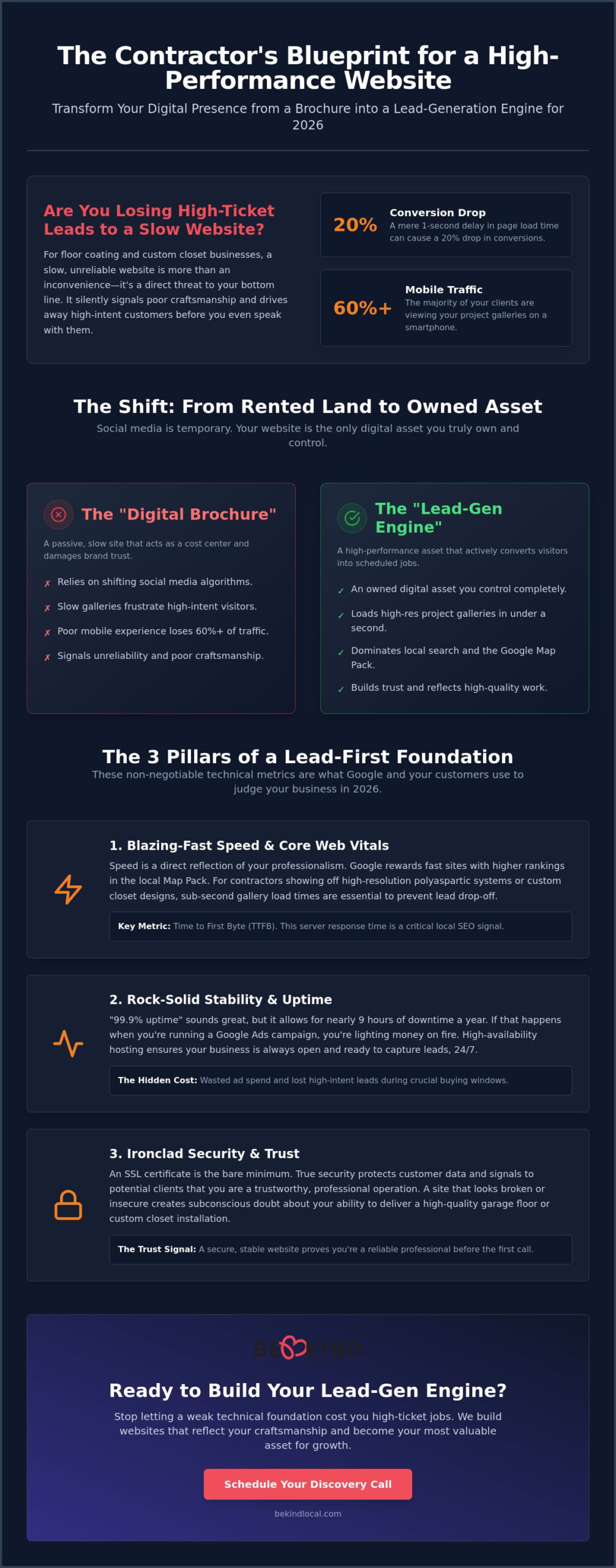
Lead-first infrastructure is the technical heartbeat of your digital presence. It isn’t just about having a pretty homepage; it’s about the invisible foundation that supports every click, scroll, and form submission. When you’re evaluating what do you need for a small business website in 2026, you must look past the design and focus on the engine. For a flooring contractor or a custom closet designer, this infrastructure is the difference between a site that captures high-ticket leads and one that simply exists in a vacuum.
Think of social media as rented land. You don’t own your followers on Instagram or your reach on Facebook. If an algorithm shifts, your visibility can vanish overnight. Your website is the only digital asset you truly own. In the broader landscape of Small business marketing, your site serves as the central hub where you control the narrative and the data. It’s the difference between a “Digital Brochure” that just sits there and a “Lead-Gen Engine” that actively works to fill your calendar.
Site stability is a direct proxy for consumer trust. High-ticket industries like garage remodeling or high-end cabinetry require a significant financial commitment from the homeowner. If your website is slow, buggy, or frequently offline, a potential client will subconsciously link that technical failure to your craftsmanship. They’ll wonder if you’ll be just as unreliable when it’s time to prep their concrete floor or install their reach-in closet system. A stable, fast site proves you’re a professional before you even pick up the phone.
The Impact of Speed on High-Ticket Conversions
In competitive markets like Texas or Florida, speed is a weapon. Data shows that a mere 1-second delay in page load time can drop conversions by 20%. When you are selling premium polyurea and polyaspartic systems, you need high-resolution visual proof. These images are heavy. Without high-performance infrastructure, your project gallery will lag. Homeowners won’t wait for your beautiful floor finishes to load; they’ll simply click back to the search results. A fast-loading site creates a psychological link to a contractor who is efficient, modern, and reliable.
Infrastructure as a Pillar of Local SEO
Ranking in the Google Map Pack isn’t just about keywords. Your server’s response time, often called Time to First Byte (TTFB), directly influences your visibility. When considering what do you need for a small business website to rank locally, a stable server located near your service area is critical. If your server is slow to respond, Google is less likely to recommend you to a local user searching for “epoxy flooring near me.” Strategic Local SEO for Specialty Contractors begins with a hosting environment that tells Google your business is ready to serve the community instantly.
Performance Metrics That Matter for Contractors in 2026
Measuring the success of your digital presence goes far beyond whether your homepage loads. In 2026, Google’s Core Web Vitals are the non-negotiable standards for ranking in the home service niche. These metrics measure visual stability and interactivity. If your layout shifts while a customer is trying to click your “Get a Quote” button, Google will penalize your ranking in the local Map Pack. When determining what do you need for a small business website, technical performance must be at the top of your list. It’s not just about aesthetics; it’s about providing a seamless experience for a homeowner looking to upgrade their garage or bedroom.
Uptime is another critical metric that contractors often overlook. A standard 99.9% uptime guarantee sounds impressive, but it actually allows for nearly nine hours of downtime per year. If those minutes happen during a peak lead-generation window while you’re running active Google Ads campaigns, you’re losing money and high-intent leads. You need a host that prioritizes high availability so your reach-in and walk-in closet galleries load instantly, every single time. Beyond speed, security is the foundation of brand authority. An SSL certificate isn’t just a technical requirement; it’s a promise to your customers that their data is safe. Incorporating these elements along with essential pages for a small business website ensures your site remains a trusted resource for your community.
Handling Heavy Visual Portfolios
Showcasing 50 or more high-resolution images of your garage slatwall systems and overhead storage units creates a significant technical challenge. Standard hosting plans often choke under the weight of large image files. Managed WordPress hosting is superior for visual-heavy contractor portfolios because it includes server-side caching specifically optimized for these assets. To ensure your work looks crisp for local customers in North Carolina or Georgia, we utilize Content Delivery Networks (CDNs). This technology serves your images from a server closest to the user, making your polyurea and polyaspartic project photos pop without delay.
Scalability for Seasonal Demand
Your website needs to breathe with your business. During peak home improvement seasons in the Spring and Fall, traffic can spike unexpectedly. If you’re on a shared hosting plan during a high-traffic PPC push for epoxy floor leads, your site might crash under the pressure. Scalable hosting is a technical environment where your server resources automatically expand to meet traffic surges, keeping your multi-location floor coating brand online and profitable. Understanding what do you need for a small business website to grow means planning for these peaks before they arrive. If you’re unsure if your current setup can handle your growth goals, it might be time to discuss a more resilient strategy.
Choosing the Right Hosting Category for Your Service Business
Choosing the right hosting is like choosing the foundation for a custom home; if it’s weak, the rest of the build doesn’t matter. When you’re deciding what do you need for a small business website to succeed in the epoxy flooring or custom closet industry, the hosting category you choose dictates your lead-generation ceiling. Managed WordPress hosting is often the gold standard for these service businesses. It provides a specialized environment where technical updates and security patches are handled for you, allowing your site to stay fast and secure without constant manual intervention. It’s the most reliable way to ensure your high-res project photos load perfectly for every visitor.
For multi-state contractors managing high traffic across several regions, cloud hosting offers essential redundancy. If one server node fails, another picks up the slack instantly. This prevents the nightmare scenario of a site going dark while a homeowner in a different state is trying to book a consultation for a new pantry or mudroom system. Specialized agency hosting takes this a step further by removing the technical “bloat” that often slows down DIY setups. It’s a partner-led approach that ensures your digital infrastructure is always compatible with high-intent lead-generation goals; Mytech Partners provides this type of strategic consulting and a direct line to support when you need it most.
Managed WordPress vs. DIY Builders
Performance-tuned hosts like WP Engine or SiteGround consistently outperform “Big Box” generic hosts. Unlike closed-ecosystem DIY builders that limit your SEO flexibility, Managed WordPress gives you full control over your metadata and site structure. One of the most valuable features is the staging environment. This allows you to test new high-res galleries of your polyaspartic floor projects or walk-in closet designs in a private area before pushing them live. It ensures your public-facing site remains professional and functional while you’re making updates. If you want a site built on this high-performance foundation, explore our Custom Website Design Services.
The Problem with “Big Box” Hosts
Many contractors start with GoDaddy or Bluehost because the entry price is low. However, these platforms often fail the strict speed requirements for 2026 Local SEO. They rely on overcrowded shared servers that create “Bad Neighborhood” issues. If a spammy website is on the same server as your garage storage business, it can negatively impact your local rankings. There’s also the “Renewal Trap.” You might sign up for a few dollars a month, but the hidden costs and massive renewal fees can quickly exceed the price of a premium host. When considering what do you need for a small business website, look past the initial discount and focus on the long-term ROI of a stable, fast server that actually helps you rank.
Avoiding the “Cheap Hosting” Trap: Hidden Costs to Your Growth
Choosing a budget host might feel like a win for your bottom line, but it’s often a silent killer for your growth. When you’re researching what do you need for a small business website, price shouldn’t be the primary metric. Cheap hosting is built on overcrowded servers where your business competes for resources with thousands of other sites. This leads to the very latency issues we discussed earlier, which directly sabotages your Google Ads for Home Services. If a homeowner clicks your ad for a polyaspartic garage floor coating and the page hangs for three seconds, they’re gone. You’ve paid for the click, but the host cost you the lead.
Poor technical support is another hidden cost. Imagine your site goes down on a Saturday morning, right when homeowners are browsing for custom walk-in closet ideas. If your host takes 24 hours to respond to a ticket, you’ve lost a weekend of high-intent traffic. We believe your time is better spent closing deals on garage slatwall systems than troubleshooting server errors. DIY maintenance is a trap that pulls you away from the craftsmanship your community expects. Be Kind Local prioritizes high-performance infrastructure because we view ourselves as your strategic partner, not just another vendor. We want your foundation to be as solid as the concrete floors you coat.
Security Risks and Reputation Damage
A hacked website is a branding nightmare. If Google detects malware, it may place a “This site may be hacked” warning next to your listing. This destroys your Google Business Profile visibility and kills the trust you’ve worked hard to build. Specialty contractors are frequent targets for bot attacks because their sites often hold valuable customer contact data. Premium hosting provides proactive firewalls and malware scanning to prevent these attacks before they reach your doorstep. Protecting your digital reputation is a core part of a resilient Home Service Brand Strategy.
Hidden Upsells vs. Transparent Value
Many “Big Box” hosts lure you in with free services that are actually stripped-down versions of what you need. A professional contractor hosting package must include automated daily backups, a robust SSL certificate, and a global CDN. Without these, your site performance will always be compromised. Choosing a bargain plan usually means you’ll eventually pay more in upsells just to reach a baseline level of functionality. Simply put, cheap hosting is the most expensive way to run a lead-generation site. If you’re ready to move past the budget traps and build a site that actually converts, schedule a technical audit with our team today.
The Be Kind Local Approach: Beyond Just a Website
At Be Kind Local, we don’t view your website as an isolated project. We treat it as the central nervous system of your entire business. When you’re evaluating what do you need for a small business website, you aren’t just looking for a digital business card; you’re looking for a lead-generation tool that works as hard as you do on the job site. We see high-performance hosting as a vital, strategic component of Floor Coating Lead Generation. By integrating this technical foundation with conversion-optimized landing pages, we ensure that every click from a homeowner searching for epoxy has the best possible chance of becoming a signed contract.
Managing multiple service areas across states like California, Indiana, Texas, or Florida requires a cohesive, unified strategy. Having a single partner handle your web design, SEO, and paid advertising eliminates the friction that often kills growth. You don’t have to worry about your developer and your advertiser pointing fingers at each other when lead volume dips. Instead, you get a dedicated team that optimizes every layer of your digital presence for local market dominance. We believe in building a community of successful contractors, which is why we focus on strategies that actually move the needle for your family-owned business.
Strategic Partnership vs. Vendor Relationship
Most agencies are generalists. They might build a site for a bakery one day and a lawyer the next. We are different. We understand the technical nuances of polyurea systems and the design intricacies of a custom reach-in or walk-in closet. This niche expertise allows us to focus on lead quality over raw traffic volume. We’d rather send you five high-ticket garage remodel leads than five hundred “tire kickers.” This precision is exactly how we improve the ROI of Custom Closet Marketing, ensuring your budget is spent on homeowners ready to invest in premium pantry or mudroom solutions.
Your Next Steps for 2026 Growth
Growth starts with an honest assessment of your current tools. Your first step should be a thorough audit of your hosting performance. Check your site speed on mobile and look for any SEO health warnings that might be suppressing your visibility in the Google Map Pack. If you discover that your current setup is holding you back, don’t fear the transition. Moving to a high-performance environment is a smooth process with zero downtime when handled by experts who know your industry. Understanding what do you need for a small business website is the first step toward reclaiming your local market. If you’re ready to stop fighting your technology and start using it as a competitive advantage, Schedule a Discovery Call with Be Kind Local today.
Building Your Local Legacy for 2026
Your digital presence should be as resilient as the polyaspartic systems you install and as organized as a custom walk-in closet. We’ve explored how high-performance infrastructure and strict adherence to Core Web Vitals form the bedrock of your success. By moving away from overcrowded budget hosts and embracing a lead-first technical strategy, you protect your local reputation and ensure every dollar spent on advertising brings a real return. Site stability is no longer just a technical detail; it is a fundamental component of consumer trust in the home service industry.
Understanding what do you need for a small business website in 2026 means prioritizing lead quality and conversion ROI over empty traffic volume. At Be Kind Local, we bring specialized expertise to the floor coating and custom closet industries, providing comprehensive support across Local SEO, PPC, and custom web design. We don’t just build sites; we build strategic partnerships that reflect the same craftsmanship you bring to every garage floor or pantry project. Your hard work deserves a digital foundation that works just as hard to fill your calendar.
We look forward to helping you grow your local community and your business with honesty and excellence.
Frequently Asked Questions
Does my website hosting affect my Google Business Profile ranking?
Yes, your website hosting directly impacts your Google Business Profile visibility because site speed and uptime are core ranking signals. If your site is frequently down or slow to load on mobile devices, Google is less likely to recommend your floor coating business in the local Map Pack. A stable server ensures that when homeowners search for local contractors, your digital presence remains a reliable, authoritative source of information.
Why is my contractor website loading slowly even with “good” hosting?
Slow loading times are often caused by unoptimized assets rather than the server alone. For custom closet designers, hosting high-resolution galleries of walk-in and reach-in closets without proper image compression can choke even a decent server. You may also have excessive plugins or unoptimized code that creates technical bloat. Proper server-side caching and a lead-first technical setup are essential to keep your project portfolios snappy and interactive.
What is the difference between shared and managed WordPress hosting for contractors?
Shared hosting places your site on a server with thousands of others, which can lead to performance dips if a neighbor site has a traffic spike. Managed WordPress hosting is specifically tuned for the WordPress environment, providing automatic updates, better security, and faster server-side caching. For contractors selling high-ticket polyurea systems, managed hosting provides the stability and speed required to convert high-intent leads without the technical headaches of DIY server management.
How much should a small business spend on hosting in 2026?
In 2026, shared hosting typically ranges from $2 to $15 per month, while WordPress-specific hosting costs between $3 and $25 per month. For larger operations, VPS hosting can range from $10 to $60. While the initial registration for a .com domain is usually $12 to $20 annually, the real investment for a contractor should be in performance. When asking what do you need for a small business website, remember that saving a few dollars on hosting often costs thousands in lost leads.
Can I change my hosting provider without losing my SEO rankings?
You can change hosting providers without losing your rankings if the migration is handled strategically. The key is to ensure zero downtime and maintain your existing URL structure so that Google doesn’t encounter broken links. A professional migration to a faster server actually improves your SEO over time. Improved server response times and better mobile performance tell Google that your garage remodeling site is a high-quality destination for local searchers.
Do I need a dedicated server for my floor coating business?
Most local floor coating businesses don’t need a dedicated server, which can cost over $80 per month and requires significant technical maintenance. Instead, a high-performance cloud or managed environment is usually more efficient. These setups offer the scalability to handle traffic spikes during peak garage remodeling seasons without the high overhead of a dedicated machine. It’s about finding the right balance between power and practical lead generation.
What is a CDN and why does my local business need one?
A Content Delivery Network (CDN) is a group of servers spread across different locations that deliver your website content from the server closest to the user. For a local business, this means a homeowner in your specific city sees your garage slatwall and overhead storage photos instantly. CDNs reduce latency and ensure your visual-heavy portfolio loads fast, which is critical for maintaining high engagement and preventing bounces on mobile devices.
How does hosting impact my Google Ads (PPC) cost per lead?
Hosting directly influences your Google Ads Quality Score by determining your landing page experience. If your host is slow, your bounce rate increases, which tells Google your page isn’t relevant. This lowers your Quality Score and raises your cost per click. By investing in what do you need for a small business website, like fast server response times, you actually lower your cost per lead and maximize your advertising ROI.