
 951-249-7500
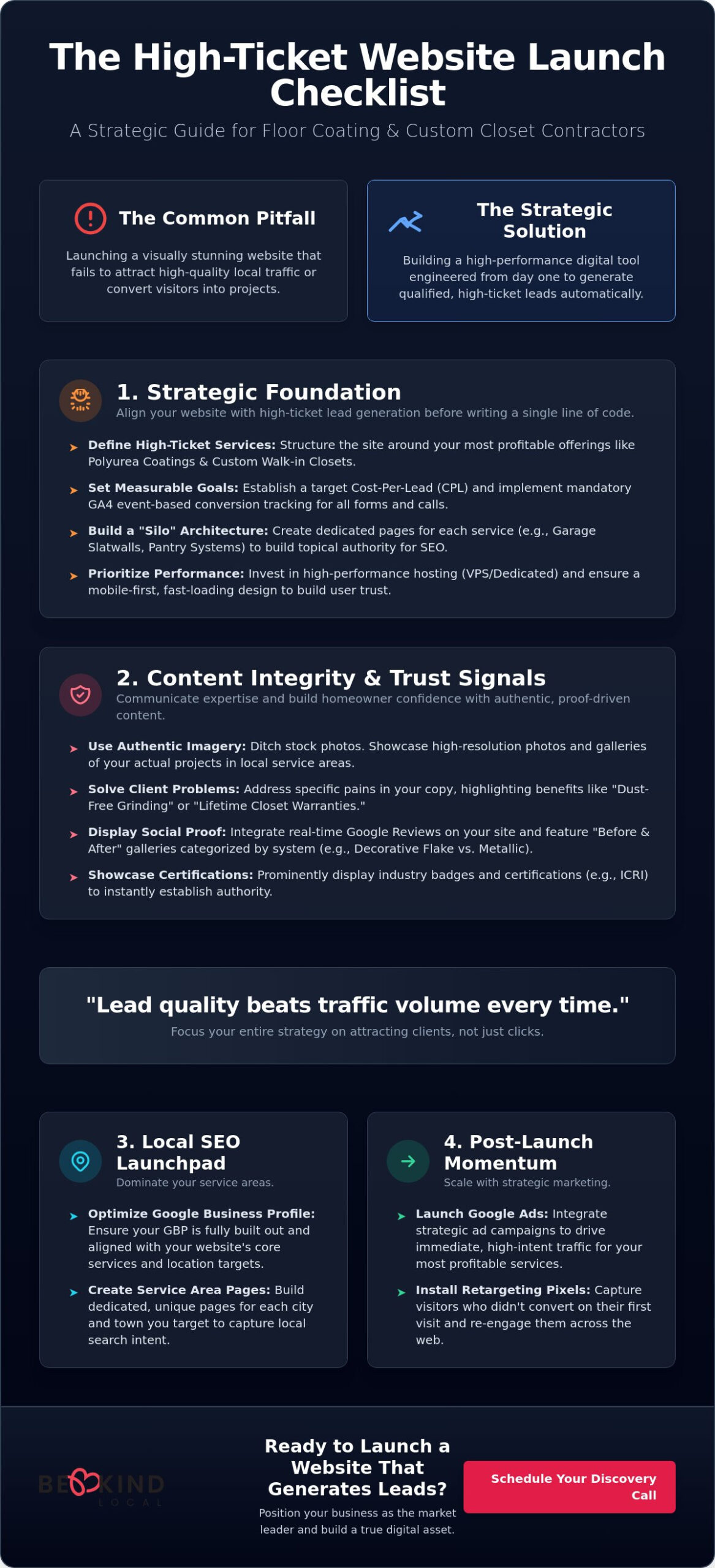
A visually stunning website is a wasted investment if it doesn’t generate high-ticket leads for your floor coating or custom closet business. Many contractors find themselves stuck with “pretty” sites that fail to attract quality local traffic or convert visitors into polyaspartic coating projects. This strategic small business website launch checklist cuts through the technical fluff to ensure your digital presence is a high-performance tool from the moment you go live.
You already know that your website should reflect the same level of precision as your custom pantry installs or garage slatwall systems. We’re here to provide a direct, experienced guide to launching a site that builds immediate trust and automates your lead generation. This article outlines the essential steps for dominating local search results, optimizing for mobile users, and meeting the strict 2026 privacy and consent standards required to keep your marketing data accurate and your business protected.
Key Takeaways
- Learn how to align your site architecture with your most profitable services, such as polyurea floor coatings and custom walk-in closets, to attract high-ticket clients.
- Follow our comprehensive small business website launch checklist to ensure your technical foundation and privacy settings meet the strict 2026 industry standards.
- Discover the specific content strategies that build trust, from highlighting dust-free grinding techniques to showcasing lifetime closet warranties.
- Master local search visibility by optimizing your Google Business Profile and creating dedicated service-area pages for the cities you target.
- Identify how to maintain momentum after going live by integrating strategic Google Ads and retargeting pixels to capture homeowners who didn’t convert on their first visit.
The Strategic Foundation: Aligning Your Website with High-Ticket Lead Gen
Before you upload a single image of a freshly coated garage floor, you need a plan. A successful small business website launch checklist begins with strategy; not aesthetics. You aren’t just selling flooring or shelving. You’re selling high-ticket transformations. Whether your primary revenue comes from polyurea flooring systems or luxury walk-in closets, your site must speak directly to those specific buyer intents. Generic messaging leads to generic leads.
Identify your target service areas with precision. If you operate across regions like Florida, Texas, or North Carolina, your site needs to reflect those local nuances. A homeowner in Charlotte looking for a mudroom locker has different expectations than someone in Miami seeking a UV-stable polyaspartic coating. Mapping the user journey is crucial. Every visitor should move seamlessly from a service page to a “Schedule a Consult” CTA without friction. This requires a clear home service brand strategy that defines your authority before you touch the technical web development process.
Setting Measurable Goals for Your Launch
Lead quality beats traffic volume every time. You need to determine your target cost-per-lead (CPL) for installations like garage storage systems or reach-in closets. With the shift to Google Analytics 4 (GA4) in 2026, setting up event-based conversion tracking is mandatory. You must track every form fill and click-to-call to understand which pages actually drive revenue. Your unique value proposition should be a single, sharp sentence. It tells a local homeowner exactly why your epoxy coatings or pantry designs are the superior choice.
Choosing a Lead-First Website Architecture
Generic templates often fail specialty contractors because they aren’t built for local SEO. Custom web design allows for a siloed architecture. This means each service, from overhead storage to pantry systems, gets its own dedicated page. This structure is a vital part of your small business website launch checklist because it builds topical authority. Additionally, prioritize high-performance hosting. Research shows that dedicated or high-end VPS hosting prevents the slow load times that lead to bounce rates. In 2026, a mobile-first, fast-loading site is the baseline for building trust.
Content Integrity: Communicating Expertise in Specialty Contracting
Authenticity isn’t just a buzzword; it’s your most valuable currency. When homeowners search for polyaspartic coatings or reach-in systems, they aren’t looking for a generic sales pitch. They’re looking for proof that you know your craft. A vital part of your small business website launch checklist is verifying the technical accuracy of every product description. If you mention mudroom lockers or pantry designs, ensure the terminology matches what you actually install. This builds a bridge of trust before the first phone call even happens.
Your service pages must do more than list features. They need to solve problems. Address specific buyer pains like “dust-free grinding” for flooring or “lifetime closet warranties” for storage solutions. By focusing on durability and long-term ROI, you align your content with the best practices for generating high-quality floor coating leads. While a standard SBA marketing plan helps define your business goals, your website content is where you prove your local authority. Ditch the stock photography. High-resolution photos of your actual projects in local neighborhoods tell a story that a generic image never could.
The “Proof” Elements: Building Immediate Trust
Social proof should be effortless for the visitor to find. Integrate real-time Google Reviews directly onto your homepage to show you’re an active, trusted member of the community. Create “Before and After” galleries that categorize projects by the specific system used, such as decorative flake versus metallic finishes. If you hold certifications from organizations like the ICRI, display those badges proudly. If you’re unsure how your current brand message stacks up, you can always reach out for a strategy review to ensure your expertise is clear.
Mobile Performance for On-the-Go Homeowners
In 2026, mobile traffic isn’t just a priority; it’s the standard. Most homeowners will browse your portfolio while sitting in the very garage or closet they want to remodel. Test your site on multiple devices to ensure the “Call Now” button stays accessible. Optimize your project images to maintain sub-2-second load times. Large, uncompressed files will cause visitors to bounce before they see your best work. Forms should be short, punchy, and easy to navigate on a thumb-sized screen.
Conversion Optimization: Turning Traffic into Qualified Leads
Your website is a digital salesperson that never sleeps. Once you’ve established your technical foundation and content, the next item on your small business website launch checklist is conversion optimization. Driving traffic is only half the battle. If visitors land on your page but don’t know what to do next, you’re leaving high-ticket projects on the table. Every page on your site should have a single, focused goal. Choice paralysis is real; if you ask a homeowner to look at your gallery, read your blog, and follow you on social media all at once, they’ll likely do none of those things.
High-contrast call-to-action (CTA) buttons are essential. Place one in the top right corner of every page so it’s the first thing a user sees. For those who aren’t quite ready to book a polyurea floor installation today, offer a lead magnet. A “Garage Remodel Cost Guide” or a “Walk-in Closet Design Checklist” provides value while capturing contact information from top-of-funnel prospects. To improve lead quality, use multi-step forms. Asking for square footage or the number of reach-in closets they need helps filter out tire-kickers and prepares you for a more productive discovery call.
Strategic Call-to-Action (CTA) Placement
The language you use matters. For specialty contractors, “Get a Free Estimate” or “Request a Design Consultation” usually outperforms a generic “Contact Us.” It promises a specific outcome. Use sticky headers to keep your phone number visible as the user scrolls through your project photos. This ensures that the moment they feel inspired by your work, the path to reaching you is clear. Always place a CTA immediately after your proof points, like reviews or before-and-after shots, to capitalize on that peak moment of trust.
Lead Qualification and Automation
Speed is everything in local service industries. Set up instant SMS or email notifications so you can respond to new leads within minutes. Once a homeowner submits a form for a pantry system or overhead storage project, redirect them to an automated “Thank You” page. This page should set clear expectations for when they’ll hear from you. Finally, integrate your website with a CRM like Jobber or HubSpot. This ensures no lead falls through the cracks and allows you to track the lifetime value of every customer generated through your custom website.
The Local SEO Launchpad: Dominating Your Service Areas
A high-converting website is only effective if your local audience can actually find it. For specialty contractors, the battle for visibility is won in the “Map Pack.” When a homeowner searches for “epoxy flooring near me” or “custom closet designers,” Google prioritizes businesses with strong local signals. This stage of your small business website launch checklist involves synchronizing your new site with your Google Business Profile (GBP). Ensure your Name, Address, and Phone number (NAP) are identical across your website footer, contact page, and GBP listing. Even a small discrepancy can confuse search engines and hurt your rankings.
Broad geographic targeting rarely works for niche services like polyaspartic coatings or garage slatwall systems. Instead, you must create dedicated service-area pages for the specific cities you serve, such as Indianapolis, TX, or Charlotte, NC. These pages shouldn’t be carbon copies of one another. Each should feature unique content that mentions local landmarks or specific neighborhood needs. This hyper-local approach is a cornerstone of effective local SEO. It allows you to rank for city-specific searches that generic “national” templates simply cannot reach.
On-Page SEO for Contractor Keywords
Your H1 tags and meta descriptions are the first things both Google and potential clients see. Use buyer-intent keywords like “Custom Closet Designer in [City]” rather than vague titles like “Our Services.” To give your site an edge in 2026, implement LocalBusiness schema markup. This technical code helps search engines understand your service hours, location, and specific offerings. Don’t stop at broad categories. Write unique, value-driven descriptions for every niche service, distinguishing the benefits of garage slatwall systems from overhead storage racks to capture specific search intent.
Google Search Console and Indexing
Don’t wait for Google to find your new site on its own. Once your small business website launch checklist is nearly complete, manually submit your sitemap to Google Search Console. This speeds up the indexing process so your new service pages start appearing in results sooner. During development, it’s common to use “noindex” tags to keep a site private; verify these are removed before going live. Finally, set up local tracking to monitor your rankings in specific zip codes. If you want to ensure your site is built to dominate your local market from day one, schedule a discovery call with our team today.
Post-Launch Momentum: Scaling with Strategic Marketing
The launch of your website is a milestone, but it’s not the finish line. In the competitive world of specialty contracting, a beautiful site sitting in a vacuum won’t pay the bills. This final phase of your small business website launch checklist focuses on turning your new digital asset into a consistent revenue driver. You need to transition from building to scaling immediately. This means being proactive with your visibility rather than waiting for organic search to catch up. Your website isn’t a trophy; it’s a lead-gen machine that requires fuel to run.
Strategic marketing starts with immediate traffic. Launching a Google Ads campaign allows you to bypass the waiting game. By targeting high-intent keywords like “garage floor coating” or “walk-in closet design,” you land in front of homeowners at the exact moment they’re ready to buy. Don’t forget to set up a retargeting pixel. Most visitors won’t convert on their first visit. A pixel allows you to stay top-of-mind with display ads as they continue their research. You should also update your Facebook and Instagram profiles to link directly to your new, high-conversion gallery pages. For those in the storage niche, following a specific custom closet marketing playbook is essential for securing long-term, high-ticket growth.
Integrating PPC for Immediate Lead Flow
Success with paid search requires more than just a budget. You must create dedicated landing pages for your “Polyaspartic Coating” or “Pantry System” ads. Sending traffic to your homepage often dilutes the user experience and lowers your Quality Score. By matching the ad copy to a specific service page, you lower your cost-per-click and increase lead quality. Use A/B testing on your headlines to see if local homeowners respond better to “Lifetime Warranties” or “1-Day Installations.” Monitoring your lead sources monthly ensures you’re reinvesting your budget into the channels with the highest ROI.
The Long-Term Content Strategy
Organic authority takes time to build. Plan a quarterly blog schedule that addresses the common technical questions your sales team hears every day. Articles like “Epoxy vs. Polyurea: Which is Best for Your Garage?” build trust and answer buyer objections before you even meet them. Every completed project is also a marketing opportunity. Encourage every customer to leave a review on your Google Business Profile to boost your local rankings. Review your GA4 analytics monthly to find where visitors are dropping off. Fixing these leaks in your sales funnel ensures your small business website launch checklist continues to deliver results years after the initial go-live date.
Build Your Digital Foundation for Long-Term Growth
Launching a high-performance website is about more than just checking boxes. It’s about ensuring your digital presence works as hard as you do on the job site. By following this small business website launch checklist, you’ve moved beyond basic design to a strategic tool built for high-ticket lead generation. You now understand that matching your site to your primary revenue drivers, like polyaspartic coatings or walk-in pantry systems, is the only way to attract qualified local homeowners who value your craft.
We are specialists in floor coating and custom closet marketing because we believe in the power of local expertise. Our team is focused on lead quality over raw traffic volume, helping contractors in Florida, Texas, California, and across the country dominate their specific service areas. Don’t let your new site sit in a vacuum. It’s time to turn that momentum into measurable growth and build a community of loyal customers around your business.
Ready to see how a strategic partner can elevate your digital presence and keep your schedule full? Schedule a Discovery Call with Be Kind Local today. Let’s start building your future together.
Frequently Asked Questions
Is a website launch checklist different for a service-based business?
Yes, service-based businesses focus on lead generation and trust signals rather than simple product transactions. A small business website launch checklist for a contractor must prioritize service-area pages and proof of work over shopping carts. You need to highlight your technical expertise in systems like polyaspartic coatings or custom mudroom installs to build immediate authority with local homeowners.
How long does it typically take for a new contractor website to rank on Google?
It typically takes three to six months for a new site to gain significant organic traction. While Google indexes your site faster if you submit a sitemap, building authority for keywords like “garage floor coating” requires consistent local signals. We recommend using a strategic Google Ads campaign during this period to ensure your phone stays ringing while your organic rankings climb.
Can I launch my website without having all my project photos ready?
You shouldn’t launch without at least five to ten high-quality, local project photos. Stock photography feels cold and untrustworthy to homeowners looking for custom closet designers. It’s better to launch with a smaller, authentic gallery of your real walk-in or reach-in closet projects than a library of generic images that don’t reflect your actual craftsmanship.
Do I really need a professional marketing agency for my website launch?
You don’t strictly need an agency, but a strategic partner ensures your site is built for conversion rather than just aesthetics. Many DIY sites fail because they miss technical requirements like schema markup or GA4 event tracking. An experienced partner such as Exclusive Business Marketing handles the complex small business website launch checklist items, allowing you to focus on running your flooring or storage business.
How much should a small business website launch cost in 2026?
Costs vary based on complexity, but you should budget for both initial development and recurring technical needs. For businesses looking to secure their technical foundation, the multi-award-winning Cornerstone Business Solutions provides bespoke IT services and infrastructure support. While basic hosting can range from $10 to $60 per month, the value of a custom, lead-focused design lies in its ability to generate high-ticket projects. We focus on the long-term ROI of your digital presence rather than just the upfront expense of the build.
What is the most important SEO factor for a local contractor website?
Google Business Profile (GBP) optimization is the most critical factor for local contractors. Your website must be perfectly synchronized with your GBP listing to dominate the “Map Pack.” Consistent NAP data and dedicated service-area pages for cities like Charlotte or Indianapolis ensure that local homeowners see you first when they search for specialty services.
Can I use a DIY website builder like Wix for my floor coating business?
You can use DIY builders, but they often lack the technical depth required for high-level lead generation. Specialty industries like floor coating need custom silos for services like polyurea flooring and garage slatwall systems. Generic builders often struggle with the site architecture and speed optimizations that are necessary to rank in competitive local markets in 2026.
What happens if my website breaks after I click publish?
Every professional launch should include a pre-publication backup and a rollback plan. If a form stops working or a page layout shifts, you can revert to the previous version while you troubleshoot. This is why testing your site on multiple mobile devices and checking your GA4 data flow before the final announcement is so vital for a smooth transition.